Image: Lloyd's Register / official
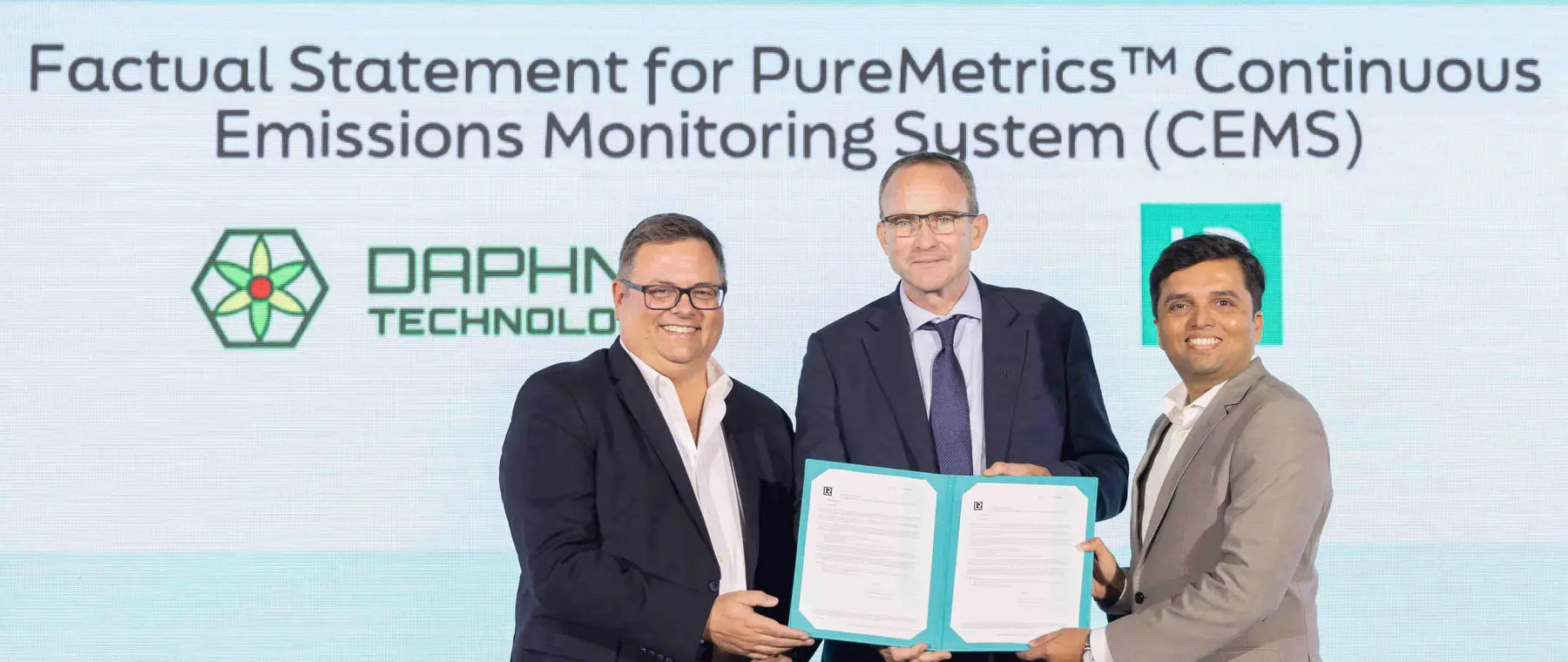
Lloyd’s Register has issued a Factual Statement confirming the suitability of Daphne Technology’s PureMetrics system for direct monitoring of selected emissions from marine diesel engines.
Lloyd’s Register has issued a Factual Statement for Daphne Technology’s PureMetrics continuous emissions monitoring system following documentation review and onboard demonstration testing. The assessment confirms that the system’s generic design is suitable for direct monitoring of selected greenhouse-gas and other emissions from marine diesel engines, providing a technical basis for later vessel-specific applications.
LR’s work included a Design Appraisal of the PureMetrics system and the methodology used to calculate emissions. Unlike an approval tied to one vessel, the appraisal applies to the generic design, allowing shipowners and operators to use it as a technical foundation when considering future installations.
That distinction matters because onboard arrangements differ significantly between vessels. Exhaust configuration, engine type, access, data integration and class requirements still need to be resolved for each installation even when the underlying monitoring technology has already undergone independent review.
The system is designed to monitor carbon dioxide and methane alongside carbon monoxide from operating marine diesel engines. Direct measurement can provide a different level of evidence from emissions figures derived only from fuel consumption, engine assumptions or periodic sampling.
For operators facing increasingly detailed environmental reporting, continuous data can help identify how emissions change across load conditions and operating modes. The value depends on calibration, data quality and correct interpretation, but the approach can make actual onboard performance more visible.
Lloyd’s Register says the Factual Statement was based on reviewed technical documentation together with onboard demonstration testing. The statement was presented during Gastech 2026 in Bangkok, placing the technology within a wider industry discussion around methane, carbon dioxide and energy-transition measurement.
Independent assessment is important for monitoring equipment because environmental claims can influence compliance decisions, operational reporting and investment. Owners need confidence that measurement methods are technically defensible before data is used to compare machinery, fuels or retrofit performance.
Large yachts increasingly face owner, charterer and regulatory pressure to understand fuel use and environmental performance in more detail. Although PureMetrics is presented for the wider marine market, the underlying principle of direct emissions measurement can also be relevant to complex yacht machinery installations.
For superyacht managers, better measurement does not itself reduce emissions, but it can identify where reductions are occurring and whether technical changes deliver the expected result. Systems that turn machinery operation into reliable data may therefore become a more important part of long-term energy-management strategies.
Official sources: www.lr.org.
Explore
Go deeper into the yachts, companies, events and destinations directly connected to this article.
Continue reading

Lloyd’s Register says nuclear propulsion for superyachts now warrants serious safety and regulatory work, while major technical and societal barriers remain.

Lloyd’s Register has presented class certification for VMG Astilleros de Sagunto’s 5,000-tonne yacht-dedicated shiplift at Monaco Yacht Show 2026.

A large private yacht could, in principle, be taken into government service or used for limited military-support roles. That does not make it a …
The most expensive luxury aboard a superyacht may be something guests cannot see. Controlling machinery noise, structural vibration, propeller disturbance and HVAC sound requires …
Superyacht Guide
Continue into the wider Superyacht Guide.
Business opportunities · Superyacht Guide
Companies serving the superyacht market can discuss clearly identified advertising, sponsorship and business-profile opportunities. Commercial activity remains separate from independent editorial coverage.