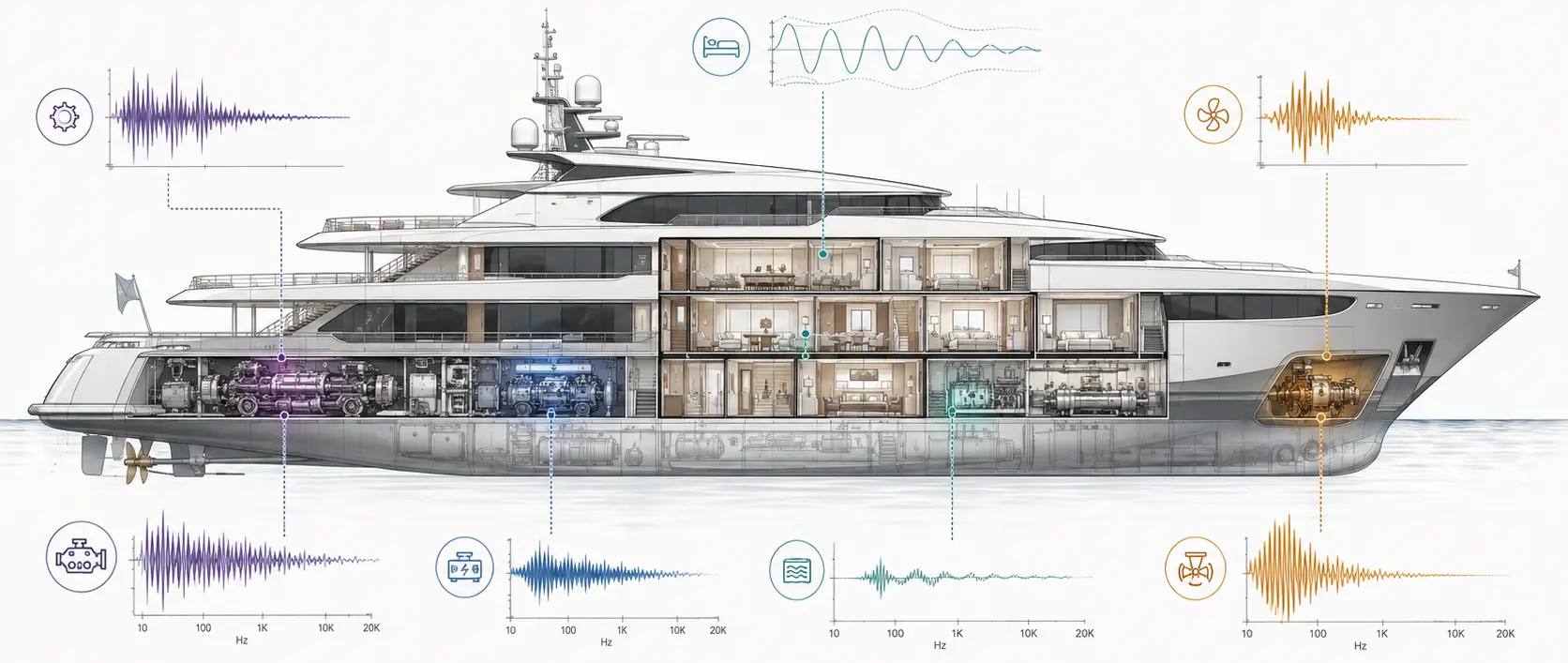
The most expensive luxury aboard a superyacht may be something guests cannot see. Controlling machinery noise, structural vibration, propeller disturbance and HVAC sound requires decisions made deep inside the yacht — often long before the interior begins to look luxurious.
Walk through a newly delivered superyacht at the dock and almost everything designed to impress an owner is visible. Stone, timber, glass, lighting, furniture and exterior spaces can be judged immediately. Noise and vibration are different. They remain largely invisible until the yacht starts a generator, leaves the berth, increases propeller load or settles at anchor for the night.
That is when a yacht which looks exceptional can begin to feel less so. A faint hum through the sole of an owner’s cabin, the low-frequency pulse of machinery through a bulkhead, air rushing through an otherwise beautiful saloon or a cupboard that develops a persistent rattle at one particular engine speed can change the character of a space without altering its appearance at all.
For a yacht expected to provide hotel-level comfort while carrying its own power station, propulsion plant, pumps, ventilation equipment and rotating machinery, silence is not the absence of engineering. It is usually evidence of a great deal of engineering that has been successfully hidden.
Lloyd’s Register describes noise and vibration as one of the clearest areas in which superyacht construction goes beyond ordinary regulatory requirements. Its assessment of large-yacht construction notes that while rules establish standards associated with safe working and crew conditions, luxury projects commonly demand substantially more. The work starts at the sources themselves: stiff machinery foundations, acoustic enclosures around generators, resilient machinery mounts and careful propeller optimisation. Even the sound generated by air moving through the ventilation system receives attention because guests experience the yacht as a complete environment rather than a collection of individually compliant systems.
The result is one of the least visible divisions between an expensive yacht and an exceptionally refined one. Both may have the same marble in the bathroom and similar dimensions on the specification sheet. Only one may allow the owner to sleep while the generators are running beneath several decks of structure.
Noise aboard a yacht does not travel in only one way. Some of it moves through the air: an engine, fan or pump creates sound that reaches an adjacent compartment. Other disturbance enters the yacht structurally. A rotating machine creates vibration in its foundation, the structure transmits it elsewhere, and a panel or piece of joinery several rooms away can effectively become the final loudspeaker.
This is why simply adding insulation late in the build is rarely equivalent to designing for low noise from the beginning. Lloyd’s Register specifically identifies source control as a major focus of superyacht work, including stiff machinery foundations, resilient mounting, generator enclosures and propeller design. DNV similarly describes diagnosis as involving shaft measurements, structural vibration measurements, measurements at local problem areas and, where necessary, finite-element modelling to identify how the disturbance is moving through the yacht.
The distinction is important for owners because the most effective acoustic work can be almost completely hidden by delivery. A resiliently mounted generator is not a feature guests admire at dinner. Neither is the stiffness of an engine foundation, the isolation of a pipe support or the engineering used to prevent vibration moving from machinery into accommodation. Yet these decisions may influence everyday comfort more often than some far more visible additions to the interior.
Propulsion creates another layer of complexity. Propellers do not operate independently of the hull around them, and the flow arriving at a propeller, its rotational speed, loading and relationship with the stern structure can influence both vibration and noise. Lloyd’s Register points specifically to propeller optimisation as part of the process of achieving elevated superyacht comfort. DNV also notes that vibration analysis can require consideration of propeller hydrodynamic forces, hull deflection and the interaction between the shaft line, bearings and hull structure.
That explains why acoustic performance cannot be delegated to the interior contractor after the naval architecture has already been fixed. Hull form, propulsion, machinery foundations, structural design and room arrangement can all establish conditions that subsequent layers of insulation may only partly mitigate.
The same applies to layout. Placing an owner’s cabin beside or directly above a machinery-intensive zone creates a different acoustic challenge from locating it farther away. A gym full of moving equipment, a technical space containing pumps or a large air-handling unit may be acceptable beside one type of room and unacceptable beside another. The drawing therefore has an acoustic dimension long before anyone chooses fabrics or veneers.
Good design tries to prevent the yacht from creating a disturbance and then relying on decorative construction to hide it. That is a much more demanding objective than simply making walls thicker.
Owners do not experience noise only while the yacht is travelling at 15 knots. In some respects, anchor and overnight hotel operation can expose acoustic shortcomings more clearly than cruising does.
At sea, wind, water and the broader sensory environment naturally create background sound. At anchor late at night, those sounds fall away. Guests may be asleep, exterior doors may be closed and there may be almost no ambient activity aboard. A generator, seawater pump, ventilation fan or hydraulic unit that seemed unobtrusive during the day can suddenly become the dominant sound in a cabin.
This is one reason hybridisation and battery systems have acquired a luxury value in addition to their efficiency and emissions arguments. DNV has highlighted that propulsion and machinery configuration can materially affect onboard comfort as well as fuel consumption, emissions, maintenance and reliability. Its yacht guidance identifies batteries and alternative machinery arrangements as part of the wider engineering choices that determine the onboard experience.
A yacht capable of carrying hotel loads for a period without operating conventional generator sets can create a very different atmosphere at anchor. It does not make every other acoustic problem disappear — pumps, HVAC equipment and other systems continue to operate — but removing a major rotating source can change what the guest perceives.
Feadship’s 75-metre Concept C illustrates how far this reasoning can extend. Its proposed fully electric propulsion arrangement uses lower propeller revolutions as part of the effort to reduce vibration, while the concept’s methanol fuel-cell power generation is described by Feadship as vibration-free. Concept C is a design study rather than evidence that every yacht should adopt the same machinery architecture, but it demonstrates how silence is becoming part of the engineering case for future power systems rather than merely a side effect of them.
Ventilation deserves equal attention because silence without climate control is not luxury either. Lloyd’s Register notes that superyacht HVAC design goes beyond achieving the required temperature: engineers also work to minimise the sound of air travelling through ducting and consider vent positioning so that achieving a quiet interior does not create uncomfortable draughts.
That creates an engineering balancing act. Reduce air velocity too aggressively and the system may require larger ducts, consuming valuable space. Increase fan speed and airflow can become audible. Restrict equipment space too heavily and the designer may create exactly the acoustic problem the finished yacht is expected to avoid.
Similar compromises exist throughout the vessel. Softer resilient mounts may reduce transmitted vibration but machinery still has to remain correctly aligned and controlled. Additional acoustic material adds weight and occupies volume. Floating floors and isolated interior structures consume precious millimetres. Quiet machinery may cost more or require a different arrangement. The yacht therefore cannot simply be instructed to “be silent” without assigning engineering, space, weight and money to achieving it.
Noise aboard ships is not an unregulated subject. The International Maritime Organization’s Code on Noise Levels on Board Ships establishes maximum limits for applicable machinery spaces, control rooms, workshops, accommodation and other areas, with the regulatory objective of protecting personnel from harmful onboard noise.
A superyacht owner, however, is usually asking a different question from the regulator. A cabin can be safe for occupation without creating the sensation of stillness expected in a premium owner’s suite.
Classification societies therefore offer voluntary comfort standards as well as baseline class requirements. DNV’s Comfort Class uses the notation COMF-V for noise and vibration and grades comfort from 1 to 3, with 1 representing the highest of those comfort levels. DNV separately offers its VIBR notation for machinery and structural vibration and SILENT notations addressing underwater radiated noise.
For an owner, a notation can provide useful independent discipline, but the notation should not necessarily become the entire specification. The owner’s acoustic expectations may be more demanding in particular rooms or under particular operating conditions. A principal bedroom at anchor, a cinema during generator operation and a sky lounge at cruising speed can each have different priorities.
The more useful contractual question is therefore what will be measured, where, and under which operating condition.
A noise figure without an operating condition can conceal as much as it reveals. The yacht may be quiet at a particular generator load but less successful when another generator configuration is running. A guest cabin may perform extremely well at one cruising speed but develop an objectionable low-frequency vibration at another. The bow thruster may never matter to an owner asleep at anchor, yet a ventilation fan running every night certainly will.
Sea trials and acoustic acceptance therefore need to represent the way the yacht is expected to live, not simply the easiest condition in which to record a favourable number. DNV’s approach to vibration diagnosis illustrates the broader principle: useful assessment can require measurements of shafts, structures and the individual locations where a problem is experienced, supported by modelling when the source is not obvious.
The character of a sound also matters. Two spaces producing a similar overall measured level may not feel identical if one contains an intrusive tone, intermittent pulse or low-frequency vibration. Owners rarely describe dissatisfaction in engineering terminology. They say that a cabin hums, the floor trembles or they can hear something every time they try to sleep. The technical team must then translate that human reaction back into machinery, structure and frequencies.
This is why experienced owner representatives and survey teams do not judge comfort only by standing in the main saloon during a demonstration. They listen and measure across the yacht, through relevant machinery configurations and operating conditions, because the defect that matters may exist only in one cabin at one speed.
The danger with noise and vibration is that the finished yacht can initially look perfect. A cosmetic defect is normally obvious. A poor paint finish can be inspected. Misaligned joinery can be seen. Acoustic faults may remain hidden until machinery begins operating under real loads and the structure behaves as a complete system.
Once that happens, diagnosing the problem can become an investigation rather than a simple repair. DNV describes one yacht case in which unfamiliar onboard noise led to a detailed analysis and the discovery of an overloaded stern-tube bearing. Resolving the underlying issue required consideration of hydrodynamic propeller forces, hull deflections and shaft-line interaction, and the yacht ultimately required major repair and time off hire.
Not every irritating vibration signals a serious mechanical problem. Some are comparatively mundane: a panel with inadequate restraint, a pipe touching surrounding structure or joinery responding to a particular frequency. The difficulty is that the guest does not know which type of problem is producing the sensation. A new rattle may be cosmetic, or it may be the first visible symptom of a system whose behaviour deserves investigation.
DNV makes the wider point that excessive noise and vibration can represent more than passenger discomfort. It can also indicate wasted energy or components subjected to excessive wear. That gives acoustic monitoring an engineering value as well as a luxury one.
For a buyer considering an existing yacht, this makes the sea trial particularly important. The yacht should be experienced not only from the bridge but from the owner’s cabin, guest accommodation, dining spaces, beach club and other areas likely to be occupied when machinery is operating. Generator-only operation at the dock or anchor can be just as revealing as full-speed running.
For an owner commissioning a new yacht, the lesson comes earlier. Acoustic performance should be treated as an owner requirement while machinery, structure and propulsion can still be changed. Waiting until interior completion to decide that the owner wants an exceptionally quiet cabin leaves the project attempting to remove energy after the pathways carrying it have already been built.
That can lead to one of the least satisfying forms of refit expenditure: spending considerable money without creating anything the owner can photograph afterwards. Foundations may need modification, machinery mounts changed, panels removed, insulation replaced, ducts altered or components rebalanced. The yacht eventually looks almost exactly as it did before, yet the improvement can transform what it feels like to live aboard.
That is precisely why noise and vibration deserve to be thought of as an invisible luxury upgrade.
The yacht market naturally concentrates on visible differentiators. Pools become larger, beach clubs more elaborate, glazing broader and interior materials more unusual because all can be communicated instantly in photographs. Silence does not photograph well. It becomes apparent only after several hours aboard, when conversation does not need to compete with ventilation noise, the floor beneath a bed remains still and the owner stops consciously noticing that machinery is running.
In that sense, the best acoustic engineering almost disappears from the yacht it improves. Guests do not need to understand resilient mounts, structural transmission paths, propeller excitation or finite-element analysis. They experience the accumulated result as calm.
A yacht can be made to look luxurious relatively late in construction. Making it feel quiet usually requires decisions much earlier, when much of what creates that luxury is still hidden behind drawings, steel, aluminium and machinery foundations.
For owners planning a new build or major refit, that makes noise and vibration one of the rare upgrades whose success is measured by how completely the technology disappears. The ultimate achievement is not that somebody notices the yacht is acoustically sophisticated. It is that after a night at anchor or a day underway, nobody thinks about noise or vibration at all.
Explore
Go deeper into the yachts, companies, events and destinations directly connected to this article.
Continue reading
The Largest Tender Garages on Superyachts Public data rarely gives comparable tender-garage volume, so there is no defensible universal ranking by cubic metres; the …
Superyachts with Swimming Pools: The Largest Pools at Sea Swimming pools are now common on large custom yachts, but the engineering becomes progressively harder …

Lloyd’s Register says nuclear propulsion for superyachts now warrants serious safety and regulatory work, while major technical and societal barriers remain.
Largest Superyachts Built in Turkey: 2026 Ranking Turkey has become one of the world’s most important large-yacht construction centres, and the current SYG fleet …
Superyacht Guide
Continue into the wider Superyacht Guide.