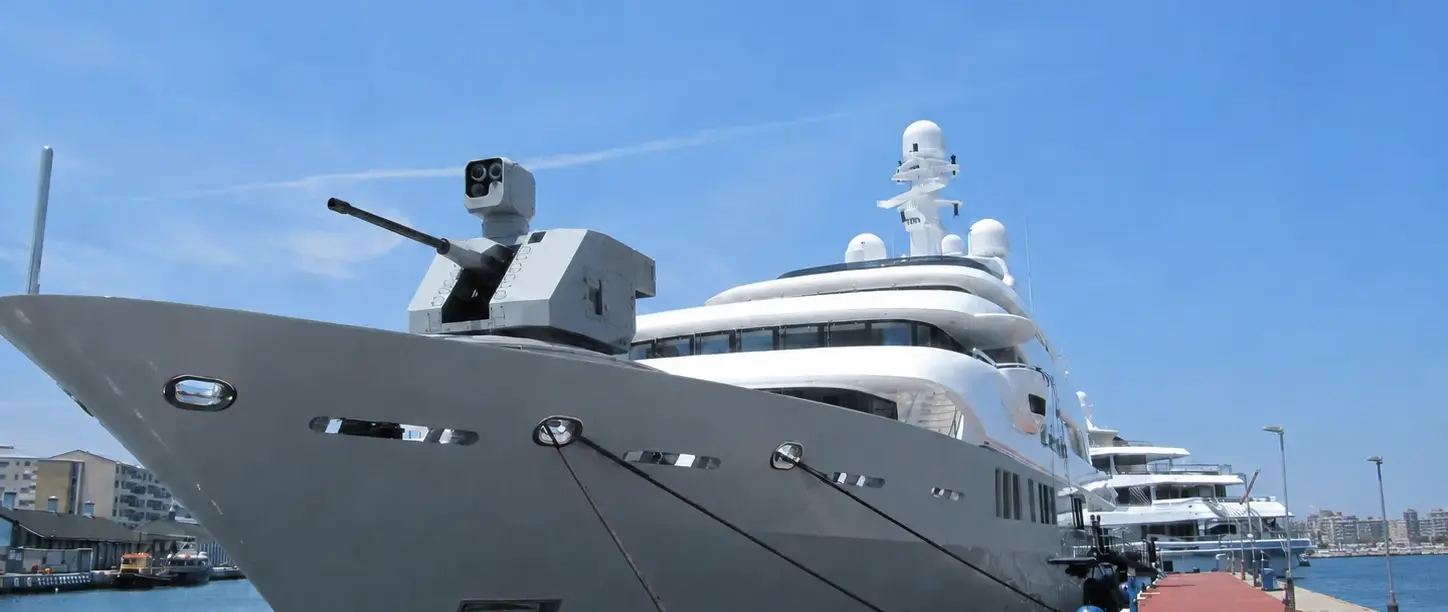
A large private yacht could, in principle, be taken into government service or used for limited military-support roles. That does not make it a practical warship, and the legal, insurance and targeting consequences would be profound.
The idea of a superyacht being turned into a military vessel has an obvious cinematic appeal. Large yachts can have transoceanic range, powerful generators, satellite communications, helicopters or substantial tender capacity, extensive accommodation and enough internal volume to support dozens of people for long periods, so it is easy to imagine a luxury vessel being transformed into a command ship, intelligence platform or even an armed patrol vessel.
Reality is much less dramatic. A modern superyacht could potentially be acquired, chartered or otherwise placed into government service, and history provides clear examples of private yachts being converted for naval use, but a contemporary yacht is not a warship simply because it is large, fast or technologically sophisticated. The distinction between a civilian yacht, a government vessel, a naval auxiliary and a warship is both technical and legal, and crossing from one category into another can fundamentally change the risks faced by the vessel, its owner and its crew.
The more useful question is therefore not whether weapons could physically be placed aboard a yacht. It is whether the yacht could perform a useful military function, what status it would acquire if it did, and whether the operational benefit would justify exposing a highly visible, lightly protected civilian vessel to the legal and physical consequences of armed conflict.
International law gives the term warship a much narrower meaning than popular language does. Under Article 29 of the United Nations Convention on the Law of the Sea, a warship belongs to the armed forces of a state, carries the external marks of that nationality, is commanded by a properly commissioned military officer and is crewed by personnel subject to regular armed-forces discipline.
A privately owned superyacht does not satisfy that definition merely because it carries former military crew, secure communications or defensive equipment. Even if a state began using a civilian vessel, its precise legal status would depend on how it was owned, operated, commanded and designated; UNCLOS separately recognises government ships operated for non-commercial purposes and provides distinct treatment for warships and other state vessels.
That distinction matters because military status brings consequences as well as privileges. Government vessels and warships may enjoy sovereign immunities in circumstances where ordinary private vessels do not, but military use can also move a ship much closer to the legal definition of a military objective during armed conflict.
For an owner, captain or manager, this means that the phrase military use cannot be treated as an informal description. It potentially changes flag-state involvement, command responsibility, regulatory treatment, insurance, port access, crew obligations and the legal character of the yacht itself.
There is nothing hypothetical about governments acquiring private yachts for naval service. During the First and Second World Wars, the United States Navy purchased numerous privately owned yachts and converted them into patrol vessels, escorts, training platforms, communications ships and other auxiliary craft.
The former yacht Remlik, for example, was acquired by the U.S. Navy in 1917 and converted into an armed patrol vessel before serving on antisubmarine patrol and escort duties in European waters. Yacona was similarly acquired and altered for naval patrol service, while the yacht Azurlite, purchased after the United States entered the Second World War, was converted for naval use and commissioned in 1942.
Those examples prove that a yacht can be repurposed, but they do not prove that a modern superyacht would make an efficient combat ship. Early twentieth-century patrol vessels were mechanically simpler, weapons and sensors placed different demands on the platform, and navies facing wartime shortages often accepted conversions that would not satisfy the requirements applied to modern naval vessels.
A modern warship is designed around military systems from the beginning. Lloyd's Register's current Naval Ship Rules apply specifically to vessels designed and constructed to carry and operate naval systems, including ships intended for command roles and worldwide deployment, reflecting the fact that naval service imposes requirements beyond those found in ordinary commercial or yacht construction.
The historical lesson is therefore that governments can improvise when circumstances require it. The mistake would be assuming that an expensive yacht automatically provides a near-finished naval platform.
The most credible military uses of a large yacht would generally be support roles rather than direct combat. Accommodation, transport, liaison, communications, command support, training, medical or humanitarian support, evacuation and similar functions could make use of characteristics that many large yachts already possess without pretending that the yacht has suddenly become a destroyer or frigate.
Large yachts are designed to sustain people away from shore, often with significant electrical generation, water production, refrigeration, workshops, communications and storage. Explorer yachts in particular may also have helicopters, cranes, landing craft, large tenders and extensive technical spaces, although those capabilities are designed around owner use and expedition logistics rather than military survivability.
A yacht might therefore have value as a temporary headquarters, personnel-transport platform, accommodation vessel or specialist support ship where the threat environment is controlled. That would be conceptually closer to government auxiliary service than to a frontline combat role, and modern defence regulation recognises auxiliary vessels as a distinct part of government maritime activity rather than treating every government-operated ship as a conventional warship.
The distinction becomes important when the vessel is expected to operate near actual hostilities. Luxury accommodation, large fuel tanks and sophisticated communications are useful, but they do not provide the structural protection, redundancy, military damage control and operational resilience that navies normally require from ships expected to survive attack.
A superyacht can be extraordinarily sophisticated while remaining fundamentally optimised for comfort rather than combat. Naval vessels must be designed around different assumptions concerning damage, redundancy, machinery availability, fire control, compartmentation, operating loads, military systems and the ability to continue functioning after casualties that would normally send a civilian vessel directly to port.
Lloyd's Register maintains separate classification rules for naval ships precisely because their design and operational requirements are different from conventional merchant shipping. Its naval standards cover structures, machinery and engineering systems intended for the unusual service conditions placed on military vessels, while defence regulators apply dedicated frameworks to government maritime operations.
A yacht may have excellent watertight subdivision and sophisticated fire detection, but its spaces are arranged around guest cabins, saloons, spas, cinemas and exterior living areas rather than military functions. Large expanses of glazing, extensive decorative interiors and highly interconnected hotel systems can be strengths in luxury design while offering little benefit if a vessel is exposed to blast, fragmentation, shock or battle damage.
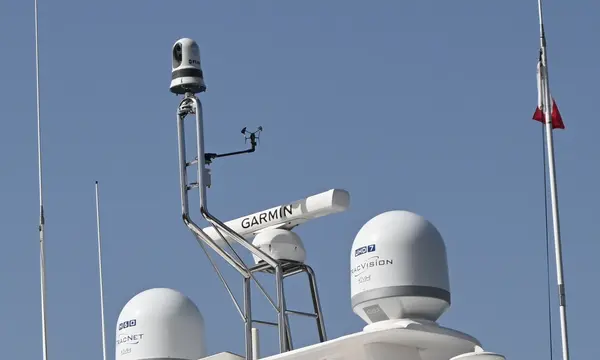
The same applies to electronics. A yacht may carry advanced navigation equipment, satellite communications and cybersecurity systems, but a modern naval combat system is an integrated military architecture involving sensors, command systems, secure networks, weapons-control functions and a degree of redundancy that cannot be inferred simply from the number of antennas visible above the bridge.
Even propulsion performance can be misleading. A 20-knot or 25-knot yacht may appear fast compared with ordinary shipping, but combat suitability is about much more than maximum speed; endurance under military loading, manoeuvrability, machinery resilience, acoustic and electromagnetic signatures, damage tolerance and the ability to remain effective after failure all matter.
The most plausible modern concern is often not whether a yacht could carry weapons, but whether it could provide surveillance, communications or intelligence support. Any large civilian vessel has the physical ability to observe its surroundings and carry electronic equipment, but using a civilian ship in direct support of military operations creates a very different legal situation from simply cruising through a conflict region.
The International Committee of the Red Cross notes that merchant and other civilian vessels remain protected unless they become military objectives. Activities such as carrying troops, directly supporting military operations or gathering intelligence can be relevant to that assessment, while the San Remo Manual identifies acting as an auxiliary to an enemy's armed forces among the activities that may make an enemy merchant vessel a military objective.
That does not mean every vessel carrying a government official, camera or satellite terminal becomes a lawful target. International humanitarian law requires a fact-specific assessment of whether an object makes an effective contribution to military action and whether attacking it would offer a definite military advantage in the circumstances at the time.
For yacht owners, the practical lesson is severe. A civilian vessel's greatest protection in wartime is its civilian character, and intentionally using it for direct military support can jeopardise that protection without magically giving the yacht the defensive qualities of a naval ship.
Popular imagination tends to focus on what capability could be added to a yacht, but military planners would also have to consider what vulnerabilities the conversion creates. Superyachts are large, recognisable, dependent on specialist maintenance and often built with exterior profiles specifically intended to attract attention rather than disappear into commercial traffic.
Their normal operating model also relies upon an extensive civilian support network. Yacht agents, marinas, fuel suppliers, management companies, insurers, banks, technicians, flag administrations and classification societies all contribute to keeping the vessel moving, and military activity could complicate or interrupt many of those relationships.
Insurance provides a particularly clear warning. Marine war risk is normally treated separately from ordinary marine cover, and insurers can impose geographical limits, additional premiums, exclusions or cancellation provisions as conflict develops. During periods of escalating maritime risk, the commercial environment around a vessel can change rapidly even when that vessel itself has no military role.
Requisition by a government can itself affect cover. P&I rules commonly contain provisions addressing state requisition or government control, demonstrating that the transition from private operation into public service can alter the basis on which a vessel is insured.
A yacht moving from private use into defence activity would therefore require far more than a technical decision by the owner. Flag status, insurance, class, crewing, contracts and the authority under which the vessel operates would all need to be resolved before the ship's military usefulness could even be considered.
The human factor is another reason the idea is more complicated than it sounds. Superyacht crews are civilian maritime professionals employed to navigate, engineer, maintain and provide hospitality aboard a private or commercial yacht, and their employment does not automatically oblige them to participate in military operations.
UNCLOS's definition of a warship specifically requires command by a duly commissioned military officer and a crew under regular armed-forces discipline. That illustrates how different formal military service is from merely having competent civilian mariners aboard a vessel.
A government could potentially operate a former yacht with military personnel, or civilian seafarers could work in certain government-support arrangements, but those are organisational and legal decisions rather than simple extensions of an ordinary yacht employment contract. Allied maritime doctrine itself recognises that civilians can operate alongside maritime forces, but doing so places them within a much broader operational framework than normal yacht employment.
Owners should therefore be cautious about the assumption that an experienced captain, engineer or deck crew automatically becomes suitable for military service. Professional competence at sea and formal military status are different things, and the obligations and risks attached to each can be very different.
Physically, many large vessels have deck area and structural capacity that could be modified to carry equipment, but that observation is almost meaningless without considering everything else required to operate a weapon safely, legally and effectively. Modern military systems depend on command authority, trained personnel, specialised sensors, secure communications, integration, ammunition management, safety controls, maintenance and rules governing their use.
Historical converted yachts carried relatively simple naval weapons because governments were prepared to undertake substantial shipyard alterations and accept the resulting platform for the wartime task required. U.S. Navy historical records show vessels such as Artemis, Remlik and Yacona undergoing formal naval conversion before operating as armed patrol craft, rather than owners simply placing weapons aboard functioning pleasure yachts.
A modern equivalent would face far more demanding engineering, regulatory and operational questions. Even if technically possible, that does not make the project sensible when a navy could instead use a purpose-built patrol vessel, offshore support ship, commercial auxiliary or other platform designed around the mission.
The popular concept of a secret missile-armed billionaire's yacht therefore belongs much closer to fiction than normal superyacht operations. The real dual-use issue lies in support, communications, transport and potentially intelligence functions, because those require fewer visible changes while carrying serious legal consequences of their own.
Perhaps the most important risk is that a yacht does not need to look military before its legal exposure changes. International humanitarian law focuses on what a vessel is doing and the contribution it makes to military action, not simply whether its hull is grey or whether it carries a naval ensign.
The ICRC's explanation of naval warfare is explicit that auxiliary vessels and merchant ships directly helping enemy military action can become military objectives. It also lists activities such as carrying troops and intelligence gathering among the factors capable of altering the protection normally enjoyed by civilian shipping.
That represents the central paradox of using a superyacht for military purposes. The vessel may gain only a limited operational capability while losing part of the civilian status that previously helped protect it, leaving a platform designed for comfort exposed to risks for which it was never designed.
For owners operating near conflict areas, maintaining a clear separation between civilian yacht activity and military operations is therefore not merely a matter of image or reputation. It can be relevant to the vessel's legal protection, insurance position and physical safety.
A superyacht could be used for military purposes, just as many other civilian vessels could be. Governments have historically acquired and converted yachts, and a modern large yacht could potentially perform accommodation, transport, communications, liaison or other support functions if placed under appropriate government control.
What it would not become easily is a modern warship. Naval ships are purpose-designed around military systems, survivability and operational doctrine, while superyachts are designed around privacy, comfort, guest experience and civilian maritime regulation; the fact that both are complex ships does not make them interchangeable.
The greater risk lies in the area between those categories. A yacht directly assisting military operations can acquire legal and insurance exposure before it gains anything resembling naval survivability, and a vessel that remains visually luxurious may nevertheless become militarily significant because of what it is being used to do.
For the superyacht industry, that is the point worth understanding. The question is not whether a yacht could be made to look like a warship, but how quickly an apparently civilian asset can lose the protections and assumptions that make normal yacht operation possible once its purpose changes.
Explore
Go deeper into the yachts, companies, events and destinations directly connected to this article.
Continue reading
Corporate structures are a routine part of superyacht ownership, but the compliance risk changes when they obscure the person who ultimately owns or controls …
Yacht brokers, managers and shipyards face sanctions risk through ownership structures, payments and services, making effective due diligence essential.
After Russia’s invasion of Ukraine, superyachts linked to sanctioned Russian elites became unusually visible test cases for asset freezes, ownership investigations and international enforcement.
Superyachts can expose far more than their location. AIS, connected systems, ownership records, suppliers and human activity can collectively reveal owners, guests and itineraries.
Superyacht Guide
Continue into the wider Superyacht Guide.
Business opportunities · Superyacht Guide
Companies serving the superyacht market can discuss clearly identified advertising, sponsorship and business-profile opportunities. Commercial activity remains separate from independent editorial coverage.