
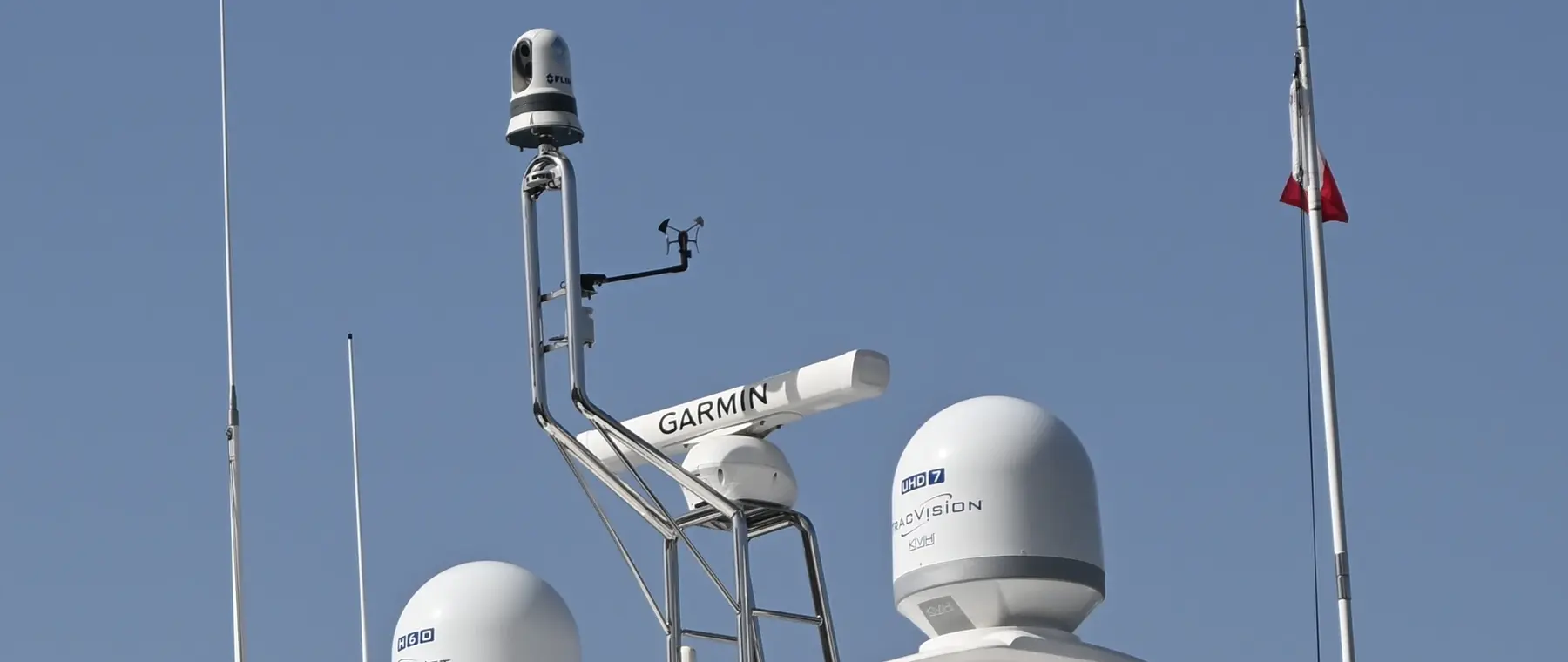
Superyachts can expose far more than their location. AIS, connected systems, ownership records, suppliers and human activity can collectively reveal owners, guests and itineraries.
A superyacht is built around privacy, yet it can be one of the most observable private assets in the world. Its position may be transmitted electronically, its movements involve ports and agents, its operation depends on dozens of suppliers, and the people aboard carry phones, laptops and communications systems that connect the vessel continuously to shore.
For most owners, none of this means that an intelligence agency is actively watching the yacht. The more realistic risk is that a large private vessel produces many separate pieces of information that can be collected, compared and combined until they reveal far more than any individual source appears to contain.
That distinction matters because surveillance does not have to involve a person hiding behind binoculars. In the modern maritime environment, information about a yacht can emerge from navigation systems, commercial databases, corporate records, financial transactions, photographs, communications infrastructure and the ordinary human activity required to keep the vessel operating.
The starting point is Automatic Identification System data. AIS exists primarily for navigational safety and automatically provides information including a ship's identity, type, position, course, speed and navigational status to appropriately equipped ships and shore stations.
For yachts falling within the relevant SOLAS carriage requirements, this is not simply an optional tracking device. IMO states that AIS is required on ships of 300 gross tonnage and above engaged on international voyages, among other categories, and that fitted ships should normally keep the system operating.
The security tension has been recognised for more than two decades. IMO's Maritime Safety Committee has specifically warned that publishing ship-generated AIS information openly on the internet can be detrimental to ship and port security, even though AIS itself remains an essential safety system.
For a superyacht owner, the consequence is uncomfortable but straightforward. A vessel may be physically isolated hundreds of metres offshore, yet its movement can still be visible within a much larger maritime information environment.
AIS is the most familiar form of yacht visibility because commercial websites have made ship movements easy to understand. It is not, however, the only mechanism through which maritime authorities can know where a vessel is operating.
The international maritime system also includes Long-Range Identification and Tracking. IMO describes LRIT as a worldwide system through which governments receive regular ship identity and position information, illustrating that government maritime awareness extends beyond the commercial tracking websites familiar to the public.
Port entry creates another information trail. Modern maritime reporting increasingly depends on electronic exchanges between ships, ports and public authorities, and IMO's Maritime Single Window framework formalises much of that exchange for international shipping.
None of this is inherently sinister. Navigation safety, immigration, customs, security and port administration require information, but the same reality means that a large yacht should never be treated operationally as though its movements exist only between the bridge and the owner's office.
A position report by itself may reveal little more than the location of a yacht. A guest photograph may appear harmless, a marina booking may be routine and a supplier invoice may simply record normal expenditure, but a sequence of such details can begin to reveal patterns.
Movements can suggest where an owner spends time, which ports are repeatedly visited and when the yacht changes cruising region. Public appearances can connect guests with the vessel, while aircraft movements, social events, tender activity and shore transportation can create additional context around who may be aboard.
This is the point at which ordinary information becomes an intelligence risk. The concern is not necessarily that one database contains everything, but that apparently unrelated sources can be fused into a sufficiently accurate picture of people, relationships, routines and future movement.
For prominent owners, the potential audience is broad. Government agencies, law-enforcement authorities, journalists, litigants, commercial investigators, activists and criminals may all be interested in different aspects of the same vessel, even though their purposes and legal authorities are entirely different.
Modern large yachts are highly connected computer environments. Bridge systems, communications, propulsion monitoring, access control, surveillance, administrative systems, crew services and ship-to-shore connections can all depend on networked computer-based systems.
IMO's revised maritime cyber-risk guidelines explicitly identify bridge and communications systems, security and surveillance equipment, crew and passenger systems, public-facing networks, ship-port interfaces and ship-to-shore integrated systems among the areas that can create cyber exposure. That breadth matters because compromise of a peripheral system can still expose information with intelligence value.
That means an intelligence breach does not necessarily need to interfere with propulsion or navigation to be valuable. Information concerning itineraries, contact details, guest arrangements, documents or communications could be sensitive even if every engineering system aboard continues functioning normally.
The risk therefore includes confidentiality as well as operational safety. IMO's guidance specifically treats the confidentiality, integrity and availability of information as cyber-security concerns, reflecting how much valuable data now exists alongside the yacht's physical machinery.
The traditional image of a secure vessel has a clear perimeter: hull, doors, passerelle and guards. Digital connectivity makes that perimeter much harder to define because guest and crew devices constantly move between the yacht, hotels, airports, homes, offices and other networks.
An owner may maintain sophisticated security at a family office while arriving aboard with several personal devices that immediately connect to yacht communications infrastructure. Guests may bring laptops containing corporate material, authentication credentials, confidential correspondence or information about meetings that have nothing directly to do with the vessel.
A yacht can therefore become a temporary extension of several organisations at once. The communications environment might simultaneously support the owner, family members, executives, advisers, crew, contractors and visitors, each bringing different devices and different levels of security discipline.
IMO's cyber guidance reflects this wider problem by specifically identifying passenger, crew and subcontracted personnel using public networks, as well as ship-to-shore connections, as areas requiring cyber-risk consideration. In practical terms, the security boundary extends to every personal device allowed to communicate through the vessel.
A superyacht cannot operate in isolation. Shipyards, management companies, yacht agents, classification societies, satellite providers, IT specialists, engineers, caterers, fuel suppliers, transport companies, marinas and dozens of specialist contractors may all hold fragments of information about the vessel.
One contractor may know when the yacht will arrive for maintenance. Another may know which satellite equipment is installed, while an agent may know the expected port call and a transport company may know when vehicles have been requested for guests.
The majority of those relationships are entirely legitimate and professional, but the number of organisations involved expands the information boundary dramatically. Security is therefore no longer determined only by the people directly employed aboard.
IMO's latest cyber-risk guidelines specifically warn that risk management must consider third-party vendors, embedded systems and software and hardware supply chains. They also call for protection where shipboard systems interact with third-party or landside networks.
Crew inevitably know a great deal about a yacht. They may know cruising plans, guest arrival dates, family routines, regular destinations, preferred restaurants, aircraft arrangements and the identity of people whose presence aboard has never been publicly announced.
That knowledge is necessary to do their jobs, and professional discretion remains one of the foundations of yacht service. The intelligence risk arises because crew also live ordinary digital lives involving social media, messaging applications, photographs, friends, family and professional networks.
A photograph does not need to show an owner to reveal useful information. Background scenery, a marina, a uniform, a date, a tender or even the timing of a crew change can unintentionally confirm that a particular yacht is somewhere at a particular time.
The objective should not be to treat crew as suspects. It is to recognise that human behaviour forms part of information security, something reflected in IMO's requirement for cyber awareness and familiarisation across personnel rather than treating cyber security solely as an IT department responsibility.
Superyachts are frequently owned through companies rather than directly in an individual's personal name. That structure can have entirely legitimate legal, operational, financing and liability purposes, but recent sanctions cases demonstrate how deeply authorities can investigate the beneficial ownership behind a vessel.
The U.S. Department of Justice's Amadea proceedings provide a striking public example. Prosecutors alleged that ownership moved through multiple companies and relied on evidence concerning transactions, use of the vessel, travel by family members, renovation plans and responsibility for operating costs when arguing who beneficially controlled the yacht.
Investigations surrounding the yacht Tango similarly focused on ownership structures, management activity and financial transactions. U.S. authorities alleged that companies were used to obscure the beneficial owner's connection with the yacht while operating expenses continued to move through the financial system.
These are enforcement cases rather than espionage cases, and allegations in court proceedings are not the same as findings of guilt. They nevertheless demonstrate how a yacht's corporate structure, money flows, operational history and patterns of use can collectively become evidence about who really controls an asset.
Since 2022, large yachts linked to sanctioned individuals have attracted an exceptional level of government and financial-sector attention. Banks, insurers, managers, ports and professional advisers have had to examine ownership and control rather than simply accepting the name of the registered company.
The UK's Office of Financial Sanctions Implementation reported in its 2026 financial-services threat assessment that suspected sanctions breaches involving superyachts had been persistently reported since 2022. OFSI also noted the use of opaque ownership structures and payments connected with continued crewing and maintenance of yachts linked to designated persons.
This has changed the intelligence environment around the sector. A yacht associated with a politically exposed or sanctioned individual may attract scrutiny not just from maritime authorities but from financial institutions, sanctions investigators and law-enforcement bodies following transactions across jurisdictions.
For owners outside sanctions regimes, the broader lesson is still relevant. Superyachts leave records because they are expensive, mobile and dependent on regulated international services, and complex ownership does not necessarily make the underlying relationship impossible to reconstruct.
Digital intelligence receives most of the attention, but physical observation remains important because yachts operate in public maritime spaces. A large vessel entering a harbour can be photographed from shore, another boat, a marina, a hotel, an aircraft or increasingly from small unmanned aircraft.
Unlike a private residence hidden behind walls, much of a yacht's exterior operation takes place in view. Tender movements, helicopter operations, security personnel, visitors and shore transfers may all become observable without anybody needing physical access to the vessel.
The existing Superyacht Guide security analysis has already examined drones as a privacy and physical-security problem. The intelligence dimension is slightly different because the concern is not only intrusive photography but what repeated observation can establish about routines, people and patterns over time.
A camera therefore does not need to capture something dramatic to be useful. Intelligence is often about confirmation, and repeated ordinary observations can sometimes be more revealing than a single sensational image.
Most large yachts carry extensive onboard surveillance and access-control systems. Cameras, door-control systems, alarms and monitoring platforms are designed to protect the people aboard, but the information they generate can itself be sensitive.
IMO's cyber guidance explicitly includes security, access-control and surveillance systems within the computer-based systems that should be considered in maritime cyber-risk management. It also warns that interconnected systems can introduce vulnerabilities when access, integration or maintenance are not adequately controlled.
A compromised surveillance system would therefore create an unusual inversion of the yacht's security model. Equipment intended to observe threats could potentially reveal internal activity, access patterns or security arrangements if improperly exposed.
The correct response is not to avoid surveillance technology. It is to recognise that physical-security equipment has become part of the yacht's digital-security environment and must be protected accordingly.
The language surrounding this subject can become exaggerated very quickly. A yacht appearing on a vessel-tracking website does not prove that a government is spying on its owner, and a photographer outside a marina is not automatically an intelligence operative.
There is an important difference between information that is publicly observable, information lawfully collected by maritime authorities, commercial data gathering, criminal surveillance and state intelligence activity. Treating all of those categories as identical makes serious security planning harder rather than easier.
The better approach is to think in terms of exposure. Owners and managers should understand what information exists, who legitimately receives it, where it is stored and how apparently harmless pieces of information could become sensitive when combined.
That creates a more useful question than asking whether somebody is spying on the yacht. The question becomes whether the vessel is unnecessarily revealing information that could matter to somebody with a reason to collect it.
Because AIS is the most obvious public signal, owners may naturally wonder whether greater privacy simply means transmitting less. That can be a dangerous oversimplification because AIS is fundamentally a navigational safety system governed by international and flag-state requirements.
IMO says ships required to carry AIS should normally maintain it in operation, except where international agreements, rules or standards provide for protection of navigational information. Captains therefore cannot treat routine AIS deactivation as a convenient privacy switch.
The same principle applies more broadly. Security cannot sensibly depend on attempting to remove every trace of a large vessel from systems that exist for navigation, safety, customs, port administration or regulation.
A professional strategy instead distinguishes between information that must legitimately be transmitted and information that does not need to be publicly or unnecessarily distributed. Compliance and privacy have to coexist rather than one being sacrificed casually for the other.
IMO defines maritime cyber risk around the possibility that technology can be compromised in ways that produce operational, safety or security failures. Its current guidance reflects how extensively shipping now depends on digitalisation, integration, automation and networked systems.
For a superyacht, however, the consequences can extend beyond machinery. The same networks may support personal communications, owner administration, guest internet access, crew welfare, security systems and shore-side management.
That makes confidentiality a first-order ownership issue. A cyber incident does not have to stop the yacht to be damaging if it exposes information about the people aboard, their communications or their future movements.
IMO consequently recommends controls including account management, authentication, network segregation, secure communications, protection of internet-connected systems, personnel training and supply-chain security. Those measures are maritime cyber controls, but on a large private vessel they are equally part of protecting the owner's intelligence footprint.
Owners often think of valuables aboard a yacht in physical terms: art, jewellery, cash, equipment or the vessel itself. From an intelligence perspective, knowing where someone will be and when can be more valuable than knowing what is locked inside a safe.
A future itinerary can reveal meetings, family movements, corporate activity or political relationships before any of them become public. Even incomplete information may become useful when combined with aircraft movements, port bookings or other independently observable activity.
This is why itinerary information should be treated according to need rather than convenience. The captain and operational team may require complete planning information, while many other parties need only the part necessary to perform a particular service.
The principle is ordinary information discipline rather than secrecy for its own sake. Every unnecessary copy of an itinerary expands the number of places from which future movements might eventually become visible.
The most sophisticated superyacht can carry excellent cyber security, professional crew and carefully controlled physical access while still depending on a very large external network. That ecosystem is part of what makes modern yacht operation possible, but it also means the vessel's information exists far beyond the hull.
A shipyard may hold drawings and system details, a management company may hold crew and financial records, an IT provider may administer network equipment, an agent may know movements and a marina may have security and berth information. Each party may hold only a fragment, but together those fragments can describe the yacht far more completely.
Protecting the yacht therefore requires a broader idea of security than protecting onboard computers. IMO's emphasis on third-party vendors, ship-port interfaces and supply chains is particularly relevant to large private vessels because so much specialist yacht knowledge sits outside the crew itself.
An owner does not need every contractor to know everything. Good information governance reduces unnecessary exposure while still allowing the hundreds of legitimate tasks surrounding a superyacht to happen efficiently.
The superyacht industry sells privacy extremely well in physical terms. A yacht can take an owner away from hotels, public roads, restaurants and crowded resorts while creating a controlled environment in which access is tightly managed.
What it cannot create is complete invisibility. Navigation systems, authorities, service providers, technology, financial transactions and human behaviour all create information, and the larger and more complex the yacht becomes, the more extensive that information ecosystem generally becomes.
The objective should therefore be realistic privacy rather than imagined anonymity. Owners need to understand which information is unavoidable, which is commercially necessary, which is being shared unnecessarily and which would become genuinely sensitive if connected with other data.
That is the real intelligence risk around large private vessels. A superyacht does not need to be engaged in espionage to become an intelligence-rich object; it only needs to carry important people through a world in which ships, systems, money and human activity all leave traces.
Explore
Go deeper into the yachts, companies, events and destinations directly connected to this article.
Company
Explore the company profile and related Superyacht Guide coverage.
Continue reading
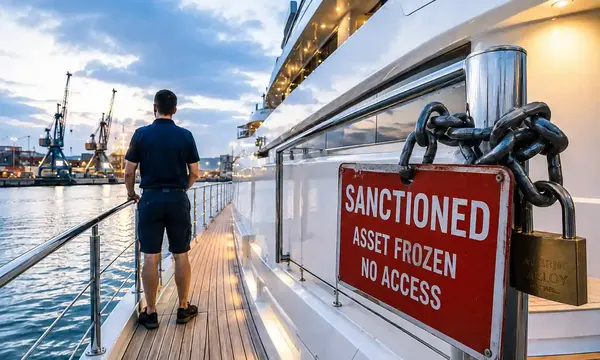
A sanctions freeze can immobilise a superyacht without making its crew sanctioned, leaving wages, contracts and daily operations caught between employment law and financial …

A superyacht can be easy to locate but far harder to connect legally to the person authorities want to target. Layered companies, differing ownership …
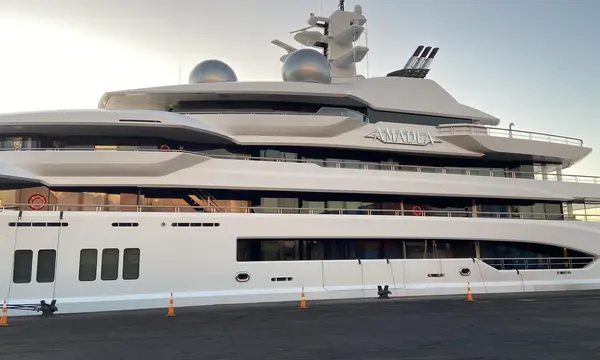
A superyacht can offer distance from conflict, but port access, sanctions, insurance and wartime law can quickly turn autonomy into exposure.

When authorities seize or freeze a superyacht, maintenance bills continue. Who pays depends on custody, sanctions rules, owner funds and eventual sale.
Superyacht Guide
Continue into the wider Superyacht Guide.
Business opportunities · Superyacht Guide
Companies serving the superyacht market can discuss clearly identified advertising, sponsorship and business-profile opportunities. Commercial activity remains separate from independent editorial coverage.