

Versilia Supply Service Develops My VSS Procurement Platform
Versilia Supply Service outlines plans for a revised My VSS yacht procurement platform, with a catalogue of more than 200,000 products and quotation tools.
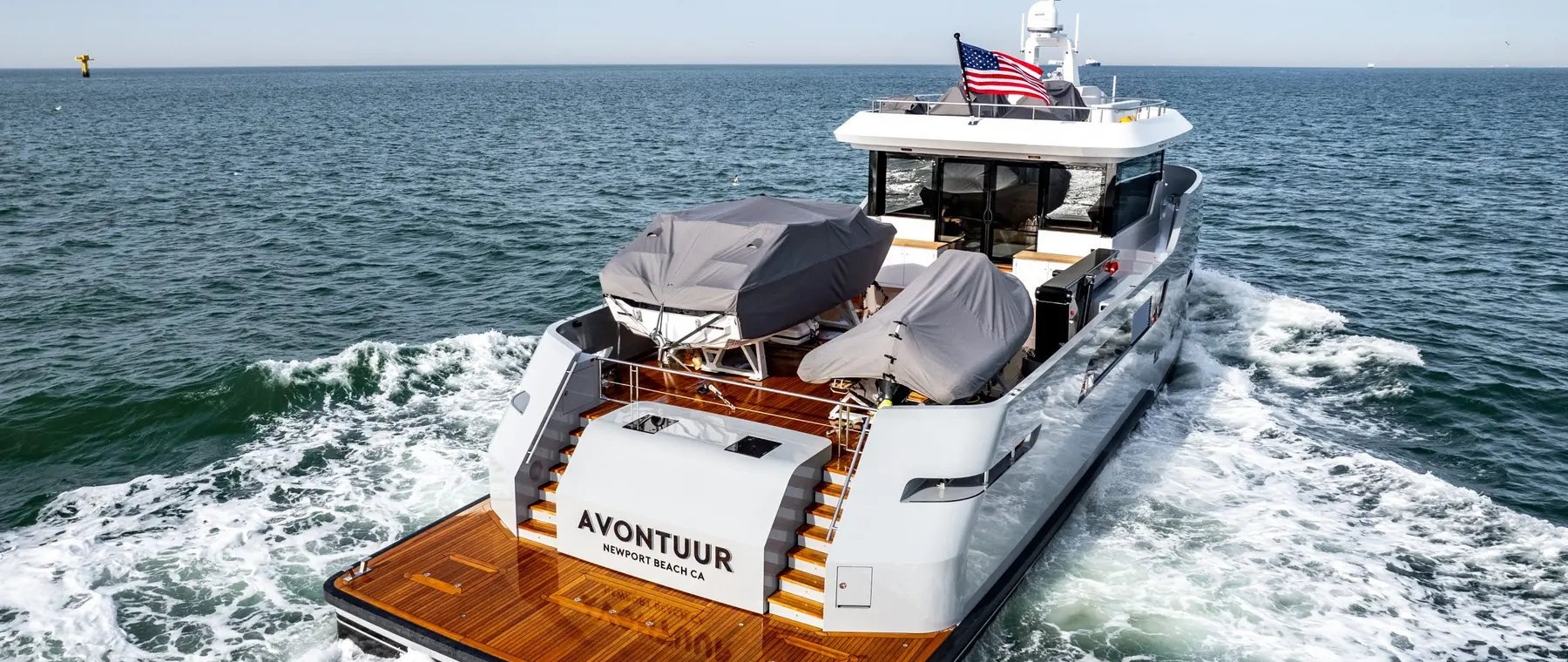
Lynx Yachts Crossover 27 during sea trials — illustration accompanying the November 2026 company guidance
Lynx Yachts outlines the decision between a fast auxiliary boat and a separate support vessel, highlighting the payload, personnel and logistics of yacht extenders.
Lynx Yachts published guidance on 15 November addressing the choice between a fast auxiliary boat and an independently operated support vessel. Its contribution comes from the perspective of a builder that specialises in yacht extenders rather than from a brokerage catalogue. For owners of larger yachts, the distinction is worth examining before they commit to additional craft: buying a suitable tender and establishing a second operational platform are fundamentally different investments.
The Dutch company's comparison places the principal decision in the context of the owner's cruising objectives. Its YXT 27 and YXT 34 programmes illustrate how a dedicated vessel can provide a significant working area apart from the main yacht. The new guidance is not a report of a recently delivered vessel. It is an opportunity to examine the practical questions that shape the specification of a yacht support fleet.
A tender specification often begins with the distance between a yacht's anticipated anchorage and its guests' destinations. A boat selected for frequent short passages to sheltered harbours may benefit from a different arrangement than one expected to cover longer distances in exposed water. Considerations include ride quality, guest protection, boarding equipment and the ability to return safely when the weather changes.
By contrast, the decision to operate a separate support vessel should begin with the anticipated itinerary over the entire season. An auxiliary yacht can have its own passage plan, crew accommodation and machinery, allowing it to carry equipment that would otherwise occupy space on the main vessel.
Coordination is central to the proposition. The support yacht may not always travel at the same speed, and it may have different bunkering requirements or restrictions on port entry. Chartering a berth for two significant vessels rather than one introduces another set of arrangements. The proposed yacht operation should be assessed as a combined fleet, with alternative plans for periods when one unit is unavailable.
A valuable first step is to establish a detailed inventory of the craft, stores and technical equipment that the owner expects to carry. It should identify dimensions and operating weights rather than rely on names or approximate catalogue figures.
For example, the space required for a tender depends on more than the length of the hull. Cradles, securing points, protection from contact damage, access for maintenance and space around lifting arrangements all need consideration. Similar issues arise for recreational diving equipment, personal watercraft and spare machinery.
This inventory should distinguish loads that will remain aboard for most of the season from equipment taken on occasional voyages. Some owners may discover that a simpler local chartering or delivery arrangement meets their requirements without the expense of maintaining a separate ship throughout the year. Others will find that the logistics of transferring equipment between different destinations make permanent support capacity attractive.
Lynx's argument is that the functions of extending the main yacht's storage capacity and extending its guests' access to shore should not be confused. Owners can use a detailed payload study to make that distinction concrete.
The builder gives a working-deck area of 74 square metres for its YXT 27 design and 145 square metres for the YXT 34. These figures provide an indication of the scale of the respective platforms, but they should not be treated as a complete description of cargo capacity.
Equipment imposes local loads through its supports. A naval architect must assess the deck structure and the arrangement of the cargo in relation to the vessel's displacement, trim and stability. A particularly heavy object may require a specific structural arrangement even when there appears to be ample free space around it.
There must also be room for crew to work safely. A crowded deck can restrict access to lifting points, securing equipment and escape routes. The preparation of a detailed deck-loading plan, together with the relevant loading limitations, is more revealing than a drawing showing several impressive recreational craft on deck.
For an existing yacht adding a support vessel, making those plans available to both captains can help establish a common understanding of where particular equipment is intended to travel and what conditions apply when it is deployed.
Lynx identifies a crane rating of 15.2 tonnes at a reach of 3.5 metres on the YXT 34 design. The inclusion of a reach dimension is important. A crane's lifting capability depends on its configuration and operating radius, and a number quoted at one radius cannot safely be assumed to apply at another.
Any proposed cargo-handling arrangement should be reviewed in conjunction with the crane supplier, naval architect and suitably qualified specialists. Relevant factors include the approved load chart, lifting equipment certification, the mass of rigging, the intended sea state and the geometry of the lifting path.
The most useful specification is one developed around the owner's actual equipment. If the proposed inventory changes during construction, the effect on the support vessel's approved arrangements needs to be assessed. A tender that is attractive in its own right may prove unsuitable for an existing handling system if the required clearances or lifting limitations cannot be met.
The builder's comparison also points to the option of carrying a fast guest tender on a larger support platform. Such a configuration could remove the need to move the smaller boat independently between widely separated cruising regions.
The operation of a second yacht introduces a separate personnel requirement. Its crew must be appropriately qualified for the vessel and its operating area. The organisation of personnel between the two yachts requires clear responsibility for navigational decisions, machinery maintenance and recreational activities.
An owner should determine which specialist services are to be based aboard each unit. The position of diving equipment, for instance, has implications for who is responsible for maintaining it, how it is prepared and where the guests will board. Similar issues arise when the support vessel carries technicians, security personnel or contractors.
An effective programme requires a reliable means of communicating changes in plans between the boats. Operational readiness, weather limitations and personnel availability must be communicated before an activity begins. This is particularly important when a tender belongs to one yacht but will be used by guests staying on the other.
The costs of a yacht support fleet include more than expenditure during the months when the owner is present. The second vessel will require its own maintenance planning, insurance, berthing arrangements and continuing attention to certification and equipment condition.
A purchaser should develop a realistic annual plan covering anticipated cruising periods, technical inspections and yard availability. If the main yacht and its support unit have to undergo work at the same time, the management company must establish whether the required facilities can accommodate both.
The second vessel may also provide opportunities to organise work differently. Where technically suitable storage is available aboard, some supplies can be carried away from the main guest environment. However, owners should not assume that every item can be moved to another vessel without implications for the main yacht's own safety equipment or operational readiness.
A dedicated support yacht is attractive when the capabilities it offers are required often enough to justify a separate operation. Its value is less apparent if the underlying difficulty can be solved by changing a tender specification, improving onboard storage or arranging assistance locally.
Before choosing between designs, an owner can compare the total cost of different scenarios over several seasons, incorporating acquisition, personnel, equipment maintenance, fuel, berthing and anticipated intervals between refits. The comparison should also recognise the owner's preferences: access to a remote destination or the ability to embark specialist equipment cannot always be reduced to a monetary calculation.
Lynx's November article encourages owners to identify what they expect an auxiliary craft to achieve before deciding on the type of boat. The significant technical context for larger yachts is the availability of platforms designed around equipment handling and independent operation rather than accommodation alone.
The YXT 27 and YXT 34 specifications should be confirmed against the builder's current project documentation. The suitability of a particular support vessel will depend on the actual cargo, intended cruising waters and approved loading and lifting arrangements. An owner considering such a project should develop the combined operational requirements with the yacht's technical team before commissioning a detailed design.
Primary source: Lynx Yachts — 15 November 2026.
Photograph: Guy Fleury / Lynx Yachts, from the yard's official news article; illustrative Crossover 27 sea-trials image, not a new delivery. Official source.
Continue reading
Versilia Supply Service outlines plans for a revised My VSS yacht procurement platform, with a catalogue of more than 200,000 products and quotation tools.

MedAire outlines wearable vital-sign monitoring for superyacht medical support, linking onboard observations with shoreside physicians through its advisory service.
Six West African states validate a draft marine pollution response agreement, with signature planned for 2027 and implications for Atlantic yacht operations.
IMO reports completion of drafts for the 2028 international search-and-rescue manual, covering new beacon communication, locating devices and rescue coordination.
Superyacht Guide
Continue into the wider Superyacht Guide.
Business opportunities · Superyacht Guide
Companies serving the superyacht market can discuss clearly identified advertising, sponsorship and business-profile opportunities. Commercial activity remains separate from independent editorial coverage.