MAN i6X Makes Cannes Debut With 1,000hp Yacht Engine
By Stephen Yardley · Edited by Stephen Yardley
Image: MAN Engines
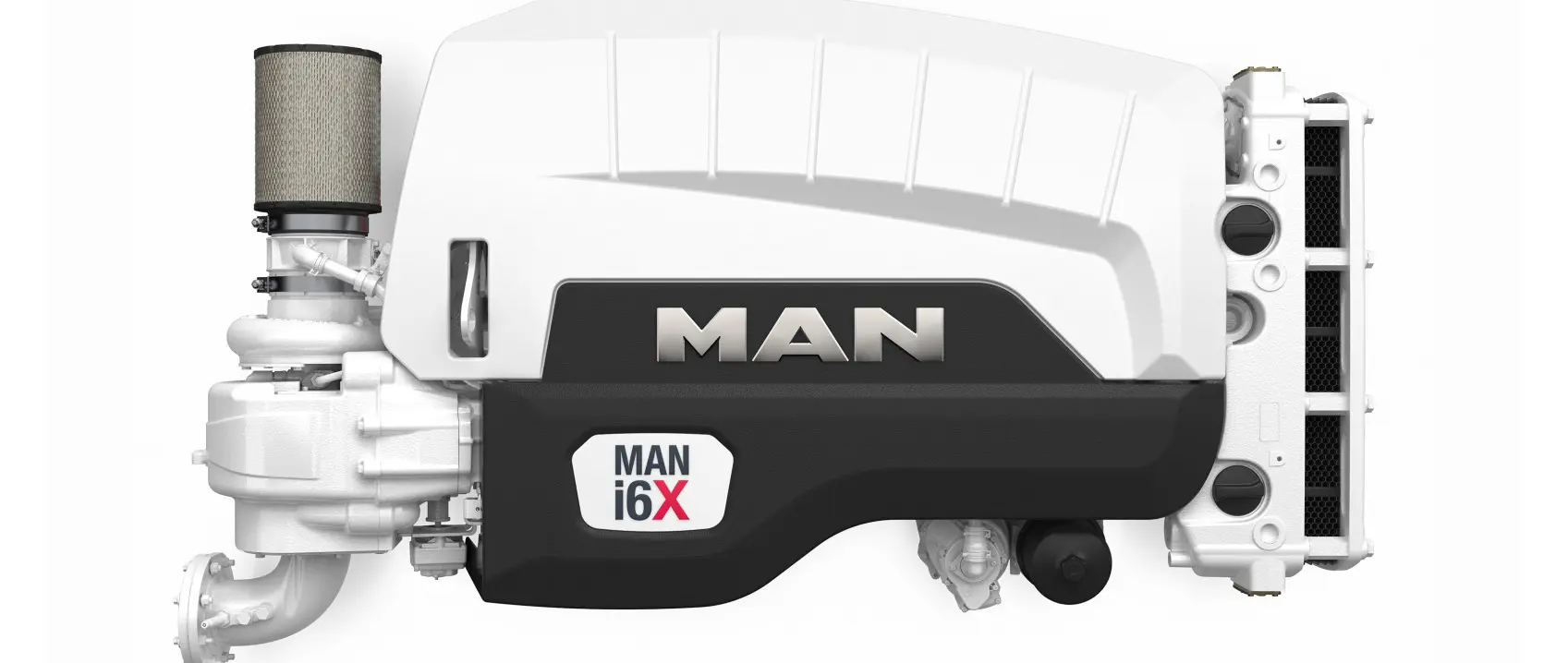
MAN Engines has shown its new 1,000hp i6X yacht engine at Cannes, extending its 12.4-litre six-cylinder platform ahead of production planned for 2028.
MAN Engines has brought its new MAN i6X yacht engine to the Cannes Yachting Festival, putting a 1,000 hp version of its in-line six-cylinder platform in front of builders and buyers during one of the year’s largest yacht shows. The engine was first announced on 27 July 2026, but its presentation at Cannes Yachting Festival 2026 gives the market a closer look at how MAN plans to extend its compact six-cylinder range into a higher-output class.
The i6X is rated at 1,000 hp, or 735 kW, from 12.4 litres, with a second 900 hp version also planned. MAN says serial availability is scheduled from the first quarter of 2028, so the Cannes appearance is best understood as an early technology and integration preview rather than an engine that builders can install immediately.
MAN has based the i6X on the technical platform behind its established D2676 and MAN i6 family rather than starting with a completely new architecture. That matters to yards and system integrators because common interfaces and a high proportion of shared components can reduce the redesign work normally associated with moving into a higher power band.
The new top rating of 1,000 hp sits above the existing MAN i6 outputs of 730, 800 and 850 hp, while the 900 hp i6X creates an intermediate step. According to MAN, the engine keeps almost the same external dimensions and customer interfaces as the existing i6, which is intended to make it easier to use the higher-output version in boat concepts already designed around the smaller platform.
The central engineering change is a new turbocharging concept that still uses a single-stage system. MAN says the arrangement is intended to deliver the higher output without the weight and complexity that can accompany multi-stage charging, while revised thermal management, intercooling and demand-driven oil cooling are designed to support stable operation at the increased load level.
Power density is not simply a headline figure for a yacht builder. Machinery-space volume, service access, exhaust routing, cooling systems, structural weight and the location of tanks and hotel systems all compete for space, so increasing output without making the engine package materially larger can give designers more flexibility in the general arrangement.
MAN quotes a power-to-weight ratio of about 0.8 hp per kilogram for the 1,000 hp i6X. The company also highlights maximum torque of 3,250 Nm and says the new charging system is intended to improve response in the lower speed range, which is relevant when a yacht accelerates onto plane, manoeuvres in confined water or needs rapid propulsion response in changing sea conditions.
The company is also positioning lower specific fuel consumption as part of the development objective, although real yacht fuel use will continue to depend on hull form, displacement, gearing, propeller selection, speed and operating profile. A more efficient engine cannot by itself make an inefficient vessel economical, but incremental reductions in fuel burn become significant across repeated cruising hours and multiple engines.
MAN says the i6X is being developed for the principal regulatory frameworks relevant to international yacht and sportfishing applications. The planned compliance package includes IMO Tier II, US EPA Tier III and the EU Recreational Craft Directive, allowing builders to consider the engine for projects intended to operate across different jurisdictions.
Emissions compliance remains an increasingly important part of machinery selection because engine-room design must take account not only of the engine itself but also of exhaust after-treatment where required, ventilation, heat rejection and future operating restrictions. For yachts that cruise widely, builders and owners increasingly look at the whole propulsion package rather than choosing an engine solely on maximum power.
That broader systems view also affects maintenance. By retaining familiar architecture and common components from the existing i6 family, MAN is arguing that the i6X can extend performance without forcing operators into an entirely unfamiliar service environment, although final maintenance intervals and lifecycle costs will only be clear when the production specification is released.
The engine’s appearance in Cannes from 8 to 13 September gives boatbuilders, naval architects and equipment integrators time to examine the package well before the 2028 production start. That lead time is useful because machinery decisions for new yacht models are often fixed long before the first hull reaches the water, particularly where engine beds, exhaust routes and cooling systems are integrated into a production platform.
For owners, the more important question will be where the i6X fits in the market once full production begins. The 900 hp and 1,000 hp ratings push MAN’s in-line six-cylinder offering into applications that might otherwise require a physically larger or heavier alternative, potentially making the engine attractive to performance-oriented motor yachts where weight and machinery-space efficiency are tightly controlled.
The Cannes presentation therefore marks a meaningful step even though deliveries remain some distance away. MAN is using a proven six-cylinder base to target more power, stronger low-speed response and easier integration, and the next test will be how builders incorporate the i6X into real yacht platforms as production specifications and first applications are confirmed.
The engine also illustrates a broader shift in yacht machinery development toward extracting more capability from established platforms instead of increasing cylinder count automatically. If the production version delivers the promised power density without a disproportionate penalty in cooling demand, noise or maintenance complexity, yards could have another route to higher performance without redesigning an entire machinery space around a larger block.
That will need to be tested in service rather than assumed from specifications alone. The most useful evidence will be the first completed yacht installations, where builders can measure acceleration, cruising fuel use, acoustic behaviour, thermal performance and maintenance access against the existing i6 and competing engines in the same power class.
As with any pre-production marine engine, final certification, installation manuals and builder experience will matter more than show specifications alone. Cannes gives the market an early view, but the production programme will determine whether the promised integration advantages translate cleanly into finished yachts.
Explore
Go deeper into the yachts, companies, events and destinations directly connected to this article.
Continue reading
Humphree has integrated a new HIG5 gyro with its fins and interceptors under one control system, claiming roll reduction of up to 95% in …
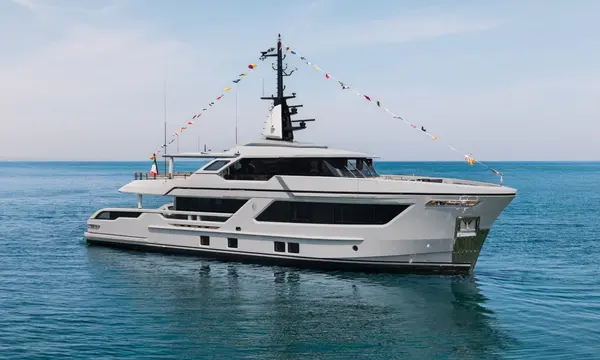
Cantiere delle Marche’s 31-metre RJ102 MON COEUR is part of the Cannes 2026 new-model lineup, bringing the yard’s RJ explorer DNA into its most …
Sanlorenzo’s 25.5-metre SHE has made her world premiere at the Cannes Yachting Festival 2026. The Heritage model combines 1960s-inspired Italian styling with Volvo Penta …
Columbus Yachts has brought the 38-metre Atlantique PRINCIPESSA CAPRICCIOSA to the Cannes Yachting Festival 2026 for her official show debut. The all-aluminium 299 GT …
Superyacht Guide
Continue into the wider Superyacht Guide.