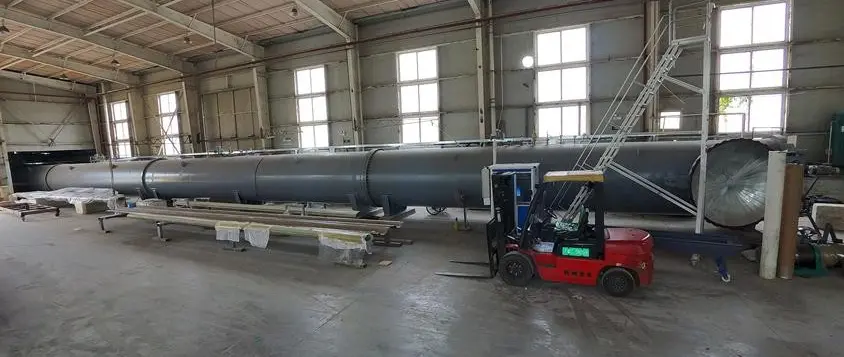
© McConaghy Boats original October 2026 press distribution photo showing actual 50-metre MC1 autoclave at facility, NOT a rendering. Source email 1452 and original SHA256 in McConaghy photo audit.
McConaghy reports a new operational 50m autoclave and dedicated clean room for its MC1 carbon-spar production, with implications for larger rigs.
McConaghy Boats reported in its September 2026 edition of *Inside McConaghy*, sent directly to Superyacht Guide in October, that its MC1 carbon-spar operation had installed a new 50-metre autoclave and completed a dedicated clean-room facility. The company described the equipment as operational and presented it as a major increase in the size of spars it can produce entirely in-house. The development is more than a routine machinery purchase. On large sailing yachts, a mast is an engineered structure with unusual constraints on mass, straightness, stiffness and reliability. A facility capable of controlled curing over this length can affect the range of projects that a composites business is equipped to bid for, although capacity should not be confused with proof of a completed fifty-metre spar.
An autoclave is a pressure vessel designed to apply specified temperature and pressure cycles to composite parts during manufacture. In a high-performance carbon structure, those conditions can support controlled resin consolidation and help manage void content and the quality of a cured laminate. The process is not simply about placing carbon fibre into an industrial oven. Tooling, material preparation, vacuum integrity, laminate sequence and precise control of the temperature through a long part all have to work together. The company's announcement gives the facility length but does not publish a completed mast's full engineering and test results. Such results would require their own evidence and should not be inferred from the autoclave's presence.
Increasing the available cure envelope can make longer one-piece components possible without requiring every structure to be divided into smaller sections. Connections between spar segments add design and manufacturing work, as they must transmit loads through local reinforced regions. But the practical advantage of a large autoclave depends on its usable internal dimensions, tooling and the ability to move and support the part during cure. A nominal fifty-metre facility does not automatically mean that a finished mast of identical length can be produced with every required fitting in place. The real benefit is a potentially broader manufacturing envelope for designers and naval architects to explore.
The newsletter also described the completion of a separate clean room intended for high-quality prepreg production. Prepreg carbon materials require strict handling because their resin systems can be sensitive to storage conditions, contamination and the length of time they spend outside specified temperature regimes. A clean workspace can support consistent lay-up and inspection, but its effectiveness depends on actual operating procedures, personnel training and documented quality checks. Production teams also need to coordinate how a part moves from the lay-up area to tooling, vacuum preparation and the autoclave. The new facility indicates an investment in that workflow; it is not, by itself, an independent quality certification.
MC1 is the carbon-rig manufacturing operation associated with McConaghy's wider composite business. The company is using its experience with grand-prix racing spars to position itself for larger projects, including the superyacht sector. That transition introduces different demands. A racing team may emphasise the finest possible performance margins and accept intensive technical support, whereas an owner of a long-range sailing yacht may also prioritise service intervals, access to inspections and predictable replacement arrangements. The new investment could make larger spar packages attractive, but a buyer still needs to understand the approved design specification, maintenance regime and independent technical oversight for each rig.
A significant theme of the same McConaghy communication is vertical integration. Its team is building a new Botin 41 racing yacht named SWING while working on the corresponding MC1 carbon rig. The builder says that having the hull, mast and associated components within the same engineering programme allows it to assemble and test-fit items before the finished boat leaves the yard. For a racing vessel, that can reduce commissioning adjustments at the dock. On a large sailing yacht, the potential coordination value is considerable, but it should not be exaggerated: specialist sailmakers, rigging suppliers, naval architects and classification bodies can still have independent responsibilities regardless of where a spar is made.
A mast's behaviour cannot be evaluated separately from the yacht supporting it. Shroud and stay loads, chainplates, rig foundations, sail shape, mast bend and dynamic accelerations all contribute to the structural environment. A larger autoclave may enable a cleaner production approach to a long component, but does not remove the need for a correctly engineered load path into the hull. A designer should understand the tolerances, material assumptions and inspection methods used to manufacture the spar. Owners comparing quotes should ask how responsibility is allocated among the mast designer, manufacturer, naval architect and shipyard. Clear accountability often matters more than the headline size of any single piece of equipment.
Pre-impregnated composite materials arrive with a controlled resin content intended for a particular cure process. They can help manufacturers achieve repeatable material characteristics, but the expected result depends on strict adherence to the approved manufacturing programme. A long part may see different thermal behaviour at different locations, and the tooling itself contributes to the heat cycle. Sensors and process monitoring therefore matter as much as the autoclave's dimensions. McConaghy's email does not disclose its exact cure specifications, equipment supplier or inspection statistics, so those details are not claimed here. The evidence supports the existence of a major production facility, not a blanket statement that it guarantees flawless spars.
MC1's facility does not represent a new commissioned superyacht or a completed sailing yacht delivery. A carbon mast could be destined for a racing boat, a custom cruising yacht, a refit or a replacement project. It would therefore be incorrect to add a fictitious fifty-metre yacht to the fleet database merely because a new piece of equipment can manufacture long rig components. The appropriate records are the McConaghy company profile, its technical capabilities and a dated original news article. When a particular named superyacht later receives a verified rig package, that separate vessel record can be updated with the actual contract and delivery information.
SWING is an example of the process at a smaller scale. McConaghy's original October message describes a yacht for a returning owner, designed by Botin Partners for inshore racing. The company is building the yacht and its carbon spars together and intends to pre-assemble and test-fit key components before delivery. This is the kind of integrated work that the group says it wants to expand. It does not mean SWING has been launched or raced successfully; the source depicts it under construction. That named yacht belongs in a smaller raceboat fleet rather than in the Superyacht Guide database, which has an editorial threshold of at least 24 metres.
The same issue describes the Sydney facility producing a pair of exceptionally large centreboards for a sailing-catamaran project associated with Echo Marine Group. The builder characterises the loads and manufacturing geometry as beyond conventional centreboard work. Centreboards are structurally different from a mast, yet both require a sophisticated understanding of carbon reinforcement and how a long composite component behaves under significant hydrodynamic or aerodynamic loads. The centreboard announcement provides evidence of the company's broader engineering ambitions, but it does not confirm the final yacht's length, completion status or identity. Those would need primary project documentation before any vessel is registered.
McConaghy also reported completing a new bow component for the Australian America's Cup programme in Sydney on a compressed, roughly two-month schedule. Racing campaigns work with relatively rapid design iterations, so the factory's ability to combine tooling, structural manufacture and inspection becomes commercially important. A yacht owner may not face the same deadline, but the transferable skills can include planning and tolerances. It would be misleading to extrapolate directly from a racing bow to an eighty-metre yacht mast: material structures, service lives and design rules differ. The source instead shows that the McConaghy group is working in several demanding composite fields simultaneously.
In the superyacht market, a long spar can require extensive coordination among the designer, yard and specialist manufacturers. A larger manufacturing envelope potentially gives more choice in how the component is segmented, assembled and inspected. It could also make certain customer schedules less dependent on outsourcing a particular cure step. However, none of those advantages is guaranteed for a specific new-build project until a proposal has been engineered, costed and checked for available capacity. Autoclave dimensions must also be considered alongside rig transport, installation, lifting and service after delivery. Large-scale manufacturing is one stage in a longer chain of professional obligations.
Manufacturing a long composite component and delivering it to the yacht are distinct problems. A finished mast may need special handling, route permissions, lifting equipment and storage before stepping. Transport risk can be significant for a highly optimised carbon structure, and installation has its own procedures and inspections. An owner evaluating a vendor should ask whether the quoted service covers not only engineering and curing but also transport protection, stepping, tensioning, mast instrumentation and later support. McConaghy's October release highlights its expanding integrated capability, but the exact scope of any individual project remains a contractual matter.
The original first-party company message says that the 50-metre autoclave and clean room are operational. The accompanying photograph shows substantial long industrial tooling inside a workshop and was sent directly from the company's corporate source. The image supports the existence of manufacturing equipment, but cannot prove a stated pressure rating, quality-assurance standard or delivered mast dimension. The corresponding photograph is registered with its original email ID, remote source URL and SHA-256 digest. This distinction matters in technical journalism because visual evidence often looks convincing even when a broader claim needs separate documentation. The article reports the maker's statement rather than representing itself as an independent facility inspection.
The investment signals McConaghy's intention to compete across a wider range of carbon construction projects, potentially including spars for large custom sailing yachts. It also reflects a broader movement toward integrating design, specialist materials and manufacturing under more coordinated programmes. That may reduce interface risk when the same organisation understands multiple pieces of a structure, but independent validation remains essential. Designers, captains and owners will want to see completed-project references, testing records, service support and clearly established responsibilities. The October announcement gives a credible starting point for those questions; it does not yet furnish the evidence needed to answer all of them.
The verified event is the company's reported installation and commissioning of a fifty-metre autoclave and dedicated clean-room facility for MC1 carbon-spar manufacture by September 2026. The same corporate newsletter connects that development with SWING's integrated race-yacht build, large composite centreboards and other advanced manufacturing projects. Superyacht Guide is recording the equipment investment as an engineering and shipyard capability story, not a superyacht launch and not proof of a particular mast delivery. The next useful evidence would be identifiable large-spar contracts, completed components, inspection records and subsequent commissioning on named yachts. Until then, the manufacturer's dated claims and the original workshop photograph remain the proper limits of the report.
Sources and provenance: McConaghy Boats original direct corporate *Inside McConaghy* email ID 1452, sent 6 October 2026; MC1 Spars company website; McConaghy official composite engineering and company information; McConaghy Botin 41 production-model information. The real MC1 facility photograph is from the first-party direct company newsletter with original URL and SHA-256 retained, and is not an AI-generated graphic. Technical process discussion is general explanatory context and not an independent audit of the facility.
© McConaghy Boats (original direct company press email, actual autoclave photograph)
Explore
Go deeper into the yachts, companies, events and destinations directly connected to this article.
Continue reading
Videoworks has issued technical details of its completed digital refit aboard the 60m CRN charter yacht ELENI, covering multi-zone audio, a 115-inch upper-deck screen …

SEA.AI has tested its machine-vision technology across multiple crewed and uncrewed vessel platforms during the REPMUS 2026 exercise in Portugal.

Floatist has launched a managed website product for charter fleet operators that displays live availability, equipment details and booking payments.
Inside the 32.82m Custom Line QUANT’s 2026 charter promotion, upgrades and original broker source, including an explicit sister-ship image warning.
Superyacht Guide
Continue into the wider Superyacht Guide.
Business opportunities · Superyacht Guide
Companies serving the superyacht market can discuss clearly identified advertising, sponsorship and business-profile opportunities. Commercial activity remains separate from independent editorial coverage.