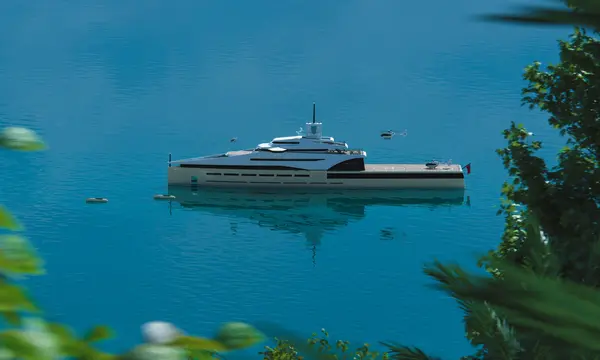
Alexander McDiarmid Details 130m GEx Four-Helicopter Concept
Alexander McDiarmid Design’s GEx proposes a 130m ice-class explorer with dual flight areas and below-deck helicopter hangars.
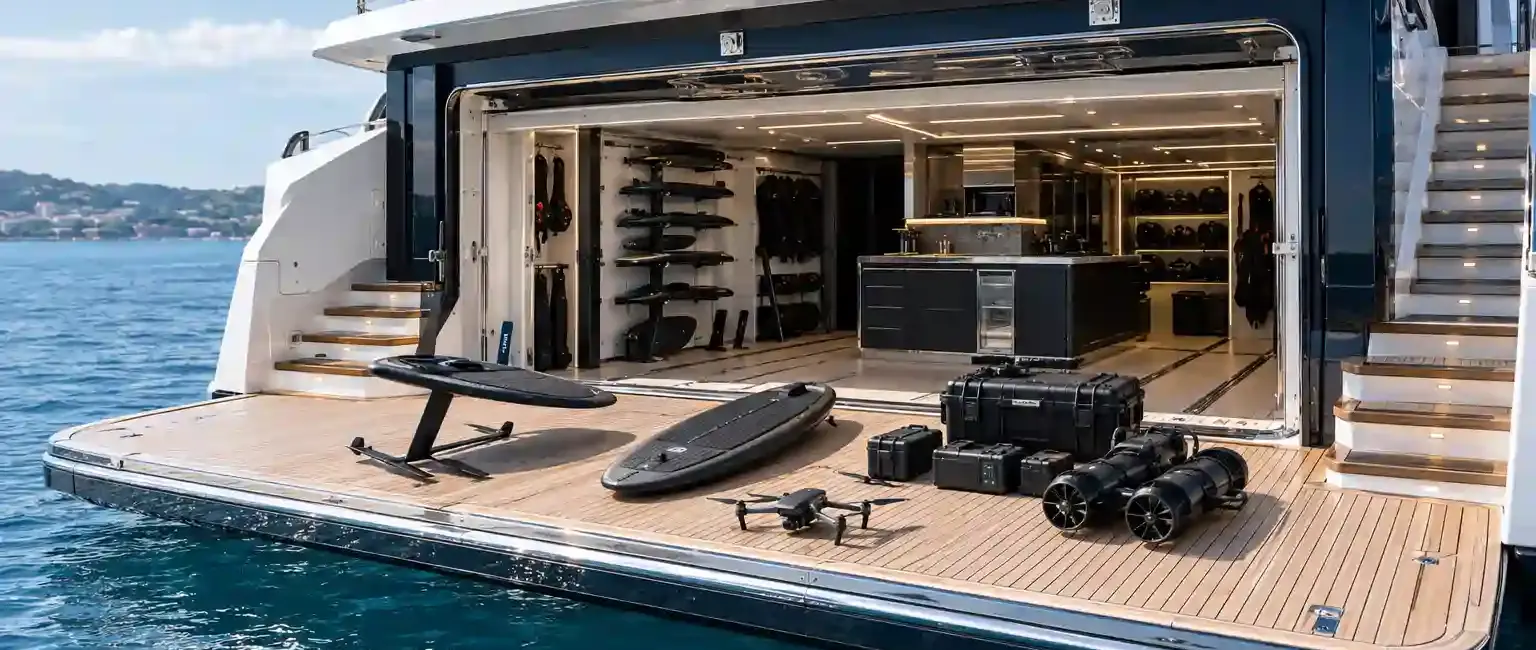
The modern superyacht toy garage is becoming a technical operations centre. Batteries, drones and personal submersibles are changing layouts, fire protection, power systems and launch equipment long before the yacht reaches the water.
The traditional superyacht tender garage was comparatively easy to understand. It needed enough volume for a tender, perhaps a pair of personal watercraft, diving equipment and a collection of boards, with doors large enough to launch everything and machinery strong enough to move it.
That brief has changed. E-foils bring substantial lithium-ion batteries into spaces that were never designed as charging rooms, drones add another layer of batteries, electronics and operational equipment, while personal submersibles can introduce several tonnes of concentrated weight together with dedicated launch, recovery and support systems.
The result is that the modern “toy garage” is becoming less like a storage locker and more like a specialised technical department. On the most ambitious yachts, what the owner wants to do once the yacht arrives may influence the general arrangement almost as much as where the owner wants to sleep.
Water toys have always consumed volume, but the problem used to be largely geometric. Designers had to fit tenders, jet skis, dive equipment and watersports gear into the available envelope while preserving machinery spaces, crew circulation and guest accommodation.
Modern equipment creates a different set of constraints because storage is only one part of the problem. Designers also have to consider electrical supply, battery charging, cooling, fire detection, ventilation, maintenance access and the route by which equipment moves from its stowed position to the water.
This becomes particularly important because the most valuable real estate on many large yachts is now concentrated around the stern. Beach clubs, pools, fold-down terraces and water-level lounges compete for exactly the lower-deck volume that was once an obvious place for tenders and toys.
Feadship's Project 1012 illustrates the resulting compromise. Its beach club occupies roughly a quarter of the lower deck, while the yacht uses a side-loading garage between the engine room and beach club for two 10-metre tenders, a ski boat and other water toys, allowing the stern itself to remain focused on the guest experience.
The modern garage therefore has to disappear architecturally while becoming more sophisticated technically. Designers are increasingly asked to preserve an uninterrupted beach-club experience on one side of the bulkhead while creating an efficient miniature workshop, charging station and launch facility on the other.
An e-foil looks simple on the dock: a board, mast, foil and electric propulsion system. Onboard a yacht, however, it is also a sizeable lithium-ion battery system that has to be charged, stored, handled and protected from damage.
Current Fliteboard equipment shows how quickly the numbers accumulate. Depending on model, removable Flitecell batteries weigh roughly 6 to 14.5 kilograms each, while boards can approach or exceed two metres in length and the propulsion assemblies introduce separate masts, wings and protective equipment that all need organised storage.
More importantly, the UK's Maritime and Coastguard Agency now explicitly identifies electric foils among the battery-powered craft being carried aboard large yachts. Its current MGN 681 guidance estimates typical e-foil battery capacities at around 1–5 kWh and says the risks associated with charging and stowage should, wherever possible, be considered early in yacht design and construction.
That moves e-foils beyond the level of an accessory added by the deck crew after delivery. A new yacht expected to carry several electric boards may need dedicated charging arrangements, temperature monitoring, fire detection, suitable ventilation and controlled battery storage designed into the garage from the beginning.
The MCA guidance is particularly significant because it recommends that electrically powered personal watercraft and their larger lithium-ion batteries be kept in suitably protected spaces. It addresses fire-resistant boundaries, charging cabinets, temperature monitoring, ventilation, electrical isolation and the ability to respond to thermal runaway without exposing crew unnecessarily.
In practical design terms, the “rack for the e-foils” can therefore become only the visible part of a much larger system. Behind it may sit protected battery lockers, power distribution, cooling and monitoring infrastructure that consumes weight and volume even when the boards themselves are in the water.
Drones present almost the opposite problem. The aircraft themselves can be remarkably compact, but a professional onboard drone operation quickly accumulates batteries, controllers, filters, spare propellers, charging hubs, tablets, cases and data-storage equipment.
A DJI Mavic 3 Pro, for example, weighs less than one kilogram and folds to approximately 231 by 98 by 95 millimetres. Its individual lithium-ion battery is rated at 77 Wh, meaning the drone itself is tiny compared with almost every conventional yacht toy.
That does not make the design issue disappear. A yacht may carry several aircraft and many battery packs so filming can continue while other packs recharge, and the onboard requirement becomes less about cubic metres of garage space than about organised electrical and electronic support.
The MCA's yacht guidance notes that even smaller lithium-ion batteries deserve attention when many are stored together, particularly once their aggregate capacity becomes significant. That is relevant to drones because an individual battery may be comparatively small while the combined inventory required for repeated filming operations is much larger.
There is also an operational difference. E-foils normally travel from garage to swim platform and then into the water, whereas drones may move between a protected equipment locker, an editing or data station and whichever exterior deck offers an appropriate launch and recovery area.
That encourages a more distributed design approach. The drone itself does not justify a large garage, but the yacht benefits from dry protected storage, convenient charging, safe battery handling and a workflow that keeps delicate electronics away from wet watersports equipment.
On expedition yachts, drones can also become part of the vessel's wider observation and documentation capability rather than simply entertainment equipment. Once that happens, the distinction between “toy”, camera system and operational equipment starts to disappear.
A personal submersible belongs to a completely different category. Even the models deliberately engineered for superyacht use can weigh several tonnes, making their effect on the host yacht fundamentally different from that of an e-foil or drone.
Triton's compact 660/2 SPII weighs about 2,500 kilograms and is specifically designed for integration with standard tender garages, cranes and davits. Its larger 1650/3 Low Profile weighs around 4,000 kilograms, while the six-person Triton 3300/6 reaches approximately 11,000 kilograms.
At that point, “where do we store the toy?” becomes a naval-architecture question. Deck loading, structural reinforcement, crane capacity, handling height, clearances, securing points and weight distribution all become part of the integration exercise.
Launch and recovery are particularly important because a submersible cannot simply be pushed across a swim platform. Triton Submarines says its integration work considers the storage environment, launch and recovery systems, battery management, tracking systems, compressors, oxygen-support equipment and the electrical services required to operate and maintain the vehicle.
The equipment itself is being designed around yacht constraints. Triton's 3300/6, for example, was deliberately configured with a lower overall height and lower-mounted equipment so that it can work with the dual-gantry tender-lift arrangements commonly found in superyacht garages.
This is a significant reversal in the design relationship. Instead of the yacht designer simply allocating a box for an existing object, the yacht and submersible manufacturers increasingly have to consider one another's geometry from the beginning.
Large toys also change the sequence of operations around the yacht. A garage is successful only if equipment can be launched safely, efficiently and repeatedly in the sea conditions for which the vessel is intended.
A compact submersible may be compatible with a conventional tender crane, while larger systems require specialised gantries, A-frames or heavy deck cranes. Triton's vessel-integration work includes not just the lifting appliance but securing arrangements, maintenance areas and the support systems required between dives.
The same logic applies on a smaller scale to electric boards. Crew need enough working room to install foils, move batteries, inspect equipment and carry wet components without blocking the tender launch path or contaminating a clean technical area with salt water.
The garage therefore begins to develop zones. One part may be wet and designed for rapid launch, another may contain battery storage and charging, while tools, spare components and delicate electronics occupy protected areas farther from spray and guest traffic.
For designers, circulation becomes almost as important as storage capacity. A beautifully packed garage that requires six pieces of equipment to be moved before the owner can use the seventh is not an efficient garage at all.
The rise of electrically powered toys is perhaps the most consequential change because it affects yachts of almost every size, not only explorer vessels carrying submersibles. Battery safety is therefore becoming a mainstream yacht-design issue rather than a specialist concern confined to expedition vessels.
MCA guidance published in its current amended form states that new yacht designs should make provision for safe charging and stowage of lithium-ion powered craft. It recommends dedicated spaces, appropriate fire protection, detection, suppression, temperature control and procedures for batteries and vehicles above the relevant capacity thresholds.
The guidance also warns against assuming that a garage designed for petrol-powered craft automatically addresses the different behaviour of lithium-ion batteries. Thermal runaway, re-ignition and the generation of heat and gases create a different emergency problem, even if an electric craft is not inherently more likely to catch fire than its petrol-powered predecessor.
That can affect boundaries, ventilation routes, alarm integration and the position of the garage relative to machinery and electrical spaces. It can also influence something as basic as where crew are permitted to plug in a battery charger.
For existing yachts, the problem is harder because many garages were designed before e-foils and high-capacity electric toys became normal owner requests. Retrofitting appropriate lockers, monitoring and charging infrastructure into a space already full of tenders and equipment can become a surprisingly substantial refit project.
Eventually there is a point at which fitting everything aboard the mothership starts to damage the yacht's primary purpose. Every additional crane, garage, workshop or equipment room occupies volume that could otherwise become accommodation, crew space, wellness facilities or guest areas.
This is one reason yacht-support vessels have developed into a distinct part of the market. Damen Yachting's current Yacht Support 53 is designed specifically to add capacity for crew, tenders, toys and specialist equipment alongside a mothership, while recent examples use heavy cranes and large working decks for equipment that would be difficult to integrate elegantly into the main yacht.
Damen's YS53 EMOTIONAL, for example, carries a 15-tonne crane and provides additional logistical and equipment capacity alongside its associated yacht. The principle is straightforward: moving operational hardware onto a support vessel can allow the mothership's decks and internal volume to remain focused on the owner's accommodation and leisure spaces.
That does not mean every ambitious toy inventory requires another ship. It does show how far the original tender-garage problem has developed, because an owner's equipment programme can now be large enough to influence whether the yacht is designed as one vessel or as part of a two-vessel fleet.
The important change is that toys are moving earlier in the design process. Asking what the owner wants to carry after the general arrangement has been fixed can now produce compromises that are expensive, inconvenient or, in the case of battery equipment, difficult to reconcile with modern safety guidance.
A designer therefore needs more than a list saying “two tenders and water toys.” The useful questions are which toys, how many batteries, whether those batteries are removable, how quickly equipment needs to be recharged, whether drones are used casually or intensively, and whether a submersible is a future possibility even if it is not ordered with the yacht.
Those answers influence door dimensions, overhead clearance, crane capacity, electrical loads, locker design, ventilation, structural weight and crew workflow. They can determine whether the garage sits aft, amidships or forward and whether a conventional enclosed garage is preferable to an open working deck.
They can even affect the visual design of the yacht. Large hull doors, side-launch arrangements and concealed cranes have to be incorporated without interrupting exterior lines, while the continued expansion of beach clubs pushes working spaces farther away from the stern.
The modern yacht toy programme says something broader about how owners use large yachts. The emphasis has moved from carrying a few recreational accessories toward carrying equipment that allows guests to travel above, across and beneath the water around them.
E-foils extend the immediate watersports environment, drones change how a voyage can be seen and recorded, and personal submersibles can open an entirely different layer of the ocean. Each occupies a radically different amount of space, but all three demand infrastructure that previous generations of yacht designers could largely ignore.
That is why the next generation of toy garages will probably be judged less by the number of objects visible when the door opens and more by how intelligently the systems behind them have been integrated. The best garage will charge, protect, launch, recover and maintain its equipment without intruding on the guest experience or creating unnecessary work for the crew.
In that sense, the toy garage is no longer a secondary compartment hidden behind the hull side. It is becoming one of the places where an owner's ambitions are translated most directly into the engineering and architecture of the yacht.
Continue reading
Alexander McDiarmid Design’s GEx proposes a 130m ice-class explorer with dual flight areas and below-deck helicopter hangars.

Hydro Tec founder Sergio Cutolo was recognised by Confindustria Nautica in June 2026 for four decades of naval architecture and explorer-yacht design.
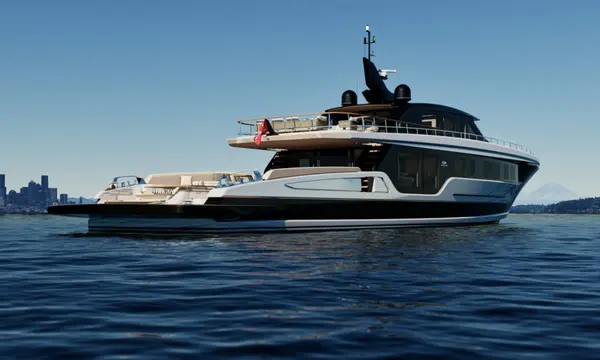
Delta Marine’s proposed 125-foot Longtail brings Roberto Curtò’s sculptural styling to a Seattle-built custom-yacht concept with a large aft pool and outdoor living space.
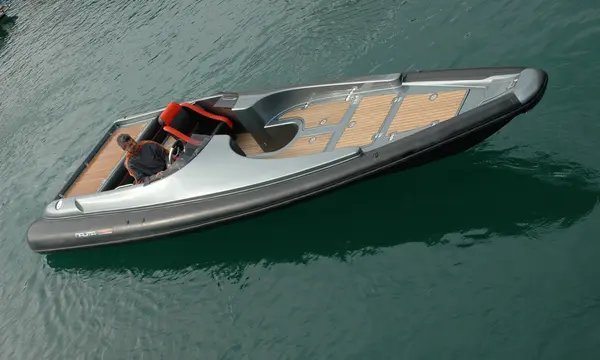
Naumatec's redesigned 7.98m Freccia 800 combines sports-tender performance with a more relaxed guest layout, after its presentation at the 2026 Monaco Yacht Show.
Superyacht Guide
Continue into the wider Superyacht Guide.
Business opportunities · Superyacht Guide
Companies serving the superyacht market can discuss clearly identified advertising, sponsorship and business-profile opportunities. Commercial activity remains separate from independent editorial coverage.