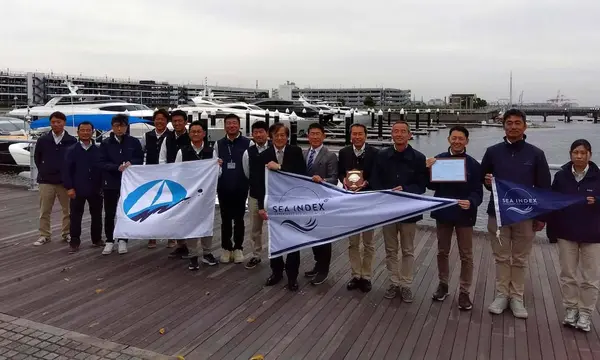
SEA Index Adds 87 Japanese Marinas in First Asia-Pacific Alliance
SEA Index has partnered with the Japan Marina & Beach Association, adding 87 marinas and extending its environmental-assessment network into Asia-Pacific for the first …
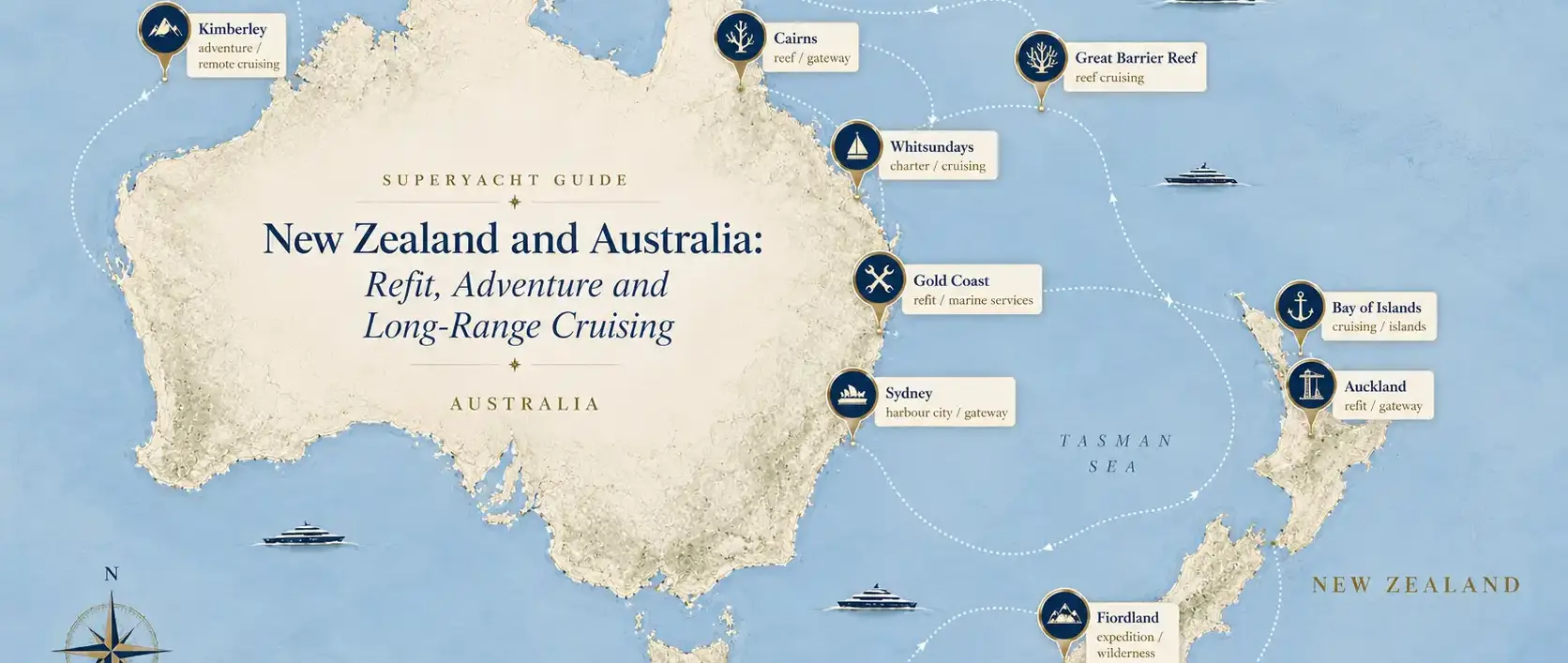
New Zealand and Australia combine serious superyacht refit capability with some of the world's most ambitious long-range cruising. For yachts prepared for the distances, biosecurity rules and technical demands, the two countries can form one compelling South Pacific programme.
For a long-range superyacht, New Zealand and Australia make more sense when viewed as part of the same operating region rather than as two isolated destinations. Both offer exceptional cruising, but their greater strategic value lies in combining remote itineraries with established marine infrastructure, allowing a yacht to move between adventure cruising, maintenance and refit without immediately returning to Europe or the United States.
The trade-off is distance. Auckland, the Bay of Islands, Fiordland, Sydney, the Gold Coast, the Great Barrier Reef and the Kimberley are separated by passages large enough to define an entire season, so an Australasian programme has to be built around weather windows, fuel range, technical readiness, crew endurance and the formalities involved in entering two countries with demanding border and biosecurity regimes.
That makes the region particularly attractive to yachts designed to travel rather than simply relocate between established charter centres. Owners prepared to stay in the South Pacific for months can combine refit, exploration and owner use into one coherent programme, turning the cost of a major repositioning voyage into access to a much larger cruising area.
New Zealand's strength is the unusually close relationship between its cruising grounds and its marine industry. NZ Marine's current 2025–2026 Destination & Cruising New Zealand publication is specifically aimed at visiting superyachts and cruising yachts, presenting the country as a destination both for cruising and for refit work while providing information on regulations and marine-service companies.
That combination matters after a long Pacific season. A yacht arriving from Fiji, French Polynesia or farther north may have accumulated engineering defects, cosmetic work, survey items and deferred maintenance, so routing into New Zealand can turn the end of one cruising phase directly into a planned technical period.
Auckland remains the principal gateway for many visiting superyachts, but the country's support network extends beyond one port. NZ Marine says its current destination guide includes more than 100 member companies supplying products and services to visiting yachts, while recent infrastructure investment has expanded refit, maintenance and berthage capacity in Auckland, Northland and the Bay of Plenty.
The attraction is therefore not simply that a yacht can be repaired in New Zealand. It is that the technical work can form part of the cruising programme, allowing the vessel to restore its engineering and cosmetic condition without sacrificing an entire season to a separate repositioning voyage.
New Zealand's arrival regime rewards preparation. The Ministry for Primary Industries says most yachts and recreational vessels fall within the long-stay category of its Craft Risk Management Standard when they intend to remain for 29 days or more, or when they plan to visit locations that are not approved Places of First Arrival.
Long-stay vessels need evidence that the hull and niche areas meet New Zealand's biofouling requirements. MPI identifies inspection and removal of biofouling within 30 days before arrival as one route to compliance, while yachts arriving for refit can instead have a confirmed booking at an MPI-approved haul-out facility and enter that facility within 24 hours of arrival for cleaning.
This turns what might look like an administrative requirement into part of the technical planning for the voyage. Antifouling records, photographs, inspection reports, cleaning documentation and maintenance records can all become relevant evidence, and MPI warns that vessels arriving without adequate proof may face underwater inspection, haul-out directions or other measures at the owner's expense.
For a yacht already planning substantial work, there is an obvious operational logic in coordinating biofouling compliance with the refit period. The same haul-out that satisfies an arrival requirement can become the starting point for engineering work, coatings, underwater maintenance and other scheduled tasks before the yacht returns to cruising.
New Zealand offers unusually varied cruising within one national programme. The northern part of the country gives yachts relatively easy access to marine services and provisioning, while the geography becomes progressively more demanding as the vessel moves toward the South Island and the Southern Ocean.
The Bay of Islands and northern New Zealand can work naturally around Auckland and the country's main yacht-support network, allowing guest cruising to take place without moving too far from technical capability. Farther south, the emphasis shifts toward self-sufficiency as the yacht enters landscapes where immediate shore support becomes less important than tenders, communications, stores, freshwater production and engineering redundancy.
Fiordland represents the clearest expression of that change. Deep sounds, steep mountain scenery and isolated anchorages place the yacht itself at the centre of the experience, rather than treating it as accommodation beside a developed resort or marina.
That variety is one of the reasons New Zealand suits long-range yachts particularly well. A single season can combine a major technical period, metropolitan access, sheltered northern cruising and remote southern exploration without forcing the owner to choose between infrastructure and adventure.
Across the Tasman Sea, Australia offers a much larger coastline and a marine industry capable of supporting significant superyacht projects. Superyacht Australia continues to highlight refit work on the Gold Coast and around Brisbane, where large projects can involve engineering, interiors, coatings, structural modifications and other substantial technical packages.
Australian customs rules also recognise repair and refit as a particular case for visiting superyachts. Australian Border Force states that concessions may be available when repairs or refits are undertaken in Australia, potentially removing requirements for duties and GST in qualifying circumstances, while the local repair and refit industry may also be able to claim GST exemption for eligible goods and services.
Those provisions do not mean every yacht automatically receives the same tax treatment, because the circumstances of the visit, use of the yacht and structure of the work still matter. They do, however, underline the fact that Australia is actively capable of functioning as a refit destination rather than merely as somewhere a yacht passes through between ocean passages.
The eastern seaboard also makes technical planning easier before a yacht heads into more remote Australian cruising. Completing preventive maintenance near established marine centres can materially reduce the operational risk of moving north toward tropical reef areas or west toward coastlines where immediate specialist support becomes much harder to obtain.
The Great Barrier Reef may be one of Australia's most recognisable cruising areas, but superyacht access is governed by rules that depend on vessel size, operating status and location. The Great Barrier Reef Marine Park Authority distinguishes recreational superyachts from commercial operations and applies different requirements to vessels according to their overall length.
For recreational superyachts more than 35 metres but under 70 metres, the Authority specifies designated anchorages with bookings in relevant areas and requires operators to consider zoning, special management areas and site-specific restrictions. Vessels over 50 metres must participate in Reef VTS, while recreational superyachts of at least 70 metres must carry a licensed pilot in designated compulsory-pilotage areas.
These are practical itinerary constraints rather than minor administrative details. A captain planning guest movements around the Whitsundays or Cairns needs to know whether the yacht itself can access an area, whether a designated anchorage requires booking and whether tenders offer the more appropriate means of reaching a location.
That degree of planning is consistent with the wider Australasian model. The cruising can be extraordinary, but the yacht gains much more from it when navigation, permits, technical condition and logistics are resolved before the owner's itinerary is fixed.
Western Australia's Kimberley coast offers a very different type of adventure. Tourism Australia describes a coastline of rugged sandstone, secluded bays, waterfalls, ancient rock art and powerful tidal features, with many areas effectively accessible from the sea rather than through an established coastal road network.
For a superyacht, that isolation is precisely the attraction, but it changes the operating calculation. Fuel reserves, stores, medical preparation, communications, spare parts, tender reliability and the ability of the engineering department to diagnose and manage faults onboard become more important as the vessel moves away from the major service centres.
A small problem that would merely disrupt an afternoon near a major marina can become itinerary-defining when the yacht is operating several days from its preferred technical support. This is why refit and adventure are not really separate subjects in this part of the world: the quality of the maintenance programme directly affects how confidently the yacht can use the remote cruising grounds.
Tourism Australia identifies April to October as the general Kimberley cruising season, with the early part of that period particularly associated with waterfalls following the wet season. For a yacht operating internationally, however, the Kimberley dates also need to fit the larger annual programme, including Australian tropical weather, New Zealand cruising conditions and the passages linking the two countries.
Australia's border formalities also have to be built into the passage plan. The Department of Agriculture, Fisheries and Forestry requires non-commercial vessels, including private yachts and superyachts, to provide a pre-arrival report before reaching Australian territory.
A significant procedural change took effect on 27 February 2026, when pre-arrival reports for non-commercial vessels became mandatory in written electronic form through the designated web portal. The report must generally be submitted before leaving the last international port, no earlier than 90 days before arrival and at least 12 hours before reaching the Australian first point of entry.
The information required goes well beyond the vessel's name and arrival time. DAFF's current guidance includes the intended voyage, past travel history, goods onboard, travellers, waste arrangements and information about vessel cleaning and biofouling management, making technical records part of the arrival process as well as the yacht's maintenance system.
For a captain approaching Australia after an ocean passage, that means customs and biosecurity cannot be treated as paperwork to solve after entering port. Arrival planning has to sit alongside berth arrangements, crew documentation, provisioning and the preparations needed before normal guest operations can begin.
Australia and New Zealand may be neighbours on a world map, but a superyacht programme cannot treat the Tasman Sea as a short transfer between adjacent cruising grounds. The crossing is a substantial offshore passage, and weather, sea state, machinery readiness, fuel, crew rest and the choice of departure and arrival ports all influence when it makes sense to move.
That distance is also what makes the two countries complementary. A yacht can complete a New Zealand refit and cruise locally before heading toward eastern Australia, or use an Australian technical period to prepare for New Zealand and the wider South Pacific.
The strongest programme gives that crossing an operational purpose beyond simply collecting another destination. Refit dates, owner schedules, crew rotation, seasonal conditions and the next remote cruising objective should determine whether and when the yacht moves east or west.
Seen in that way, Australia and New Zealand are not a single itinerary but two major operating bases connected by a serious ocean leg. The yacht moves between them when doing so improves the wider programme rather than because geography makes the crossing inevitable.
Australasia exposes the difference between a yacht that can make a long passage and one that is genuinely comfortable operating far from dense shore support. Range is important, but so are redundancy, refrigeration, freshwater production, communications, storage, workshop facilities, tender capability and the crew's ability to diagnose and repair systems independently.
Those qualities become much more visible when a yacht leaves Auckland or the Gold Coast for Fiordland, offshore reef systems or the Kimberley. The farther the itinerary moves from established service centres, the more the yacht itself has to function simultaneously as a hotel, transport system, engineering base and emergency reserve.
For owners, this can change the definition of luxury. In established Mediterranean destinations luxury often involves immediate access to restaurants, airports and services ashore, whereas in remote Australia and New Zealand it can mean reaching an isolated anchorage with very little infrastructure while preserving exactly the comfort, reliability and flexibility expected from a major yacht.
That is why technically capable explorer yachts are naturally suited to the region, but conventional displacement yachts can also operate successfully when their programmes are realistic. The essential question is less about styling or marketing category than whether the yacht, crew and support plan can sustain the distances involved.
The strongest reason to combine New Zealand and Australia is therefore not convenience. The region requires substantial positioning passages, disciplined border preparation and an acceptance that some of the best cruising grounds lie far from the largest technical facilities, but those same characteristics allow owners to use a yacht as a genuinely independent platform for travel.
New Zealand provides a comparatively concentrated mixture of serious marine services and diverse cruising, while Australia's enormous coastline adds major refit centres, the Great Barrier Reef and expedition territory such as the Kimberley. Together they create enough technical depth to support an extended South Pacific programme without making every significant maintenance requirement a reason to send the yacht back to Europe or the United States.
For a yacht prepared to stay in the region long enough, refit and adventure do not compete for time. They become different phases of the same programme, with technical preparation enabling the remote cruising and long-range operation that make the journey to Australia and New Zealand worthwhile.
Continue reading
SEA Index has partnered with the Japan Marina & Beach Association, adding 87 marinas and extending its environmental-assessment network into Asia-Pacific for the first …
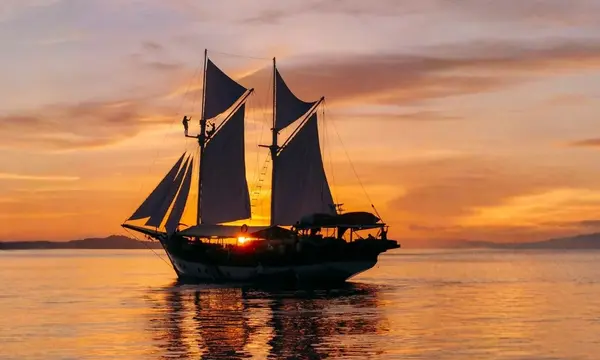
Bernard Gallay Yacht Brokerage promotes five yachts for Raja Ampat and Komodo-Bali itineraries, with weekly charter rates starting at $32,550 plus ALL.
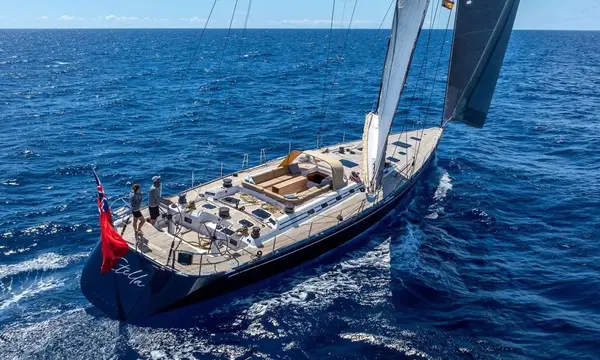
The 24.89m Swan 82 FD STELLA OF RORC has announced a Mediterranean charter programme spanning the Balearics, southern France and the America's Cup in …
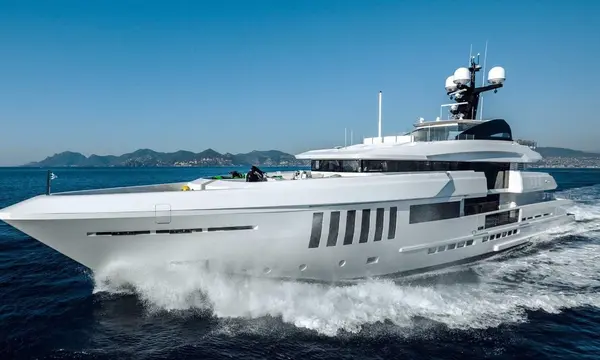
The 49.9-metre Admiral OURANOS is advertising an extra charter day for selected Greece bookings in May 2027, subject to a December 2026 signing deadline …
Superyacht Guide
Continue into the wider Superyacht Guide.
Business opportunities · Superyacht Guide
Companies serving the superyacht market can discuss clearly identified advertising, sponsorship and business-profile opportunities. Commercial activity remains separate from independent editorial coverage.