Opacmare Puts VIPER 1181 Telescopic Gangway Engineering in Focus at METSTRADE
By Superyacht Guide Newsroom · Edited by Superyacht Guide Newsroom
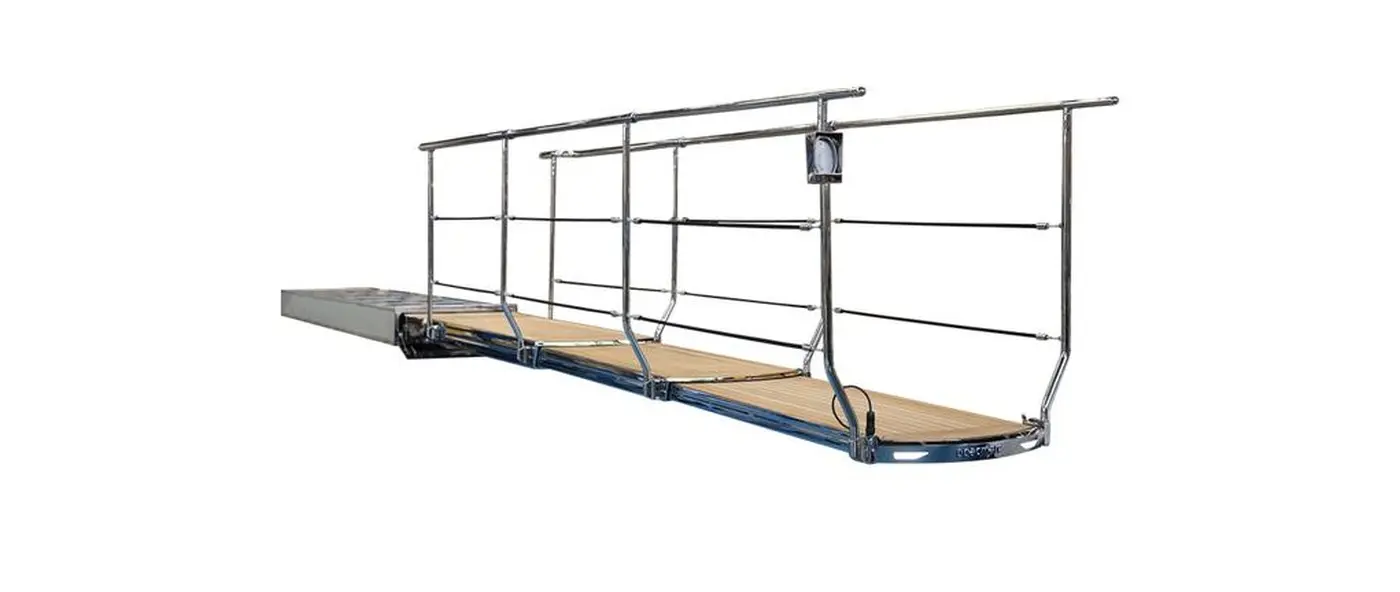
Opacmare VIPER 1181 telescopic yacht box gangway original manufacturer product photograph METSTRADE
Opacmare details VIPER 1181 stainless-steel telescopic gangways with hydraulic actuation, multiple sections and a 150kg boarding limit at METSTRADE for crews.
Italian marine-equipment manufacturer Opacmare is presenting the VIPER 1181 telescopic box gangway in the METSTRADE 2026 Superyacht Zone catalogue, offering owners and shipyards a detailed example of how boarding hardware affects a yacht's safety, design and everyday operation. The official product listing describes a stainless-steel gangway with one, two or three telescopic sections, hydraulic operation and manual or automatic stanchions depending on the version. It specifies a maximum boarding allowance of 150 kilograms, while noting that some models have separately defined capacities for lifting a tender or jet ski. Those are important distinctions for designers and crew planning how an arrangement will actually be used. The exhibition presentation does not claim that the VIPER 1181 was newly launched this year; the editorial interest is in its documented configuration and the issues raised by a sophisticated boarding system.
A passarelle may look like a simple link between a yacht's aft deck and the quay, but its function changes constantly with tides, swell, berth geometry and the vessel's motion. On many superyachts, boarding also takes place while crew handle luggage, catering or other equipment, sometimes alongside delicate guest movements. A gangway therefore has to be structurally appropriate, stable, easy to inspect and straightforward to operate. The manufacturer's telescopic design addresses the physical challenge of bridging changing distances while allowing the equipment to be stowed discreetly when not in use. Yet the final installation depends on the vessel's design and the range of berths it is likely to visit. A long extension can be attractive in a drawing without necessarily providing a safe angle or sensible landing point at every marina.
Opacmare describes the VIPER 1181 as a telescopic box gangway using AISI 316L stainless steel. The catalogue identifies configurations with one, two or three extending sections, with the number of sections and stanchion arrangement varying by model and length. Swing and extension are moved by hydraulic actuators under an electronic control unit. Different lengths and box heights are available, so the equipment cannot be specified solely by naming the product family. The naval architect needs the exact variant and its installation drawing, including maximum projection, operating angle and stowage requirements. A full specification must also account for how the platform is supported within the yacht's structure and how it interfaces with the stern. Not every variation advertised in a product family should be presumed available in every hull geometry.
The official METSTRADE listing states a maximum boarding allowance of 150 kilograms. That figure should be treated as an explicit manufacturer limit requiring clarification for the selected model and configuration, not as a general indication that any weight can be carried so long as the gangway appears rigid. A crew member assisting a guest, for example, might bring the combined load close to or above the published boarding allowance, depending on the actual circumstances. Similarly, wheeled luggage or equipment can impose concentrated and moving loads different from a person walking carefully across the deck. Operators must follow the manufacturer's documented loading rules, operating conditions and any restrictions associated with the extension angle. The captain should ensure that the usage policy is understandable to every crew member, not hidden in a technical manual consulted only after a fault.
Opacmare also states that certain VIPER configurations can lift a tender or jet ski, with differing capacities according to model. This should not be conflated with the 150-kilogram boarding allowance or treated as a universal feature of all VIPER 1181 gangways. A lifting function has its own loads, rigging arrangements, procedures and requirements. Before an owner specifies dual-use equipment, the yard should obtain documented confirmation of the exact certified lifting arrangement, its limitations and its relationship to the vessel's tender plan. The tender's wet weight, centre of gravity, lifting points and conditions during deployment are all relevant. A piece of equipment that is adequate for pedestrian access might not be suitable for the owner's chosen watercraft. Marketing shorthand about multi-function deck equipment must be translated into clear engineering boundaries.
Hydraulic actuation allows equipment to move with substantial force, making control design and personnel protection central to the installation. According to the official product description, VIPER 1181 swing and extension are performed by hydraulic actuators managed by an electronic control unit. That arrangement offers controlled movement but requires attention to power supply, hydraulic fluid integrity, hoses, mechanical stops and control permissions. A crew member operating the gangway needs a reliable view of the surrounding deck and quay, including areas where hands or feet could become trapped. The installed system should have clearly understood emergency-stop and recovery procedures where applicable under its design. The METSTRADE listing does not provide every safety interlock or failure mode, so these must be checked against the selected unit's technical documentation rather than guessed from the product photograph.
The catalogue notes manual or automatic stanchions depending on the model. Handrails and stanchions are not merely decorative details on a large yacht: they influence how secure a guest feels when stepping aboard, especially in poor light or when the vessel is moving slightly at the berth. Automatic stanchions can simplify preparation, but they also add mechanisms that must be inspected and maintained. A manual arrangement may be easier to understand, yet it can require more direct crew handling. The appropriate choice depends on the available space, operating routine and the people likely to use the gangway. If a yacht regularly hosts older guests or people with mobility limitations, the full boarding arrangement should be assessed for real accessibility rather than assuming that a premium telescopic gangway alone resolves every obstacle.
A retractable box gangway is typically considered early in the design of the stern or aft deck because its housing can compete with structural members, machinery spaces, tender garages and service routes. The exact VIPER model must fit within the available envelope and allow maintenance access. The naval architect must also assess support reactions, deck penetration details and the effect of the equipment's mass on the surrounding structure. If a yacht is being refitted, the challenge may be greater because the stern was designed around an earlier arrangement or no permanent gangway at all. A compact mechanism may still need room for the hydraulic power and electrical connections that serve it. The project should not reach an advanced stage before these interfaces are checked against real installation drawings and a complete equipment schedule.
A gangway does not operate in isolation from the yacht's lines, fenders and the relative movement between boat and shore. A stern-to berth may leave changing separation between the transom and quay as the yacht moves. An extended gangway may be exposed to a different set of movements at low tide, and a busy marina can introduce the possibility of contact with passing craft or shoreside equipment. Crew need procedures for monitoring the landing point, controlling access and withdrawing the gangway when circumstances make continued use unsafe. The presence of powered swing and extension should not encourage operators to chase a moving quay with the mechanism while guests are crossing. Technical manuals, mooring plans and captain-led risk assessments should define a sensible operating envelope for the chosen berth and weather conditions.
Stainless steel is widely used aboard yachts for its durability and appearance, but it is not maintenance-free. Crevice corrosion, salt deposits, mechanical wear and damage to moving components remain possible. Telescopic sections require attention to guides and bearing surfaces, while hydraulics depend on hose condition and system cleanliness. Stanchion mechanisms may also need regular adjustment or lubrication. A yacht's maintenance programme should reflect the manufacturer's recommended inspections and the actual frequency of operation, particularly in charter service where repeated guest transfers can generate substantial use. Owners should ask whether the selected model can be supported in the vessel's principal cruising areas and whether common replacement parts can be supplied without lengthy delays. Maintenance access built into the installation is usually less expensive than dismantling surrounding joinery later.
A high-quality boarding system can still be operated unsafely if its procedures are unclear. Guests may be distracted by luggage, children or a view of the water, while the crew may be balancing security, hospitality and mooring duties. The gangway should be prepared before people approach it, and the person responsible for operating the controls should be clearly identified. Communication between the quay and deck can be especially important where the operator cannot see both ends of the gangway. Appropriate lighting, non-slip surfaces and a stable landing arrangement deserve as much attention as the polished finish of the equipment. The objective is not merely to present a smart entrance but to provide a predictable route aboard for every visitor. Training should include what to do if the gangway stops or needs to be recovered during a malfunction.
An exhibition model can show the movement of telescoping sections, but it cannot demonstrate every angle and distance that a completed yacht will encounter. Owners should insist on documented acceptance testing of the actual installation, including controlled extension and retraction, relevant safety devices, stanchion operation and the behaviour of the hydraulic system. Testing should also confirm that the equipment fits its housing and can be serviced without damaging nearby fittings. A successful deckside trial at one berth is useful, but crews should know how to evaluate a different quay arrangement without exceeding the manufacturer's limits. If optional lifting functions are included, those should be commissioned and documented under their separate approved procedures. There is no substitute for a vessel-specific handover in which officers can demonstrate that they understand both normal operation and practical limitations.
Opacmare's METSTRADE 2026 VIPER 1181 listing is a reminder that some of a superyacht's most important equipment is used for only a few minutes at a time. A gangway may not attract the same attention as a beach club or a panoramic saloon, yet nearly every guest must rely on it when embarking or disembarking. The published product information offers useful distinctions: AISI 316L construction, multiple telescopic configurations, hydraulic swing and extension, optional stanchion mechanisms and a stated boarding allowance of 150 kilograms. It also draws a boundary between ordinary boarding and the separate lifting capability found on some models. For a prospective buyer or refit team, the next step is to translate those advertised characteristics into an installation drawing, a documented safe operating envelope, crew procedures and a sustainable maintenance programme. That is how an attractive piece of marine hardware becomes a reliable part of the yacht's daily service.
Primary source: Opacmare Spa — official METSTRADE 2026 BOX GANGWAYS VIPER 1181 product listing.
Manufacturer image: Opacmare VIPER 1181 telescopic box gangway, official METSTRADE 2026 product catalogue. Official source.
Explore
Go deeper into the yachts, companies, events and destinations directly connected to this article.
Continue reading
An IYC and SuperYacht Times panel at Monaco Yacht Show 2026 examined how crew rest, staffing, mental wellbeing and working culture affect the guest …
During a charter, the captain has to balance guest expectations with crew capability, rest requirements and a weather picture that can change by the …
Guests may experience the first day of a superyacht charter as a seamless transition from airport to anchorage. For the crew, it is a …
CMC Marine has provided new technical detail on the energy-management architecture behind its electric stabilisers and thrusters, explaining how capacitor storage can reduce abrupt …
Superyacht Guide
Continue into the wider Superyacht Guide.
Business opportunities · Superyacht Guide
Companies serving the superyacht market can discuss clearly identified advertising, sponsorship and business-profile opportunities. Commercial activity remains separate from independent editorial coverage.
