
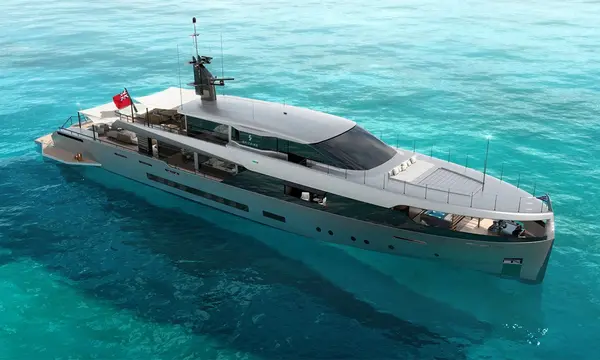
ARES Details Hybrid Engineering Behind 50.55m SPITFIRE Motor Superyacht
ARES Yachts' 50.55m SPITFIRE project combines a lightweight composite hull, hybrid electric drive and a radically flexible guest layout as the Antalya yard develops …
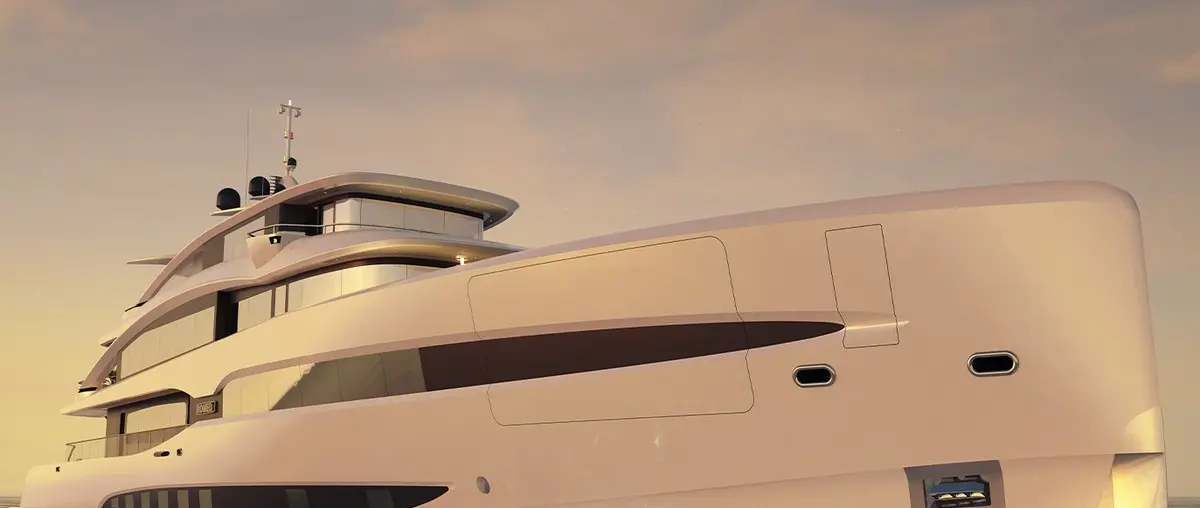
© Romeo Marine and original yacht-project artwork creator. Genuine builder-owned Romeo 60 media.
Independent November 2026 yacht-industry reports identify two Romeo 60 superyachts under construction at Romeo Marine's Dubai Maritime City facilities.
Romeo Marine's Romeo 60 has moved beyond being a design presented to show visitors: two examples of the 59.75-metre class are now reported under construction in Dubai Maritime City. Independent industry reporting on 25 and 26 November 2026 identifies the two-hull programme, while the builder's original published project information confirms that keel laying for a Romeo 60 began earlier. This is a meaningful distinction from the shipyard's previous presentation of the concept at the Monaco Yacht Show. It suggests the class is being developed as more than a single vessel, although specific delivery dates and contractual terms for each hull have not been confirmed in the material reviewed. The proper news is construction status, not a premature claim of launch or sea trials.
Romeo Marine published an account titled Romeo 60: Next in line in October 2025, stating that keel laying had begun for a 60-metre yacht. It identified Gresham Yacht Design on the exterior, Pulina Exclusive Interiors inside and accommodation for twelve guests across six cabins. Those are first-party facts from the company's own project description. The subsequent number of hulls comes from newer trade reporting, including SuperYacht Times and YachtBuyer, and should be attributed accordingly. This separation matters: a contemporary report does not become an original builder press release simply because it concerns a real shipyard. The two forms of evidence can be considered together without misrepresenting the date or scope of the company's original announcement.
The more detailed new-build reports give the Romeo 60's length as 59.75 metres and internal volume at approximately 850 gross tonnes. A yacht of this size is operating in a different design and regulatory category from many smaller production boats, with complex demands around accommodation, crew circulation, technical systems and long-range capability. Gross tonnage is a measure of enclosed volume rather than the vessel's actual weight, and the two terms should not be conflated. Owners considering this class will pay attention to how the design uses its interior capacity, particularly when separate guest and service zones need to coexist. The reported dimensions describe the Romeo 60 series, but the details of each individual hull still require a confirmed specification.
Building two large superyachts in parallel requires careful management of fabrication, suppliers, design approval and skilled labour. A shipyard must sequence work so that teams and equipment can move efficiently between hull construction, outfitting and testing. The reported two-hull status is therefore relevant to Romeo Marine's operational development, not only to its order book. It would be premature to infer that both yachts will be completed at the same time or will have identical custom interiors. A series platform can provide shared engineering foundations while still leaving considerable scope for individual owner preferences. The available reporting supports the existence of construction work; it does not provide independent details of each contract or a firm handover calendar.
The Romeo 60 has been described as a hybrid-capable superyacht, with particular attention to efficient operation across different onboard loads. Trade reporting cites a design aim of cruising at up to ten knots on a single generator under specified conditions while still supplying hotel services. That is a significant technical objective, but it is a claimed design capability rather than a result demonstrated by a sea trial for both new yachts. Performance depends on actual displacement, weather, mechanical configuration and commissioning. Owners should ask how propulsion and hotel loads are separated, how batteries or generators are managed and what operating modes will be available. Hybrid terminology is not sufficient on its own to establish efficiency or emissions savings under every journey profile.
A large yacht can consume substantial energy when stationary, particularly through cooling, lighting, galley appliances, entertainment and other hotel services. Improving propulsion efficiency without considering these demands would produce an incomplete picture of onboard energy use. Romeo's hybrid approach therefore needs to be assessed as a total vessel system, balancing drive power with the needs of passengers and crew. The exact configuration and control philosophy for each hull have not been independently verified in this review. The practical measure of success will be how comfortably the yacht supports normal operations, including busy guest days and quiet nights, while managing machinery running hours. A design goal is encouraging, but commissioning data will ultimately provide the evidence.
The builder's original announcement identifies Gresham Yacht Design as the exterior designer, with the Romeo 60 continuing a modern design vocabulary. The relationship between the exterior and the hull below the waterline is important because visual style alone cannot determine how the yacht performs. Large openings, windows and terraces must be resolved alongside structure, stability, classification and safety requirements. The new design has been presented through official concept material, which illustrates intended appearance rather than the finished result of the two hulls under construction. A project can retain its general silhouette while individual details evolve through technical development. Readers should distinguish design drawings from photographs of completed construction.
Pulina Exclusive Interiors is named as the interior studio for the Romeo 60, which the builder describes as offering accommodation for twelve guests in six cabins. Such a guest arrangement can support family cruising or private charter-style hospitality, although charter certification and commercial availability cannot be assumed. On a yacht approaching sixty metres, privacy between guest and working areas is particularly important. Stairways, elevators where fitted, storage and routes used by crew all influence the quality of the onboard experience. The company has not released complete, verified final arrangements for both in-build hulls in the material reviewed. Conceptual images may suggest an atmosphere, but a detailed specification and eventually inspections will be required to judge the delivered interiors.
Romeo Marine's recent development has been associated with the Romeo 55, a large steel-and-aluminium motor yacht promoted at the 2026 Dubai International Boat Show. The Romeo 60 is a separate project rather than a new name for the 55-metre vessel. This distinction is necessary because the shipyard has been introducing its brand to the international market with both models in related communications. The appearance of the Romeo 55 at a show establishes an opportunity to inspect one completed or ready-for-delivery yacht. It does not establish that a Romeo 60 has been delivered, and a report on the larger class should not reuse Romeo 55 photographs without clear labels. The two projects illustrate different stages of the builder's development.
The yard operates in Dubai Maritime City, placing it within an industrial environment with established marine infrastructure and access to the Gulf. For a prospective owner, the location may be relevant to supervision visits, local technical expertise and eventual commissioning. Yet geography does not remove the need to verify the capability of individual suppliers, subcontractors and testing arrangements. Large-vessel construction involves coordination across electrical, mechanical, structural and interior disciplines, often with international partners. The reported second hull increases the importance of that coordination. There is no basis in the available evidence to claim that the facility has completed every new investment it may ultimately need. The story records the hull programme currently reported, with later production milestones to follow.
The description of a Romeo 60 series indicates that more than one yacht can share a design foundation. It does not necessarily mean mass production or an absence of customisation. At this scale, owners commonly seek particular arrangements for leisure, wellness, water access and professional crew work. A shared technical platform may help standardise engineering and shorten some development tasks, but it must still be integrated carefully with each yacht's equipment and chosen interior. The builder has not publicly disclosed every configuration or buyer agreement for the two reported hulls. Rather than speculate about how alike they will be, it is more useful to recognise the industrial importance of moving from a single announced project to a reported pair.
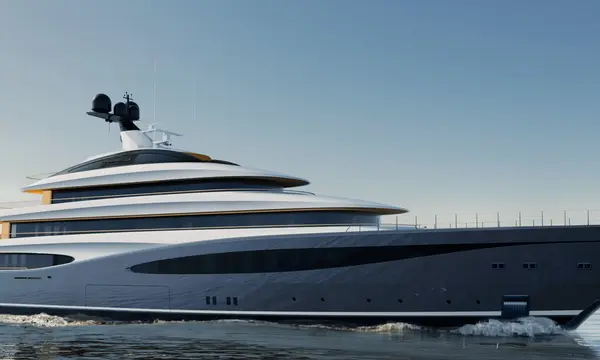
The lead visual comes from Romeo Marine's own earlier Romeo 60 project material. It should be read as official builder publicity for the class, not a photograph proving that both reported 2026 hulls have launched. This difference is central to credible reporting on superyacht construction, where attractive renderings often circulate well before steel and aluminium work is complete. The first-party illustration establishes the design direction associated with the project; the November two-hull status is sourced separately to contemporary reporting. No independent shipyard inspection is claimed. The company and the original image creator are credited, and the story avoids borrowing an unrelated third-party photograph to create a false sense of progress.
The two-hull report raises questions that future owner or builder announcements may resolve. Are both yachts being constructed to the same technical configuration, and what options will be available for energy storage and charging? How will the interior designs differ, and has the shipyard specified delivery sequences? What classification and operational arrangements are intended? None of these can be answered reliably by inventing specifications from a general Romeo 60 overview. The owner community will also want to understand crew facilities, maintenance access, endurance and the vessel's performance once sea trials have been completed. For now, the industry can distinguish firm published design attributes from the details still awaiting confirmation.
Romeo Marine's original keel-laying announcement established the Romeo 60 as an actual construction project. New reporting in late November 2026 adds the more specific development that two 59.75-metre vessels are in build in Dubai Maritime City. With design work linked to Gresham Yacht Design and Pulina Exclusive Interiors, and hybrid capability presented as a core technical objective, the class represents a substantial undertaking for the UAE builder. But construction is not delivery, and intended efficiency is not the same as proven trial performance. The next significant independent milestones will be hull progress, systems installation and ultimately completed sea trials. This update is important precisely because it documents progress without asserting outcomes that have not yet occurred.
Original primary record: Romeo Marine official WordPress original article JSON resource, October 2 2025 keel-laying post, with independently attributed November 2026 two-hull update. © Romeo Marine and original yacht-project artwork creator. Genuine builder-owned Romeo 60 media. Original first-party media: source photograph or official illustration. Copyright and image source are credited; first-party availability does not imply unrestricted reproduction permission.
Independent November 2026 two-hull construction status: YachtBuyer original dated reporting. The builder source is its earlier October 2025 Romeo 60 project announcement.
© Romeo Marine and original yacht-project artwork creator. Genuine builder-owned Romeo 60 media.
Continue reading
ARES Yachts' 50.55m SPITFIRE project combines a lightweight composite hull, hybrid electric drive and a radically flexible guest layout as the Antalya yard develops …
The first Pearl 100 Hybrid has completed initial sea trials ahead of its world debut at the 2026 Fort Lauderdale International Boat Show.
Turquoise Yachts is building the 76.25-metre Project Arrow with hybrid propulsion, 1,930 GT of volume and design by Enrico Gobbi and H2 Yacht Design.
Turquoise Yachts’ 81-metre Project Rafale is under construction with H2 Yacht Design, three pools and a hybrid-focused technical package.
Superyacht Guide
Continue into the wider Superyacht Guide.
Business opportunities · Superyacht Guide
Companies serving the superyacht market can discuss clearly identified advertising, sponsorship and business-profile opportunities. Commercial activity remains separate from independent editorial coverage.