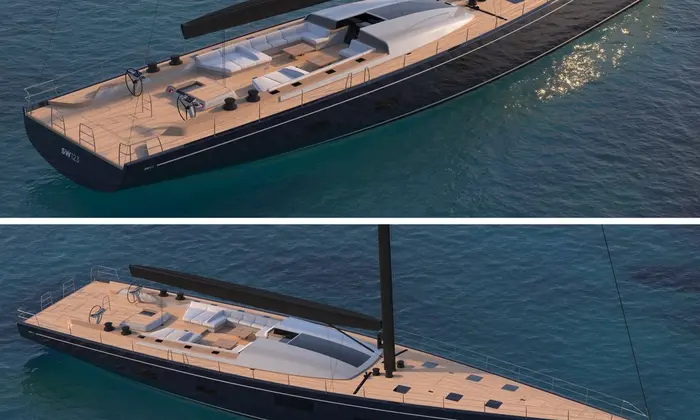
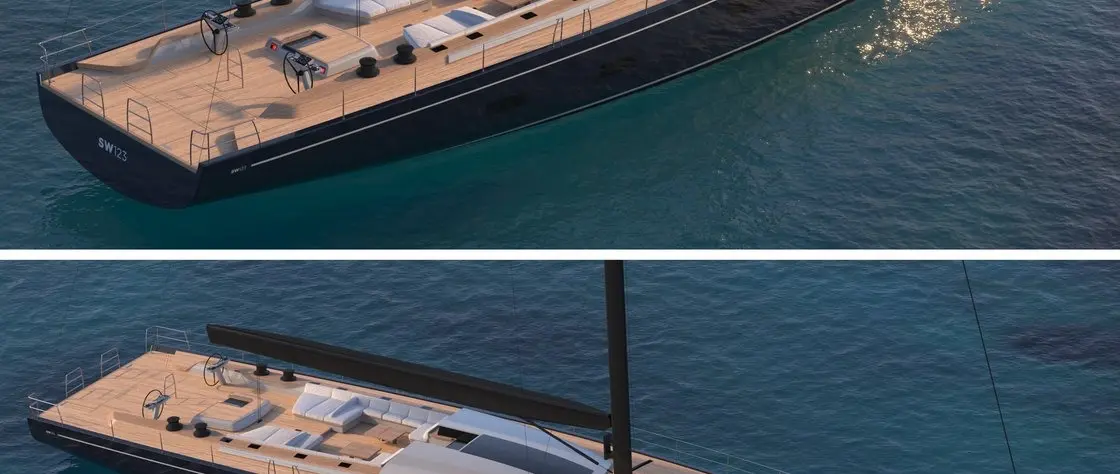
© Southern Wind Shipyard. Original 2025-03-07 press release email 900; unbuilt SW123 design rendering; sha256 0d282670d9fb34432fd13cdd8a448f
The 37.46m Southern Wind SW123 flagship was under construction when unveiled in 2025. Explore its design, lightweight build, project status and 2027 launch target.
Southern Wind announced a new flagship in January 2025, moving its Smart Custom sailing concept into the 37.46-metre class with the first SW123 hull already in construction. A more detailed March presentation described the design thinking behind a yacht intended to combine efficient ocean passage-making with performance on the racecourse. The announcement did not concern a completed yacht. Hull SW123#01 remained a building project, with the shipyard identifying February 2027 as its intended launch window. Keeping that status clear is especially important when an original press release is examined well after the first announcement.
Southern Wind has earned a reputation for building long-distance sailing yachts that can also compete in substantial offshore and inshore regattas. The SW123 is an attempt to advance that philosophy without abandoning the qualities that make an individual yacht useful over many seasons. The proposed length gives its design team greater internal volume than the yard's established SW96 and SW108 families. It also creates opportunities for more substantial owner accommodation, storage and a working environment for crew.
Larger dimensions are not an automatic performance benefit. Extra volume invites more amenities, and those amenities bring weight, additional systems and demands on service space. The challenge is to make each extra metre contribute something useful while preserving the yacht's responsiveness. Southern Wind presents the SW123 as a performance cruiser rather than a floating residence whose sailing rig happens to be a decorative feature.
The builder describes Smart Custom as an approach in which a tested platform is used as the foundation for owner-specific choices. Naval architecture, primary structures and important engineering interfaces are developed in advance. The buyer can then influence deck configuration, accommodation and other features without forcing the entire design process to start from zero. In theory, this reduces the risks of late changes and makes future maintenance more predictable.
It does not make the boats identical. Each owner brings different priorities: a long-range family voyage, competitive events, a wish to entertain regularly or a preference for quiet private space. A pre-engineered foundation can help designers balance these choices without losing control of displacement and technical complexity. For a 37-metre yacht, that relationship between personalisation and disciplined engineering is particularly valuable.
Farr Yacht Design is responsible for the naval architecture and performance-related design, while Nauta Design contributes the yacht's exterior and interior architecture. Both teams have long associations with Southern Wind. The arrangement allows an integrated conversation between hull geometry, sail plan, the movement of people aboard and the appearance of the finished yacht.
The aesthetic concept favours clean lines and a Gran Turismo-style deckhouse. That choice has operational implications. A low-profile superstructure can reduce visual obstruction and create a purposeful silhouette, but the designer must still provide useful shelter, sufficient headroom and clear routes between the cockpit and foredeck. The SW123 is therefore better understood as a negotiated balance among many requirements than as a styling exercise.
The first SW123 is planned around a lightweight composite structure using carbon and epoxy materials. Such a construction method makes it possible to pursue stiffness while controlling overall weight, although the actual result depends on laminate engineering, build quality and the distribution of structure throughout the hull. On a sailing yacht, a reduction in unnecessary mass may influence acceleration and the handling of loads under sail.
Composite construction also requires careful work during fabrication and subsequent repair. The quality of the resin system, the preparation of bonded joints and the treatment of high-load areas are fundamental matters. It is not enough to describe a yacht as 'carbon' and assume that every element must be lighter, more robust or more environmentally benign. The meaningful assessment comes from engineering documentation and the behavior of the finished vessel during trials.
The yard's design information describes keel options, including a telescopic configuration that can reduce draft when a passage or berth demands it. A deeper configuration is valuable under sail because the keel contributes to righting moment and efficient progress upwind. A shallower mode can expand access to places where draft is a limiting consideration. The proposed range is a design parameter, not a claim that a completed SW123 has already demonstrated every mode.
A movable keel needs suitable engineering and maintenance access. Hydraulic or mechanical systems must remain dependable under substantial loads, and the movement of ballast must be managed within clearly defined operating limits. An owner deciding whether the complexity is worthwhile should look at intended cruising grounds and the frequency with which shallow-water access would be genuinely useful.
One of the SW123's distinctive interior proposals is a central skylight that brings daylight into the saloon. Rather than relying solely on large lateral openings, the design can direct natural light down through the middle of the vessel. Enlarged hull windows also contribute views from the accommodation. For a yacht intended to cruise for long periods, the quality of natural light can change the experience of daily life aboard.
Extensive glazing introduces its own questions. Heat gain, ventilation, privacy, structural openings and maintenance all need consideration. A large uninterrupted interior is not necessarily better if it loses the useful boundaries between working, resting and social activity. The value of a flexible design is that the owner can influence these choices before the accommodation plan is fixed.
Southern Wind's Gran Turismo approach seeks a connection between the saloon and open-air spaces without requiring guests to move through a maze of steps. Cockpit protection and straightforward access to the stern can support relaxed living at anchor, while the working sailing deck remains available for crew activity. The arrangement matters because a performance yacht must remain safe and practical when a large sail plan is being handled.
The size of the SW123 opens possibilities for a substantial tender and leisure equipment, but each item has to be designed into the ship. Storage consumes volume and creates structural and service requirements. It is important to distinguish an option illustrated in a design presentation from equipment actually ordered for hull #01. No current toy inventory or owner's private specification is inferred from the 2025 announcement.
A builder's first vessel in a new size establishes a reference point for the series that may follow. During the design and construction of SW123#01, the team can test whether assumptions made on smaller Southern Wind yachts scale effectively into the flagship class. The first hull will also make visible any differences between attractive renderings and the realities of production, outfitting and maintaining a more complex yacht.
An individual project is also a learning opportunity for the yard. Structural solutions, supply arrangements and installation procedures can be reviewed for future builds. That cumulative knowledge is one reason a family of related yachts can become more efficient over time, even when its owners request different interiors or rig details. The SW123's commercial significance therefore extends beyond one prospective delivery.
The January and March 2025 releases identify the first hull as under construction and refer to a planned launch in February 2027. This remains a programme target, not an independently confirmed completion event. A yacht can experience changes to outfitting, testing and commissioning schedules without changing its basic identity. Any subsequent launch or delivery deserves a new, precisely dated source rather than an automatic assumption that the old target was met.
For this reason Superyacht Guide has created a project entry marked construction started. The yacht has not been given a launch year merely because the original announcement stated a future month. Similarly, the official rendering is clearly described as computer-generated design material rather than a photograph of the first hull under sail.
A buyer comparing the SW123 with a smaller Southern Wind or a larger custom sailing yacht would need to evaluate how the extra volume affects crew demands, berthing, sail handling and operating costs. Higher displacement can influence manoeuvring and anchorage choices. A longer hull may provide more comfortable motion on passage, but the actual behavior depends on loading, hull form and weather rather than length alone.
The attraction of Smart Custom is not that all uncertainties disappear. It is that the yard and client can begin with a coherent design philosophy and make deliberate choices about which aspects deserve individual engineering. For a performance-minded owner, that creates a framework for discussions about both speed and the quality of living aboard.
The SW123 is an ambitious step for Southern Wind: 37.46 metres of planned high-performance ocean-going sailing yacht, using Farr and Nauta design experience and a configurable owner-oriented platform. Its value to the industry lies in the design decisions it brings together, not in treating a future launch as a completed achievement. The builder has already created enough official material for a useful project profile, but the construction chronology must remain open to verified updates.
This feature records the flagship as it stood in the original 2025 source correspondence and in the subsequently checked builder descriptions. It is a study of design and development, with the yacht's current project status stated plainly. When the first hull enters the water, the newsroom can document that milestone with a separate official source and a new photograph of the actual boat.
Original sources and photo provenance: Southern Wind Shipyard original press correspondence IDs 445 (17 January 2025) and 900 (7 March 2025), original MIME files retained in the shipyard CRM. Official SW123 project presentation and hull SW123#01 specifications. Image: © Southern Wind Shipyard, official SW123 concept rendering, not a photograph of a completed yacht.
Southern Wind Shipyard (official unbuilt SW123 design rendering)
Explore
Go deeper into the yachts, companies, events and destinations directly connected to this article.
Continue reading

Southern Wind reports Marco Alberti’s Lighthouse Legend recognition at the 2026 South African boatbuilding awards, honouring his long industry career.
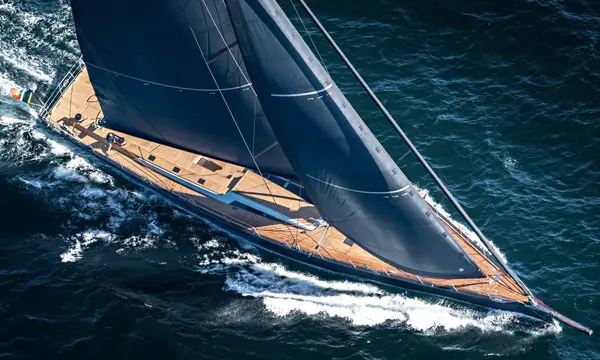
The 32.87-metre Southern Wind sailing superyacht Kiboko 4 has earned the 2026 International Superyacht Society Best in Sail 24–40m award, recognising a yacht built …
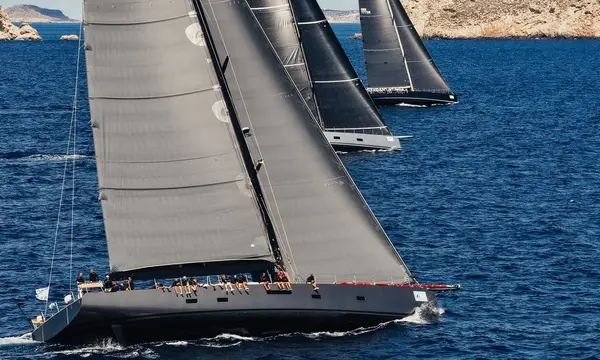
Southern Wind reports seven yachts in the 20-boat Ibiza JoySail fleet, with Gelliceaux second, Kalantis third and Fortissimo making her regatta debut.
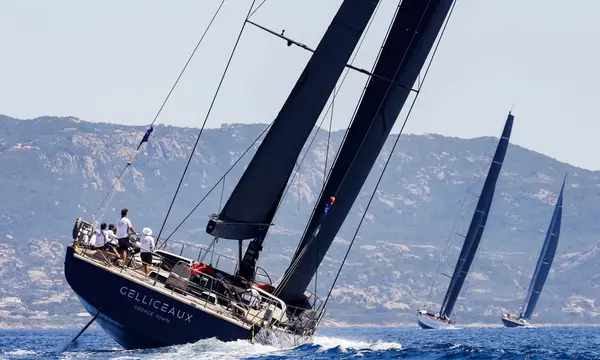
Southern Wind Rendezvous 2026 results from Porto Cervo: SW96 LIBERTY wins ahead of the SW108 sisterships GELLICEAUX and KALANTIS, with four days of racing.
Superyacht Guide
Continue into the wider Superyacht Guide.
Business opportunities · Superyacht Guide
Companies serving the superyacht market can discuss clearly identified advertising, sponsorship and business-profile opportunities. Commercial activity remains separate from independent editorial coverage.