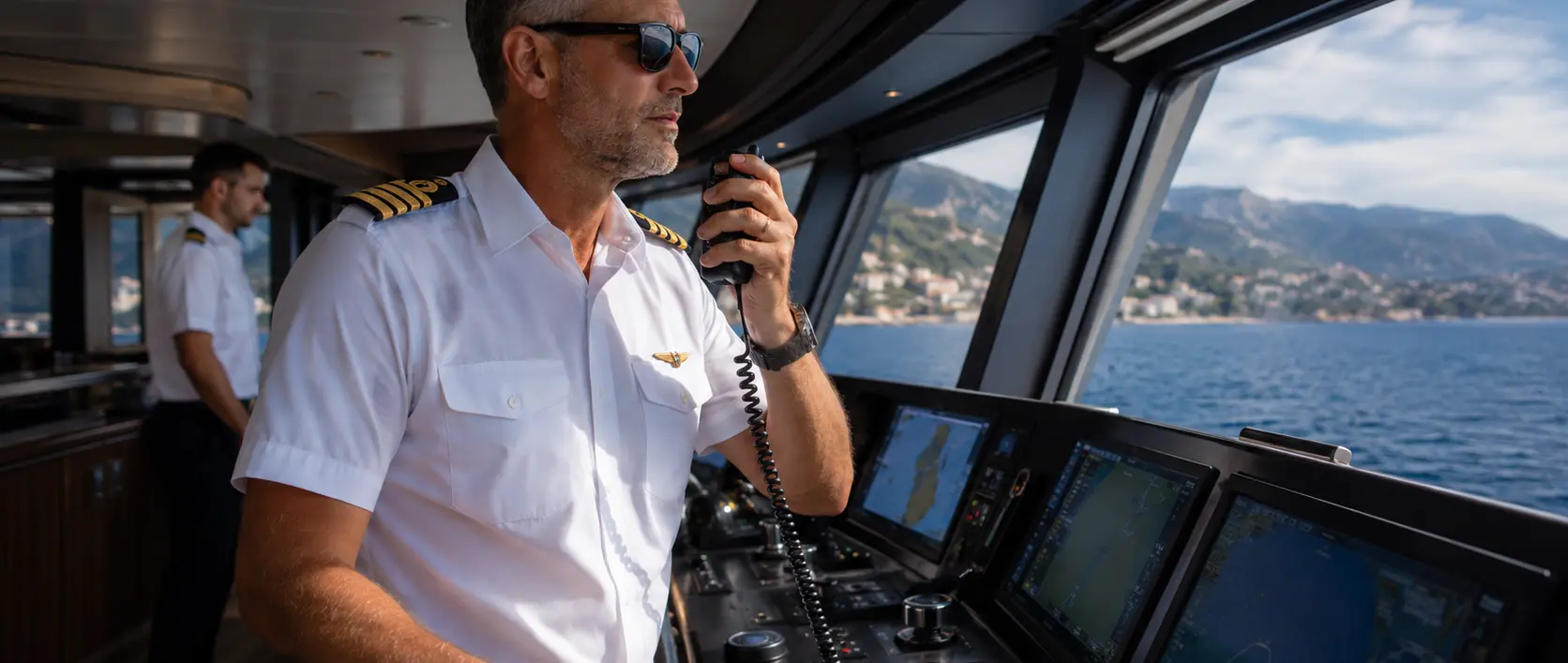
Superyacht Captain Salaries 2026: Pay by Yacht Size and Rotation
By Stephen Yardley · Edited by Stephen Yardley
Current 2026 salary benchmarks show captain pay rising sharply with yacht size and responsibility, while time-for-time rotation is increasingly common. We compare published pay ranges, rotation and benefits.
Superyacht captain salaries in 2026 vary enormously because the job itself changes with yacht size, gross tonnage, cruising programme, flag, ownership style and the level of responsibility carried ashore as well as on board. There is no official industry pay scale, so the most useful benchmarks come from recruitment-market salary guides and surveys of captains actually employed across different yacht-size brackets.
Current published data show a clear pattern: monthly base pay generally rises as yachts become larger and more operationally complex, while structured rotation becomes increasingly common at the senior end of the fleet. The headline salary is only part of the package, however, because time-for-time leave, flights, bonuses, medical cover, training support and whether the captain is expected to remain available while off rotation can materially change the real value of an offer.
Yotspot's 2026 salary guidelines place captains below 30 metres at approximately €5,000 to €6,000 per month and captains on 30m to 39m yachts at around €6,000 to €9,000. Those are indicative market bands rather than guaranteed rates, and a 30m private yacht with a straightforward programme can be a very different command from a vessel of similar length operating intensively for charter.
For 40m to 49m yachts, the same 2026 guide gives a range of about €9,000 to €13,000 per month. At 50m to 59m the published range rises to roughly €11,000 to €16,000, reflecting the larger crew, more complex maintenance and compliance environment, greater guest operation and the higher level of management expected from the captain.
On 60m to 69m yachts, current guidance is around €15,000 to €18,000 per month, while 70m to 79m yachts are shown at roughly €16,000 to €20,000. Quay Group's 2025/26 Captain Salary and Leave Report independently found that the 70m to 79m bracket had risen by about 7% compared with its 2023 survey, making it one of the clearest areas of recent salary growth.
For 80m to 89m yachts, Yotspot lists approximately €18,000 to €21,000, rising to about €20,000 to €23,000 on 90m to 99m yachts. Quay Group's latest survey then places average monthly pay above €25,000 on 100m to 119m yachts, illustrating why a simple linear euros-per-metre formula becomes increasingly unreliable once yacht operations reach the very large-yacht category.
A captain earning €18,000 a month on a permanent contract with limited annual leave is not receiving the same employment package as a captain earning €18,000 while working time-for-time rotation. Equal rotation normally requires two suitably qualified captains to cover the command position, and for the individual it can transform the sustainability of a career that otherwise involves long periods away from home and constant operational responsibility.
Quay Group's 2025/26 survey, based on responses from 367 captains on yachts from 20 metres to more than 120 metres, found that 63% were on time-for-time rotation. Rotation is therefore no longer confined to the very largest yachts, although availability still varies sharply by yacht size, ownership preference and whether the programme has the budget and management structure to support two senior captains.
The survey also exposes an important weakness in the headline concept of equal rotation. Only 28% of captains said they completely switched off during leave, while many continued to handle emails, calls or yacht matters from shore, so a nominal two-month-on, two-month-off package may not deliver two months of genuine rest if responsibility follows the captain home.
It is tempting to assume that a rotational captain should always receive a lower monthly salary because half the year is spent away from the yacht, but real packages do not follow one simple rule. Recruitment surveys have shown that the gap between permanent and rotational salaries can narrow or reverse in different size bands because owners are competing for experienced captains who can work effectively within a dual-command structure.
The better comparison is total annual compensation and actual workload. A permanent captain may receive a higher cash figure in some programmes, but a rotational captain may gain substantially more protected time ashore, while another rotational captain may remain so involved during leave that the theoretical benefit is much smaller than the contract suggests.
Owners and captains should therefore define what "rotation" actually means before treating it as part of a salary negotiation. Handover responsibilities, availability during leave, who deals with crew and technical decisions ashore, travel days, emergency contact expectations and whether training is taken inside or outside leave periods can all affect the true value of the arrangement.
Yacht size is only the first filter because gross tonnage and certificate requirements can be more important than length alone. A captain with the appropriate Master qualification, strong command history, proven safety record and experience managing complex refits, shipyard periods, charter programmes or remote cruising can justify a different package from somebody taking a first command on a yacht of similar length.
Longevity also carries real value because owners and managers are not simply buying boat-handling skill. They are hiring somebody to manage people, budgets, contractors, compliance, insurance relationships, guest expectations and the owner's confidence in the entire yacht programme, so a captain who has demonstrated stability and sound judgement over several years can be more valuable than a candidate whose CV shows frequent short commands.
Charter intensity, unusual itineraries, high guest usage, new-build delivery, warranty management and major technical projects can also change the role. The salary should be considered against the actual scope of responsibility rather than against length alone, particularly where the captain is expected to act as project manager, owner's representative or senior operational adviser beyond conventional command duties.
Quay Group reports that 53% of captains in its 2025/26 survey receive some form of annual pay rise, but only 13% have that increase written into their contracts. That makes salary progression less predictable than the headline monthly figure suggests, and it puts more weight on annual review, longevity and the negotiating position of both the yacht and the individual captain.
Benefits are also moving. More than half of captains in the Quay survey receive business-class travel on long-haul routes, while bonus structures range from 13th-month payments to discretionary awards, so two apparently identical €20,000 monthly salaries can produce materially different annual packages once travel, bonuses and leave are included.
For a captain considering a move, it is therefore sensible to compare the entire employment proposition rather than chase the highest monthly number. A slightly lower base salary with genuine time-for-time leave, reliable relief coverage, contractual review, paid training and clear authority can be a stronger long-term package than a higher headline figure attached to constant availability and unclear expectations.
Salary guides are most useful as negotiating evidence, not as a price list that every yacht must follow. The 2026 ranges above describe published market benchmarks, while the correct package for a specific yacht still depends on tonnage, manning requirements, qualifications, programme, command history, leave, benefits and the difficulty of recruiting the right person for that particular operation.
For owners, the cost of underpaying an experienced captain can appear later as turnover, recruitment expense and loss of operational continuity, while overpaying does not compensate for a poor leadership or programme fit. For captains, the strongest position is to understand the market range, document the scale of responsibility actually carried and negotiate the complete package with the same care applied to the monthly salary.
Explore
Go deeper into the yachts, companies, events and destinations directly connected to this article.
Continue reading
Superyachts move between cruising grounds under their own power or aboard specialist transport ships. We explain lift-on and float-on methods, preparation, cost and wear.
Draft can decide whether a yacht can enter a harbour or anchorage safely. Using current SYG fleet data, we explain typical draft, deep-draft examples …
Yachtmaster and OOW are not competing certificates: Yachtmaster proves practical skipper competence, while OOW is the STCW officer route for large yachts. We explain …
An ENG1 confirms that a seafarer meets recognised medical and eyesight standards for work at sea. We explain who needs it, what the examination …
Superyacht Guide
Continue into the wider Superyacht Guide.