
40m Superyacht Running Costs: Crew, Fuel, Berthing and Refit
Running a 40m superyacht requires a substantial annual budget for crew, maintenance, fuel, berthing and other operating costs. Superyacht Guide's 2026 model of 322 …
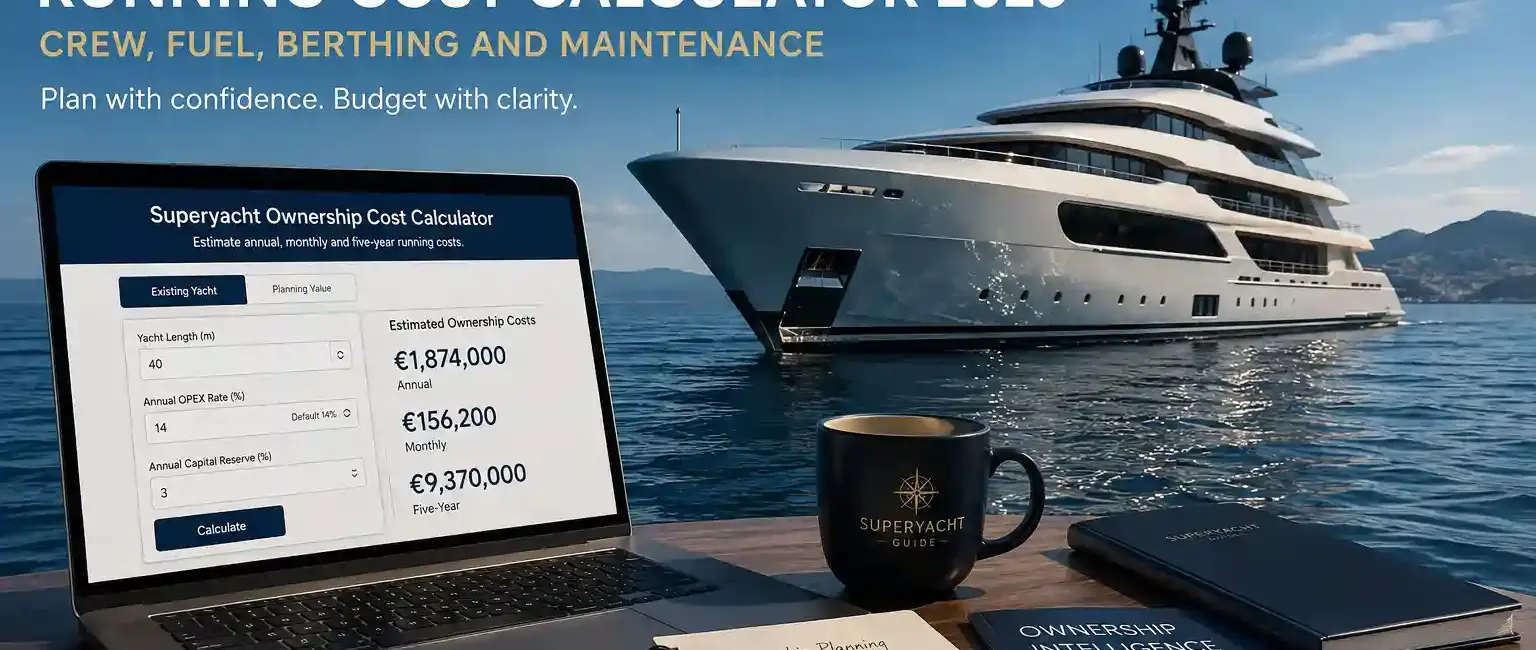
Superyacht Guide's 2026 running cost calculator provides annual, monthly and five-year ownership estimates using either an existing yacht or a planning value. It gives owners a starting point for testing OPEX and long-term capital requirements before building a yacht-specific budget.
Superyacht ownership does not stop at the purchase price. Crew, maintenance, fuel, berthing, insurance, management and periodic renewal continue whether a yacht is cruising heavily or spending much of the year alongside, so an owner needs a repeatable way to test the annual financial commitment before turning an estimate into a working budget.
Superyacht Guide's 2026 Ownership Cost Calculator is designed for that first stage of planning. It can use an existing yacht's public Superyacht Guide financial profile or a user-entered planning value, and it produces annual, monthly and five-year ownership estimates rather than presenting a single headline number without context.
For a value-based scenario, the calculator starts with Superyacht Guide's established 14% annual OPEX basis. The percentage is adjustable, which matters because a new privately used yacht with a stable home berth can have a very different cost profile from an older yacht facing major technical work, extensive cruising or a more demanding crew structure.
A €50 million yacht entered at the default 14% rate produces a €7 million annual OPEX planning figure before the calculator's separate capital-reserve allowance is considered. That is a scenario calculation, not a claim that every €50 million yacht spends €7 million each year, and the output should be refined with actual salaries, berth quotations, insurance terms, fuel use and maintenance schedules as soon as those figures are available.
The calculator is deliberately a planning tool rather than a substitute for a yacht manager's detailed operating spreadsheet. Its current value-based mode does not ask the user to enter separate crew, fuel, berthing and maintenance figures, so the headline OPEX result should be treated as the amount that ultimately has to be reconciled against those real cost categories.
Crew is normally one of the largest fixed commitments because salaries sit alongside travel, training, medical requirements, uniforms, recruitment, food and relief arrangements. Maintenance is similarly persistent: engines, generators, stabilisers, HVAC, navigation equipment, paint, teak, tenders and hotel systems continue to require attention even during relatively quiet operating periods.
Fuel and berthing are more sensitive to programme. Passage distance, speed, generator use, tender activity, home port, seasonal marina pricing and premium-event berths can move those costs sharply, which is why two yachts with similar market values can end the year with materially different actual expenditure.
Routine annual operating expenditure is not the same as long-term capital renewal. Paint, major machinery overhauls, teak replacement, technology upgrades, class-driven work and substantial refits often arrive in concentrated yard periods rather than as smooth monthly expenses, so a yacht can look inexpensive in an ordinary year and then require a much larger capital programme later.
The Superyacht Guide calculator therefore combines annual operating expenditure with an annual capital reserve when presenting ownership planning figures. Looking at the monthly and five-year outputs alongside the annual estimate helps owners avoid treating a quiet twelve-month period as evidence that the yacht's long-term cost has permanently fallen.
Selecting an existing yacht is useful when Superyacht Guide already holds a public financial profile for that vessel. Entering a planning value is more useful earlier in the buying process, when an owner may be comparing several yachts or testing the financial effect of moving into a different value or size bracket before detailed due diligence is available.
Neither route turns a modelled estimate into documentary evidence of a yacht's actual accounts. Superyacht Guide explicitly distinguishes planning figures from source-backed expenditure records, and owners should replace model assumptions with real contracts, invoices, technical forecasts and management accounts before relying on the result as an operating budget.
The calculator focuses on the cost of owning and operating the yacht rather than the structure of the acquisition. Purchase price, tax, financing interest and depreciation are excluded because they depend on transaction structure, jurisdiction, financing arrangements and the eventual resale market, variables that should be modelled separately with the appropriate professional advice.
That separation makes the calculator more useful for comparisons because it keeps operating economics distinct from how a particular owner chooses to finance or hold the asset. A buyer can therefore test the yacht's ongoing cost first, then add purchase taxes, financing, ownership structure and other transaction-specific considerations without confusing them with the vessel's normal annual operation.
The best time to test superyacht running costs is before an asking price becomes the centre of the decision. Running several scenarios can show whether a yacht remains comfortable to own when the OPEX assumption is increased, whether a larger yacht creates an acceptable five-year commitment and whether the planned cruising programme leaves enough headroom for refit and unexpected technical work.
That makes the Superyacht Ownership Cost Calculator a starting point rather than a final answer. The purchase price establishes what it costs to acquire the yacht; the running-cost calculation starts answering the longer-term question of what it will take to keep the yacht safely crewed, maintained, berthed, fuelled and ready to operate at the standard its owner expects.
Continue reading
Running a 40m superyacht requires a substantial annual budget for crew, maintenance, fuel, berthing and other operating costs. Superyacht Guide's 2026 model of 322 …

A superyacht can function as a full-time home, but continuous living changes crew, maintenance, berthing and operating requirements. We examine the practical and financial …

A 50m superyacht can require several million euros a year to keep professionally crewed, maintained, insured, berthed and ready to cruise. Superyacht Guide examines …

Superyacht insurance is not simply a percentage applied to the yacht’s value. Underwriters assess the vessel, crew, cruising programme, claims history, machinery, security and …
Superyacht Guide
Continue into the wider Superyacht Guide.
Business opportunities · Superyacht Guide
Companies serving the superyacht market can discuss clearly identified advertising, sponsorship and business-profile opportunities. Commercial activity remains separate from independent editorial coverage.