

Aluland Details Certified Aluminium Supply and Processing for Yachtbuilders
Aluland outlines certified aluminium plates and profiles plus cutting, bending, machining and custom processing for large-yacht builders at METSTRADE 2026.

The Italian Sea Group Marina di Carrara shipyard 2026 archive aerial photograph
T.I.S.G. Asia Investment Holding disputes the exclusion of its €250 million proposal as Italian Sea Group prepares further court-supervised restructuring.
A dispute has emerged over the competitive process intended to support the restructuring of The Italian Sea Group, whose brands include Admiral, Tecnomar and Perini Navi. Following a 16 November 2026 procedure in Florence in which an offer from SRI Global was selected at €220 million, Hong Kong-based T.I.S.G. Asia Investment Holding challenged the exclusion of its proposed €250 million bid. The holding company says its offer was fully financed and should have been considered; reporting on the process also describes procedural objections concerning timing and documentation. The distinction between these accounts is important. A statement by a bidder contesting its exclusion is not a court finding that the exclusion was improper, and the difference between the headline offers does not establish which proposal provides greater recoverable value to creditors. The latest developments matter to superyacht buyers and suppliers because the eventual industrial arrangement may affect ongoing builds and the future operation of major Italian shipyards.
The Italian Sea Group confirmed in a company release that the competitive bidding process had resulted in a €220 million proposal from SRI Global for the business undertaking. The company's next stated step was to convene its board on 23 November to consider the appropriate applications and agreements within the court-supervised restructuring process. Separately, T.I.S.G. Asia Investment Holding described an offer of €250 million, or €30 million more than the SRI headline consideration. Comparing only those totals is insufficient. Offers in a restructuring can have different conditions, financing arrangements, asset perimeters, employment obligations and requirements for future investment. A lower headline price could in some circumstances have greater certainty or different costs, while a higher offer might produce a better outcome if it is admissible and fully executable. Those questions must be assessed against the court procedure and complete documents, which are not reproduced here.
According to the 18 November industry report, T.I.S.G. Asia Investment Holding says it was not treated fairly during the process and has asked Italian lawyers to examine options for challenging its exclusion. Its chief executive, Traugott Kaminski, argues that the €250 million commitment was genuine and should have been compared with the other proposals. The group also disputes reporting that late submission and incomplete supporting documentation justified exclusion. These remain claims advanced by the interested bidder, not established judicial findings. The reporting of the competitive process describes the excluded proposals as facing questions about deadline compliance, evidence of available funds and organisational clarity. For readers following the sale, it is essential to distinguish these reported procedural concerns from the bidder's opposing explanations. Neither a press statement nor a larger stated consideration automatically determines whether the court must reopen a competitive process.
Court-supervised restructuring is not identical to an unrestricted commercial auction. It is conducted under procedural rules intended to coordinate creditors, debtors and potential purchasers. Deadlines, financial evidence and legal entity identification may therefore be central to determining whether a proposal can be admitted. A prospective investor must demonstrate more than an interest in paying a certain sum; relevant parties may need confidence that funds can be delivered and any specified operating obligations can be met. The full procedural record is necessary to judge what happened in this case. Superyacht Guide does not infer that the bidder deliberately ignored requirements or that the process was administered incorrectly. Both would be conclusions going beyond the evidence reviewed. The practical development is that an excluded bidder has publicly disputed the result, creating an additional point of uncertainty while The Italian Sea Group pursues its proposed restructuring arrangements.
A thirty-million-euro gap between headline offers is significant in absolute terms, particularly for a business whose suppliers and subcontractors may be owed money. The excluded bidder argues that considering its proposal could improve creditor recoveries. That assertion depends on whether the offer is legally admissible, what assets and liabilities it covers and when the money would become available. A going-concern proposal may involve obligations that do not appear in a single purchase-price figure, including capital injections to continue construction or responsibility for specified debts. The actual economic value to creditors can also depend on the cost and risk of implementation. It is therefore better to treat €250 million and €220 million as competing headline proposal amounts rather than a confirmed thirty-million-euro loss to any creditor class. A court, financial adviser or creditor representative would need the detailed terms to make that comparison.
The Italian Sea Group is associated with several prominent luxury yacht names, including Admiral and Tecnomar, as well as the sailing-yacht marque Perini Navi and other industrial activities. Its facilities and project workforce form part of a wider Italian supply chain involving naval architects, welders, outfitters, equipment makers and specialist contractors. A restructuring decision could affect those relationships even if the legal ownership of particular assets or contracts remains complex. Buyers with yachts under construction need clarity about who is responsible for work, guarantees, contractual milestones and after-sales support. Suppliers want reliable payment arrangements and realistic production schedules. The competing investors may each describe a plan for continuity, but a plan is not the same as a completed transfer, restarted project or successful delivery. Those outcomes require subsequent evidence and formal implementation.
The reported T.I.S.G. Asia proposal describes a going-concern acquisition encompassing Italian industrial sites and associated group businesses, with an intention to keep established yacht brands and core production activity. It names TGG Group as a proposed financial partner and envisages operational management by a European team. The group also describes commitments concerning employment and the completion of yachts already under construction. These are the bidder's proposed arrangements and should not be presented as obligations adopted by The Italian Sea Group or guaranteed by a court. Whether the proposed capital, management structure and delivery programme could be implemented depends on matters that a public summary cannot resolve. For suppliers and customers, the important questions concern the credibility of the funding plan, the treatment of outstanding obligations and the practical arrangements for restoring production. The project count and schedule described by the bidder are forward-looking statements, not confirmed yard progress.
An owner who has signed a construction contract with a shipyard facing restructuring may have concerns distinct from those of an unsecured trade creditor. Payments, title to completed sections, ownership of equipment, performance guarantees and insurance arrangements can be governed by different contracts and laws. It is inappropriate to assume that every client has the same rights or that one restructuring proposal automatically protects every vessel. Owners and their advisers should review the actual agreements, request accurate status information and identify which party has authority to make commitments about the project. Public reporting about a competitive bid can inform that review, but it cannot replace direct contractual analysis. The priority is to establish verifiable facts about the individual yacht, its materials, outstanding work and payment position. That is preferable to making decisions based only on political or commercial statements accompanying an investment contest.
Small and medium-sized marine suppliers may depend on timely payments to maintain staff, production capacity and availability of specialist components. An industrial restructuring can interrupt normal ordering practices or create uncertainty about which invoices relate to work before or after a transition. A company considering new orders should verify who is contracting, the payment arrangements and any relevant security. Existing creditors need information from authorised representatives about claims and procedural deadlines. The bidder's argument that a higher proposal could improve recoveries is understandably important to them, but the available public information does not establish the exact recovery rate that will ultimately be achieved. Suppliers should distinguish statements made by interested parties from official notices and decisions. In a complex restructuring, that distinction can help prevent a business from committing further resources on an unverified assumption.
The company's release says its board will meet on Monday 23 November to consider further action concerning the selected SRI Global proposal, including the process for seeking court authorisation for relevant agreements. As of this 22 November report, that meeting is a future scheduled event. Its outcome should not be invented, and even a favourable board resolution would need to be understood within the wider court procedure. Other dates reported by industry sources concern the anticipated transition of operations and later proceedings. These are plans or procedural milestones rather than proof that all industrial assets have been transferred or all claims resolved. The excluded bidder's stated consideration of legal action is also not, by itself, proof that proceedings have been filed or that an injunction has been granted. Reporting will need to follow the documents and decisions as they become available.
The Italian Sea Group's financial difficulties and efforts to find investors have been reported across several months. The initial selection of a reference bid is one part of that longer sequence. The distinct current development is an excluded potential purchaser asserting that its larger proposal was improperly left out and outlining an alternative operating plan. That is a narrower and more contested issue than the general question of whether the company needs new capital. It deserves independent treatment because the procedural dispute may influence market expectations, creditor decisions and the way the next formal steps are interpreted. It should not, however, be rewritten as if the rival bidder has won or as if the originally selected investor has already lost its position. The available evidence supports a dispute over eligibility and the reported competing amounts, not a definitive legal resolution.
Owners, brokers, suppliers and builders will want to know whether the scheduled 23 November meeting produces new board resolutions, whether the Court of Florence authorises the contemplated arrangements and whether any formal action is filed by the excluded bidder. They should also watch for independently documented changes to the company's operating structure, project schedules, management and guarantees. A credible production restart requires more than an investment announcement: it needs contractual certainty, staff availability, supplier cooperation and funds in the right place at the right time. The industrial value of a major yachtbuilding organisation includes skills and unfinished projects that can be difficult to preserve through prolonged uncertainty. For the international industry, a transparent and workable outcome matters because it affects not only investors but also existing yacht clients and the network of specialist firms supporting their vessels.
The public record presently supports several carefully separated facts: SRI Global's €220 million proposal was selected through the reported competitive process; T.I.S.G. Asia has promoted a €250 million alternative; the latter group objects to its exclusion; and The Italian Sea Group scheduled further restructuring decisions for 23 November. The alleged defects and proposed benefits remain disputed. Superyacht Guide is not making a finding of wrongdoing by the court, advisers, investors or any other party. The substantive question for owners and the industry is which legally admissible and fundable arrangement can preserve production and meet obligations in the long term. That answer cannot be determined from the two headline figures alone. Readers should expect future reporting to distinguish formal court and company decisions from the claims advanced by participants.
Primary source: SuperYacht24 — 18 November 2026 account of T.I.S.G. Asia Investment Holding's contested bid and company statements.
Further information: The Italian Sea Group — official company release on 16 November 2026 bidding outcome and planned board resolutions.
Archival photo: The Italian Sea Group shipyard at Marina di Carrara, published by NERO Lifestyle. Illustrates existing facilities; not a photograph of the disputed November 2026 auction. Official source.
Continue reading
Aluland outlines certified aluminium plates and profiles plus cutting, bending, machining and custom processing for large-yacht builders at METSTRADE 2026.

Ferretti CEO Stassi Anastassov outlines brand loyalty, yacht quality, after-sales service and warranty extensions for eligible yachts under 45m.
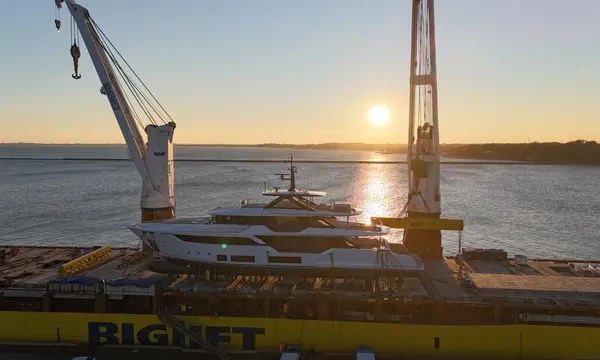
Sevenstar Yacht Transport handles a 40-metre, 300-tonne-plus yacht at Monfalcone, using coordinated shipboard cranes before transatlantic shipment to the US.

October 2026 records 33 sales of yachts over 24 metres worth €415.6 million, while new listings decline and resale asking prices per gross tonne …
Superyacht Guide
Continue into the wider Superyacht Guide.
Business opportunities · Superyacht Guide
Companies serving the superyacht market can discuss clearly identified advertising, sponsorship and business-profile opportunities. Commercial activity remains separate from independent editorial coverage.