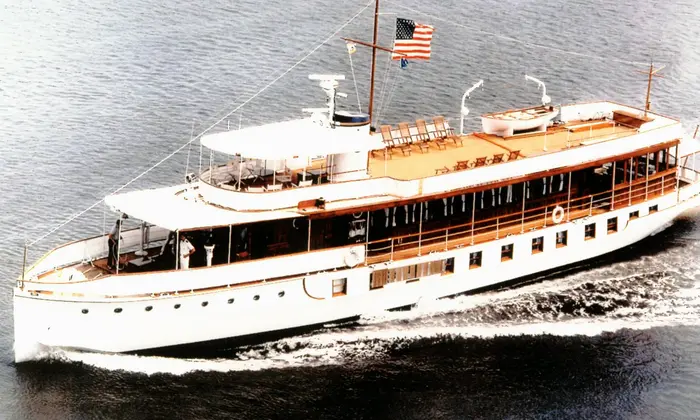
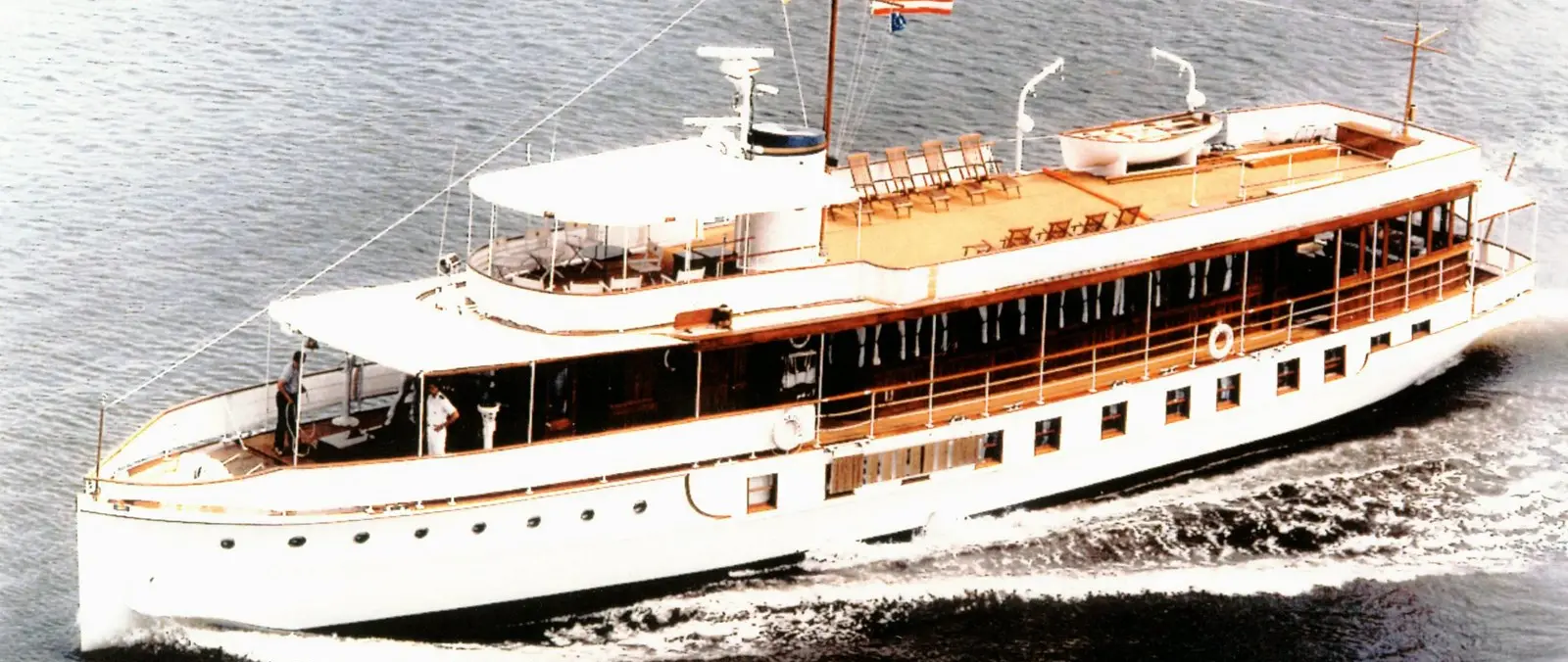
USS Sequoia served nine U.S. presidents and became a floating setting for diplomacy, political decisions and private presidential life. From Roosevelt and Kennedy to Nixon and Carter, the 1920s wooden yacht occupies a unique place in American maritime history.
Few historic yachts can claim to have carried as much political history as USS Sequoia. The wooden motor yacht served as a presidential and government vessel across almost half a century, and the National Park Service records her use by nine U.S. presidents from Herbert Hoover to Jimmy Carter.
Her importance lies less in size than in what happened aboard. Sequoia became a private extension of the White House where presidents entertained guests, debated policy, escaped Washington’s formality and, at several moments, confronted decisions that entered the wider history of the United States.
National Historic Landmark documentation identifies Sequoia as a John Trumpy design built by the Mathis Yacht Building Company at Camden, New Jersey, and completed in 1925. Trumpy became one of the defining names in American twentieth-century yacht design, and Sequoia emerged from the same wooden-yacht tradition that made the Mathis and later Trumpy name synonymous with elegant American motor yachts.
The landmark documentation records a yacht about 104 feet long, with an 18.2-foot beam and approximately 4.5-foot draft. Those dimensions are modest beside modern superyachts, but Sequoia’s relatively intimate scale ultimately became central to her usefulness as a setting where presidents and senior officials could meet away from the ceremonial atmosphere of the White House.
The National Park Service counts Herbert Hoover as the first of nine presidents to use Sequoia, beginning a presidential association that would continue until 1977. After Franklin D. Roosevelt entered office, Sequoia became the presidential yacht and was actively used during his first term.
Roosevelt eventually replaced Sequoia with the larger USS Potomac because of Sequoia’s smaller size and the potential fire risk posed by her wooden construction. That change did not remove Sequoia from government life, and USS Potomac subsequently became the vessel most closely identified with Roosevelt’s later presidential cruising.
Harry S. Truman used Sequoia for both hospitality and official business. The National Park Service records a post-war conference aboard involving the leaders of Great Britain and Canada at which the exchange of nuclear-weapons technology was discussed, demonstrating how a relatively small yacht could become the setting for decisions of international consequence.
Dwight D. Eisenhower is also among the nine presidents recorded by the National Park Service as having used Sequoia. The NPS summary provides more detail for several other administrations, but Eisenhower’s inclusion extends the yacht’s presidential association continuously through the post-war and early Cold War period.
John F. Kennedy used Sequoia frequently, including for his final birthday celebration before his assassination in November 1963. Lyndon B. Johnson later used the yacht for his own political style, lobbying members of Congress aboard for support on measures including his Great Society programmes before Sequoia again received formal presidential-yacht status near the end of his administration.
No president used Sequoia more frequently than Richard Nixon, according to the National Park Service. He conducted extensive foreign-policy meetings aboard, and the NPS identifies Sequoia as the place where Nixon made his decision to withdraw from the war in Vietnam.
The yacht also became a personal retreat during the Watergate crisis. That combination of official power, private conversation and temporary physical separation from Washington explains why Sequoia became so closely associated with the idea of a floating White House.
Gerald Ford continued using Sequoia for official and social occasions, including a reception honouring the Apollo–Soyuz astronauts. By then the yacht represented more than transportation: she embodied a surviving presidential tradition that had crossed numerous administrations, the Second World War, the Cold War and major changes in American political life.
Jimmy Carter ended that tradition as part of his effort to present a less extravagant presidency. On 18 May 1977, Sequoia was sold at public auction to a private owner, ending forty-six years of government association and bringing the modern era of the dedicated U.S. presidential yacht to a close.
Private ownership did not diminish Sequoia’s historical importance. The yacht was designated a National Historic Landmark in 1987 because of her association with important political, diplomatic and social activity conducted by successive presidents.
The designation recognises that Sequoia is more than an old vessel that happened to carry famous passengers. Her surviving spaces form part of the physical history of the presidency itself, linking private celebrations, political lobbying, diplomacy and major national decisions to a single wooden yacht.
Preserving Sequoia is especially demanding because she is a century-old wooden yacht rather than a steel museum ship built for static display. The National Park Service’s latest published status, dated 2024, describes Sequoia as privately owned and undergoing restoration with the goal of reopening the vessel for public access.
Restoration therefore has to balance structural renewal with historical integrity. Timber, machinery, accommodation and decades of alterations all have to be considered against the need to preserve a recognisable presidential yacht whose significance accumulated gradually across almost half a century of government service.
Sequoia links John Trumpy and the Mathis tradition of American wooden yacht building with the political history of Hoover, Roosevelt, Truman, Eisenhower, Kennedy, Johnson, Nixon, Ford and Carter. Few surviving yachts connect maritime design so directly with the White House, the Cold War, Vietnam, Watergate and twentieth-century presidential culture.
That breadth makes Sequoia a natural addition to Superyacht Guide’s Historic Yachts collection. Her dimensions may be modest beside today’s giga yachts, but measured by the historical importance of the people, conversations and decisions carried aboard, USS Sequoia belongs among the most significant surviving yachts in the world.
Explore
Go deeper into the yachts, companies, events and destinations directly connected to this article.
Continue reading
Feadship has collaborated with Assouline on a new Ultimate Collection volume drawing on private archives to document the builder’s heritage and working culture.
Sanlorenzo unveils SHE, a tribute to timeless elegance where heritage meets innovation Sanlorenzo introduces SHE, a unique 25.5-metre project that reinterprets the Maison’s heritage …
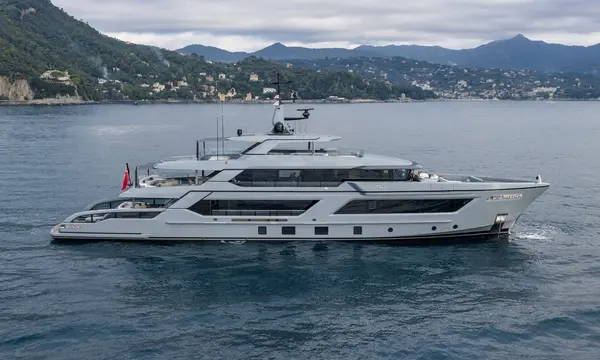
Double triumph at the Boat International Design & Innovation Awards 02.02.2026 Double triumph at the Boat International Design & Innovation Awards Double triumph at …
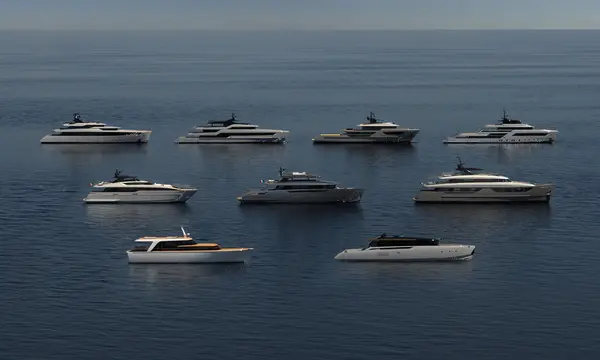
Sanlorenzo’s official news and events area highlights current superyacht innovation, launches and brand activity.
Superyacht Guide
Continue into the wider Superyacht Guide.
Business opportunities · Superyacht Guide
Companies serving the superyacht market can discuss clearly identified advertising, sponsorship and business-profile opportunities. Commercial activity remains separate from independent editorial coverage.