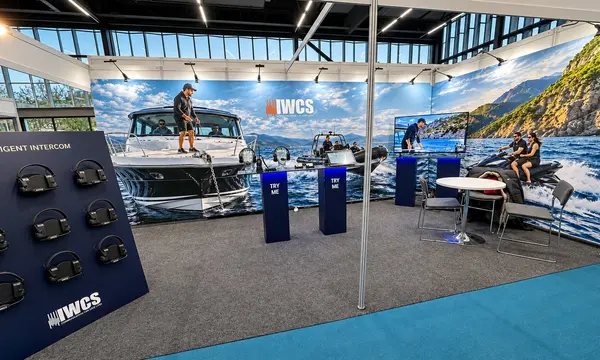
IWCS Reviews Yacht Communications Demonstrations at METSTRADE
IWCS describes three days of product demonstrations and new marine communications contacts at METSTRADE 2026, thanking its distributors and confirming plans for 2027.
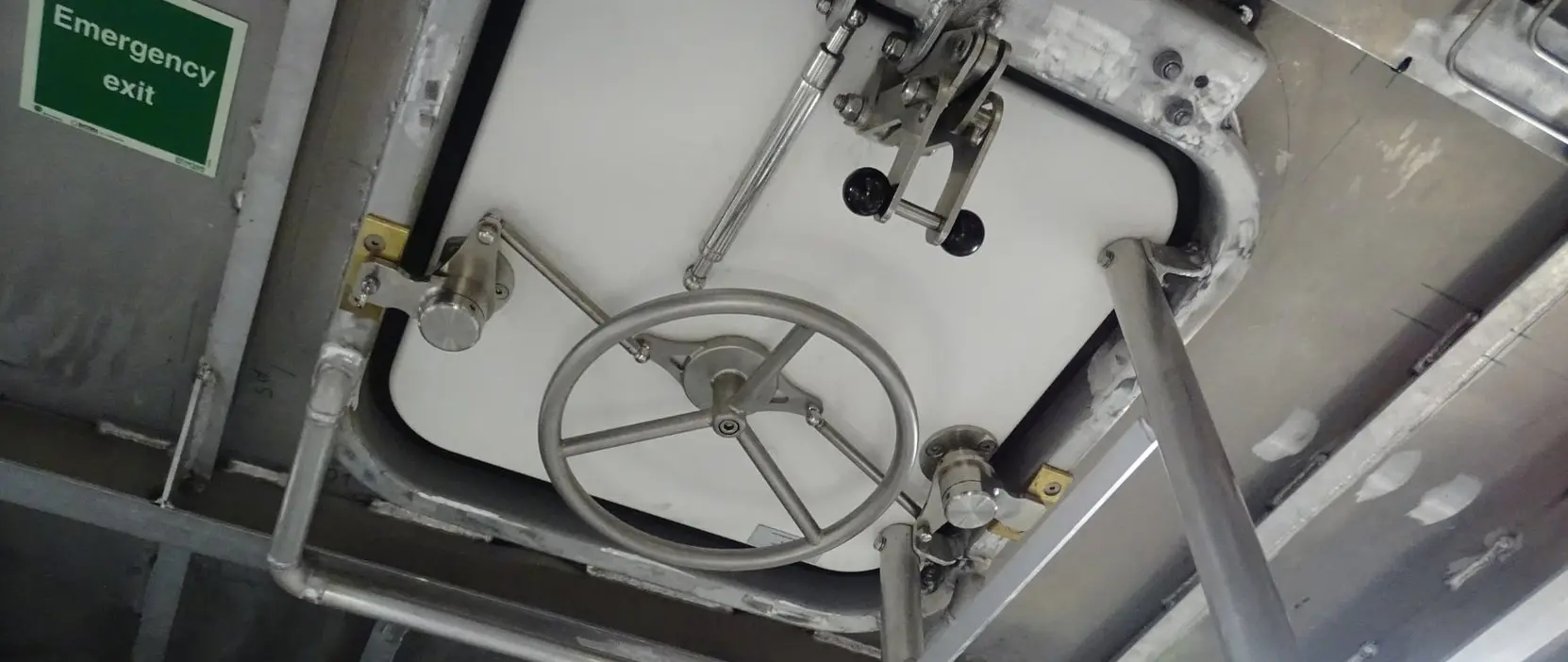
VABO Composites, original company portfolio photograph of a completed marine hatch assembly; illustrative VABO product, not the actual Sunreef project.
VABO Composites says it completed a multi-yacht production programme for Sunreef Yachts in Poland involving FRD60-rated lightweight doors and hatches under DNV approval.
Dutch specialist VABO Composites has completed a series of lightweight doors and hatches for Sunreef Yachts in Poland, according to a manufacturer announcement published on 25 November 2026. The company says the products were developed for installation across several yachts, carry an FRD60 fire rating and were completed under DNV approval. Its account identifies reduced weight as a decisive consideration for Sunreef in selecting the supplier, alongside VABO's established composite engineering experience.
The update is relevant to superyacht construction because apparently modest structural components can affect a yacht's overall weight, fire-safety arrangements and maintenance strategy. The announcement does not identify the Sunreef models involved or provide the mass saved compared with particular metal doors. Those unknowns matter: a completed supply programme is verifiable news, while the actual design benefit on each yacht still requires project-specific engineering data.
VABO describes a series-production assignment in which composite doors and hatches were made for more than one Sunreef vessel. That distinction is useful because the challenge differs from producing a single bespoke component for a demonstration. A series order requires repeatability in dimensions, mounting interfaces, fit, finish and documentation, particularly when components form part of a fire-safety boundary or a watertight arrangement.
The manufacturer's release states that the products were completed, but it does not publish a hull-by-hull delivery list or confirm where each installation stands. Reporting the project as an accomplished manufacturing assignment therefore should not be confused with reporting delivery of specific finished yachts. The underlying news is the completed component work and the technical requirements the supplier says guided its design.
The company explicitly says reduced weight was the deciding factor for Sunreef. In yacht construction, additional mass can influence displacement, draft, stability margins and the allocation of weight to other systems. Replacing a heavier component with a lighter alternative may create useful engineering flexibility, but the net effect depends on its quantity, location and the properties of the material and supporting structure.
On a large luxury catamaran, the distribution of weight also deserves attention. The potential value of a lighter door or hatch should be evaluated within the vessel's overall weight estimate, rather than by multiplying a catalogue saving that has not been published. VABO has not disclosed a percentage reduction in this announcement, so no such figure should be invented. The strongest established claim is that Sunreef considered low mass important enough to select the composite approach.
The doors and hatches are described by their manufacturer as FRD60-rated and completed under DNV approval. Those details are material because they distinguish a safety-related product from a purely decorative lightweight panel. Marine fire boundaries need products that are compatible with the approved design, including seals, frames, fastenings and installation methods. A standalone fire-performance label does not establish suitability for every opening on every vessel.
The announcement should likewise not be interpreted as an independent certification report that lists all test conditions. The precise scope of DNV approval, any applicable drawings and the restrictions on installation would need to be obtained by the responsible shipyard and reviewed in the context of each yacht. A prudent article can record VABO's first-party statement while leaving those additional technical conclusions to documented project evidence.
VABO's broader company materials describe its specialism in composite doors, hatches, masts and superstructure elements. Composite manufacture can give designers flexibility to combine different layers and materials to address a particular structural or functional requirement. The main commercial question is whether that flexibility delivers measurable benefits while satisfying the vessel's approved technical specifications.
A lightweight hatch is not automatically the best solution. Engineers still need to consider repeated operation, hinges, latches, frame movement, seals, exposure to saltwater and the behaviour of a complete assembly under the applicable loads. The underlying material may be only one part of the answer. VABO's update is interesting because it presents lightweight construction and fire-safety requirements as simultaneous project objectives rather than competing marketing claims.
The manufacturer emphasises repeatable engineering, detailing, functionality and finish across the Sunreef order. On luxury yachts, visible and technical components often receive close scrutiny from owners, surveyors and shipyard quality teams. A component can meet its nominal function yet still cause operational frustration if its operation is inconsistent or adjustment becomes difficult after installation.
Production consistency is particularly valuable when multiple vessels use related components. Clear identification of parts, standard fitting procedures and well-maintained drawings can simplify inspections and future replacement. That does not mean every yacht should use identical parts regardless of its design. It means the manufacturer and shipyard need a controlled approach to variants, acceptance checks and the documentation supplied with each completed assembly.
A door or hatch is installed at the junction of several responsibilities. The structural team prepares the opening, designers determine surrounding finishes, electricians may need to accommodate nearby systems, and the safety team checks the required performance of the boundary. If those activities are left until late in construction, even a well-made component can prove difficult to fit or certify in its intended location.
VABO presents collaboration early in a project as part of its working method. For a yard, the practical value lies in obtaining accurate interface drawings, tested details and an installation sequence before the adjoining structure is finalised. The Sunreef assignment offers a contemporary example of a specialist supplying multiple components into a broader yacht-building programme, although the company's statement does not detail the contractual division of installation responsibilities.
Superyachts incorporate a range of technical spaces, accommodation areas, machinery compartments and service routes. Not every door carries the same safety duty, and a product intended for one boundary may not meet the design requirements of another. Selecting an assembly therefore requires the project team to confirm the relevant fire classification, the approved installation method and any associated requirements for closures or emergency operation.
The VABO announcement demonstrates that composites can be considered for demanding door-and-hatch applications when the required performance can be documented. It does not establish that all doors on the referenced Sunreef yachts are composite, or that the same product can replace every conventional steel or aluminium installation. The appropriate conclusion is narrower and more useful: a documented production project exists in which a specialist supplied FRD60-rated composite assemblies.
A well-specified hatch or door should remain serviceable after years of movement, cleaning and environmental exposure. Crew may need to inspect hinges, gaskets, locking systems and surrounding structures, sometimes in locations that are difficult to access. A lighter assembly may make some aspects of operation easier, but that possibility should be assessed against how its components will be maintained and repaired over time.
In a refit, a supplier may be asked to replace a damaged closure or adapt an existing opening. The original manufacturing documentation then becomes especially valuable. Composite repairs or alterations can require specialist procedures and should not be undertaken by assumption. VABO's general expertise in yacht refit applications is relevant background, but the November 2026 Sunreef release concerns new component production, not an announced refit contract.
Sunreef Yachts is a Polish builder known for luxury catamarans. The official VABO statement identifies Sunreef as the customer for this multi-yacht supply assignment, making the collaboration directly relevant to the higher-end multihull sector. The source does not name the hulls or disclose individual dimensions, so an article should not attach the FRD60 products to a particular Sunreef model without independent confirmation.
For the 24-metre-plus superyacht market, the broader interest is the approach to weight and systems integration being applied by a luxury-yacht builder. Manufacturers serving several sizes of craft often develop components whose lessons are relevant beyond one hull length. However, an appropriate installation on a specific large yacht must still be verified against that yacht's classification, arrangement and operating requirements, rather than inferred from the identity of the yard.
VABO is based within the Dutch maritime supply sector and describes more than two decades of experience with composite construction. Its business covers hatches, doors, superstructures and specialist pieces, with work extending into maritime and industrial markets. The company also highlights internal engineering and quality control, giving shipyards an opportunity to discuss more than the physical manufacturing of an individual panel.
The November announcement adds a concrete example to that portfolio by naming a customer, the type of components delivered and a stated fire-performance category. Those are stronger reporting anchors than a general assertion that composites are the future of yachting. They allow buyers and readers to understand what has actually been completed, while reserving technical judgement on performance for the underlying approval documents.
Shipyards face continual pressure to coordinate structural work, equipment deliveries, finishing standards and regulatory checks. Specialist suppliers can help by producing well-documented components with repeatable characteristics, but they also introduce dependencies on material availability, manufacturing lead times and aftersales support. The right balance varies from one project to another, particularly in a fully custom yacht where openings and finishes may not repeat.
The value of the VABO-Sunreef development is therefore not a claim of dramatic savings that the manufacturer has not quantified. It is an example of a builder choosing a lightweight, safety-related composite solution and an established supplier reporting that the required series production has been completed. For other shipyards, the next step would be to examine the actual engineering and approval evidence before deciding whether a similar approach is useful.
The original company announcement is dated 25 November 2026 and identifies the manufacturing assignment, Sunreef Yachts in Poland, FRD60-rated composite doors and hatches, the DNV approval context and weight reduction as a primary selection factor. It does not publish exact units supplied, the dimensions of the affected yachts, individual mass savings, prices, or the specific test certificates. No such figures are added here as established facts.
This precision matters in technical reporting. An item can be newsworthy because a project was completed without pretending that every aspect of the engineering has been independently tested by the newsroom. The next useful evidence for prospective buyers would be installation drawings, relevant approval documentation, operating-life data and a shipyard assessment of the complete closure assembly. Those documents would establish the boundaries of any wider application.
The principal source is VABO Composites' original 25 November 2026 Sunreef project announcement, also listed among the manufacturer's own recent projects. Product and approval descriptions are attributed to VABO. Editorial discussion of engineering implications is analysis, not an unreported Sunreef specification or a certification claim about every yacht.
The accompanying photograph is a separate original VABO portfolio photograph of a marine composite hatch, supplied through the manufacturer's own website image library. It is clearly a representative example of VABO's component manufacturing and **not** a photograph claimed to show the exact Sunreef doors or hatches announced in November 2026. The manufacturer's credit is retained; no AI illustration or photograph sourced from a competing magazine is used.
Continue reading
IWCS describes three days of product demonstrations and new marine communications contacts at METSTRADE 2026, thanking its distributors and confirming plans for 2027.
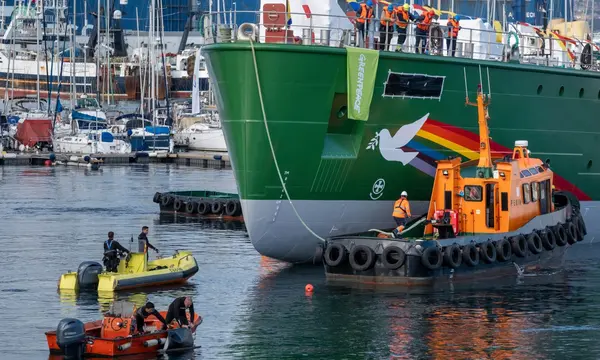
Greenpeace's 75-metre wind-powered campaigning and research ship has floated out at Freire Shipyard in Vigo, combining a DynaRig concept with hybrid onboard energy systems.
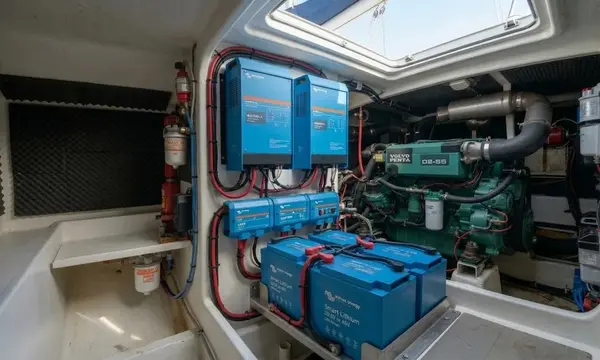
Valencia-based Mediterranean Yachts Solutions describes how 48V batteries, solar panels and high-output alternators may reduce generator use on suitable smaller boats.

AMIT Marine Services reports its 2026 Abu Dhabi International Boat Show appearance, outlining five marine technology and safety sectors and its international brand partnerships.
Superyacht Guide
Continue into the wider Superyacht Guide.
Business opportunities · Superyacht Guide
Companies serving the superyacht market can discuss clearly identified advertising, sponsorship and business-profile opportunities. Commercial activity remains separate from independent editorial coverage.