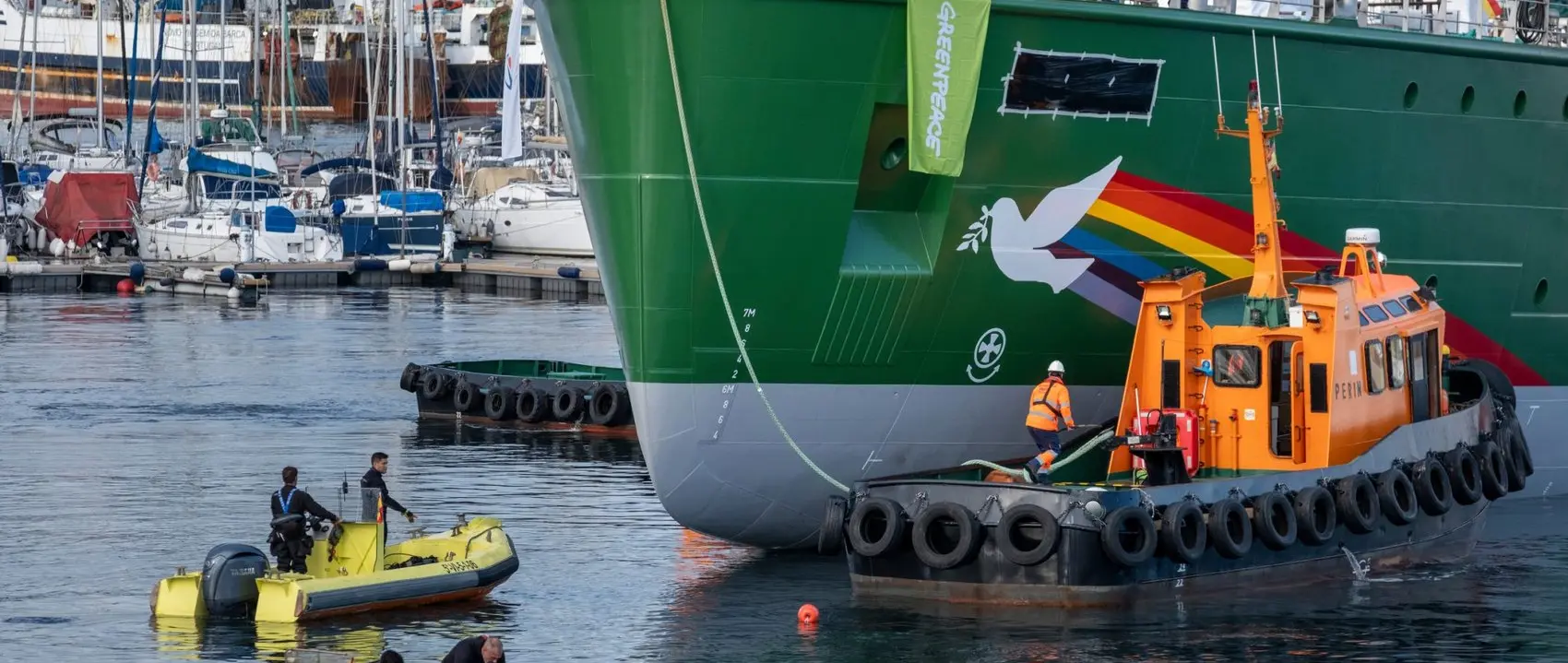
Greenpeace's 75-metre wind-powered campaigning and research ship has floated out at Freire Shipyard in Vigo, combining a DynaRig concept with hybrid onboard energy systems.
A 75-metre vessel reaches the water in Vigo
Greenpeace has confirmed the first float-out of its new 75-metre wind-powered ocean-going ship at Freire Shipyard in Vigo, Spain. The organisation's announcement dated 25 November 2026 marks a significant visible stage in a project intended to support research, campaigning and maritime operations around the world. The vessel is not a privately owned luxury superyacht. It is a purpose-built environmental campaigning and research platform, although its sail technology and system integration invite relevant comparisons with large sailing-yacht design.
A float-out confirms that a hull has reached the water, not that a complete vessel has entered operational service. The organisation still describes further outfitting, testing and commissioning ahead of its intended future use. Treating this milestone accurately is important because the demands of constructing a complex ship extend beyond the spectacular moment when it leaves the building hall.
The role of Freire Shipyard
Freire Shipyard in the Spanish port city of Vigo is responsible for constructing the new vessel. The yard's expertise in specialist ships provides a practical setting for a project with substantial environmental, scientific and operational ambitions. Greenpeace's statement establishes the location and construction milestone, but it does not disclose the complete shipbuilding contract price or suggest that the owner has accepted a finished ship.
A shipyard building a vessel intended for extended ocean passages has to coordinate structural fabrication with an extensive programme of propulsion, sail handling, navigation and safety-system installation. Large custom yacht projects face some of the same interfaces, even though their accommodation briefs and classification arrangements differ. The float-out therefore serves as an indicator of construction progress, not a substitute for later sea trials.
Wind propulsion as a central design choice
The ship is being developed to exploit wind power as a major means of propulsion. Its DynaRig-style sailing arrangement is relevant to the evolution of large sailing yachts, where automated or semi-automated sail handling can reduce some of the effort associated with managing substantial sail areas. Such systems must work with the hull, rigging, controls and machinery to deliver a vessel that can be operated reliably across different routes.
Wind is a variable energy source, so a contemporary sail-assisted ship still needs a comprehensive operational plan. The amount of useful propulsion depends on weather, course, sea conditions and the sail-control system. A claim that wind can supply a significant share of movement is not the same as saying the vessel will never consume fuel. The Greenpeace project illustrates this distinction through its multi-system design.
Two large rotating sailing masts
The published design includes two major sailing masts configured around a DynaRig concept, a method already familiar in the world of large sailing yachts. The approach uses a structured sail plan that can be adjusted through controlled mechanical systems instead of relying entirely on conventional individual sail handling. It is especially relevant where a ship requires a manageable crew workload and predictable operational procedures.
Automation does not remove the need for trained mariners or competent maintenance. Sail equipment and its supporting systems are exposed to significant dynamic forces and the harsh maritime environment. Engineers must consider redundancy, access for inspection, component fatigue and safe operating limits. For superyacht designers, the technology offers useful lessons, but its suitability for a private yacht must still be examined vessel by vessel.
Hybrid energy and alternative fuels
Greenpeace describes a broader low-emission architecture involving sail power and onboard systems intended to reduce dependence on conventional fossil fuel. Its plans include battery storage and other forms of energy management, while hydrogen and alternative fuels form part of the design conversation. Such features should be understood as elements of the published project rather than as evidence that a zero-emission operating record has already been achieved.
Actual emissions will depend on where electricity and fuels originate, how machinery is run and how the vessel travels. A hybrid system can provide flexibility, but the climate effect of any fuel should be evaluated over its production and supply chain as well as at the exhaust. Those details matter to superyachts considering similar technology and should not be obscured by a single marketing description of a ship as green.
Hydrogeneration and the energy budget
Energy recovery from water movement and solar generation are among the approaches discussed around next-generation sailing ships. When properly integrated, renewable sources may help supply some onboard services without relying continuously on engine-driven generators. Their usefulness is ultimately limited by real-world generation, available equipment space and the vessel's electrical demand.
A campaigning and research ship may need to power communications, laboratory or recording equipment, navigation and guest or crew services. These demands persist even when the vessel is making good progress under sail. Designers have to balance available generation against battery capacity and the need for dependable reserves. The practical lesson for yacht owners is that an attractive energy feature should always be considered within a complete load calculation.
Research and campaigning require a working platform
Unlike a charter superyacht focused on hospitality, Greenpeace's vessel is intended to be a platform for environmental fieldwork, advocacy and campaigning. It therefore has to accommodate personnel and equipment that support demanding missions, including operations away from established marine facilities. The published programme reflects a different set of priorities from those of a traditional owner-focused yacht.
That distinction does not make the technical work irrelevant to yachting. Both sectors may face questions about reliable long-range travel, quiet operation, crew workload and system redundancy. The appropriate comparison lies in engineering methods and experience, not in treating the ship as another luxury yacht launch. The project's mission and its still-unfinished status should remain clear throughout coverage.
The challenge of integrating sail and propulsion
Large sail-powered vessels must coordinate their rigs with propulsion machinery and the electrical distribution system. A transition between operating modes may affect noise, equipment loading and the manoeuvring flexibility available to the crew. The safest arrangement is one in which the bridge and engineering teams understand what the system is doing and retain appropriate authority over its operation.
The first float-out does not prove that all these interfaces have completed acceptance tests. Commissioning may involve extensive checks of control systems, rigging and propulsion equipment. Shipyards undertaking custom work routinely confront the gap between equipment that is installed and systems that have been demonstrated as an integrated whole. That is an important reason not to describe a new vessel as delivered before its formal handover.
A potential test bed for low-emission operation
Environmental organisations have a practical interest in examining the impact of their own ships. A purpose-built wind-powered research vessel can provide opportunities to observe how hybrid systems perform over many passages and operating conditions. Credible evidence would include fuel use, electrical demand, operating hours and the circumstances in which different energy sources are employed.
The November announcement does not supply that completed operating history because the ship has not yet entered normal service. Predictions about future savings therefore need to be presented as intentions or engineering expectations, rather than measured fleet results. Yacht designers and owners will be better served by later data from the completed vessel than by precise percentages invented before commissioning.
The technology's relevance to superyachts
Large private sailing yachts have helped demonstrate sophisticated automated rigs and highly integrated power systems. The Greenpeace project sits within the broader technical conversation about using wind, efficient hull design and modern energy equipment together. The potential benefit for the yacht industry is an additional example from a ship with a different operational mission and different constraints.
The transfer of a technology between sectors cannot be assumed to be straightforward. Yacht owners may require a different balance of accommodation volume, aesthetics, deck access and speed. Installation and certification conditions also vary. The most useful insight is that a complex sailing system demands early coordination between naval architecture, rig engineering and the complete onboard energy system.
Testing remains ahead of operational service
Once a hull has been floated out, outfitting and verification continue before the owner can rely on it for demanding international voyages. Equipment may need to be installed or adjusted, and the vessel must complete the inspections and trials applicable to its intended service. Greenpeace's public planning points toward a future operational role rather than declaring that those steps were completed on 25 November.
For audiences following large shipbuilding projects, distinguishing milestones is essential. Keel laying, float-out, launch ceremonies, sea trials, delivery and first deployment refer to different stages. The statement from Vigo concerns the hull entering the water. Future milestones should receive separate reports with dates and evidence when they actually occur.
A maritime project with a public mission
The vessel is designed to carry Greenpeace's work into the places where its campaigns and research are undertaken. That public purpose may influence its equipment and operating arrangements, including the need to work at sea for long periods and communicate with a wider network on shore. The decision to emphasise wind power also forms part of the organisation's message about energy use.
That mission should be described as Greenpeace's own aim, not as an independently verified conclusion about the environmental superiority of the completed ship. A robust assessment will depend on how the vessel performs and the impacts of its construction and maintenance. The most defensible news today is the concrete shipyard milestone and the design direction documented by the organisation.
What the original statement establishes
The first-party release confirms the float-out of a 75-metre ship built at Freire in Vigo for Greenpeace, with wind-powered operation central to its design and future research and campaigning duties. It does not confirm that a paying charter party has taken possession, that a private superyacht has been launched, or that the ship has already completed full ocean trials.
This editorial account identifies the connections with sailing-superyacht engineering as analysis rather than as a claim of a shared owner, contract or certification. That separation preserves the significance of a major specialist shipbuilding project without converting it into a different class of vessel merely because the hull is comparable in length with large yachts.
Source and original float-out photograph
The primary source is Greenpeace España's original announcement of the vessel's first float-out. The ship's purpose, dimensions, yard and progress milestone are attributed to Greenpeace. Technical comparisons with superyacht construction are editorial context, not copied third-party reporting.
The lead photograph is a real image from the Greenpeace announcement showing the new vessel in its shipyard setting. It is credited to Greenpeace and is not a rendering of an imaginary yacht. No separate unrestricted photographic licence, unnamed photographer identity or independently measured emissions figure is invented.