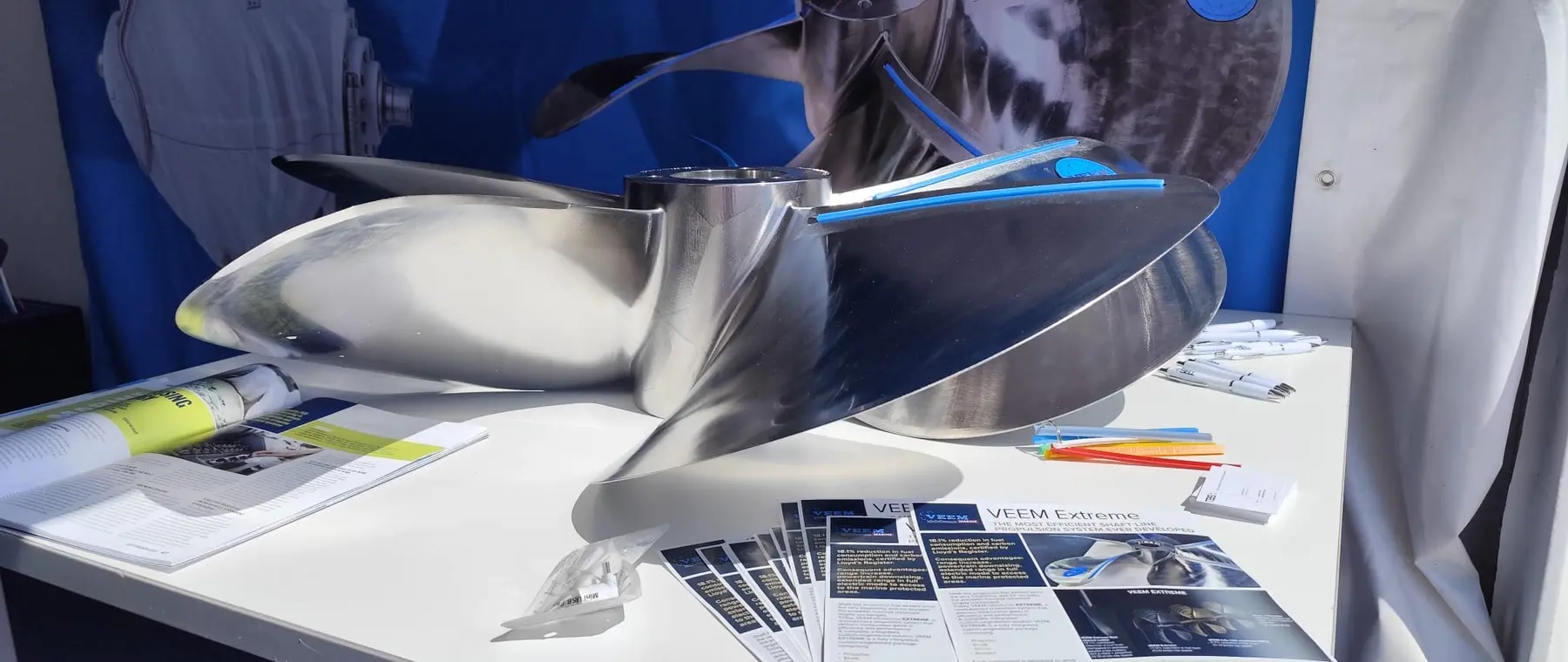
Image: VEEM
VEEM says Lloyd's Register-witnessed trials of its Extreme propeller and rudder delivered 18.1% higher efficiency and 11.9% lower fuel burn.
VEEM says Lloyd's Register-witnessed sea trials of its VEEM Extreme propulsion package delivered an 18.1 percent improvement in propulsion efficiency compared with an industry-standard system. The same trials recorded an 11.9 percent reduction in fuel burn, figures the Australian manufacturer is now using to position the system for wider yacht-builder OEM adoption.
The technology was selected for the 2026 Cannes Yachting Festival Innovation Route and shortlisted in the sustainability category. VEEM's regional agent TBS Marine presented the system in Cannes, giving the company a European showcase for a propulsion package first launched in 2025.
The VEEM Extreme concept combines a precision propeller, twisted rudder and flow-aligned shaft-line approach rather than treating each component independently. The Lloyd's Register-witnessed trial cited by VEEM compared the Extreme propeller and rudder package with a conventional reference system.
VEEM reports an 18.1 percent efficiency improvement from the trial configuration. The company attributes the gains to hydrodynamic design and to a proprietary high-tensile alloy that allows thinner blade sections while retaining the required structural strength.
The same test programme produced an 11.9 percent reduction in fuel burn, according to VEEM. Lower fuel consumption has an immediate operating-cost effect and also reduces emissions for a given vessel profile, although real-world savings will depend on hull form, machinery, loading and operating speed.
The manufacturer also reported a 3.36-knot speed increase in earlier testing of the Extreme propeller and rudder combination. Those figures make the technology relevant not only to efficiency-led yacht projects but also to builders looking for greater performance from a fixed machinery package.
VEEM's proprietary alloy is central to the Extreme range because it allows the propeller blades to be manufactured with thinner sections than conventional materials would normally permit. Thinner blades can reduce drag and help the propeller convert engine power into thrust more efficiently.
The material also allows the company to manage structural loads within the propeller and shaft system differently. For yacht builders, the value will depend on how the component package integrates with the vessel's full propulsion train rather than on the propeller alone.
Selection for the Cannes Innovation Route gives VEEM a route into a market where many production and semi-custom yacht builders are under pressure to improve efficiency without abandoning established diesel propulsion. The company says it intends to support more European builders and owners with Extreme systems following the 2026 show.
The figures remain manufacturer-reported trial results, albeit from testing witnessed by Lloyd's Register, and should not be treated as a guaranteed saving for every yacht. Even so, an 18.1 percent efficiency gain and 11.9 percent fuel reduction are large enough to make the system worth following as it moves into wider OEM use.
Explore
Go deeper into the yachts, companies, events and destinations directly connected to this article.
Continue reading
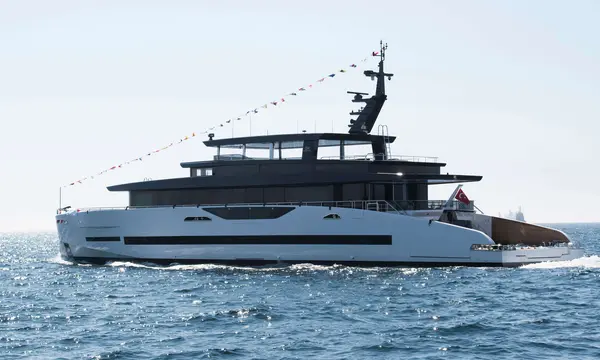
SES Yachts is highlighting the delivered 42m MERINOS at Monaco, where its 940kWh battery bank and solar-assisted hybrid architecture provide the technical focus.
OmniAccess Fusion 2.0 combines multiple LEO and GEO satellite services under one yacht subscription and shared data allowance instead of separate carrier plans.

Quantum says its F45 hybrid stabiliser power system can reduce power use by up to 80% underway and 60% at zero speed while recovering …

Danfoss says the hybrid-electric Waitematā 2 reached 36 knots in full-electric mode, demonstrating a high-power battery architecture with four propulsion lines.
Superyacht Guide
Continue into the wider Superyacht Guide.