
What Happens After You Buy a Superyacht? The First 100 Days of Ownership
Buying the yacht is only the beginning. The first 100 days turn a multimillion-euro acquisition into a functioning yacht operation, covering handover, crew, management, …
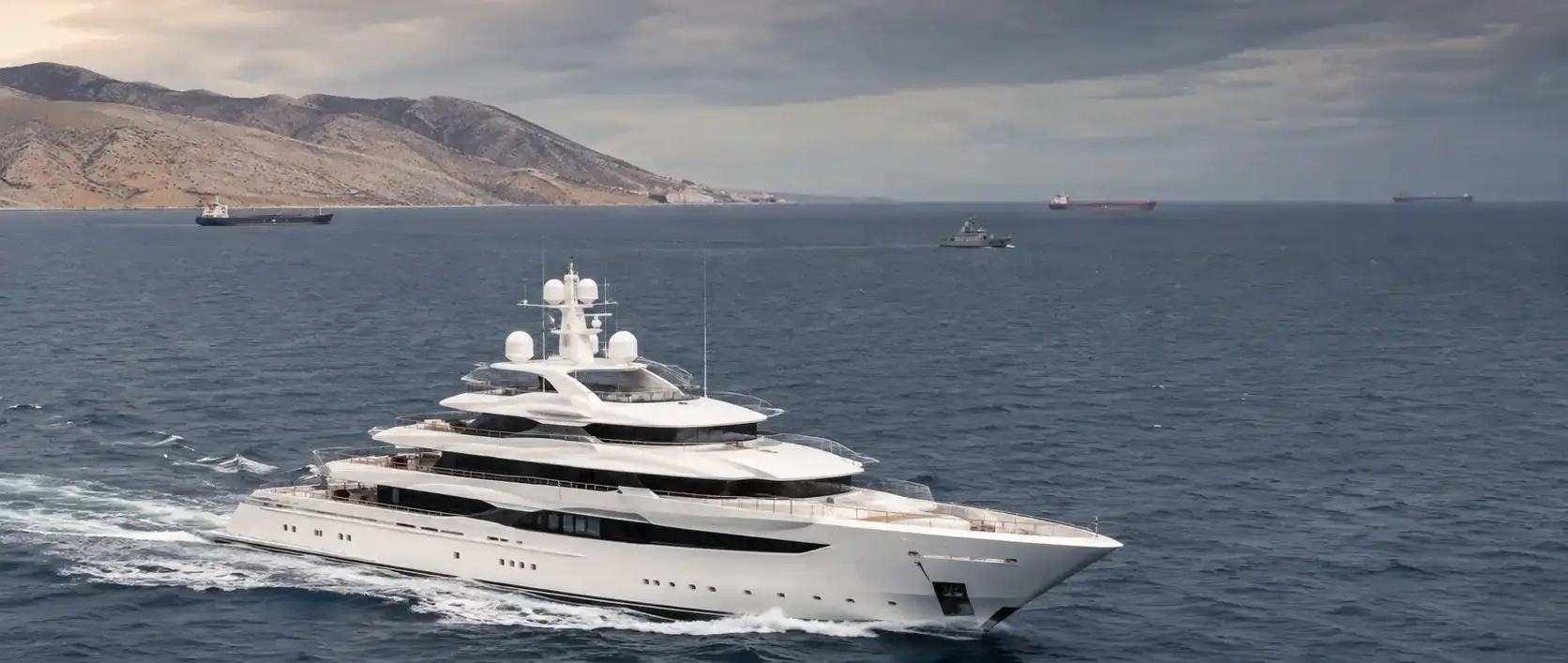
A conflict hundreds of miles from a yacht can still alter its insurance, cruising programme and commercial value. War-risk designations affect where yachts can operate, what cover costs, whether financiers approve a voyage and how buyers assess an asset whose freedom of movement may suddenly be restricted.
A superyacht does not have to be struck by a missile for war to become expensive. The moment a cruising area is classified as presenting an elevated war, terrorism or political risk, an owner's apparently simple decision about where to sail can become an insurance, legal, financial and operational problem.
That distinction matters because yachts are unusually mobile high-value assets. A villa remains where it was built, but a 70-metre yacht may move between the Mediterranean, Red Sea, Gulf, Indian Ocean and Caribbean within a single ownership cycle, meaning that geopolitical events can change the risk attached to the asset without anything physically changing aboard.
For captains and managers, war risk therefore begins well before anybody considers entering an active battlefield. It can affect navigation limits, insurance premiums, crew willingness, lender requirements, charter availability, sanctions checks, fuel planning, resale negotiations and ultimately the owner's freedom to use the yacht as intended.
Marine insurers do not have to regard an entire country or ocean as uninsurable before the economics of a voyage change. The London marine market's Joint War Committee publishes Listed Areas where vessels are considered exposed to heightened war-related perils, and entering those areas may cause underwriters to impose additional terms or premiums.
The current JWLA-034 list demonstrates how broad those exposures can become. It includes defined Black Sea and Sea of Azov waters, a large area encompassing parts of the Persian/Arabian Gulf, Gulf of Oman, Indian Ocean, Gulf of Aden and southern Red Sea, together with named territories elsewhere in the Middle East, Africa, Russia and South America.
Being on the list should not be confused with a blanket prohibition on navigation. The Joint War Committee itself says application of its list to individual contracts is a matter for specific negotiation, while the Lloyd's Market Association has emphasised during the 2026 Gulf crisis that hull war cover continues to be available through the London market.
The practical result is that two yachts making apparently similar voyages can face different insurance outcomes. Their flag, ownership, insured value, policy wording, crew profile, route, speed, security arrangements, intended ports and even timing can all influence how an underwriter views the exposure.
That makes the captain's voyage plan only one part of the decision. Before committing to a conflict-sensitive passage, the owner, manager, broker and insurer may all need to agree that the proposed operation remains inside the yacht's insured trading limits and that any additional war-risk terms have been accepted.
Owners sometimes assume that an expensive all-risks hull policy means almost any physical loss to the yacht will be insured. War and related political perils are commonly treated separately, however, precisely because a conventional hull underwriter cannot price peacetime machinery and navigation risks in the same way as missile attacks, mines, confiscation or politically motivated seizure.
Pantaenius, for example, describes its yacht war, strike and political-acts cover as insurance for risks routinely excluded under standard hull insurance. Its yacht-specific wording includes war and warlike events, political violence, seizure, confiscation and intervention by authorities, subject to the exclusions and geographical limits contained in the policy.
This distinction becomes critical when a yacht moves toward a deteriorating region. The owner may still have perfectly valid hull cover for ordinary accidental losses while discovering that war-related damage in the proposed area requires separate cover, an endorsement, a voyage declaration or an additional premium.
Navigation limits create another layer. Pantaenius states in its current yacht guidance that cover applies within the navigation limits shown in the policy schedule and that planned cruising outside them must be agreed in advance, with premium or conditions potentially changing according to destination, duration and level of risk.
The exact answer always depends on the actual yacht policy rather than a generic industry rule. One owner's policy may allow a voyage after notification and payment of an additional premium, while another underwriter may decline the same exposure completely.
Insurance arrangements around conflict are deliberately capable of changing much faster than ordinary annual yacht policies. War cover frequently contains cancellation and reinstatement mechanisms allowing insurers to reassess exposure when a previously acceptable area becomes materially more dangerous.
A yacht-specific example can be found in Pantaenius's published war, strike and confiscation conditions, which provide for termination of that cover on seven days' notice. Commercial marine arrangements use different wordings and notice periods, so owners should never assume that one insurer's mechanism applies universally.
The speed of the 2026 Middle East changes shows why this matters. In March, insurers issued notices affecting specified war-risk liabilities in Iranian and Persian/Arabian Gulf waters, while on 12 August West of England issued a further cancellation-and-reinstatement notice affecting certain non-mutual war-risk business in defined Indian Ocean, Gulf of Aden and Red Sea waters.
Those notices did not simply mean that every vessel suddenly became uninsured. Gard explains that a Notice of Cancellation is often a mechanism for cancelling existing war-risk terms so that cover can be reinstated on altered conditions, and the precise effect depends on the policy and the category of cover involved.
For a yacht owner, however, that distinction may provide little comfort if a voyage is only days away. A passage that appeared fully insured when the itinerary was approved can suddenly require a new quotation, additional premium, amended navigation warranty or entirely different route before departure.
This is one reason professional yacht management needs active geopolitical monitoring rather than an annual insurance review. The important question is not only what the policy covered when it renewed, but what the insurer will cover when the yacht actually crosses the boundary.
The safest response to a conflict zone is often to stay away from it, but avoiding one stretch of water can transform an itinerary. A route that normally passes through the Red Sea and Suez may require a much longer ocean passage if the yacht instead goes around the Cape of Good Hope, changing fuel consumption, crew scheduling, provisioning, maintenance windows and owner availability.
Commercial shipping has experienced exactly that calculation. Gard has previously estimated that routing around the Cape instead of the Red Sea can add around ten days depending on vessel speed, illustrating how quickly a security decision turns into a voyage-cost decision.
A superyacht may have greater flexibility than a merchant ship carrying contractual cargo, but its operating economics are often less forgiving than they appear. An extra week or two of repositioning can mean large quantities of fuel, additional crew travel, changed berth reservations, lost yard slots and a carefully planned owner itinerary becoming impossible.
Paying the additional war-risk premium is therefore only one side of the calculation. The yacht must compare the cost and insurability of the shorter route with the fuel, time, maintenance and schedule consequences of the safer alternative.
Insurance availability should also never be mistaken for a declaration that a route is safe. The LMA made that point directly during the 2026 Strait of Hormuz crisis, arguing that reduced traffic was being driven substantially by physical safety concerns even while marine war cover remained available.
The captain's judgement consequently remains central. An insurer may be prepared to quote a risk, but the captain still has to decide whether the yacht, guests and crew can reasonably make the passage within the vessel's safety-management, flag-state and operational responsibilities.
Modern war risk is not confined to physical violence. A yacht can remain well away from missile fire yet encounter serious problems because the voyage involves a sanctioned port, counterparty, authority, payment mechanism or beneficial owner.
This is particularly important to superyachts because their operations involve a long financial chain. Owners, owning companies, managers, insurers, reinsurers, banks, fuel suppliers, agents, charterers and service providers may all sit in different jurisdictions and therefore face different sanctions obligations.
The 2026 Strait of Hormuz situation illustrates the problem. The Lloyd's Market Association highlighted U.S. sanctions guidance concerning proposed payments for safe passage and warned that transactions involving designated Iranian entities could create sanctions exposure independently of the physical navigation risk.
The LMA subsequently introduced a model clause addressing transit-fee or other payments associated with passage through the Strait of Hormuz. Its purpose was to give hull underwriters greater clarity where payments connected to a vessel's transit could engage sanctions or terrorism legislation.
For a yacht, this means that obtaining war-risk insurance is not necessarily enough to make a voyage executable. A bank may refuse a payment, an insurer may be legally unable to respond to a claim involving a sanctioned party, or a management company may conclude that the compliance exposure is unacceptable even where the sea route itself remains open.
The correct response is therefore due diligence rather than improvisation. Captains and yacht managers should not be expected to interpret sanctions regimes alone, and owners operating near affected jurisdictions need advice from their insurers, brokers, banks and qualified sanctions counsel before financial arrangements are made.
A yacht is not simply an insured hull moving between coordinates. It is a workplace containing people whose willingness and legal ability to enter an unstable region can become as important as the owner's wishes.
Crew may have individual concerns about missile attacks, mines, piracy, detention or being stranded if an airport or waterway closes. Nationality can also matter because governments may issue different travel advice or impose different restrictions on their citizens, while visas and immigration arrangements can deteriorate rapidly during a crisis.
The consequences extend to recruitment and retention. A yacht repeatedly operating near conflict may become less attractive to some experienced crew, potentially increasing rotation requirements or making key positions more difficult to fill.
Evacuation planning also becomes more important as the yacht gets closer to an unstable region. Managers need to consider not only whether the vessel can escape by sea but whether injured, frightened or relieved crew can be moved ashore and flown home if the political environment changes.
Medical capability, communications and security intelligence consequently become part of route planning. A yacht fitted for comfortable Mediterranean cruising may technically possess the range to enter a conflict-sensitive area without necessarily possessing the operational resilience that a responsible captain would want before doing so.
The owner may ultimately decide that no destination is valuable enough to justify these complications. That is not an insurance decision alone, but insurance often forces the conversation by attaching an immediate financial cost to risks that might otherwise appear abstract.
The most subtle effect of war risk appears when the yacht is offered for sale. A yacht can be physically immaculate and still become commercially less attractive if its location, ownership structure or expected cruising programme makes acquisition complicated.
Market value is partly a reflection of utility. If a buyer believes a yacht can be freely moved, insured, financed, crewed and operated throughout the places they want to cruise, the asset offers greater practical utility than an otherwise identical yacht trapped behind a high-risk route or facing uncertain insurance terms.
Location can therefore matter at the moment of sale. A buyer examining a yacht in a stable Mediterranean port may see a straightforward survey, sea trial and delivery, while the same yacht positioned inside a conflict-sensitive region can involve additional insurance, security, logistics and uncertainty before ownership can even begin.
That does not produce an automatic percentage reduction in market value. Instead, it can reduce the number of willing buyers, increase the cost of completing a transaction and strengthen the negotiating position of anyone prepared to accept the additional risk.
Financing can magnify the effect. Howden notes that war-risk cover is frequently required under loan covenants and other marine contracts, so a lender's insurance requirements may become another practical restriction on where a financed yacht can operate.
Insured value should also be distinguished from market value. Pantaenius, for example, uses an agreed fixed value in its superyacht programme for insured total-loss purposes, demonstrating that a policy valuation can remain a contractual figure even while the real-world marketability of the yacht changes.
A conflict-zone discount is consequently better understood as a liquidity and utility problem than as physical depreciation. The yacht itself may be unchanged, but the cost and difficulty of transferring, operating or insuring it can alter what a buyer is prepared to pay today.
Owners naturally focus on the danger of entering a conflict zone, but one of the more serious risks is losing the ability to leave. Ports can close, mines can make channels unsafe, insurers can alter terms, airspace can shut and authorities can impose restrictions with very little notice.
Commercial shipping has already demonstrated how prolonged entrapment creates problems far beyond the original conflict. Allianz has highlighted the maintenance, crew-welfare, insurance and claims difficulties that arise when vessels cannot safely leave affected Black Sea ports.
A yacht has additional vulnerabilities because much of its value depends on intensive maintenance. Paint, machinery, generators, batteries, chilled-water systems, tenders and interior systems continue ageing whether the owner can use the vessel or not.
Specialist war policies may address prolonged deprivation or trapping, but the definitions are policy-specific. Pantaenius's yacht wording, for example, contains defined periods after which certain seizure or war-related loss of use may be treated as a total loss, but another yacht's policy may respond differently.
That makes exit planning as important as entry approval. Before approaching a rapidly deteriorating region, the captain and manager should understand what happens if the intended port closes tomorrow rather than merely whether it is accessible today.
Fuel reserves, alternative ports, range, visa arrangements, crew relief and alternative insurance permissions all become relevant. The best war-risk strategy is often the one that preserves the greatest number of options if the owner's original plan stops being possible.
For most superyachts, conflict-zone planning should not begin with the question, “Can we get insurance?” The better starting point is whether there is a sufficiently compelling reason for the yacht to accept the combination of physical, financial, legal and human risk involved.
If the voyage remains desirable, the yacht can then establish the precise insurance position. That means checking hull and machinery cover, war cover, P&I or liability arrangements, navigation limits, additional premiums, lender requirements and any endorsements applying to the intended route.
The legal review runs in parallel rather than afterward. Ownership, beneficial ownership, banking, suppliers, ports and proposed payments may all need sanctions screening, especially where the conflict involves heavily restricted states or designated organisations.
The captain then has to translate those approvals into an operational plan. Weather routing, fuel, security information, communications, crew welfare, emergency alternatives and the ability to reverse course all matter more than the theoretical shortest track between two destinations.
Finally, the owner needs to understand that every decision has a price even when nothing goes wrong. Additional insurance, longer passages, more fuel, missed charter weeks, changed owner itineraries and weaker resale liquidity are all real economic consequences of geopolitical risk.
The essential lesson is that a superyacht's mobility is both one of its greatest advantages and one of its greatest exposures. Conflict can redraw the practical cruising map overnight, and when that happens the yacht's insurance, routing and commercial value begin changing long before the vessel itself comes anywhere near the fighting.
Continue reading
Buying the yacht is only the beginning. The first 100 days turn a multimillion-euro acquisition into a functioning yacht operation, covering handover, crew, management, …
D-Marin UAE marina customers can now access marine insurance advice and risk-management services through ult. Insurance, with placement and claims handled by the broker.
The 37m sailing yacht RADIANCE hosted the first joint manta-ray surveys by Fiji and New Zealand researchers in the northern Lau Group, documenting baseline …
The 54.7m BUCCARA LATITUDE has been photographed in Germany’s Kiel Canal while sailing westward, highlighting a 1973 commercial vessel converted into an explorer yacht.
Superyacht Guide
Continue into the wider Superyacht Guide.
Business opportunities · Superyacht Guide
Companies serving the superyacht market can discuss clearly identified advertising, sponsorship and business-profile opportunities. Commercial activity remains separate from independent editorial coverage.