
Company
MYBA - The Worldwide Yachting Association
Explore the company profile and related Superyacht Guide coverage.
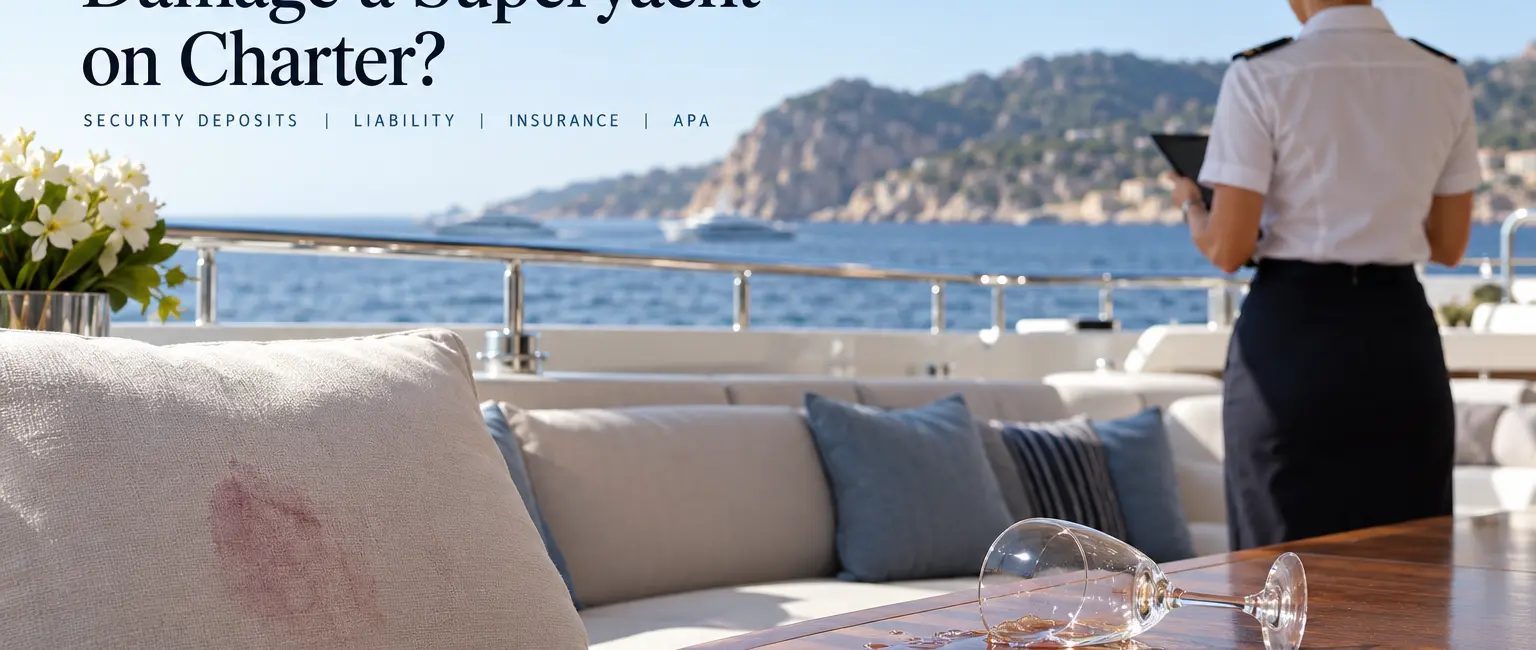
Guest-caused damage on a superyacht charter can involve the security deposit, the yacht's insurance and separate charterer liability. Superyacht Guide explains where APA ends, what MYBA's agreement says and what happens when repair costs exceed the deposit.
A superyacht charter is designed to feel effortless, but the vessel itself may be worth tens or hundreds of millions of euros and contain bespoke furniture, stone, artwork, tenders, water toys and technical equipment that can be expensive to repair. That creates an uncomfortable question for guests: what actually happens if someone in the charter party damages the yacht?
The answer is not that every broken glass or stained cushion produces a claim. Professional crews deal with ordinary wear, minor accidents and routine breakages all the time, but the position changes when damage is material, clearly attributable to a guest, or creates a liability that the owner cannot recover under the yacht's insurance.
The MYBA Charter Agreement requires the owner to insure the yacht against customary risks for a vessel of its size, value and type, including third-party liabilities and specified watersports exposures. That protects the vessel and the operation, but it does not give a charterer unlimited protection from the consequences of their own actions.
MYBA's agreement states that the charterer remains liable for loss, damage or liabilities arising from an act or negligence of the charterer or their guests when that loss is not recoverable by the owner under the yacht's insurance. In practical terms, the existence of a substantial hull-and-liability policy does not mean that every guest-caused incident simply disappears into an insurance claim.
A security deposit and the Advance Provisioning Allowance perform different jobs. APA is a working account used to fund variable charter expenses such as fuel, food, drinks, berthing and other agreed operating costs, while a security deposit exists to protect against damage or liability for which the charterer may be responsible.
Under Clause 17 of the MYBA Charter Agreement, the security deposit is held by the stakeholder on the owner's behalf and may be used towards damage or liability incurred by the charterer under the agreement. If it is not required, the agreement provides for the deposit to be returned without interest after the charter or after outstanding questions are settled, whichever occurs later.
The security deposit is also separate from a crew gratuity. A tip is a discretionary recognition of service, whereas a security deposit is contractual protection against specified liabilities, so the two should never be treated as interchangeable parts of the charter budget.
There is a large difference between normal use of a yacht and negligence. A wine glass broken during dinner, a towel accidentally marked with sunscreen or routine wear to guest areas may be treated very differently from a damaged piece of bespoke furniture, misuse of a jet ski, an unauthorised party, smoking damage, a blocked system caused by prohibited material or an incident that follows a direct safety instruction being ignored.
The key issue is usually not whether something went wrong, but what caused it and whether the loss falls within the responsibilities allocated by the charter agreement. MYBA requires the yacht to be re-delivered in as good a condition as at delivery except for fair wear and tear arising from ordinary use, which is an important distinction between normal charter activity and potentially recoverable damage.
The professional response should be evidence rather than argument. The captain and crew can document the damage, preserve photographs or other records, establish what happened, notify the relevant broker or management representatives where required and obtain a realistic assessment of the likely repair cost before money is retained or a final claim is made.
That distinction matters because a visible mark on a piece of furniture does not automatically tell anyone the actual financial loss. A repair may cost less than initially feared, while damage to a specialist finish or custom component can require removal, transport, specialist labour and replacement work that is disproportionately expensive.
APA should not be treated as though it were automatically a damage deposit. Its primary purpose is to fund the variable expenses of the charter, and the MYBA agreement requires the captain to account for APA expenditure and return or settle the resulting balance at the end of the charter.
A guest-caused damage issue can still become part of the overall end-of-charter financial discussion because the captain, broker and stakeholder may need to reconcile money held and identify a separate security-deposit claim. The important point is that normal APA expenditure and contractual liability for damage are different concepts and should be accounted for as such.
One of the most important parts of Clause 16 is easy to overlook: the MYBA Charter Agreement says that neither Charterer's Liability Insurance nor Cancellation and Curtailment Insurance are included in the agreement. MYBA separately requires the owner to maintain yacht insurance, but the charterer can still face liability for guest-caused losses that are not recoverable under that policy.
For a high-value booking, it is sensible to ask the broker or an appropriate insurance adviser whether separate Charterer's Liability cover is suitable. This is distinct from cancellation, medical and personal-effects insurance, each of which addresses a different risk.
A security deposit is a source of funds, not necessarily a contractual cap on liability. MYBA's wording allows the deposit to be used towards damage or liability, while its insurance clause separately preserves the charterer's responsibility for relevant losses that are not recoverable by the owner under the yacht's insurance.
That means a serious incident can potentially exceed the amount being held. The actual outcome will depend on the signed agreement, evidence, applicable law and insurance, but a charterer should not assume that the most they could ever owe is automatically limited to the value of the security deposit.
Modern charter yachts can carry jet skis, tenders, e-foils, diving equipment and other high-value toys, and some of the most serious guest incidents occur away from the main vessel. MYBA's insurance clause specifically addresses liabilities arising from authorised use of personal watercraft and other watersports equipment, illustrating how closely insurance, competence and the captain's permission are connected.
The captain also has authority to stop a charterer or guest using watersports equipment where they are unsafe, acting irresponsibly, under the influence of alcohol or failing to show due concern for people or property. Ignoring that instruction can therefore turn a leisure activity into a safety, insurance and liability problem.
Before signing, ask the broker to identify the security deposit, the circumstances in which it can be used, whether Charterer's Liability Insurance is appropriate and how guest-caused damage is handled under the specific agreement. The same conversation should separate the deposit from APA, because the two pools of money exist for fundamentally different reasons.
Once aboard, the simplest protection is also the most obvious: follow the captain's instructions, use equipment as briefed and report accidental damage promptly rather than hoping nobody notices. Most charter incidents can be dealt with professionally when everyone is clear about what happened, while disputes become much harder when the facts, costs or responsibility are obscured; individual liability ultimately depends on the signed contract, insurance and applicable law.
Explore
Go deeper into the yachts, companies, events and destinations directly connected to this article.
Company
Explore the company profile and related Superyacht Guide coverage.
Continue reading
Yes, some superyachts can be chartered for three days, but minimum terms and pricing are yacht-specific. Depending on the contract, a short booking can …
Superyacht crew gratuities remain discretionary, and MYBA has removed its former percentage recommendation in updated 2026 guidance. We compare current broker tipping ranges, explain …
Chartering outside the traditional summer peak can bring quieter destinations, greater yacht availability and sometimes lower rates. Weather, positioning, operating schedules and the yacht's …
Difficult charter guests are not necessarily the most demanding. The hardest groups to serve are often those whose expectations are unclear, contradictory or constantly …
Superyacht Guide
Continue into the wider Superyacht Guide.
Business opportunities · Superyacht Guide
Companies serving the superyacht market can discuss clearly identified advertising, sponsorship and business-profile opportunities. Commercial activity remains separate from independent editorial coverage.