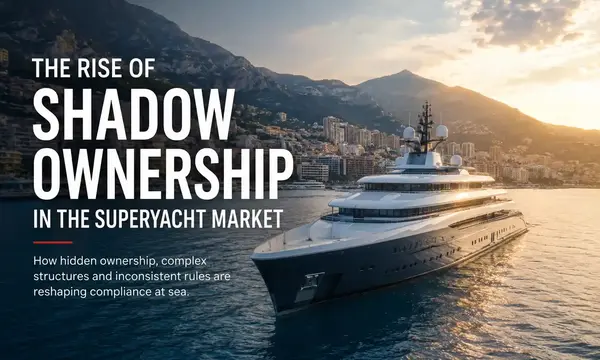
The Rise of Shadow Ownership in the Superyacht Market
Corporate structures are a routine part of superyacht ownership, but the compliance risk changes when they obscure the person who ultimately owns or controls …

Registration documents may identify the company holding legal title to a superyacht, but they do not always reveal the individual who directs its movements, pays its bills or enjoys its private use. When ownership is disputed, investigators look beyond the name on the certificate and reconstruct control through money, instructions, access and conduct.
A superyacht may be registered in the name of a company that owns no other substantial asset, employs no shore-based staff and conducts no visible business beyond holding the vessel. That arrangement is not inherently improper. Single-purpose companies are widely used to separate liabilities, organise finance, simplify administration and place ownership within an appropriate legal and regulatory structure.
The difficulty begins when the registered owner does not explain who is making the important decisions. A company may hold title while instructions come from a family office, payments arrive through another entity and the yacht is used almost exclusively by one individual and their guests. In those circumstances, the ownership certificate remains important, but it becomes only the first page of a much larger evidential record.
Financial-crime and sanctions frameworks distinguish between formal ownership and ultimate beneficial ownership or control. The Financial Action Task Force defines a beneficial owner as the natural person who ultimately owns or controls a legal person, including someone exercising ultimate effective control even where the position is not apparent from the share register. FATF guidance also makes clear that ownership thresholds are not the only means of identifying control because influence may be exercised through voting rights, agreements, personal relationships or other practical mechanisms.
For a superyacht, the central question is therefore rarely limited to whose company name appears on the registry. Investigators seek to establish who pays for the yacht, who gives instructions, who makes the significant decisions and who receives the principal private benefit from its use.
The registered owner has a formal legal position that cannot simply be ignored. Registration records, bills of sale, mortgages, corporate filings and ownership declarations establish the documentary chain through which the yacht is held. Where those records are genuine, consistent and supported by lawful transactions, they may provide strong evidence of ownership.
They may not, however, establish the full picture of practical control. A company can be directed by another company, held through a trust or administered by professional directors who act on instructions received elsewhere. The individual using the yacht may have no direct shareholding in the registered owner, yet still possess the practical ability to determine where the yacht travels, who is welcomed aboard and which expenses are approved.
The Financial Action Task Force guidance on beneficial ownership describes the search for the natural person at the end of the ownership or control chain. It recognises that control may exist beyond a simple percentage of shares and may be exercised through influence over appointments, voting arrangements, financing, family relationships or the ability to direct important corporate decisions.
This distinction matters because different legal systems apply different tests. Under the United States Treasury’s Office of Foreign Assets Control rules, an entity is automatically treated as blocked when one or more blocked persons own at least 50 per cent of it directly or indirectly in aggregate. OFAC states, however, that control without the required ownership percentage does not itself trigger that automatic rule, although dealings involving a blocked person may still be prohibited for other reasons.
The United Kingdom uses an ownership-and-control framework that can extend restrictions to an entity where a designated person holds more than half its shares or voting rights, can appoint or remove a majority of its board, or can ensure that its affairs are conducted according to that person’s wishes. The purpose is to prevent restrictions from being defeated merely by placing assets or companies behind nominal intermediaries.
The same yacht structure may consequently be examined differently depending upon the jurisdiction, the legal power being used and the evidence available. Investigators must first identify the applicable test before deciding which facts carry the greatest weight.
Operating a large yacht requires a continuous flow of money. Crew wages, marina fees, fuel, insurance, management charges, class surveys, repairs, provisioning, aviation support and refits generate an extensive financial record. Those payments can provide a more revealing account of control than a company’s registered address or list of directors.
Investigators may examine who funds the owning company and whether those funds arise from genuine corporate income, documented loans, capital contributions or transfers from related parties. Repeated payments from the same individual, family office or associated business may suggest that the yacht’s formal owner is financially dependent upon someone outside the apparent ownership chain.
The route taken by the funds can also matter. Money may pass through several companies before reaching the yacht’s manager, payroll provider or shipyard. A layered payment chain is not automatically suspicious because international yacht ownership often involves banks, holding companies, trusts and professional administrators in different jurisdictions. The evidential question is whether the transactions have a coherent commercial explanation and whether the parties identified in the documents match the people directing the yacht.
Invoices reveal more than amounts. They show who is addressed, who receives copies, who disputes charges and who approves additional expenditure. A person who repeatedly authorises refit variations, negotiates insurance claims or releases substantial payments may exercise more practical influence than a nominal director whose name appears only on statutory paperwork.
Crew payroll is particularly informative because it connects ownership structures with the people running the asset. Investigators may ask which company employs the crew, who funds the payroll account and who intervenes when salaries, bonuses or termination payments are discussed. The same analysis can be applied to management fees because the party appointing and paying the yacht manager may possess important rights of instruction.
Financial evidence must still be interpreted cautiously. A relative, lender or affiliated company may fund the yacht under a legitimate loan or support arrangement without becoming its owner. A family office may administer payments for several assets without holding beneficial title to any of them. The strength of the evidence comes from the way funding aligns with instructions, use and decision-making rather than from one transfer viewed in isolation.
A yacht produces a large volume of communications between captains, managers, owners’ representatives, shipyards, brokers, lawyers, accountants and suppliers. When control is disputed, those communications can show who possesses the authority to make decisions that materially affect the vessel.
Routine requests are not always decisive. An owner’s guest may ask for a change of restaurant or an earlier tender without exercising control over the owning company. Investigators are more interested in decisions involving significant cost, risk or long-term commitment, such as approving a refit, appointing a manager, changing flag, entering a charter programme or authorising the sale of the yacht.
The captain’s reporting line can be especially important. A management agreement may state that instructions come from a corporate director, but in practice the captain may report directly to an individual, family member or personal assistant. Emails, messaging records and meeting notes can establish whether the formal chain of authority was followed or merely existed on paper.
The same applies to shipyard work. Major projects generate technical specifications, quotations, variation orders and approval records. The person who selects the designer, changes the interior, approves additional expenditure or decides whether the yacht will remain in the yard may demonstrate substantial practical control.
Professional intermediaries can complicate the record. Lawyers, trustees, directors and managers may communicate instructions in their own names while acting for another party. Investigators therefore examine whether the intermediary exercised genuine independent judgement or simply transmitted decisions already made elsewhere.
FATF guidance recognises that control can arise through mechanisms other than share ownership, including personal connections to formal decision-makers or participation in financing and management decisions. That does not mean every influential adviser becomes the beneficial owner, but it does mean that the legal analysis cannot stop at the corporate chart.
A yacht’s pattern of use may provide another important part of the evidential picture. Investigators can examine who occupies the owner’s suite, who determines the itinerary, whose family and associates are carried and whether the yacht’s movements repeatedly correspond with one person’s travel and social programme.
Occasional use is not conclusive. A genuine charterer, friend or family member may enjoy extensive access without owning or controlling the yacht. The significance increases where the same person receives exclusive or preferential use over a long period, bears little or no charter cost and can displace other planned activity at will.
Guest lists, preference forms, aviation movements, security arrangements and crew instructions may help reconstruct who was expected aboard and how the yacht was prepared for them. Provisioning records can show whether the vessel was routinely configured around one household’s preferences, while invoices for transport, entertainment and personal services may link the yacht’s activity to the same beneficiary.
Itinerary control can also be revealing. The person who decides where the yacht will spend the season, when it will reposition and whether it will interrupt maintenance to accommodate a private trip may possess a degree of authority inconsistent with being merely an occasional guest.
Use evidence is strongest when combined with financial and corporate records. A person who enjoys the yacht but neither funds nor directs it may be a beneficiary without being the controlling owner. A person who funds the operation, issues instructions and receives exclusive use presents a much more coherent case of practical control.
Investigators must also distinguish between private use and commercial activity. A yacht may be genuinely chartered through an operating company, and its beneficial owner may use it under documented charter arrangements on the same terms as other clients. The quality of the contracts, payments and booking records will influence whether those arrangements appear commercially genuine or merely formalise private use after the event.
Captains and yacht managers are often among the few people who can describe how authority worked in practice. They know who received operational reports, who approved unusual expenditure and whose instructions took priority when several representatives expressed different wishes.
Their evidence is valuable because formal documents may not capture daily reality. A company director may sign contracts, while the captain knows that no important decision was taken without approval from another individual. A manager may administer the yacht, while recognising that budgets and itineraries were effectively controlled by a family office or personal adviser.
This places maritime professionals in a difficult position when disputes arise. They may be required to preserve documents, answer questions or provide evidence concerning relationships that were previously treated as confidential. Their duty is not to speculate about ultimate ownership but to describe accurately who gave instructions, how payments were handled and what records were maintained.
Contemporaneous documents usually carry greater weight than memories reconstructed years later. Well-kept management reports, approval logs, employment records and technical correspondence can demonstrate the actual chain of authority without asking the captain to interpret legal concepts beyond their expertise.
The reverse is also true. Informal working practices can create serious ambiguity. Shared email accounts, unrecorded telephone instructions and payments approved through messaging applications may allow the yacht to operate efficiently in the short term while leaving a poor evidential record. When ownership is later challenged, the absence of formal governance may harm both the owning company and those who dealt with it.
An owner who values privacy should therefore not confuse discretion with a lack of records. Clear instructions, documented authority and proper separation between the company, the owner’s representative and the crew provide stronger protection than an arrangement in which everybody understands the relationship but nothing is written down.
Not every yacht has one individual exercising every form of authority. Legal ownership, financial responsibility and operational direction can be divided among several people or institutions. A trustee may hold shares, a lender may restrict major expenditure, a family office may fund operations and a principal beneficiary may determine private use.
The fact that control is shared does not make the structure improper. It does, however, make simplistic statements about ownership less reliable. Investigators may need to identify different forms of control for different legal purposes, including corporate control, beneficial ownership, sanctions exposure and rights over the physical asset.
A lender with a mortgage may possess strong contractual rights without becoming the beneficial owner. A manager may direct the yacht’s daily operation under delegated authority while remaining accountable to the owning company. A captain holds overriding authority in safety matters, but that professional authority does not make the captain the owner of the vessel.
Trust structures require particular care because legal title and beneficial enjoyment are intentionally separated. FATF guidance on legal arrangements recognises that trustees, settlors, protectors, beneficiaries and any other person exercising ultimate effective control may all be relevant to beneficial-ownership analysis.
The purpose of the investigation is therefore not to force every relationship into one category. It is to identify who held which power, how that power was exercised and whether the declared structure accurately reflected the yacht’s real operation.
Brokers, managers, shipyards, marinas, insurers and professional advisers face their own exposure when accepting instructions or payments from yacht-owning structures. A certificate of registry may confirm the vessel’s formal owner, but it may not be sufficient to establish who ultimately owns or controls the company or who benefits from the transaction.
The US Office of Foreign Assets Control urges parties dealing with complex structures to conduct appropriate due diligence to determine relevant direct and indirect ownership interests. Its guidance also warns that even where an entity is not automatically blocked under the 50 per cent rule, transactions involving a blocked person acting on its behalf may still be prohibited.
UK guidance similarly advises businesses to examine whether an entity’s affairs are carried out under the direction of a designated person rather than relying exclusively upon the absence of the company’s name from a sanctions list. This requires businesses to consider practical influence and authority alongside the formal corporate ownership record.
For yacht businesses, proportionate due diligence may include reviewing the ownership chain, identifying the natural persons behind the structure, understanding the source of funds and confirming who is authorised to issue instructions. Unexplained changes in ownership, sudden substitutions of paying entities or reluctance to identify the principal may require further examination.
Due diligence should not become an assumption that every offshore company or private yacht is suspicious. Legitimate structures deserve accurate treatment, and service providers should avoid making unsupported allegations based on nationality, wealth or corporate jurisdiction. The objective is to obtain enough reliable information to understand the relationship and comply with the laws that apply.
The best protection is consistency. The person identified as the authorised representative should correspond with the person giving instructions, and the funding route should match the documented ownership and contractual arrangements. Where those elements diverge, the discrepancy should be understood before the business proceeds.
No single document necessarily proves who controls a superyacht. Registration may establish title, but not practical influence. Bank transfers may establish funding, but not ownership. Guest records may establish use, but not authority. Emails may demonstrate instructions, but not the legal basis upon which they were given.
The evidential case emerges when these separate records point in the same direction. The same individual may appear behind the funding, the itinerary, the refit approvals, the employment decisions and the exclusive private use of the yacht. Alternatively, the records may support the declared structure by showing that directors exercised real authority, transactions were properly documented and private users dealt with the yacht through genuine contractual arrangements.
This is why record control has become so important in modern yacht ownership. Corporate registers, contracts, invoices, crew records, management correspondence and technical approvals are not merely administrative material. Together, they explain how the asset was governed.
When the records are incomplete, investigators may draw inferences from patterns of behaviour, but uncertainty increases for everyone involved. The owning company may struggle to defend its position, service providers may be unable to demonstrate adequate due diligence and innocent parties may find their rights tied up in a wider ownership dispute.
A transparent and professionally governed yacht structure does not require the owner’s identity to be advertised publicly. It requires the relevant registries, banks, insurers, advisers and contractual counterparties to understand who holds authority and where responsibility lies.
The question of who owns the yacht may therefore have several answers. One company may hold legal title, another may provide finance and an individual may receive the principal private benefit. The task for investigators is to determine whether those roles reflect a legitimate and properly documented arrangement or whether they have been constructed to conceal the person exercising ultimate control.
For owners, the lesson is straightforward. Privacy can be preserved through disciplined governance, but anonymity created by confused payments, informal instructions and nominal decision-makers may not survive serious scrutiny. When a yacht becomes the subject of an investigation, the people examining it will follow the money, the messages, the decisions and the use until the practical structure behind the registered owner becomes visible.
Continue reading
Corporate structures are a routine part of superyacht ownership, but the compliance risk changes when they obscure the person who ultimately owns or controls …
Yacht brokers, managers and shipyards face sanctions risk through ownership structures, payments and services, making effective due diligence essential.

After Russia’s invasion of Ukraine, superyachts linked to sanctioned Russian elites became unusually visible test cases for asset freezes, ownership investigations and international enforcement.

Seizing a sanctioned superyacht is only the beginning. The yacht may remain immobilised for years while ownership is disputed, maintenance bills continue, crew arrangements …
Superyacht Guide
Continue into the wider Superyacht Guide.