War Risk and Superyachts: Why Conflict Zones Change Insurance, Routing and Value
A conflict hundreds of miles from a yacht can still alter its insurance, cruising programme and commercial value. War-risk designations affect where yachts can …
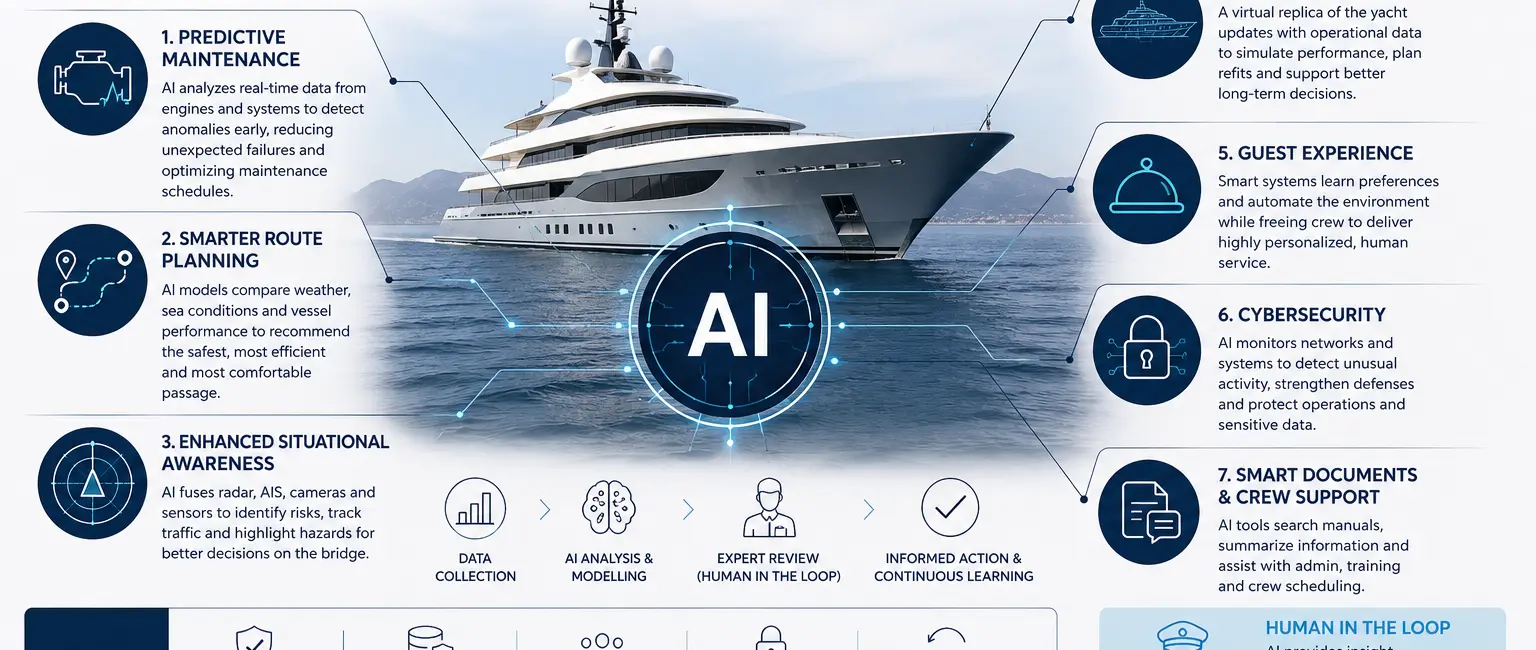
Artificial intelligence is moving into superyacht operations through machinery monitoring, route planning, cybersecurity, document management and carefully controlled guest services.
Artificial intelligence is beginning to enter the superyacht industry, but not in the form most often imagined.
The immediate future is unlikely to involve an autonomous captain replacing the bridge team or a conversational robot taking over from experienced interior crew. The more credible applications are less theatrical and more useful: detecting machinery behaviour that may indicate a developing fault, comparing routes against weather and vessel-performance data, identifying unusual network activity, organising maintenance records and helping crew interpret increasingly large quantities of operational information.
Guest-facing technology is developing too, but here the distinction between artificial intelligence and conventional automation is particularly important. A cabin that recalls preferred lighting, temperature and music may appear intelligent, yet it may simply be following rules programmed by an integrator. A true AI system would analyse changing behaviour, infer a preference and adapt without every response being specified in advance.
For owners and captains, that distinction matters. Automation can be highly reliable and predictable. AI can offer greater flexibility, but it also introduces questions about data quality, explainability, privacy, cybersecurity and responsibility when the system is wrong.
The most sensible approach is therefore not to ask whether a yacht should “have AI”. It is to identify specific operational problems for which AI can produce a measurable improvement without weakening human control.
Machinery monitoring is likely to be one of the most valuable applications of AI aboard large yachts.
Traditional planned maintenance is usually based on running hours, calendar intervals, manufacturer instructions, inspections and the engineering team's experience. This remains essential, but it has limitations. Components do not always deteriorate according to a fixed schedule, and faults can begin developing between inspections.
AI-supported condition monitoring looks for changes in the behaviour of equipment rather than waiting for a fixed maintenance date or a clear alarm.
Data may be collected from engines, generators, pumps, bearings, propulsion equipment, electrical systems and heating, ventilation and air-conditioning machinery. The system can compare vibration, pressure, temperature, load, fuel consumption or other values against the equipment's established operating pattern.
A single reading may not indicate a fault. A combination of small changes developing over time may be more significant.
Wärtsilä's Expert Insight service, for example, combines real-time vessel data, AI-based analysis, rule-based diagnostics and human technical expertise. The company says the system compares incoming data with the vessel's individual operating profile, identifies early symptoms and sends them to specialists who can recommend action before the problem develops into a serious failure.
In a June 2026 white paper, Wärtsilä reported that vessel operators using combinations of real-time data, AI diagnostics and expert support had reduced unscheduled maintenance by an average of 25 per cent across the examples examined. That is a supplier-reported result rather than a universal performance guarantee, but it illustrates why operators are interested in predictive maintenance.
For a superyacht, the benefit is not limited to repair cost.
A machinery failure can interrupt an owner's holiday, prevent a charter from beginning, delay a passage or force the yacht into an unsuitable repair port. A warning received several days earlier may allow the chief engineer to order a component, arrange a technician and select an appropriate maintenance window before guests arrive.
The commercial-shipping systems already available may not always be configured specifically for superyachts, but the principle transfers directly. Large yachts operate sophisticated engines, power-generation systems, stabilisers, watermakers, refrigeration plants and hotel loads that can generate enough data for useful trend analysis.
Predictive systems can improve engineering decisions, but they cannot remove the need for technical judgement.
An AI model depends upon the information supplied to it. Incorrect sensor calibration, inconsistent equipment naming, missing service records or a change in operating conditions can all affect its conclusions.
A yacht that spends several months running generators at low hotel load may develop a very different data pattern from the same yacht during a hot charter season, when air-conditioning, galleys, laundry equipment and water production are working continuously.
The system must understand that context. Otherwise, normal operating changes may be mistaken for faults, while genuine abnormalities may be overlooked because they occur outside the model's previous experience.
False alarms are not harmless. If a system repeatedly warns the engineering team about conditions that prove insignificant, crew may gradually stop trusting it. Equally, an apparently confident prediction may encourage people to postpone a physical inspection that would have identified a problem.
The proper model is therefore human-in-the-loop operation.
The software detects patterns, ranks possible concerns and presents evidence. The chief engineer, manufacturer or shore-based specialist decides what the information means and whether intervention is required.
This is already how serious marine predictive-maintenance services are described. Wärtsilä does not present its AI as an independent engineer. It uses algorithms to identify developing symptoms and then involves technical experts who interpret the finding and recommend action.
For superyachts, where machinery spaces may contain systems from many different manufacturers, this combined approach is especially important. No single model is likely to understand every component, modification and maintenance decision aboard an older custom yacht without extensive integration work.
Weather-routing software has existed for many years, but AI and improved vessel modelling are making route advice more specific to the actual ship.
A basic routing system may compare forecast weather with destination and departure time. A more advanced platform can also consider the vessel's speed, draught, propulsion limits, fuel consumption, motion characteristics and safety margins.
ABB's voyage-optimisation systems use vessel-performance models alongside weather and routing information. Its published interface specifically includes yachts among the supported vessel categories, allowing a performance model to be used in subsequent route calculations.
ABB describes its current route- and speed-optimisation work as combining real-time information, vessel behaviour and meteorological expertise to advise operators when changing course or speed may reduce exposure to heavy weather, improve safety and lower fuel consumption.
For a superyacht captain, the most valuable result may not be the mathematically lowest-fuel route.
Guest comfort, arrival time, safe tender operations and the condition of an anchorage may matter more than a small reduction in consumption. A technically efficient route that produces uncomfortable motion for twelve hours may be unacceptable during an owner's passage.
AI can nevertheless process more alternatives than a bridge team could reasonably compare manually. It may help answer whether reducing speed will allow the yacht to pass behind a weather system, whether an alternative course will reduce rolling or whether a delayed departure will provide a safer and more comfortable passage.
The captain must retain authority over the answer.
The International Maritime Organization's work on autonomous and remotely operated commercial ships continues to emphasise human oversight and the master's responsibility. Although the developing framework is directed at commercial autonomous shipping rather than ordinary superyachts, the principle remains relevant: increasingly capable systems do not remove command responsibility.
Another important area is situational awareness.
Modern bridges already receive information from radar, Automatic Identification System data, electronic charts, cameras, depth sounders, weather instruments and other sensors. The challenge is not always the absence of information but the crew's ability to interpret several sources simultaneously.
AI-assisted systems can combine these inputs and identify objects, unusual movement or developing collision risks.
Kongsberg's SeaAware systems, for example, create a unified digital representation by combining information from sources including radar, cameras and AIS. The objective is to present bridge and shore personnel with a clearer picture of surrounding traffic, structures and hazards.
For a large yacht, this type of integration may be valuable during close-quarters manoeuvring, night approaches, crowded anchorages and operations involving tenders or water toys.
Computer vision could also be used to identify floating debris, people in the water or vessels that are not transmitting AIS. Thermal cameras and object-recognition tools may improve detection in darkness, although performance can still be affected by rain, glare, waves, camera position and sensor contamination.
These systems should be treated as additional lookouts rather than infallible observers.
AI can miss an object, misclassify it or produce an alert too late. A bridge team that becomes dependent on automated detection may become less attentive to information that does not fit the system's expected pattern.
The strongest implementation would provide clearer evidence without obscuring the original radar, camera and chart information from which the conclusion was drawn.
A digital twin is a computer-based representation of a physical vessel, system or component that is updated using operational data.
In its simplest form, it may represent the expected relationship between engine load, speed and fuel consumption. A more complex twin can model electrical demand, machinery condition, stability, environmental performance and the effect of planned modifications.
Kongsberg describes digital twins as virtual replicas that can support safer, more sustainable vessel operations and improve understanding of how a ship and its systems perform over time.
For new-build superyachts, a digital twin could begin during design.
The naval architect, shipyard and equipment suppliers already create detailed three-dimensional models and engineering calculations. If properly structured and maintained, part of that information could follow the yacht into service rather than becoming a collection of disconnected drawings and manuals.
Operational data could then be compared with the designed condition.
A naval architect might assess how added equipment affects weight distribution. The engineering team could model electrical demand before installing a new system. A refit yard could examine whether proposed machinery will fit, how it will be accessed and how its additional heat load will affect ventilation.
The difficulty is maintaining the twin.
A model becomes unreliable when the physical yacht changes but the digital record does not. Superyachts undergo continual modification: furniture moves, equipment is replaced, cable routes change, tanks are altered and temporary installations become permanent.
A trustworthy digital twin therefore requires disciplined configuration management. Every significant modification must be reflected in the model, and the owner must decide who is responsible for preserving its accuracy throughout the yacht's life.
The most publicised vision of AI aboard a superyacht is the virtual concierge: a system that learns what guests want, anticipates requests and controls the environment without requiring them to search through menus.
Some elements of that experience already exist through conventional integration.
Modern yacht-control systems can combine lighting, climate, blinds, entertainment, communications and crew-call functions. Crestron's published yacht case studies describe guest interfaces that control cabin conditions, entertainment and service requests, including a text-based steward-call function aboard ArtemiSea.
Systems aboard yachts such as Lush, the Arksen 85 and MY Gioia similarly integrate lighting, climate, audio, video, shades and communications into centralised interfaces.
This is sophisticated automation, but it is not necessarily artificial intelligence.
Crestron has itself cautioned that, although AI and machine-learning applications are increasing, a genuine virtual assistant capable of replacing crew involvement in guest care is not yet a practical reality aboard yachts.
That limitation may be beneficial.
Luxury service depends upon context, discretion and judgement. A steward notices whether a guest wants conversation or privacy, whether a child is becoming tired, whether an owner has changed plans or whether a request should be confirmed rather than followed literally.
An AI system may recognise that a guest normally orders coffee at 08:00, but it does not know whether the person is asleep after a late arrival, fasting for a medical procedure or simply wants something different that morning.
The system can prepare information and reduce repetitive work. It should not become a mechanism that makes guests feel observed or removes the human discretion for which experienced crew are employed.
The more effectively an AI system personalises service, the more information it is likely to collect.
A guest-preference system might retain meal choices, allergies, cabin temperature, media history, wake-up time, spa appointments, alcohol consumption, preferred companions or location around the yacht.
Voice control may store recordings or transcripts. Facial recognition may involve biometric information. Health and accessibility requests can reveal particularly sensitive personal data.
Under the European Union's General Data Protection Regulation, personal-data obligations can apply when information relating to people in the EU is processed. Biometric data used to identify a person is treated as sensitive data.
The GDPR also requires appropriate technical and organisational safeguards and limits organisations to collecting data that is necessary for a defined purpose.
This creates difficult questions for yachts. The owner, management company, charter company and technology supplier may each have some involvement in controlling or processing guest information.
The yacht must establish where the information is stored, how long it is retained, who can access it and whether guests can request its deletion. It must also consider whether years of sensitive preference data could be transferred unintentionally when the yacht is sold.
The safest design is usually to collect less information, retain it for less time and separate essential service information from unnecessary behavioural surveillance.
A system does not need a permanent psychological profile to remember that a guest prefers a cabin at 20°C during a one-week charter.
A connected AI platform can expand the yacht's attack surface.
It may require access to sensor data, maintenance systems, cloud services, guest interfaces, cameras or operational networks. Each connection creates another route through which data can be intercepted, corrupted or manipulated.
The IMO defines maritime cyber risk in terms of threats that may cause operational, safety or security failures when technology or information is compromised. Its guidance recommends identifying risks, protecting systems, detecting incidents, responding effectively and recovering operations.
The risks aboard a superyacht are unusually broad.
The vessel combines industrial-control equipment, navigation technology, satellite communications, corporate devices, crew phones, guest devices, entertainment networks, cameras and confidential information about wealthy or prominent people.
An AI model connected to maintenance records might reveal the yacht's technical weaknesses. A compromised guest assistant could expose conversations or cabin occupancy. A manipulated predictive-maintenance system could hide a genuine alarm or create a false one.
The solution is not to avoid digital technology altogether, but to isolate systems according to consequence.
Guest entertainment should not provide an easy path into machinery control. An external AI service should receive only the data necessary for its task. Critical functions should retain local control and continue operating when shore connectivity is lost.
The yacht should also know how to operate when the AI platform is unavailable.
Manual procedures, original alarms, technical documentation and conventional watchkeeping must remain usable. A system that cannot fail safely is unsuitable for safety-critical operation.
Generative AI presents a different opportunity.
Crew and management offices handle large quantities of text: manuals, defect reports, safety procedures, service invoices, charter preferences, inventory records, port information and correspondence with suppliers.
A language model could help search technical manuals, summarise work lists, compare quotations, draft routine emails or organise maintenance notes.
It could also help an engineer retrieve information from thousands of pages of documentation by asking an ordinary-language question rather than knowing the manufacturer's exact terminology.
The risk is that generative systems can produce plausible but incorrect answers.
A fabricated torque value, service interval or wiring instruction may look convincing enough to be used. The system may merge information from different equipment models or present an outdated manual as current.
NIST's Generative AI Profile treats information security, privacy, human-AI configuration and third-party technology as areas requiring explicit risk management. It recommends defining responsibility, testing systems and maintaining incident-response arrangements rather than assuming the output is trustworthy because it is fluent.
Onboard use should therefore be based on controlled source material.
A yacht-specific assistant should cite the manual, drawing, maintenance entry or regulation from which it obtained an answer. Crew should be able to open that source and verify the wording before acting.
It should not be permitted to invent missing instructions.
AI may also help captains and managers organise crewing, although this area requires sensitivity.
Systems could analyse certification expiry dates, training requirements, leave patterns, watch schedules and travel arrangements. They may identify future gaps before a crew member's certificate expires or before several essential personnel request leave at the same time.
AI could also assist with rota planning and workload analysis, particularly where operations involve helicopters, tenders, diving, security or intensive charter turnarounds.
The danger is that optimisation may be applied to people as if they were machinery.
An algorithm may conclude that the yacht can operate with fewer crew because a task appears infrequent in the records. It may not understand that the same person is already carrying several safety, service and emergency responsibilities.
Historical performance information may also reflect unequal management, incomplete reporting or subjective assessment. Turning those records into automated recruitment or disciplinary recommendations can amplify earlier bias rather than remove it.
AI may help organise facts, but decisions concerning employment, competence, welfare and safe manning require accountable human judgement.
Artificial intelligence can become an expensive specification item with no clear operational purpose.
A shipyard or owner may be attracted by the label because it signals technical ambition. Yet a conventional alarm, properly configured database or well-designed automation system may solve the problem more reliably.
Before purchasing an AI product, an owner's team should define the precise decision or task the system will improve, the data it needs, where that data will be stored, who owns and maintains the model, how accuracy will be tested, who acts on its recommendations and what happens when it fails.
The team should also determine how the system will be updated during refit and whether the yacht can change suppliers without losing its operational history.
The cost is not limited to initial software or equipment.
Sensors must be maintained. Data must be cleaned. Interfaces must be supported. Cybersecurity must be reviewed. Crew must be trained, and the system may require a service agreement for the yacht's entire operating life.
A poorly supported AI installation can become another obsolete black box hidden behind the bridge or engine-control-room panels.
AI aboard superyachts is likely to develop through gradual integration rather than one dramatic invention.
Maintenance platforms will become better at recognising anomalies. Routing tools will account more accurately for the yacht's real behaviour. Bridge systems will combine sensor information more clearly. Guest interfaces will become more adaptive, while crew will use language models to search records and prepare information.
The successful systems will probably be those that remain largely invisible.
Owners will notice fewer interrupted trips, more comfortable passages and service that feels consistent without being intrusive. Captains will receive clearer operational information. Engineers will have more warning before equipment fails. Crew will spend less time searching documents and more time applying professional judgement.
The least successful implementations will be those that collect large quantities of data without a defined purpose, automate decisions that require human understanding or connect safety-critical systems without adequate security.
Artificial intelligence does not reduce the importance of experienced crew. It increases the value of crew who understand when to trust a system, when to question it and when to ignore it.
The superyacht of the near future will not necessarily be autonomous. It will be better informed—but only if the people responsible for it remain firmly in command.
The maintenance sections were checked against Wärtsilä's official Expert Insight service information and its June 2026 white paper on AI-supported vessel maintenance.
Route optimisation and vessel modelling were checked against ABB's official vessel-performance service and marine route-optimisation material. Situational-awareness information was checked against Kongsberg's official SeaAware information.
Guest-service examples were checked against Crestron's official marine case studies and its assessment of the current limitations of AI-based virtual assistants aboard yachts.
Cybersecurity guidance was checked against the International Maritime Organization's maritime cyber-risk guidance. Privacy and AI-risk sections were checked against European Commission GDPR guidance and the NIST AI Risk Management Framework.
Continue reading
A conflict hundreds of miles from a yacht can still alter its insurance, cruising programme and commercial value. War-risk designations affect where yachts can …
A superyacht's freedom to stay away from marinas depends partly on an unglamorous machine deep in the technical spaces. Watermakers turn seawater into freshwater, …

Lloyd’s Register says nuclear propulsion for superyachts now warrants serious safety and regulatory work, while major technical and societal barriers remain.
SCHOTTEL’s new PropControl 4 platform combines propulsion controls, telemetry, cybersecurity and remote service for thrusters and controllable-pitch propellers.
Superyacht Guide
Continue into the wider Superyacht Guide.