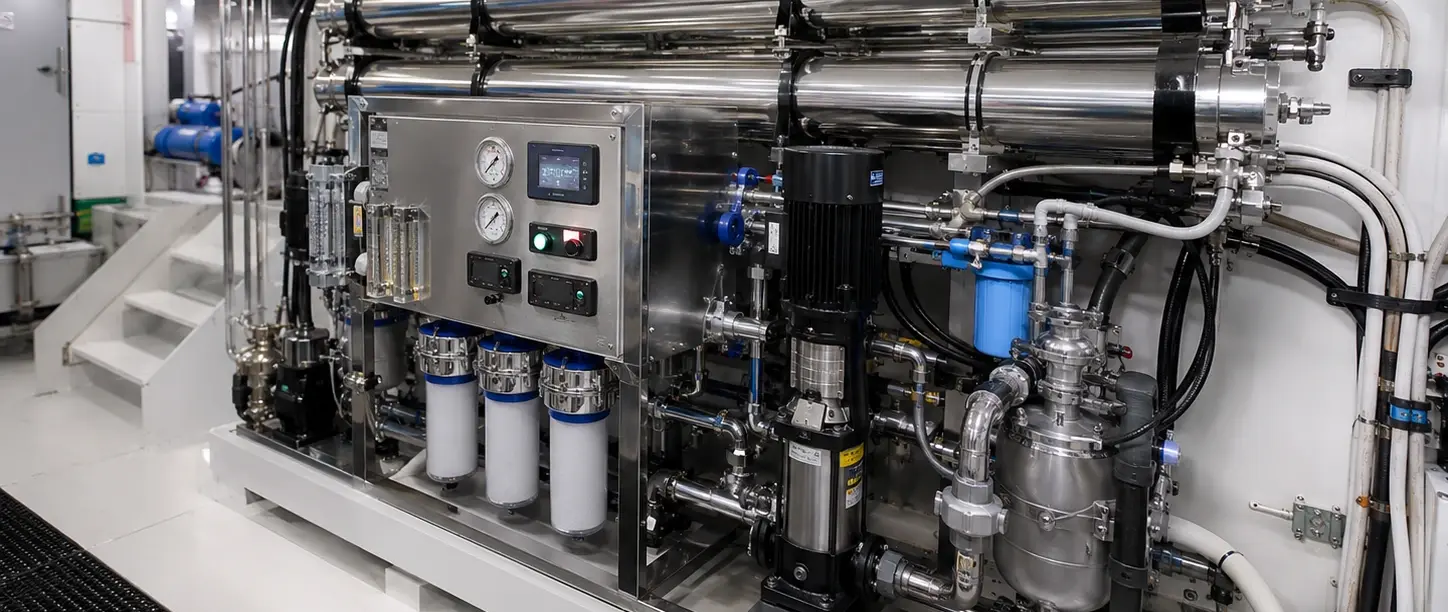
A superyacht's freedom to stay away from marinas depends partly on an unglamorous machine deep in the technical spaces. Watermakers turn seawater into freshwater, but real independence depends on capacity, redundancy, water quality and maintenance.
A guest standing on the swim platform of a superyacht at anchor sees almost unlimited water, yet almost none of it can be used directly for drinking, cooking, showers, laundry, cleaning or the dozens of domestic functions that make a large yacht feel more like a private hotel than a vessel at sea. Somewhere below deck, seawater therefore has to be turned into freshwater, and that process has an enormous influence on how independently the yacht can operate.
The machinery responsible rarely receives the attention given to engines, stabilisers or navigation systems, but the watermaker can determine how long a yacht remains comfortably away from shore-side support. Without reliable freshwater production, every remote itinerary eventually becomes a calculation about what remains in the tanks and when the yacht must return to a marina, harbour or shore supply; with sufficient onboard production, one of the yacht's most basic dependencies can be reduced dramatically.
Modern marine watermakers use reverse osmosis to separate freshwater from dissolved salts, and equipment now ranges from comparatively small leisure units to high-output systems intended for large yachts. The underlying principle is familiar, but the engineering challenge becomes progressively more serious as the yacht grows because production has to be integrated with seawater intakes, filtration, electrical generation, storage, treatment and the wider potable-water distribution system.
This distinction matters because the watermaker itself is only one link in a much larger chain. A highly productive reverse-osmosis unit is of limited value if its intake is contaminated, filters are blocked, the high-pressure pump is unavailable, product-water quality is not being monitored correctly or the yacht cannot safely store and distribute what the machine produces.
Reverse osmosis sounds almost impossibly straightforward when reduced to its basic principle. Seawater is forced at high pressure against a semi-permeable membrane that allows water molecules to pass while rejecting most dissolved salts and other material, producing a freshwater stream on one side and a more concentrated brine stream on the other.
The difficulty lies in everything that has to happen before and after the membrane. Raw seawater first has to reach the machine through a suitable intake and strainer without carrying unacceptable quantities of debris, suspended matter or contamination, and prefiltration then removes material that could foul or damage the high-pressure components and membrane surface.
Feed-water quality can change significantly from one anchorage to another, so crews cannot treat the sea as a uniform raw material. Water beside an isolated island may be comparatively clean, while water inside a busy harbour can contain sediment, plankton, suspended solids or traces of hydrocarbons, making an apparently simple decision to manufacture freshwater far harder on the equipment.
This is why experienced engineers often choose where and when to operate the system rather than simply leaving it running whenever tank level falls. If the yacht has sufficient reserve, production can be delayed until cleaner open water is available, reducing filter loading and avoiding unnecessary stress on more expensive components farther downstream.
Once the feed water has been prepared, a high-pressure pump or energy-recovery system creates the pressure needed for reverse osmosis. Product water then has to be monitored before it is allowed into the freshwater tanks because passing through the membrane does not automatically mean that every litre produced should enter the potable-water system.
Modern systems therefore use conductivity or salinity monitoring to assess product-water quality and can automatically reject water that falls outside the required limits. Automation reduces the need for constant manual intervention, but the engineer still needs to understand what normal operating pressures, temperatures, production rates and conductivity values look like so that an emerging problem is recognised before output or water quality deteriorates seriously.
For the guest, all of this disappears behind a tap, which is exactly how a successful system should feel. The shower runs, the chef fills a pan, housekeeping starts another laundry cycle and deck crew wash equipment without anybody thinking about pressure vessels, feed pumps or membrane rejection.
Watermaker capacity is usually expressed as litres or gallons produced per hour or per day, but the headline number is meaningful only when compared with how much freshwater the yacht actually consumes. A large yacht carries a demanding domestic environment in which guest and crew showers, laundry, galley work, dishwashing, housekeeping, deck cleaning, technical requirements and drinking-water production can create substantial daily demand.
The same yacht can also have very different consumption profiles from one week to the next. A quiet owner trip with few guests may use far less water than a full charter programme, while consecutive charters can increase laundry, cleaning and turnover demand at exactly the time the engineering team is also trying to recover tank levels before the next guests arrive.
Hot climates can push demand still higher because personal consumption rises and more frequent washing, showering and deck cleaning may become normal. Remote cruising adds another dimension because the yacht needs a larger safety margin when there is no reliable shore supply nearby, so the correct capacity is not simply the amount needed to survive an average day.
Tank capacity remains important even when production capacity is high because storage creates a buffer between manufacture and consumption. That buffer allows the yacht to continue functioning if the watermaker is shut down temporarily, feed water is unsuitable, maintenance is taking place or the engineering team deliberately waits for cleaner water before restarting production.
This gives engineers operational flexibility that cannot be achieved by production capacity alone. A yacht arriving in a crowded harbour with healthy tank reserves does not have to manufacture water from poor feed water simply because several guest showers have reduced the level overnight, and it can instead rebuild the reserve after departure when conditions are more favourable.
Electrical demand is another part of the calculation because conventional reverse-osmosis desalination requires substantial pressure and producing that pressure consumes energy. Water production therefore sits within the wider hotel load alongside air conditioning, refrigeration, galleys, lighting, AV and other machinery, and a plant that operates for many hours each day can become a meaningful continuous consumer.
Manufacturers have consequently invested heavily in energy recovery, variable-speed drives and softer-starting arrangements that reduce the penalty of producing freshwater. The exact savings depend on equipment and operating conditions, but the engineering objective is clear: water independence should not require unnecessary generator loading or a disproportionate increase in fuel consumption.
The useful question for an owner or captain is therefore not how large the watermaker is, but whether the combination of production, storage and energy use fits the way the yacht is actually operated. A well-sized system provides enough margin for guest demand, weather and maintenance without forcing the machinery to run continuously at the edge of its capability.
The word independence can be misleading because a yacht with one very large watermaker remains dependent on one machine. If a high-pressure pump, feed pump, control unit or another critical component fails, the yacht can lose its entire freshwater-making capability in a single event even though the installed daily production figure looked impressive on paper.
This is why system architecture matters as much as headline capacity. Two independent units can sometimes provide greater operational resilience than one larger plant because one can remain available while the other is serviced, and both can be operated when demand rises or tank levels need to be recovered quickly.
The correct arrangement depends on space, weight, electrical design, installation cost and the yacht's intended programme, so there is no universal answer. What matters is that the designer and operator consider what happens after the first failure rather than assuming the system will always be available at full output.
Redundancy also extends beyond the reverse-osmosis units themselves because the yacht still depends on freshwater tankage, transfer pumps, level monitoring, distribution pumps and treatment equipment. A duplicate watermaker achieves little if a single shared component farther downstream can still remove the yacht's entire potable-water capability.
Spare parts become part of the redundancy strategy as cruising moves farther from technical support. Filters, seals, sensors and other manufacturer-specified consumables may be easy to source in established yachting centres, but the same small component can become an itinerary problem when the yacht is several days from a major service hub.
Global service coverage therefore matters when equipment is selected for a yacht intended to cruise widely. Access to authorised parts, accurate technical documentation and people who understand the installed system can be just as important as the machine's theoretical output because a repair only protects the itinerary if it can be completed in time.
A genuinely independent yacht is therefore not the one whose brochure carries the largest water-production number. It is the yacht that can suffer a blocked filter, planned membrane service or component failure without immediately forcing the captain to abandon the owner's cruising programme.
Producing low-salinity water is not the same thing as managing an entire potable-water system safely. Shipboard water has to remain suitable from the point of production or loading through storage, treatment and distribution, so engineers have to think about the whole chain rather than assuming the membrane guarantees what eventually reaches the tap.
Reverse osmosis is an extremely effective treatment process, but product water may still pass through additional treatment before entering storage depending on the yacht's system design and intended use. Some installations use remineralisation or pH adjustment because reverse-osmosis water can be low in dissolved minerals, while disinfection may also form part of the wider potable-water arrangement.
The freshwater tanks then become part of the water-quality system rather than passive containers. Tank condition, pipework, stagnant sections, temperatures, transfer arrangements and maintenance practices can all influence the quality of water after production, which is why a good salinity reading at the membrane outlet does not answer every question about what is stored elsewhere aboard.
This is also why engineers monitor trends rather than relying on a single satisfactory reading. If conductivity, production rate or another operating value begins moving away from normal, the change can provide an early indication that feed conditions, membrane performance or another part of the system deserves investigation.
Material compatibility and chemical exposure matter as well because reverse-osmosis membranes have specific tolerances that have to be respected during cleaning, flushing and storage. Manufacturer procedures are therefore critical, particularly when the system is preserved for a long shutdown or treated after contamination.
Freshwater flushing is one of the most common features used to protect modern marine systems between operating cycles. Flushing reduces the amount of seawater left sitting inside parts of the plant after production stops, but the correct method, timing and preservation procedure still depend on the exact equipment installed and should not be improvised from generic practice.
The engineering discipline is simple to describe even if the machinery is not: produce good water, verify it, protect it and make sure it remains good all the way to the outlet. That requires attention to the entire potable-water system rather than treating the watermaker as an isolated appliance.
Watermakers reward regular use and disciplined maintenance, but they become unreliable quickly when they are ignored. Filters load with contamination, pumps wear, seals age, sensors require checking and membranes can foul or suffer biological growth if shutdown and preservation procedures are not handled correctly.
This changes the engineer's relationship with the equipment because the plant should not be treated as something to switch on only when the tanks become critical. Production rate, pressure, temperature and product-water quality can all be watched over time, giving the engineering team a performance history against which gradual deterioration becomes visible.
A falling production rate under broadly comparable conditions can provide an early clue that something in the feed system, prefiltration, membrane stage or high-pressure circuit requires attention. The point is not to diagnose every problem from one number, but to recognise that a system which suddenly behaves differently deserves investigation before the yacht becomes dependent on it during a remote programme.
Prefilters remain among the simplest and most important consumables because their job is deliberately sacrificial. A filter that blocks quickly in dirty water may actually be demonstrating that it has protected more expensive equipment, although it also tells the engineer that continuing to manufacture water in that location may not be sensible.
Long shutdowns create another risk because biological activity does not stop simply because the yacht is alongside or laid up. Manufacturers therefore publish preservation procedures for membranes and associated equipment, and crews need to follow the exact instructions for the installed plant rather than relying on habit from a different make or model.
None of this work is glamorous, which is precisely why the watermaker belongs among the yacht's hidden systems. The owner normally notices it only when independence begins disappearing and tank levels start influencing housekeeping, laundry, deck washing or the captain's next destination.
A failed watermaker rarely prevents the engines starting or the yacht leaving a berth immediately, but it can begin shrinking the operational envelope hour by hour. Laundry may be reduced, non-essential washing postponed and reserve levels discussed during morning meetings while the captain starts identifying the next place where reliable shore water can be taken.
The difference between a healthy system and an unreliable one can therefore be measured in itinerary choices rather than machinery-room statistics. A yacht with reliable production, adequate storage, appropriate redundancy and engineers who understand the equipment can stay at anchor longer and approach remote cruising with a far larger safety margin.
Freshwater production does not make a superyacht self-sufficient because fuel, food, waste capacity, spare parts and other resources still define endurance. What it does is remove one of the most fundamental dependencies of life afloat by converting the environment surrounding the yacht into a usable resource, provided the system is designed and maintained well enough to be trusted.
For guests, that independence may look like another morning in an empty bay with no marina in sight, while for the engineer it looks like stable pressures, clean filters, acceptable conductivity, healthy membranes and freshwater tanks quietly filling below deck. The guest remembers the bay, but the watermaker is one of the hidden reasons the yacht can stay there.
Explore
Go deeper into the yachts, companies, events and destinations directly connected to this article.
Continue reading
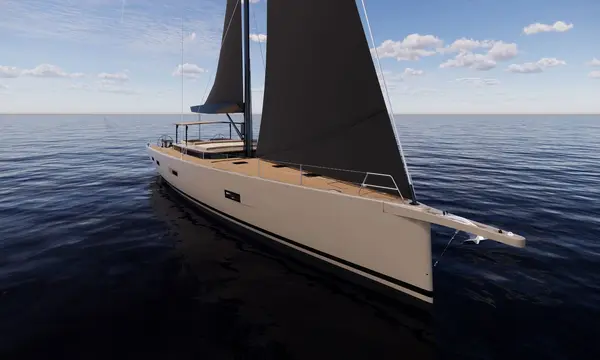
IYC has added the 24m YYachts FITZROVIA to its global charter fleet. Delivered in 2026, she is the first hybrid-powered Y8 and combines sailing …
Can Charter Income Cover Superyacht Running Costs? Charter income can offset a meaningful share of superyacht operating costs, but it rarely makes ownership cost-free …
OmniAccess Fusion 2.0 combines multiple LEO and GEO satellite services under one yacht subscription and shared data allowance instead of separate carrier plans.
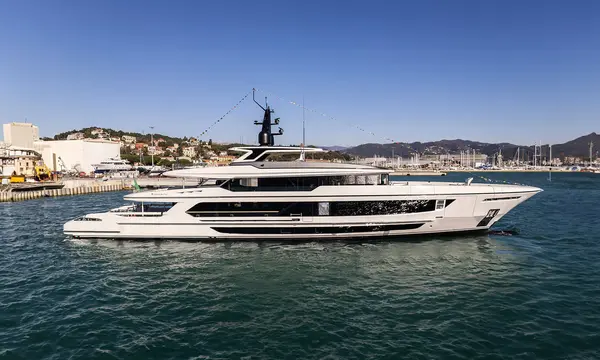
The builder’s Ark of Fate profile documents the first hybrid T52 and the machinery behind its electric and diesel operating modes.
Superyacht Guide
Continue into the wider Superyacht Guide.
Business opportunities · Superyacht Guide
Companies serving the superyacht market can discuss clearly identified advertising, sponsorship and business-profile opportunities. Commercial activity remains separate from independent editorial coverage.