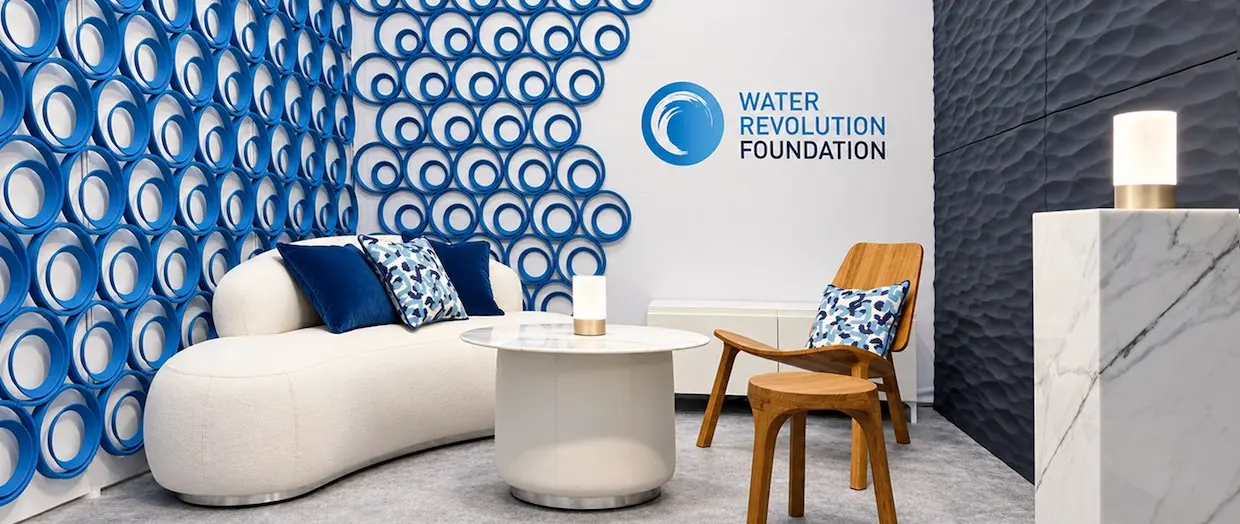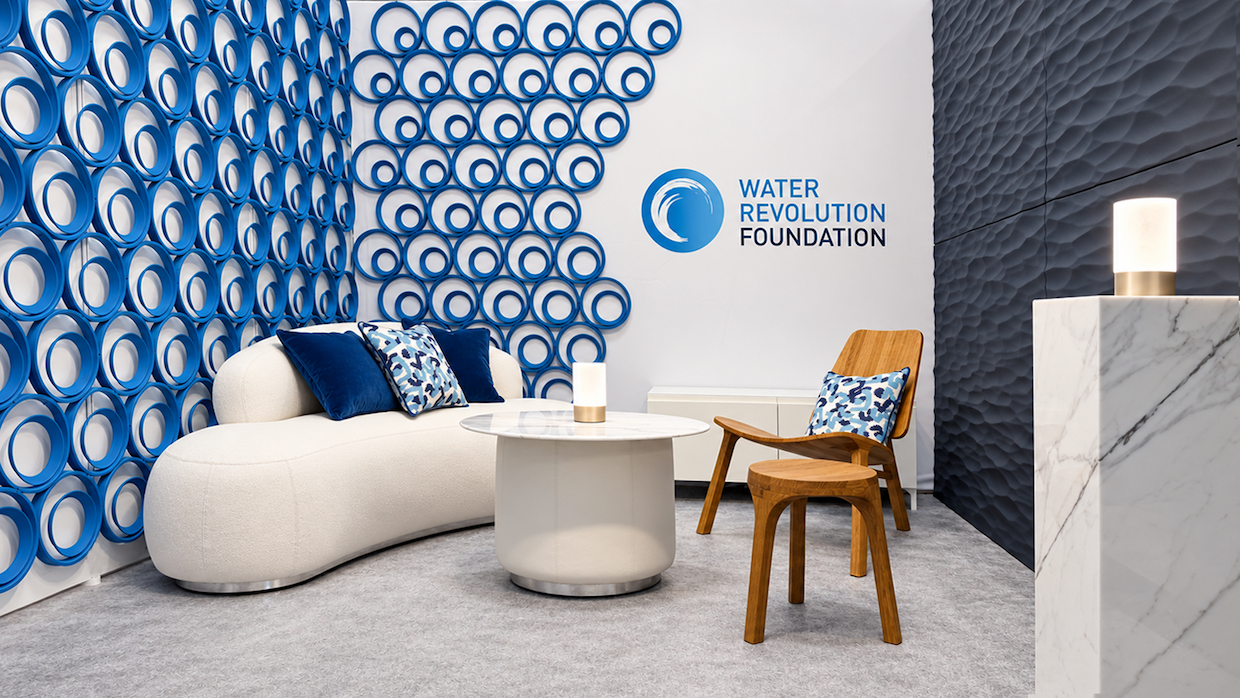
Water Revolution Foundation Monaco Yacht Show stand, official Amadei Collett project design visual

News

Amadei Collett Reveals How Co-Makers Built Water Revolution Foundation's Monaco Stand

Nov. 13, 2026 Design

Water Revolution Foundation Monaco Yacht Show stand, official Amadei Collett project design visual

Amadei Collett details how designers and specialist suppliers created Water Revolution Foundation's Monaco Yacht Show stand through shared expertise and materials.

A modest stand became a statement about collaboration The Water Revolution Foundation's stand at the 2026 Monaco Yacht Show was created through an unusually collaborative process involving superyacht interior designers, material specialists and craftspeople. In an account published on 10 November, design practice Amadei Collett described how it developed the space and coordinated the contributions of several companies with limited time and no dedicated budget. The resulting display brought leather, marble, digitally produced forms and references to the sea into a shared visual setting. For the large-yacht industry, the interest is not simply how a stand looked during one event. It is the example of several normally separate suppliers working together to produce a coherent design in circumstances similar to the tight schedules of a yacht refit.

The Water Revolution Foundation provided the purpose Water Revolution Foundation works on sustainability-related initiatives in the superyacht sector, where design decisions can influence material use, manufacturing processes and the environmental impact of a vessel over its working life. Its stand needed to communicate that mission without becoming a conventional sales display for an individual product. Amadei Collett says the starting point was little more than three bare white surfaces. The design team had to create a recognisable environment while accommodating the practical contributions of several partner companies. This is not evidence that the completed stand was independently certified as carbon-neutral or had a quantified environmental benefit. The verified news concerns the collaborative design process and the decisions the participants chose to make.

Amadei Collett coordinated more than decoration The studio was responsible for the overall design concept and for bringing the partners' materials and expertise together, working with Smart Interiors Horizon. That role extended beyond selecting attractive finishes. Drawings, physical components and installation arrangements had to fit within an extremely short programme, with companies contributing different skills and resources. In a custom yacht interior, a similar coordination task can involve shipyard project managers, designers, joiners, upholsterers and specialist material suppliers. A finish may look simple in a rendering but be difficult to fabricate or install within the available tolerances. The case illustrates why early coordination matters when a design relies on several companies whose work must meet at shared interfaces.

A sofa became an example of cross-company work The design account identifies Romital as the maker of a bespoke sofa developed to Amadei Collett's drawings, using leather supplied by fellow contributor Prodital. This demonstrates how material choice, fabrication and the final design can be shared rather than confined to one manufacturer. It is tempting to call such cooperation sustainable by definition, but that would require evidence concerning material sourcing, waste and the product's expected life. The more defensible observation is that cooperation allowed the stand to be completed using the experience and available resources of different specialists. For yacht owners, the practical analogy is the ability to commission bespoke furniture without allowing the separation among designer, supplier and maker to become an obstacle.

Leather and texture represented movement on water One of the display's principal visual elements was a leather bas-relief panel developed through collaboration among Romital, Foglizzo and other specialists under the design team's direction. The surface was intended to suggest ripples and movement on the sea, connecting the visual identity of the space to the environment the foundation seeks to protect. This is a design interpretation, not a scientific model of ocean behaviour. The interplay of texture and light may communicate a theme more subtly than a large written slogan. On a superyacht, the same kind of approach can create interiors that refer to a destination or landscape without replicating it literally. The appropriateness of the material still depends on its durability, fire performance and maintenance requirements.

The structure behind a decorative surface matters A large decorative panel requires more than a material sample and an attractive pattern. It needs backing, suitable fasteners, support and a method of assembly that works within the surrounding structure. The account notes that contributors supplied structural panels and supporting elements while working under Amadei Collett's design direction. This is the part of interior work that guests rarely see but which determines how reliably a finish can be installed and later maintained. On a yacht, these questions are particularly demanding because the structure moves, temperature and humidity can vary, and certain spaces have fire and access requirements. The Monaco stand is not a marine classification test, but it offers a useful example of fabricators addressing such practical interfaces early.

Three-dimensional printing contributed a symbolic element The team also developed a pattern of circles of different sizes that evoked oxygen bubbles and represented companies participating in the foundation's mission. According to the studio, the forms were produced using a biocompatible material and arranged in a deliberately incomplete composition. The visual effect was intended to suggest that other businesses could join the effort. The phrase biocompatible does not by itself establish the environmental impact of producing, transporting or disposing of the material. Those matters would require product-specific life-cycle information. The importance of the example is that digital manufacturing was used as part of a design language and as a way to make an unusual physical feature within a constrained project.

The incomplete pattern was an invitation Leaving visible spaces in the pattern allowed the designers to communicate that the foundation's work remains unfinished and open to more participants. For a trade-show audience, that is a different message from the completion-focused language of many product launches. A yacht may be delivered after years of work, yet its environmental and operational performance continues to evolve through maintenance, refits and decisions about how it is used. The stand's concept uses that openness as a metaphor, rather than claiming that a particular company has already solved the environmental challenges facing the sector. Owners and designers can appreciate the symbolism while still asking for evidence when products are described as more responsible.

Time constraints resembled a refit programme Amadei Collett described an exceptionally short period for drawing, sourcing, production and installation, complicated by the summer period when some workshops and suppliers operate with reduced availability. The studio compared the working process with a demanding yacht refit, in which decisions must evolve around available skills, materials and installation slots. Such scheduling pressures can make it tempting to compromise on documentation or quality. A successful project instead requires clarity about who can provide what and when. The Monaco collaboration cannot be treated as evidence that every future interior can be delivered with no cost, but it does show how willing suppliers can coordinate quickly around a shared and well-defined brief.

Smart Interiors Horizon had a coordinating role The first discussions with Smart Interiors Horizon were reportedly a turning point in establishing whether the project was feasible. Enthusiasm from participating firms helped the designers turn an ambitious concept into a workable plan. That highlights the importance of a coordinator able to connect companies with complementary skills. On large yacht projects, suppliers may be selected through different contracts and introduced at different stages, creating potential delays when interfaces are not resolved. A collaborative structure can reduce those problems if responsibilities, deliverables and quality requirements are clear. Collaboration is not the absence of commercial discipline; it works best when each participant knows what the others need.

The contributors did not approach it as a normal sale Amadei Collett says participating companies contributed expertise and products without expecting a direct financial return from the stand itself. That generosity is part of the story, but it should not lead to unrealistic expectations about yacht projects. A full-scale private refit involves wages, materials, approvals, project management and business risks, all of which require appropriate payment and contractual protection. The value of the Monaco example is that its participants chose to support a common industry organisation under exceptional circumstances. It provides a model of voluntary cooperation and shared technical input rather than a procurement formula that yacht owners can simply impose on suppliers.

Sustainable materials require credible evidence Materials were chosen to reinforce Water Revolution Foundation's themes, but the presence of leather, marble or a 3D-printed element does not automatically make a construction environmentally preferable. Decisions should be assessed through sourcing, production energy, transport, repairability and end-of-life handling. Some materials may offer a long service life while carrying different environmental costs at manufacture. Others may be renewable or recyclable in principle but difficult to process after use. A yacht designer making sustainability claims needs product information rather than a collection of appealing adjectives. The Monaco stand can encourage more thoughtful material discussions while leaving the quantitative assessment to appropriate data and methods.

Design can influence how people discuss responsibility A successful exhibition space can make visitors curious about why materials were selected and how a project was put together. By placing diverse contributions within one coherent design, Amadei Collett aimed to focus attention on the collective challenge rather than on competing companies' products. That is relevant to the superyacht industry because large custom vessels often rely on a network of international designers, yards and manufacturers. An individual supplier may improve one part of a yacht, yet the wider environmental outcome depends on decisions made across the vessel's life. A design-led conversation can help people understand that complexity, provided it remains connected to measurable actions and accountable procurement.

Sharing expertise can have commercial benefits The designers argue that industries such as automotive and aerospace have benefited from sharing knowledge and drawing together different disciplines. Within yacht building, similar cooperation may help solve complex problems involving advanced materials, fabrication methods and bespoke installation. Some large European yards use the concept of co-makers to describe companies contributing actively to a project's development. The Monaco example is presented as another expression of that approach. It would be simplistic to assume that competitors can or should share every proprietary method. Effective cooperation must respect intellectual property, contractual obligations and safety requirements. The opportunity lies in sharing appropriate expertise where it improves a common technical and design outcome.

The completed stand was not a yacht installation The display at Monaco was temporary exhibition architecture, not a finished interior aboard a vessel exposed to continuous vibration, marine humidity and class requirements. Its methods may inspire yacht design, but individual materials and fixing techniques would need to be tested and approved for their intended onboard use. A detail suitable for a short-lived stand may need substantial redesign to survive years of service at sea. This distinction is essential when translating trade-show presentations into commercial specifications. A yacht owner should ask for evidence of performance in the actual environment, not assume suitability because a sample looked impressive at an event.

A design-process story with lasting relevance The November report provides a specific account of how Water Revolution Foundation's 2026 Monaco stand was designed and built through cooperation coordinated by Amadei Collett and Smart Interiors Horizon. The new information concerns the process, named contributors and thinking behind the installation, not a fresh announcement of a yacht launch or proof of quantified emissions reductions. Its relevance to the superyacht industry is practical: complex projects benefit when specialists work across the boundaries of their individual contracts and understand the complete design intent. The challenge for the wider sector is to apply that collaborative discipline while maintaining rigorous technical documentation, meaningful environmental evidence and realistic commercial relationships.

**Reporting basis:** Amadei Collett's detailed interview with PressMare published 10 November 2026. Official Water Revolution Foundation stand design image supplied by Amadei Collett / PressMare, an exhibition design visual rather than evidence of independently certified environmental savings.

Primary source: Amadei Collett's official project interview through PressMare on 10 November 2026.

Image: Amadei Collett / Water Revolution Foundation stand design documentation supplied to PressMare in November 2026; not third-party yacht photo or measured eco-certification. Official source image.

Photo licence and source

Image: Amadei Collett / Water Revolution Foundation stand design documentation supplied to PressMare in November 2026; not third-party yacht photo or measured eco-certification.

Continue reading

All news

Superyacht Guide

Explore the superyacht world

Continue into the wider Superyacht Guide.

Business opportunities · Superyacht Guide

Reach the superyacht industry audience

Companies serving the superyacht market can discuss clearly identified advertising, sponsorship and business-profile opportunities. Commercial activity remains separate from independent editorial coverage.