Baglietto Lays Keel of 48m Ice-Class Custom Hull 10277
Baglietto has marked the keel-laying of its fully custom 48-metre hull 10277 at Carrara, giving a project first announced as a sale in October …
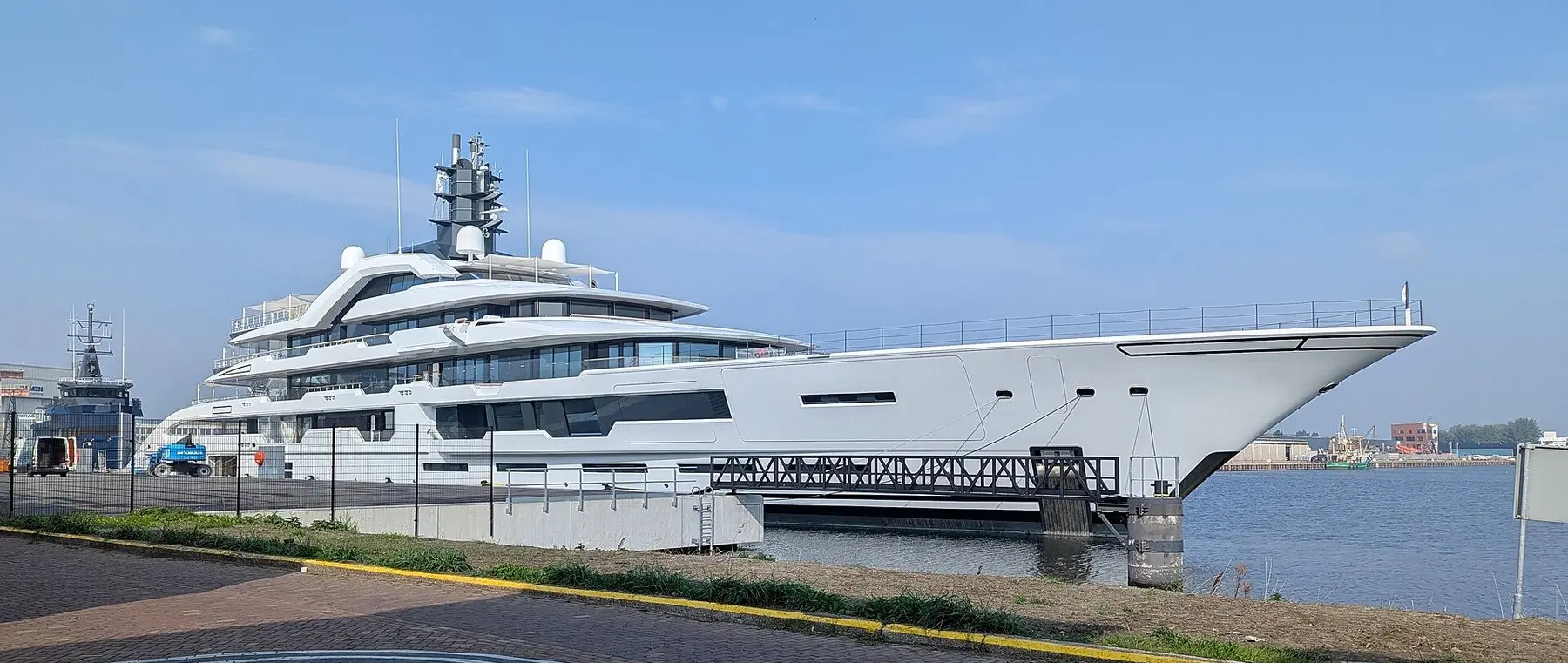
Amels Project Tanzanite near Vlissingen (archive; not Route 66)
Damen Yachting says the hull of its 80-metre Amels Project Route 66 has arrived at Vlissingen after launch in Galaţi, moving the custom superyacht into the outfitting phase.
Verified shipyard build update, 10 November 2026. Damen Yachting announced the hull arrival on 9 November. Technical context from earlier Amels 80 releases is clearly distinguished from vessel-specific confirmed specifications.
Damen Yachting has confirmed that the hull of the 80-metre Amels superyacht Project Route 66 has reached its Vlissingen facility in the Netherlands. The move follows the hull’s launch in Galaţi, Romania, and marks the transition into Dutch outfitting ahead of a delivery planned for 2028. The announcement, dated 9 November 2026, is a genuine construction milestone rather than an announcement of a new yacht design or a completed delivery. Much of the vessel’s complexity still has to be installed, integrated, tested and commissioned.
The distinction matters for anyone following an expensive large-yacht build. Launching a hull establishes that a substantial part of the structure is complete and that the project can be moved to its next location. It does not mean the interior is finished or that the yacht is ready for an owner to cruise. Project Route 66 now sits at the meeting point of two specialist yard operations, with structural work undertaken in Romania and the next phase of fit-out at Damen Yachting’s Dutch base.
The official Damen Yachting release identifies the yacht as the latest Amels 80, gives her project name as Route 66, locates her earlier launch in Galaţi and says she is now in Vlissingen for outfitting. The expected delivery is in 2028. The company also describes an owner-specific interpretation of its proven Amels platform with efficient hybrid technology. These facts establish the project’s immediate status, but they do not disclose an exhaustive technical specification, a trial result or the eventual appearance of the finished yacht.
Project manager Joppe Osté emphasises the work undertaken by teams in Romania and the Netherlands and the coordination needed between them. Jan van Hogerwou, the company’s commercial executive for the United States, describes an owner-led project incorporating distinctive features. Both statements are expressions from the builder, not independent evidence that every system has completed commissioning. The latest development is the physical arrival and the work programme that can now continue, not the achievement of a finished product.
Large-yacht construction often divides work between facilities that have different equipment, physical constraints and specialist staff. For the Amels programme, the Romanian stage provides substantial hull-building capability, while Vlissingen is set up for complex yacht outfitting and completion. Moving a large hull between those sites requires planning and marks an important handover in project control. A newly arrived structure has to be incorporated into the detailed schedules of mechanical, electrical, interior and testing teams.
The immediate challenge is not simply filling empty spaces. Designers, engineers, class specialists, subcontractors and the owner’s representatives must keep interfaces between systems consistent. A change in one compartment can influence cable routing, ventilation, firefighting arrangements or access to machinery. Coordination can become more demanding as each discipline moves from drawings into physical installation. The company’s announcement identifies a successful transfer; it does not claim that all those later steps have been completed.
Amels has developed its Limited Editions philosophy around an established technical platform adapted for individual owners. In principle, that combines more predictable base engineering with opportunities to specify interior arrangements, materials and other aspects of the onboard experience. The design is not a claim that every yacht in the series is identical. Nor should readers assume that a feature advertised for one hull will necessarily appear in another simply because the two share the 80-metre class designation.
Earlier official Amels 80 communications describe exterior styling by Espen Øino and broad class features such as an expansive sundeck, a waterside beach club and an owner-focused deck arrangement. Those are contextual descriptions of the design family, not newly verified specifications for Project Route 66. Details of this individual yacht must come from its own authoritative release or later disclosure. That distinction protects readers from mistakenly combining different hulls, layouts and delivery schedules into one fictional vessel.
Outfitting a superyacht is a major engineering and craft phase. The hull may receive or complete propulsion machinery, auxiliary services, electrical distribution, automation, air handling, accommodation, deck hardware and specialist systems. Interior work adds another sequence of structural tolerances, joinery, stone, glass, lighting and furnishings, often in spaces where access can become progressively more restricted. Every installation must be planned so that it can be inspected, serviced and safely operated once the yacht has left the yard.
A project team will also need to manage suppliers whose equipment is manufactured or configured off site. Some systems must be tested independently before being integrated; others can only be meaningfully commissioned when several disciplines are complete. Working on a large yacht is therefore not a simple succession of isolated jobs. The point of arriving in Vlissingen is to bring the structure into the setting where those jobs can be coordinated toward acceptance, not to suggest that the 2028 timetable is guaranteed.
Damen Yachting’s 9 November statement refers to efficient hybrid technology aboard Project Route 66. The term can encompass different ways of combining conventional power generation, electric machines, energy storage and vessel power management. Precisely how a system behaves depends on its configuration, the installed equipment and the operating mode. The short arrival announcement does not provide a complete powertrain diagram, battery capacity, emission calculation or speed and range figure specific to Route 66.
Earlier Amels 80 product material describes hybrid operation and in one class description mentions electric propulsion at low speed. Such information is useful for understanding the platform’s design intentions, but cannot automatically be reproduced as a guaranteed operating figure for this particular hull. Owners should look for the project’s final technical documentation and sea-trial data. In real use, fuel consumption, vibration, noise and emissions depend on how the yacht is loaded and operated.
Every large custom interior creates pressure on the underlying engineering. The owner may favour changes to windows, circulation, deck furniture, wellness spaces or the presentation of guest areas. Those choices must fit within fixed structural and safety constraints. A Limited Editions platform can provide a stable base for decisions, but it still requires careful engineering when a personal brief meets an established arrangement. Every choice that consumes space or weight can influence other parts of the ship.
Damen describes Project Route 66 as shaped around her owner and incorporating distinctive features, without enumerating those details in the latest notice. Responsible reporting therefore leaves them undisclosed. It would be tempting to attach a pool size or an interior designer from another Amels 80 story, but the fact that multiple vessels share a design family does not establish that their individual spaces are identical. An accurate build report respects the difference between platform characteristics and the finished owner commission.
The arrival of a hull is a visually attractive event for the industry, but the milestones that follow may be more consequential to eventual performance. Systems energisation, safety tests, machinery commissioning, harbour trials, sea trials and regulatory acceptance each test different elements of the build. Problems discovered at a late stage can affect an operating programme, so managers need evidence of readiness rather than optimism based on a calendar date.
The builder has communicated a 2028 delivery expectation. That remains a schedule, not confirmation of completion. A responsible future update will report distinct progress as it is verified, ideally naming the specific system or stage involved. Owners and charter planners should avoid treating the anticipated date as permission to market availability before final acceptance. The same caution applies to performance figures and interior features that have not yet been made public.
Shipyard projects on this scale depend on continuity between design, fabrication and outfitting teams. Welders and fitters create the structure and install early technical foundations; later teams need accurate records of what has been built and how it differs from drawings. Engineers integrate equipment made by numerous suppliers, while quality and safety specialists monitor whether the work meets agreed standards. The move between sites is therefore also a transfer of knowledge and responsibility.
The owner’s representatives have another role: evaluating choices and approvals without fragmenting the build process. Timely decisions can protect the critical path, while poorly controlled late changes can create rework and delay. Damen’s public comments acknowledge the collaboration of the Galaţi and Vlissingen teams. The factual report does not identify individual subcontractors, warranty arrangements or financial terms, which have not been disclosed in the arrival release.
Project Route 66 illustrates a common feature of modern large-yacht construction: the long period between a significant structural milestone and the point at which a yacht is operational. A prospective client comparing build programmes should ask not only when a hull is expected to float, but which disciplines must complete after that event and how the yard will demonstrate progress. The way a contractor manages systems interfaces and quality documentation may have more influence on the final result than the dates of ceremonial milestones.
For a vessel with an individually tailored interior and hybrid machinery, the questions extend to power management, equipment support, service access and operating documentation. The owner and captain eventually inherit the result of thousands of technical decisions. None of this implies that a specific deficiency exists on Route 66. It is a framework for understanding why the builder’s announcement of an outfitting phase represents the beginning of another demanding stage.
The next credible updates from Damen Yachting will concern the progress of the fit-out, confirmation of further vessel-specific specifications and eventual commissioning and trials. Project Route 66 is a real 80-metre superyacht under construction, not a concept drawing or an unnamed model range. At present, the shipyard has confirmed her hull launch in Romania, arrival in Vlissingen, planned continuation of outfitting and a 2028 delivery horizon.
Superyacht Guide is illustrating this report with a Creative Commons photograph of another Amels yacht, Project Tanzanite, on the water near Vlissingen. It is explicitly identified as an archival contextual image, not a portrait of Route 66. That distinction is important: readers should be able to separate verified project news from generic class imagery. The substantive development is the arrival of the named hull and the continuation of its build programme.
Primary sources: Arrival; Amels; Amels 80 Design.
Continue reading
Baglietto has marked the keel-laying of its fully custom 48-metre hull 10277 at Carrara, giving a project first announced as a sale in October …
Chinese builder Heysea Yachts has reported a contract for a 54.65-metre full-custom superyacht designed by the Netherlands-based studio Vripack, with delivery anticipated in 2029. …
Oceanco has reported that the 72-metre expedition support yacht Indratus has begun sea trials following an extensive refit at its Zwijndrecht facilities in the …

Marina di Villasimius is considering an 80-metre superyacht berth, shore-power improvements and a proposed €5 million refurbishment, but the development remains dependent on maritime …
Superyacht Guide
Continue into the wider Superyacht Guide.
Business opportunities · Superyacht Guide
Companies serving the superyacht market can discuss clearly identified advertising, sponsorship and business-profile opportunities. Commercial activity remains separate from independent editorial coverage.