Baltic Sea Boating Forum Secures Three-Year Helsinki Agreement — licensed SYG News 26Nov batch07
European Boating Industry and Helsinki Boat Show confirm a three-year Baltic Sea Boating Forum partnership, with 2027 sessions on emissions and safety.
European Boating Industry (EBI) and the Helsinki International Boat Show have agreed a three-year partnership to develop the Baltic Sea Boating Forum as an annual meeting point for the marine industry, policymakers and regional stakeholders. The arrangement covers the 2027, 2028 and 2029 editions and follows the forum's first event in February 2026. The next forum is scheduled for Friday 19 February 2027 during the Helsinki boat show, with its programme built around two practical questions: decarbonising recreational boating across its whole lifecycle and understanding the role of boating in a changing Baltic maritime security environment. Both subjects extend well beyond small-boat ownership to the concerns of yacht operators, marinas and the businesses supplying the wider marine economy.
The official announcement specifies that the Baltic Sea Boating Forum's second edition is planned for 19 February 2027, beginning at 15:00. It forms part of Vene 27 Båt, the Helsinki International Boat Show taking place from 12 to 21 February at the Helsinki Expo and Convention Centre. The Finnish Marine Industries Federation, Finnboat, will again cooperate in organising the forum. A separate Nordic Marine Expo is scheduled for 18 to 21 February. These dates matter to businesses considering travel because the discussion forum is a concentrated part of a longer exhibition, not an event lasting the whole show. Speaker lists and the detailed programme remain to be published.
A one-off conference can generate attention, but a recurring forum offers an opportunity to revisit commitments and record what has changed. The new EBI–Messukeskus agreement covers three consecutive future editions. That may help organisers establish continuity between discussions on technology, legislation and industry practice. It does not itself enact new rules, create subsidies or guarantee investment in sustainable propulsion. Its value depends on attracting participants able to connect policy proposals with operational experience. A predictable annual meeting can also help companies plan research updates, technical demonstrations and conversations with organisations that might otherwise meet only sporadically.
The inaugural Baltic Sea Boating Forum took place in February 2026 and, according to the organisers, included Finnish climate and environment minister Sari Multala, the Helsinki Commission, representatives of the boating industry and environmental organisations. That combination is central to the forum's intended identity. Marine businesses understand production constraints and customer expectations, while regulators and environmental bodies bring another set of responsibilities. Constructive work requires distinguishing an attractive idea from a standard that can be implemented, inspected and funded. The 2027 programme appears designed to narrow the conversation from general ambitions to specific lifecycle and safety subjects.
The first announced 2027 session addresses environmental impact throughout a recreational craft's lifecycle, not merely exhaust emissions while underway. The organisers identify lifecycle assessment, alternative fuels, propulsion systems and regulatory developments as discussion topics. This broader perspective is essential because emissions arise from materials, manufacturing, maintenance, energy supply and eventual disposal as well as operations. For a large yacht, any meaningful comparison must account for the vessel's size, annual use, lifetime and refit history. Focusing only on a single fuel figure can conceal the consequences of construction choices and the environmental impact of replacing equipment before the end of its useful life.
The forum's emphasis on alternative fuels and propulsion is relevant across the recreational market, yet a uniform solution cannot suit every craft. A small coastal dayboat with regular shore charging has a different energy and range profile from a vessel making long offshore passages or a superyacht running extensive hotel services at anchor. Operators must also consider storage volume, weight, charging infrastructure, redundancy and safe handling. Technologies should be assessed against realistic duty cycles and the infrastructure available along an intended route. A public industry forum can compare these operational questions, provided participants clearly separate proven systems from early-stage proposals.
Lifecycle assessment attempts to draw a consistent boundary around the materials, processes and energy involved in a product over time. In yacht manufacturing it can illuminate trade-offs between structural materials, propulsion packages, batteries, interior equipment and refurbishment. The method is only as useful as its assumptions and supporting data. Different estimates of annual hours, lifespan and maintenance can alter a comparison considerably. For an owner or builder, a transparent assessment can be more informative than a sustainability label applied without explanation. The organisers specifically include the topic in the first session, creating scope to discuss methodology as well as product claims.
The forum's other announced session explores recreational boating against the region's evolving maritime security situation. This is not an instruction to yacht owners to change their itineraries immediately. Rather, the organisers say the discussion will consider how developments affect boating and how the sector can both contribute to and benefit from maritime safety. For yacht captains and marina operators, relevant broad questions include navigational information, emergency communication, awareness of restricted areas, resilience of infrastructure and cooperation with relevant authorities. Definitive operating guidance must always come from current official notices and competent authorities, not speculative predictions from a conference agenda.
Recreational vessels share coastal waters with commercial shipping, fishing activity, military movements and environmental monitoring. The idea that boating might contribute to safety should be approached with appropriate limits. Private crews are not substitutes for coastguards or security services, and they should not conduct sensitive surveillance or take avoidable risks. What the sector can do is maintain good watchkeeping, reliable equipment, accurate reporting and compliance with relevant navigation rules. Industry organisations can help distribute credible guidance to boat owners and service providers. The forthcoming discussion can examine those responsibilities without turning leisure users into an improvised security organisation.
The Baltic Sea has particular seasonal, geographic and environmental conditions. Short operating seasons in some areas, sensitive coastal habitats, extensive archipelagos and varied local infrastructure can shape decisions about vessel design, mooring and propulsion. Manufacturers exporting into the region cannot assume that a product developed for warm-water marinas will automatically match northern requirements. Conversely, technologies designed for efficient coastal use in the Baltic can offer wider lessons about operation in confined waters. An annual forum hosted in Helsinki is well placed to bring the regional experience into discussions about European standards and product development.
For a builder or equipment supplier, attendance can be useful when the aim is to understand what information owners, regulators and technical partners genuinely need. A manufacturer claiming lower emissions should be able to explain its comparison and applicable operating conditions. A marina operator discussing shore power should distinguish installed capacity from real-world connection and utilisation. A designer should be ready to address maintenance and material choices over a vessel's life. Meetings between those disciplines can expose gaps that marketing materials are unlikely to mention. Whether such discussions lead to specific projects remains uncertain until organisers and participants publish concrete commitments.
The official announcement describes EBI as representing the European recreational boating and nautical tourism sector through 24 national associations and 14 sustaining members. It lists a wider industry encompassing roughly 32,000 companies, more than 18,000 marinas and 280,000 direct jobs. Those estimates describe the broader sector, not the attendance or economic impact of the Helsinki forum. EBI also has stakeholder relationships with marine environmental and regulatory bodies, including HELCOM. That combination helps explain why it is an appropriate participant in a discussion joining economic activity with water quality, safety and evolving regulation.
The forum is not specifically an international superyacht sales exhibition, and its principal topics cover the entire recreational boating market. Nevertheless, the industry categories named by EBI include large yachts, component manufacturers, refit yards, marinas, charter companies and service providers. Superyacht businesses therefore have a reason to follow the outcomes, especially where developments in regulation, environmental accounting or marine technology cross vessel-size categories. A supplier may serve boats from five metres to fifty metres, but technical assumptions and legal obligations change across that range. The productive approach is to extract relevant findings without treating every policy discussion as directly applicable to every large yacht.
The detailed speaker programme for February 2027 has not been announced, nor have the organisers specified binding decisions or formal recommendations expected at the conclusion. It would be inaccurate to attach particular regulatory outcomes to the event. The confirmed commitments concern a three-year organising partnership, event timing and the two main discussion themes. Interested industry participants should check the official show and EBI channels for future agenda updates, registration arrangements and confirmed speakers. For businesses planning a visit to Helsinki, the separate dates of the boat show, Nordic Marine Expo and forum should be kept clear.
The Helsinki agreement creates continuity for a discussion that can otherwise become fragmented between trade shows, research projects and individual policy initiatives. Decarbonisation and maritime safety have different technical foundations, but both require credible information and cooperation among groups with different incentives. A well-run forum can make the limits of present knowledge visible and provide a place to revisit progress year after year. The 2027 edition's success will be assessed through its substance, participants and follow-up rather than the number of years in the partnership headline. For yacht professionals, the immediate development is a defined Baltic Sea forum programme to monitor as the 2027 season approaches.
Primary source: Helsinki Expo and Convention Centre (Messukeskus), official 20 November 2026 announcement.
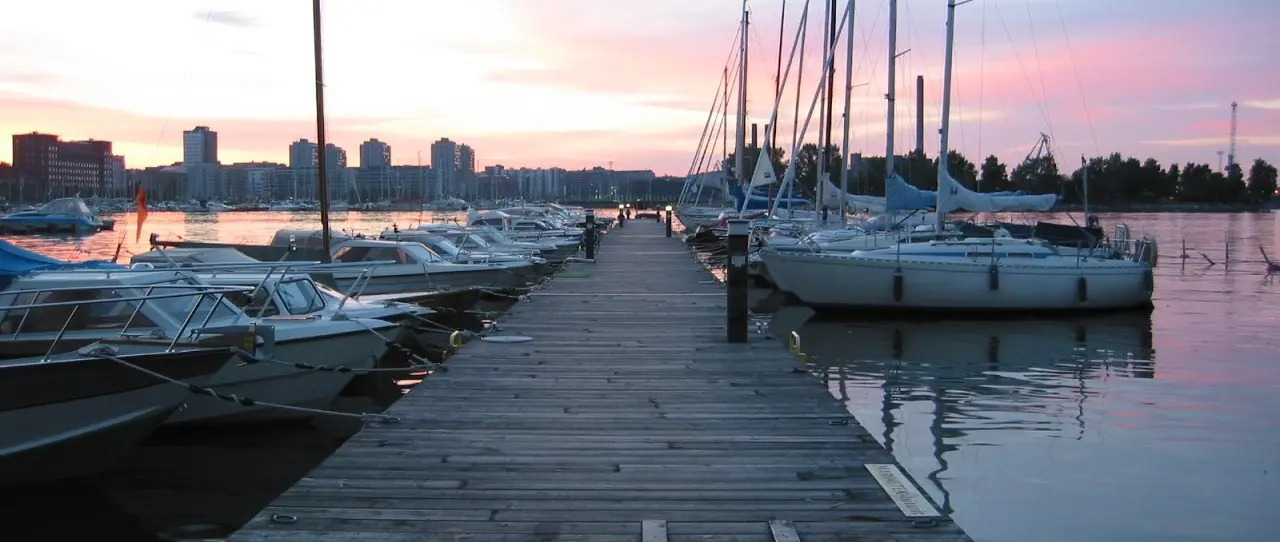
Archival Helsinki marina image; not a photograph of the planned February 2027 forum. Photo: André Riemann ✍ at de.wikipedia; CC BY-SA 3.0 via Wikimedia Commons. Licensed photograph.
Explore
Go deeper into the yachts, companies, events and destinations directly connected to this article.
Continue reading

European Boating Industry secretary-general Philip Easthill has identified continuing resilience in larger yachts despite slower trading in much of the small-boat market. Speaking during …
Embrace The Challenge has named six international sailors, led by Oliver Heer, for the 2027 Ocean Race, with four crew members selected to compete …
AIMEX has reported Australia's first dedicated Superyacht Pavilion at METSTRADE 2026 in Amsterdam, with Echo Yachts, Muir Engineering and new industry talent in the …
Monaco’s March 2027 exploration programme brings expedition yachts, scientific discussions, captains and marine innovation together at Yacht Club de Monaco.
Superyacht Guide
Continue into the wider Superyacht Guide.
Business opportunities · Superyacht Guide
Companies serving the superyacht market can discuss clearly identified advertising, sponsorship and business-profile opportunities. Commercial activity remains separate from independent editorial coverage.

