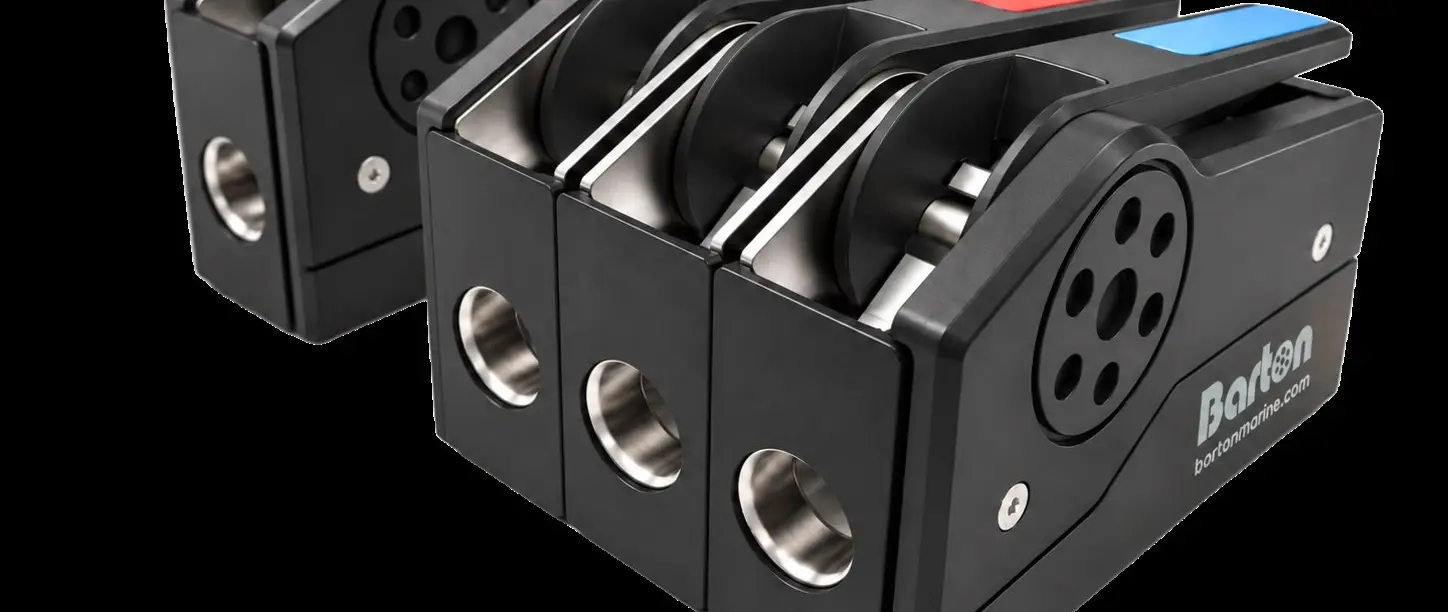
Barton Marine MCS 1000 modular rope clutch official product photograph

News

Barton Previews Modular MCS 1000 Rope Clutch at Metstrade 2026

Nov. 12, 2026 Technology

Barton Marine MCS 1000 modular rope clutch official product photograph

Barton Marine will introduce its MCS 1000 modular rope clutch at Metstrade, offering configurable banks and stated compatibility with 6–12mm lines.

Marine equipment news, 12 November 2026. The MCS 1000 is scheduled for its public launch at Metstrade on 17–19 November. This is an equipment announcement for sailing craft and potentially suitable auxiliary rope systems on larger yachts, not proof that it is rated for every high-load superyacht rigging application.

A modular deck-equipment launch for Amsterdam Barton Marine has announced plans to introduce the MCS 1000 modular rope-clutch system at Metstrade 2026 in Amsterdam. British Marine published the product announcement on 10 November, ahead of the trade show scheduled for 17–19 November. The headline idea is configurability: rather than buying a collection of fully separate clutches, an installer can select a starter pack with two end plates and add individual internal clutch units to build a bank sized for the desired number of lines. The manufacturer promotes that approach for boatbuilders, riggers, retailers and owners. The product itself is intended for a broad sailing market, and this does not automatically make it a suitable primary halyard clutch for a very large superyacht. For Superyacht Guide readers, its relevance is primarily to the equipment and refit supply chain, including the need to assess smaller auxiliary rope systems carefully in relation to the loads aboard each vessel. The claimed specifications require the usual engineering scrutiny before installation.

One, three or ten modules without a bank of separate housings Barton says the design can be configured as a single clutch or as a larger row of units, with one, three or ten clutches cited in the announcement. The starter pack includes the end plates, and supplementary internal units allow a bank to be expanded. This can be attractive where the equipment layout must match a particular deck or control station rather than rely on a standard three-clutch arrangement. It may also simplify how dealers hold stock and how an installer responds when a customer's requirements change. But the apparent simplicity of the parts system should not obscure the importance of a final load assessment. The number of modules is not the only variable. Rope entry angles, access for hands, labels, maintenance clearances and the relationship between adjacent lines can all influence whether a bank works well when underway. A design that is compact in a photograph may still be unsuitable for a particular position if it limits safe operation.

Rope size and holding capacity establish clear boundaries The manufacturer advertises compatibility with rope diameters from 6 to 12 millimetres and a holding performance of up to 1,000 kilograms for larger line diameters. Those figures are an important limitation, not an invitation to treat the device as universally suitable for large sailing yachts. High-load lines on a superyacht can greatly exceed the requirements of a smaller cruising boat, and the working load of a particular system may be very different from an advertised holding figure. Installers need to establish what test conditions support the claim, which rope constructions are compatible and what safety factors are required. A clutch can interact differently with covered and uncovered lines, varying textures or ropes that become wet and worn. Equipment should be chosen with manufacturer guidance, an appropriately qualified rigger and the vessel's own technical requirements. The announced rating is a statement from the product supplier, not an independently verified certification for every yacht or application.

The cam design addresses a familiar rope-management concern Barton says the MCS 1000 cam-tooth arrangement is designed to grip without damaging rope and to tolerate a range of diameters. Rope protection matters because the condition of a line can influence its reliability well beyond the point at which it runs through the clutch. Repeated compression, slipping or inappropriate rope geometry can contribute to local damage. But an assurance that a system is designed to minimise harm does not eliminate the need to inspect the rope, follow compatible-line guidance and replace worn components. A responsible installer should ask what the manufacturer's testing established, what inspection intervals are recommended and whether a specific rope manufacturer has approved the proposed combination. Crews need to know how to identify slippage and to distinguish normal bedding-in from an emerging problem. The difference is especially important when a system is routinely used under tension rather than handled only occasionally.

A base plate designed around existing deck holes The announcement says Barton's replacement base plate can reuse existing drilling arrangements from many other manufacturers, reducing the need to make new holes when upgrading. That may offer practical value on a finished deck, where every new penetration can complicate waterproofing and future maintenance. However, a statement that an arrangement is compatible with many installations does not mean it fits them all. An installer must check the actual hole pattern, fastener specification, the strength of the supporting structure, backing plates and the condition of the deck. Surface alignment and proper sealing remain essential. In a composite structure, seemingly minor changes should be reviewed against the original design. A product feature intended to avoid unnecessary drilling cannot substitute for ensuring that the current fastener holes are sound and appropriately positioned for the expected loads. Where doubt exists, advice from the yard or a structural engineer should take priority over convenience.

Installation sequencing could help boatbuilders Barton also describes a production approach in which builders install the base plates in the factory but leave the clutch modules until the finishing or pre-delivery stage. This may reduce the exposure of finished components to dirt or damage during later construction and transport. From a project-management perspective, the broader idea is to separate embedded or structural work from installation of delicate final equipment. Many yards already use that philosophy in different areas, but the new clutch system has been designed to support it explicitly. The potential advantage depends on accurate documentation and proper protection of temporary openings. A pre-fitted base that is poorly sealed, misplaced or left exposed could create more work rather than less. Build teams therefore need clear drawings, a well-defined acceptance process and responsibility for completing the installation before commissioning. Any claimed savings in labour or materials would need to be established with real project data.

Materials and environmental assertions require precise language The manufacturer lists 316 stainless steel and marine-grade Nylon 7 among the principal materials. It also points to the possibility of separating components for recycling and retaining certain parts, such as the side cheeks and base plate, during later service. This is a design consideration worth examining, particularly as yacht owners and refit companies increasingly ask about equipment longevity and repairability. Still, the ability to separate materials is not equivalent to a measured life-cycle environmental benefit. Local recycling facilities, actual product longevity, spare-part availability and servicing practices will determine what happens to the unit at end of life. Nor should stainless steel be understood as immune to corrosion simply because it is specified for marine conditions. Inspection, drainage and the treatment of dissimilar metals remain important. A serious environmental comparison would need verified performance and durability data, not a conclusion inferred solely from material names.

The difference between a manufacturer claim and an on-board trial Metstrade gives buyers a chance to inspect a product at a stand and ask engineers questions about the detail hidden by photographs. Barton says visitors can find the MCS 1000 on stand 01.474 during the 17–19 November exhibition. Before deciding to use a new clutch aboard a yacht, a rigging professional may wish to see how a module opens and closes, how it is cleaned, which parts can be replaced and what happens when a line is released under controlled conditions. The hand feel, access to fixings and the way several units fit together matter in daily operation. Product demonstrations should still be treated as demonstrations under particular conditions, not proof of performance in every environment. The supplier can explain the scope of its published rating, but the yacht's owner-side technical team needs to make the ultimate suitability judgement.

Implications for crew procedures and maintenance A new deck fitting may seem modest compared with a propulsion upgrade or an interior refit, yet changes to running rigging can affect deck routines. Crew members should be trained in the operation of the particular clutch, including line release, visual inspection and any restrictions on use. The equipment layout should make it difficult to confuse lines or create a trapping hazard. Maintenance logs should identify the model, installation date, rope type and any subsequent faults. Spare parts need to be available in the cruising region, not merely at the manufacturer's headquarters. On a large yacht, the responsibility for checking these details should be clearly assigned to the captain and relevant deck or engineering personnel. The manufacturer announcement does not give a universal service interval or an approved rigging arrangement for a specific vessel. Those questions must be addressed through the manual and the actual application.

An Amsterdam debut, not yet an established sea-service record British Marine's announcement establishes the planned Metstrade launch, the modular construction approach, the stated 6–12mm line range and the advertised holding performance of up to 1,000kg. It does not demonstrate a proven service history across every sailing-yacht class or provide evidence that the system is suitable for the primary loads of a 40-metre racing yacht. That distinction is essential to responsible coverage of new marine equipment. The design may be useful in many correctly engineered applications, including on support craft or less heavily loaded line arrangements associated with larger yachts. The show provides an opportunity to inspect the product and obtain the manufacturer's technical documentation. Owners considering an installation should have it assessed against their specific lines, structure and sailing regime. The broader lesson is that flexibility in a component system is useful only when it is supported by disciplined rigging decisions.

Primary source: British Marine / Barton Marine, 10 November 2026, Modular Clutch System Launch.

Photo licence and source

British Marine / Barton Marine press photography of the MCS 1000 equipment supplied with its November 2026 announcement, not independent laboratory testing.

Continue reading

All news

Superyacht Guide

Explore the superyacht world

Continue into the wider Superyacht Guide.

Business opportunities · Superyacht Guide

Reach the superyacht industry audience

Companies serving the superyacht market can discuss clearly identified advertising, sponsorship and business-profile opportunities. Commercial activity remains separate from independent editorial coverage.