
DeepBlue Rebuilds Crewing Package Around Contracts, Planning and Payroll
DeepBlue has overhauled its Crewing Package so contracts, crew planning, payroll, timesheets and Hours of Rest work from a connected crew record.
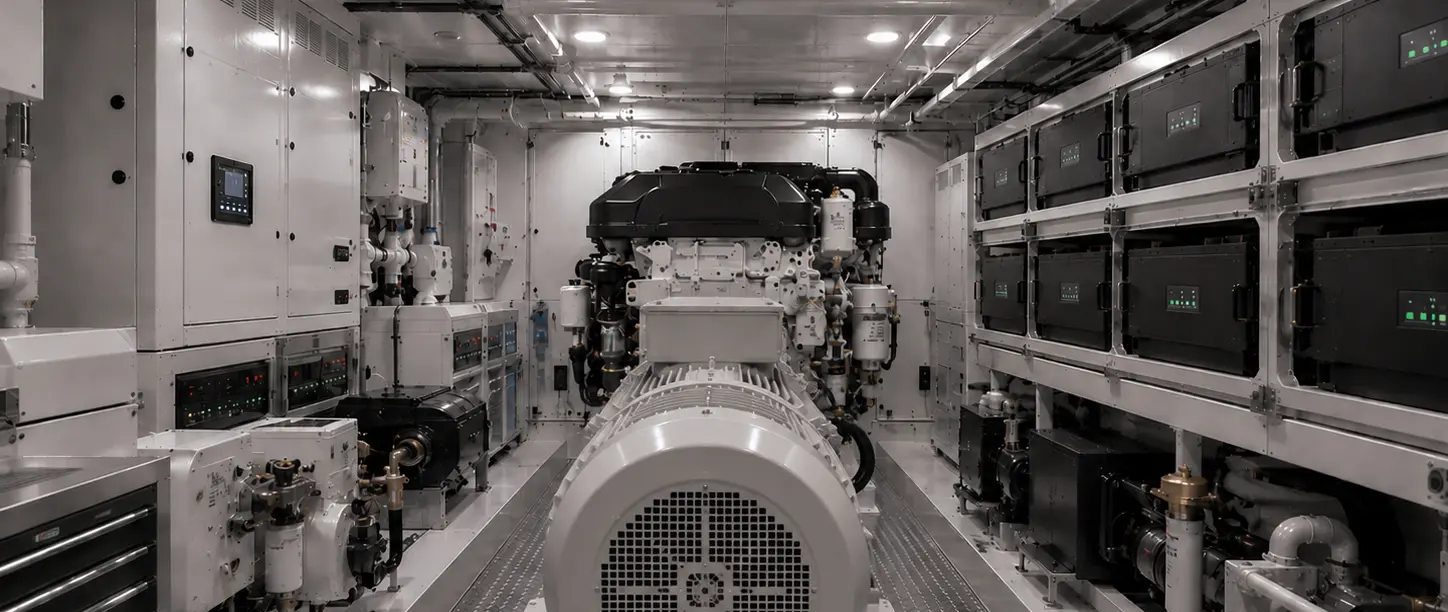
Batteries, solar and shore power can reduce superyacht fuel use and generator hours, but weight, hotel loads, range and marina infrastructure still impose hard limits.
The promise of an electrically powered superyacht is seductive. Batteries offer silence without generator exhaust, solar panels appear to turn sunlight directly into usable energy, and shore power allows a yacht to sit in harbour without running diesel machinery for days at a time. Taken together, these technologies can make a modern yacht dramatically quieter, more efficient and less dependent on conventional generation during certain parts of its operating cycle. What they cannot yet do, except in highly specialised designs, is make the enormous energy requirement of a large yacht disappear.
That distinction has become increasingly important as builders, designers and technology companies adopt terms such as hybrid, electric, battery-assisted, zero-emission mode and shore-power ready. Each can describe a genuine technical achievement, but none tells an owner how much fuel the yacht will actually avoid over an entire season. A yacht may cross a harbour under battery power yet require diesel engines for the voyage that brought it there. It may spend a silent night at anchor while its batteries discharge, only for generators to recharge them the following morning. A marina connection may eliminate local exhaust while alongside, but the overall carbon benefit still depends partly on how the electricity supplied ashore was generated.
The underlying difficulty is scale. A superyacht is not merely a vessel that needs energy to propel itself through the water. It is also a floating hotel, power station, water-treatment plant, communications centre and climate-controlled residence. Air-conditioning, refrigeration, lighting, pumps, stabilisers, watermakers, galley equipment, laundries, entertainment systems, communications, pools and technical machinery continue consuming electricity whether the yacht is travelling at 15 knots or sitting motionless off Saint-Tropez. On larger yachts, the hotel load alone can represent an energy demand that would be substantial even before propulsion is considered.
The real question for green yacht energy is therefore not whether batteries, solar power or shore connections work. They do. The more useful question is where each technology makes the greatest difference, where its physical limitations appear, and how intelligently it can be integrated into the yacht as a whole. The answer is increasingly pointing away from a single miracle technology and towards a much more sophisticated energy system in which efficiency, storage, generation and operating profile are designed together.
Battery storage has probably changed yacht design more visibly than any other electrical technology of the past decade. The attraction is obvious. A sufficiently large battery bank can allow generators to shut down for periods at anchor, absorb rapid changes in electrical load, assist propulsion, provide silent manoeuvring and reduce the need to keep additional generator sets running lightly loaded simply because power might suddenly be required. For owners, the result can be one of the most immediately noticeable improvements aboard a yacht: less vibration, less machinery noise and fewer exhaust fumes during the hours when the vessel is supposed to feel most peaceful.
The limitation is equally fundamental. A battery is an energy store rather than an energy source. Every kilowatt-hour removed from it must previously have been generated by something else, whether that is a diesel generator, a shore-side electrical grid, solar panels, hydrogeneration or another onboard system. Batteries can therefore transform when and how power is used without necessarily changing where that energy originally came from. Their environmental value depends not only on their capacity but on the complete charging cycle and on the operating decisions that surround them.
The scale of large-yacht storage demonstrates why batteries are so effective for some tasks and much less suited to others. Foundation Zero's 68.9-metre sailing yacht Zero has been designed around approximately 5MWh of battery capacity, an extraordinary amount of stored electrical energy for a yacht. The project is able to justify storage on this scale because the entire vessel has been conceived around an energy architecture that includes sailing propulsion, regenerative power production and solar-thermal collection. It is not simply a conventional yacht into which a huge battery bank has been installed after the naval architecture was completed.
Even several megawatt-hours should not be mistaken for unlimited endurance. Marine batteries remain heavy, and the surrounding installation brings additional structural and technical requirements. A representative commercial marine battery system with an energy density of roughly 77Wh per kilogram illustrates the order of magnitude involved: one megawatt-hour of battery packs alone can correspond to around 13 tonnes before accounting for cooling, containment, cabling, converters, fire protection, switchboards and the structures required to support the installation. A multi-megawatt-hour system can therefore consume tens of tonnes and a considerable volume inside the yacht.
That weight has consequences. Naval architects must account for displacement, trim, stability, structural loading and the space that would otherwise have been available for fuel, machinery, stores, crew areas or guest accommodation. Battery rooms also require careful thermal management, sophisticated monitoring and robust protection against fire and propagation. Large lithium-ion installations concentrate enormous amounts of stored energy, making battery safety a design discipline rather than an accessory specification.
This is why the strongest case for batteries aboard many motor yachts is not that they will replace long-range propulsion. It is that they allow the yacht's existing machinery to work more intelligently. Instead of running several generators at inefficient low loads, a power-management system can operate fewer engines near their preferred load range while batteries absorb short peaks and supply low-demand periods. A yacht may be able to arrive or depart electrically, sit silently through the night, or operate hotel services for several hours without combustion machinery running. The savings arise not only from replacing diesel-generated electricity but from reducing the inefficient way in which conventional generator capacity has historically been kept available.
Much of the public conversation about greener yachts focuses on propulsion because main engines are the most obvious consumers of fuel. Owners understand speed, range and litres per hour, and conventional yacht specifications are still dominated by maximum speed, cruising speed and transatlantic capability. Yet from the perspective of energy management, some of the most important opportunities occur when the yacht is not travelling at all.
A modern large yacht can carry a formidable hotel load. Air-conditioning becomes especially demanding in Mediterranean and Caribbean summer conditions, where expansive glazing, open doors and constant guest movement introduce additional heat into an already heavily cooled environment. Refrigeration operates continuously. Fresh water must be produced, sewage treated, pools circulated, galleys powered and laundry processed. At anchor, stabilisation systems may work continuously to maintain guest comfort. On highly equipped vessels, spas, cinemas, server rooms and sophisticated entertainment systems add further electrical demand.
The distinction between propulsion consumption and total yacht consumption is therefore critical when evaluating efficiency claims. Heesen's 50-metre hybrid yacht Orion, for example, has been presented with a fuel consumption figure of around 45 litres per hour at ten knots in hybrid mode, but the yard explicitly distinguishes this from hotel load. That qualification is not a weakness in the technology; it is precisely the kind of transparency required if owners are to understand what hybrid performance actually means. A propulsion figure does not describe the complete energy cost of operating a yacht filled with guests and crew.
The same reality explains why reducing hotel load can sometimes be as important as installing more generation. Better insulation, more efficient glazing, heat recovery, intelligent climate control and variable-speed pumps reduce the amount of electricity that needs to be produced in the first place. This can create a compounding benefit. A yacht that consumes less requires smaller generators, smaller batteries and less fuel, while the battery capacity it does carry lasts longer during silent operation.
This is where energy management becomes more significant than individual components. Batteries are particularly valuable because yacht loads fluctuate. A galley may create a short demand peak, a watermaker may start, a large pump may cycle on or a stabiliser system may suddenly require additional power. Historically, generators had to be running with sufficient reserve capacity to meet such peaks even when average demand was much lower. A hybrid system can use batteries to provide that reserve, allowing engines to operate in a narrower and more efficient range.
For an owner, the difference may be experienced less as a dramatic technological moment than as a better yacht. There are fewer generator starts, less low-load running, quieter anchorages and reduced machinery hours. Maintenance intervals can improve and fuel consumption can fall without requiring the vessel to abandon conventional propulsion. This is an important part of the green-yacht transition because it reflects what engineering can deliver today rather than what might become possible once energy-storage density changes radically in the future.
Solar panels appear to offer the cleanest possible answer because sunlight arrives without fuel, noise or exhaust. On land, enormous photovoltaic farms solve the problem of output by spreading panels over hectares of available space. A yacht does not have that luxury. Its surface area is finite, heavily contested and rarely positioned at an ideal angle to the sun.
A large yacht may possess substantial horizontal areas, but many are needed for guest decks, tenders, rescue equipment, antennas, skylights, ventilation, technical access or the visual proportions demanded by the exterior designer. Panels integrated elegantly into a superstructure must also cope with shading caused by masts, radar equipment and other parts of the yacht. Their output varies with latitude, weather, season, time of day and the vessel's orientation, while salt contamination and the marine environment add practical maintenance requirements.
Solar therefore works best when its contribution is understood realistically. It can provide a steady background source of electricity during favourable conditions, supplement batteries, reduce generator running time and supply low-level electrical demand over many hours. These are valuable contributions, particularly because the fuel avoided by continuous background generation accumulates over an entire season. The difficulty comes when a relatively modest photovoltaic installation is presented as though it fundamentally powers the yacht.
Zero again provides an unusually revealing comparison. The yacht has approximately 100 square metres of hybrid photovoltaic-thermal panels, yet its designers identify hydrogeneration while sailing as the far more significant source of renewable energy. The yacht's underwater regeneration system is designed to produce very substantial power when the vessel is moving efficiently under sail. In effect, the yacht uses wind to move through the sea and then converts some of that movement back into electricity.
That approach is not readily available to a conventional motor yacht. A large displacement motor yacht cruising under engine power cannot meaningfully claim renewable energy by using propulsion energy to regenerate electricity, because the additional drag ultimately has to be overcome by the engines. Its solar installation therefore remains constrained by the sunlight falling on the surfaces that can realistically be fitted with panels.
This does not make solar insignificant. It makes solar honest. A yacht whose panels consistently offset part of its hotel load, maintain batteries or allow generators to remain shut down for longer periods is using renewable energy effectively. The technology becomes less credible only when the marketing implies that a few panels have altered the fundamental energy balance of a vessel whose propulsion and hotel systems may require hundreds or thousands of kilowatts.
For future designs, the most interesting developments may come not from simply adding more conventional panels but from integrating energy collection into surfaces that already exist. Lightweight photovoltaic materials, improved thermal collection, solar-control glazing and better energy-management software could allow more of the yacht to contribute without surrendering entire decks to power production. Even then, the central limitation remains physical. Sunlight provides only so much energy per square metre, and a yacht has only so many square metres available.
If batteries are constrained by storage density and solar panels by surface area, shore power has a different advantage: the yacht no longer needs to carry the generating system supplying its electricity. A marina can connect the vessel to an electrical network orders of magnitude larger than anything that could sensibly be installed onboard.
For a yacht spending days alongside, this can be one of the most straightforward ways to reduce local fuel consumption. Generators can be shut down or used far less, eliminating much of the exhaust, vibration and machinery noise associated with producing electricity aboard. Generator operating hours fall, maintenance is reduced and batteries can be recharged without burning diesel on the yacht itself. In densely populated ports, the local air-quality benefit can be significant because combustion is removed from the immediate waterfront.
Modern standards cover both low- and high-voltage shore connections. The IEC/IEEE framework includes low-voltage systems extending up to approximately 1MVA, while high-voltage shore connections address vessels whose electrical requirements move beyond that level. For superyachts, these numbers matter because the assumption that any marina electrical outlet constitutes useful shore power quickly collapses as yacht size and hotel demand increase.
A 40-metre yacht and a 100-metre yacht do not place comparable demands on a marina. Large vessels may require substantial continuous power for air-conditioning and hotel services even before battery charging begins. The shore infrastructure therefore needs sufficient grid capacity, appropriately rated transformers and switchgear, compatible voltage and frequency, safe cable-handling systems and the ability to support multiple large vessels simultaneously. A Mediterranean marina filled with superyachts during a hot August week can create an entirely different electrical problem from the same harbour operating through winter.
This makes shore power a two-sided technology. The yacht can be designed with sophisticated shore-connection capability, but that capability has limited value at a berth unable to supply the required power. Conversely, a marina can invest heavily in electrical infrastructure, but yachts must be equipped to accept it. The transition therefore requires coordination between yacht builders, refit yards, marinas, utilities and regulators rather than changes aboard vessels alone.
Its environmental benefit also depends on the shore-side energy mix. Electricity drawn from a grid increasingly supplied by renewables, nuclear generation or other low-carbon sources can produce a much stronger lifecycle advantage than power generated predominantly from high-carbon fuels. Even where the grid itself is not fully decarbonised, however, shore power can still improve local conditions and centralise energy production in systems that are generally easier to regulate and upgrade than thousands of individual marine generator sets.
For many yachts, shore power may therefore deliver a larger practical reduction in generator use than more glamorous onboard technologies. It does not help while the yacht is crossing the Atlantic, but yachts spend considerable portions of their lives alongside. Removing diesel generation from those periods addresses a large, repetitive source of consumption using technology that already exists.
The emerging picture is not of batteries defeating diesel, solar defeating batteries or shore power making propulsion irrelevant. It is a yacht whose energy sources are selected according to what the vessel is doing at that moment.
A battery is highly effective when the yacht needs silence, rapid response or short-duration power. Shore power is compelling while alongside a suitable marina. Solar generation makes sense whenever sunlight is available because the marginal fuel cost of harvesting it is effectively zero. Conventional engines remain extremely difficult to replace when a heavy motor yacht requires sustained high power for many hours or days. The role of the hybrid system is to connect these technologies so that each is used where it performs best.
This is why hybrid propulsion is more significant than the simplistic ambition to make every large yacht fully electric immediately. A carefully designed hybrid vessel can manoeuvre electrically, maintain hotel loads from batteries, recharge from shore and then use highly efficient combustion propulsion for extended passages. Batteries can smooth electrical demand and permit fewer generators to operate at higher, more efficient loads. Energy-management software continuously decides where power should come from and where excess capacity should go.
Heesen's hybrid work illustrates this philosophy. Its systems have combined conventional propulsion with electrical machines and battery-assisted operating modes, allowing different configurations to be selected according to speed, noise requirements and energy demand. The wider commercial marine industry is moving in the same direction, with companies such as Wärtsilä integrating batteries, engines, shore connections and sophisticated power-management systems into a single architecture rather than treating each as an isolated product.
The important consequence is that the yacht begins to be designed around an energy profile rather than simply an engine-room specification. Naval architects can examine the vessel's actual life: how many hours it spends in marinas, how many nights it remains at anchor, what percentage of passages are short coastal movements, what electrical demand exists during guest operation and how often transoceanic range is genuinely required. A yacht that regularly operates between Mediterranean ports may warrant a very different battery and shore-power strategy from an expedition yacht spending months beyond developed marina infrastructure.
Regulation and classification are beginning to reflect this shift. IMO work continues on the safety framework for lithium-ion battery ships and other emerging low-carbon technologies, while classification societies are formalising battery-ready and shore-power-ready arrangements. The direction of travel is significant because it encourages builders to make future energy transitions possible even when an owner does not specify the maximum battery installation at launch.
This also places safety at the centre of the discussion. More batteries require more than additional cells. They require thermal monitoring, containment, fire detection, ventilation, emergency procedures and crew training appropriate to the amount of energy stored onboard. The technology may remove conventional combustion from one part of the yacht while introducing a different hazard that must be managed through design and operating discipline. Green energy does not eliminate engineering risk; it changes its form.
The most credible route towards lower-emission superyachts may ultimately begin with a less exciting question than which battery manufacturer or solar technology to select: how much energy should the yacht require in the first place?
Every kilowatt that can be removed permanently from the vessel's normal demand has a disproportionate value. A more efficient hull reduces propulsion power not merely for an hour but for the yacht's entire life. Better thermal insulation reduces air-conditioning demand every day of every summer. Efficient pumps, intelligent ventilation and heat recovery reduce the hotel load before batteries or generators are asked to supply it. Weight reduction can improve performance while simultaneously allowing smaller machinery to achieve the same operating profile.
Once demand has been reduced, batteries, shore power and renewable generation become more powerful because they are serving a smaller requirement. A battery bank that might sustain a conventional yacht's hotel systems for four hours could potentially support a carefully optimised vessel much longer. Solar panels supplying a small percentage of an inefficient yacht's electrical demand can provide a materially larger share once consumption has been reduced. Shore charging can replenish the system faster relative to its daily requirements.
This is one reason projects designed from the beginning around low-emission operation are fundamentally different from yachts that receive individual green technologies during refit. Both approaches can produce worthwhile savings, but a clean-sheet yacht can make decisions about hull form, machinery, battery location, thermal design, power distribution and renewable generation before the arrangement has been fixed. The technologies become parts of the architecture rather than equipment fitted into whatever space remains.
For owners considering a new yacht, this makes the specification stage unusually important. The useful questions are not simply whether batteries or solar panels are available. Owners should know the yacht's expected daily hotel demand, how long the batteries can sustain normal guest operation, which systems remain dependent on combustion, how quickly batteries can be recharged from shore and which of the yacht's regular cruising destinations can actually provide that connection. They should understand the weight and replacement implications of the battery installation, the realistic annual contribution expected from solar generation and what happens when weather or operating conditions differ from the assumptions used in the sales presentation.
The same scrutiny should be applied to the phrase zero emission. A yacht travelling electrically produces no exhaust at that moment, but the electricity in its batteries may have been generated previously by diesel. A yacht connected to shore power produces no local generator emissions, but the marina's electricity still has an upstream source. These distinctions do not invalidate the technology. They simply allow an owner to distinguish a genuinely lower-energy vessel from one whose environmental credentials depend heavily on how individual operating modes are described.
Batteries can already transform life at anchor and allow propulsion systems to operate more efficiently. Solar energy is worth collecting wherever design permits it. Shore power should increasingly become the normal way for large yachts to operate alongside capable marinas. Hybrid propulsion can reduce fuel consumption, noise and generator running without requiring owners to sacrifice the range and flexibility that remain central to the superyacht concept.
Their limitation is that none can overturn the basic physics of a large vessel. Moving thousands of tonnes through the water requires considerable energy, and supporting the lifestyle contained inside a modern yacht requires considerable energy even when the hull is stationary.
The greener superyacht will therefore not be created by placing a single new technology in an otherwise conventional vessel and giving it an environmental label. It will be the yacht that requires less power to begin with, stores energy intelligently, harvests renewable energy wherever practical, plugs into cleaner shore infrastructure whenever possible and uses combustion machinery only where its extraordinary energy density still provides a benefit that current electrical storage cannot economically replace.
That future is less dramatic than the idea of a battery-powered 100-metre yacht silently crossing an ocean without compromise. It is also much closer to the direction in which serious yacht engineering is already moving.
DNV — July 2026 class rules and battery-ready and shore-power-ready provisions
IEC — IEC/IEEE shore-connection standards
Foundation Zero — Powering the electric yacht Zero
Foundation Zero — Hydrogeneration development for Zero
Wärtsilä — Marine shore-power systems
Heesen Yachts — Hybrid yacht Orion
Corvus Energy — Representative marine battery-system specifications
Continue reading
DeepBlue has overhauled its Crewing Package so contracts, crew planning, payroll, timesheets and Hours of Rest work from a connected crew record.

MB92 Group and Voly have announced a controlled integration linking Pinpoint Works worklists with The Bridge customer portal to support refit quotations and project …
A technical guide explains why a superyacht pool needs careful structural, water-management and maintenance planning, drawing on yacht-specific design material from Idea Piscine.

The partners appoint Philippe Hamon to lead Elektra Marine and expand the JOOOL electric propulsion and energy platform across 14 boat models.
Superyacht Guide
Continue into the wider Superyacht Guide.