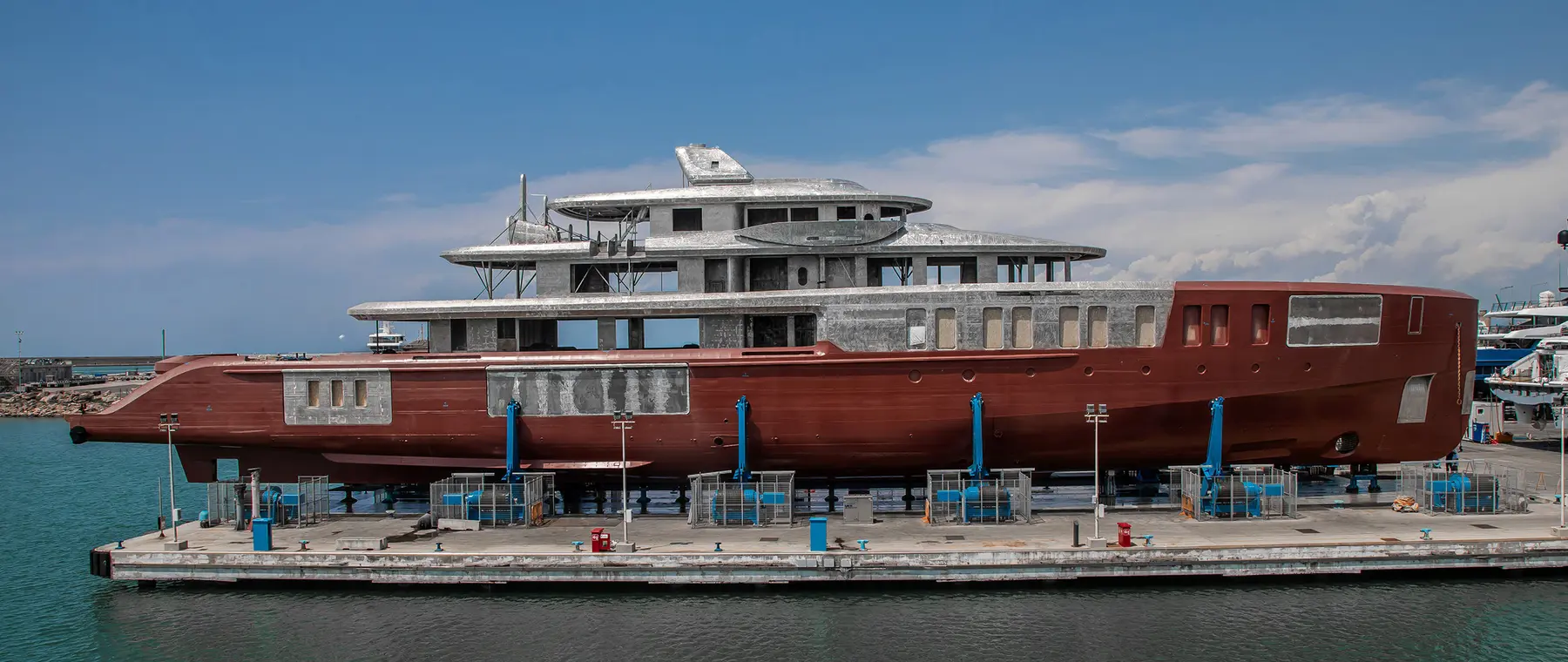
Benetti’s full-custom 80-metre Project Iron Man has arrived at the builder’s Livorno shipyard, where machinery, technical systems and interiors will now be installed ahead of its planned 2028 launch.
Benetti’s full-custom 80-metre Project Iron Man has arrived at the Italian builder’s Livorno shipyard, marking the start of the yacht’s outfitting phase ahead of a planned 2028 launch.
The steel hull and aluminium superstructure of Benetti’s 80-metre FB291 have been transferred to the company’s Livorno facility, where the yacht will now undergo the extensive technical and interior work required to transform the completed structure into a finished custom superyacht.
Known during construction as Project Iron Man, FB291 is arranged across six decks and has been developed as a fully bespoke commission. Both the exterior styling and interior design are by Cassetta Yacht Designers, while naval architecture is attributed to the Azimut|Benetti Group.
The arrival in Livorno follows completion of the yacht’s main structural work and moves the project into one of the longest and most complex stages of its construction programme. Launch remains scheduled for 2028.
The beginning of outfitting represents considerably more than the installation of furniture and decorative finishes.
During this phase, shipyard teams and specialist contractors will install and commission the yacht’s propulsion machinery, electrical generation and distribution systems, pipework, navigation equipment, communications infrastructure, hotel services and safety systems.
Insulation, flooring, ceilings, wall panels, lighting, loose furniture and fixed cabinetry must then be fitted around those technical installations. Each space must meet the design brief while maintaining access to machinery, cabling and equipment that may require inspection or maintenance throughout the yacht’s operational life.
On a yacht of 80 metres and approximately six decks, these systems extend through a substantial internal volume. The work must also proceed in a carefully coordinated sequence because delays or design changes in one technical area can affect several other trades.
Livorno serves as Benetti’s principal facility for the construction and outfitting of its largest and most technically demanding steel yachts. The yard brings together the workforce, covered production areas and specialist supplier network required for large custom projects.
Project Iron Man was sold in 2024 to an experienced owner who had previously worked with both Benetti and Cassetta Yacht Designers.
Benetti said at the time of the sale that the owner’s requirements had been interpreted through a completely custom design rather than adapted from a standard production platform. The yacht was conceived around extensive outdoor living and entertainment spaces intended to serve a large, multigenerational family.
The repeat relationship is significant in the custom-yacht sector. An owner returning to the same builder and designer brings first-hand knowledge of their working methods but may also arrive with more detailed expectations developed through operating an earlier yacht.
For the shipyard, the project therefore involves both continuity and progression. Existing trust can support faster decision-making, while the larger dimensions and increased technical ambition of the new yacht introduce a different level of engineering and project management.
Few detailed interior arrangements have been disclosed. However, the six-deck configuration and substantial overall volume provide scope for several guest and family areas, formal and informal lounges, extensive exterior decks and the service spaces required for extended private cruising.
Cassetta Yacht Designers is responsible for both the exterior and interior design of FB291.
Using one studio for both disciplines can support a more consistent relationship between the yacht’s external form, interior circulation and views from the principal living areas.
The yacht’s profile combines a near-vertical bow with a long, gently descending stern. The exterior design appears intended to preserve substantial deck space while maintaining a clean and relatively restrained overall silhouette.
Project images also indicate generous openings towards the water near the stern. Final details of any beach club, pool arrangement or fold-down platforms have not been officially confirmed, and those features should not be treated as established until Benetti releases further specifications.
The design process has been developed closely around the owner’s personal brief. Benetti described the project as an example of its ability to convert demanding individual requirements into a technically viable large-yacht platform while preserving flexibility through the construction process.
Project Iron Man sits within the full-custom end of Benetti’s production rather than one of the builder’s established semi-custom yacht families.
Series yachts can offer owners a proven engineering platform, known dimensions and a more predictable design and construction process. A full-custom yacht begins with a much broader range of possible arrangements, technical systems and exterior forms.
That freedom increases the importance of early design development and weight management. Structural engineering, machinery selection, tank arrangements, guest circulation, crew workflow and regulatory compliance must all be resolved around a unique yacht rather than an established platform.
Changes made later in the programme can be particularly expensive. Equipment may need to be moved, pipe and cable routes altered, structural supports revised or finished areas reopened to accommodate modified systems.
The outfitting phase will therefore be a test of how effectively the project’s design, engineering and construction teams have resolved the owner’s requirements before final installation.
Benetti’s Livorno operation occupies a central role in the builder’s large steel-yacht programme.
The site is used for projects that exceed the scale generally associated with the company’s composite and semi-custom production. Its infrastructure allows large hulls and superstructures to be transferred into outfitting positions while teams work on several technically complicated vessels at different stages.
Large-yacht construction increasingly depends on coordination across more than one production location. Structural elements may be fabricated or assembled separately before being moved to the principal outfitting yard.
Project Iron Man’s arrival in Livorno therefore marks both a physical transfer and a change in project responsibility. The focus now shifts from primary steel and aluminium work to integration, finishing, testing and preparation for launch.
The yacht will remain supported by a large network of equipment manufacturers, interior contractors, classification surveyors, naval architects, engineers and owner representatives throughout the remaining programme.
Although the main structure is complete, the planned 2028 launch illustrates how much work remains.
Large custom yachts can spend considerably longer in outfitting than in visible structural assembly. Much of the remaining progress will take place inside the vessel and may not be apparent from external photographs.
After launch, Project Iron Man will still require harbour commissioning, stability work, machinery trials and sea trials. Systems will be tested individually and together, while outstanding defects and owner observations will be addressed before delivery.
The schedule must also allow sufficient time for class and flag-state inspections. Equipment ranging from fire-detection systems and lifesaving appliances to propulsion controls and watertight closures must be demonstrated and documented.
For the owner, representatives and yard, the challenge is not simply completing thousands of individual tasks. The yacht must emerge as a coherent vessel in which technical reliability, crew operation and the intended guest experience all work together.
Project Iron Man is notable not only for its 80-metre length but for what it represents within Benetti’s broader order book.
The project demonstrates continued demand for one-off yachts at the upper end of the market, where owners are prepared to commission vessels developed around highly personal operational and lifestyle requirements.
It also reinforces the role of returning clients in large-yacht construction. Owners with previous experience may be more willing to undertake ambitious custom projects, but their operational knowledge can produce exacting briefs and detailed scrutiny throughout the build.
FB291 has now passed from structural construction into the stage where its identity will become more visible. Machinery, interiors and exterior spaces will gradually convert the bare hull and superstructure into the yacht envisaged by its owner and design team.
The transfer to Livorno is therefore a major milestone, but not the conclusion of the programme. The most intricate phase of Project Iron Man’s development has only just begun.
Explore
Go deeper into the yachts, companies, events and destinations directly connected to this article.
Continue reading
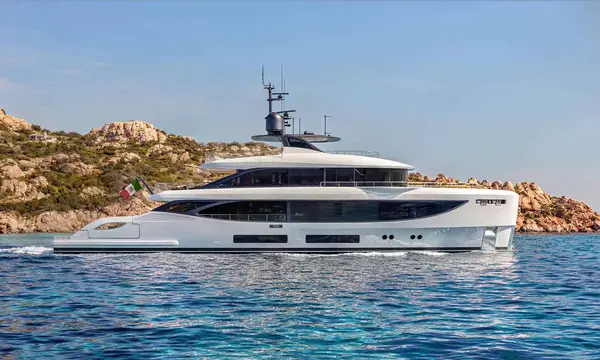
Benetti has added the 35.6m Oasis 36M to its range, combining an 82m² Oasis Deck with five guest cabins and a 2,500nm range. RWD …
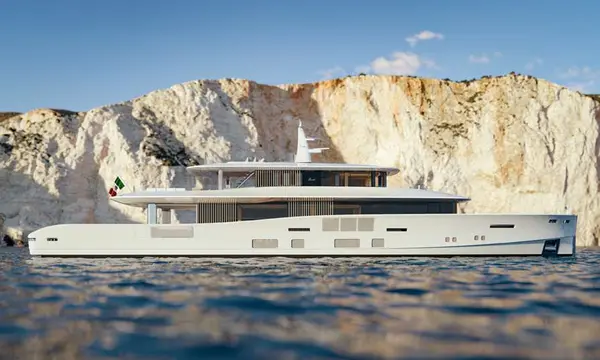
Royal Yacht International has sold the first 40.6m Benetti B.Neos, with CEO Manuele Thiella representing the buyer. The hybrid yacht is scheduled for delivery …
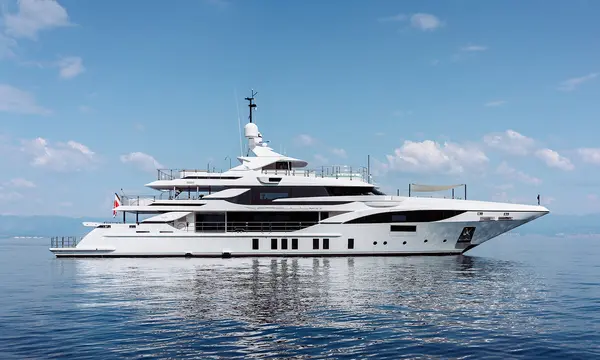
The 49.9m Benetti SEAGULL MRD has been reduced by €1 million to €23.95 million after completing her five-year class survey. The 2020-built yacht is …
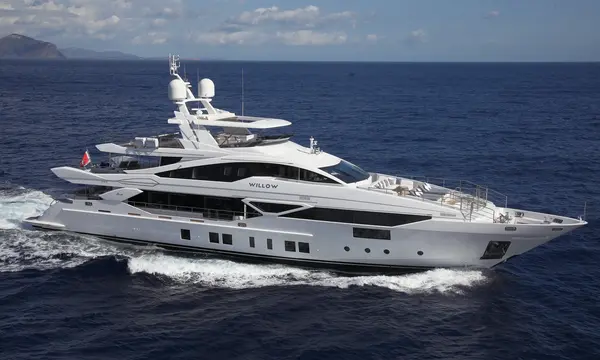
Burgess has reduced the asking price of 42m Benetti motor yacht WILLOW by a further €1 million to €12.95 million.
Superyacht Guide
Continue into the wider Superyacht Guide.