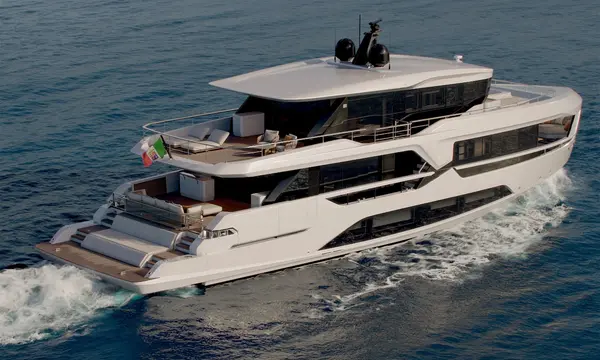
Ferretti Yachts Presents INFYNITO 100 with Private Upper-Deck Owner Suite
Ferretti Yachts unveils INFYNITO 100, its new 100-foot flagship with private upper-deck owner accommodation and versatile aft and forward terraces.
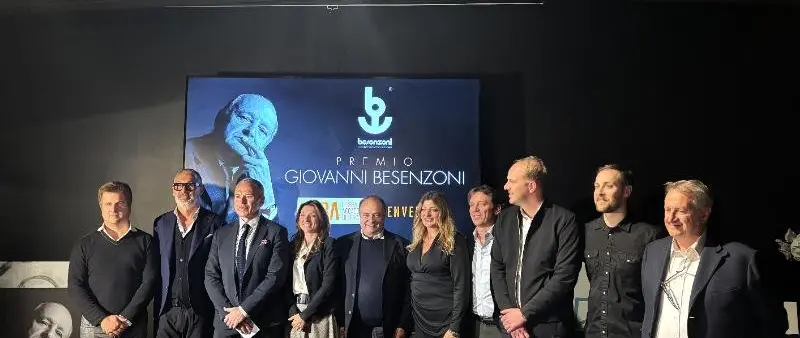
© Besenzoni / respective photographer. Original company-hosted 2025 LABA scholarship photograph, ARCHIVAL, not 2026 MEMORA ceremony.
MEMORA by Giada Faccini and Elisabetta Savoldi wins the fourth Giovanni Besenzoni Award for Yacht Design, recognising creative concepts for a yacht balcony inspired by the five senses.
Besenzoni has awarded first prize in the fourth Giovanni Besenzoni Award for Yacht Design to MEMORA, a yacht-balcony concept developed by Giada Faccini and Elisabetta Savoldi. The result was announced on 24 November 2026, following the presentation of student projects at the Italian marine-equipment manufacturer's headquarters in Paratico. This year's brief invited young designers to reconsider the relationship between people on board and the sea through the five senses.
The official company media release identifies the prize winners and the nature of the challenge. It does not announce that MEMORA has already entered production or been installed aboard a named superyacht. That distinction is central to the story: the award recognises design exploration and future talent rather than a completed commercial balcony system. The new ideas may inform later development, but implementation and certification would require entirely separate engineering work.
A large yacht's side balcony can bring guests closer to the water without requiring everyone to descend to the bathing platform. Depending on its design, the space may connect directly to a saloon or suite and create a different sense of openness when the yacht is safely at rest. Those benefits explain why openings in the hull side have become an important field of creative and technical discussion in custom yacht design.
The balcony is also a demanding piece of marine engineering. A hinged or moving platform has to work with the structure of the yacht, prevent unintended movement and operate safely under the correct conditions. A beautiful concept illustration alone cannot answer questions about load limits, watertight boundaries or access arrangements. The Besenzoni competition deliberately focused on the quality of the guest experience, while any eventual product would still have to meet the relevant technical requirements.
Giada Faccini and Elisabetta Savoldi received first prize for MEMORA. The official release gives the designers' names and project title, but does not supply a complete public technical package or claim that the design has passed classification approval. It would therefore be wrong to invent moving components, material choices or a proprietary mechanism for the winning entry.
What can be reported is the nature of the judging challenge: the students were asked to think about the balcony as a place where the vessel meets the marine environment through sensory experience. A strong proposal in that context must communicate an idea about how people feel and behave aboard, not simply make a familiar platform look different. The final verdict recognises MEMORA within the submitted design competition, not as a commercially commissioned yacht component.
The competition's second prize went to ONDE DI LUCE by Luca Agliardi and Alice Marzani. Its title suggests an interest in the relationship between the sea and light, but a title alone does not prove a particular use of lighting technology or specify the physical form of the concept. The company has made the ranking and designers public; further design details would need an authorised project presentation.
This restraint matters when reporting student work. Concepts are often deliberately exploratory and can change considerably before becoming manufacturable products. Treating a project name as a full engineering description risks misrepresenting both the students and the judges. The meaningful development is that a distinct second-place proposal was recognised within an evaluation centred on the balcony's relationship with its environment.
AETHER, developed by Giada Tosana and Giorgia Generali, placed third. Again, the public announcement establishes the winning team and ranking without publishing a detailed statement of the system's operating characteristics. Its inclusion helps show that the jury did not simply select a single concept and dismiss the other approaches to the brief.
For the marine industry, the breadth of proposals can be valuable. A design exercise may generate fresh ways of thinking about use, atmosphere or materials even when none of the individual submissions proceeds directly to production. The main outcome is a dialogue between young designers and established technical professionals, which may influence future ideas without producing an immediately saleable accessory.
The jury also gave a special mention to KRIOS by Letizia Albertini, Marina Volpi and Tommaso Tognetti. A special mention is distinct from a ranking among the first three prizes, and the company lists it separately. Recognition of another team shows that the process allowed the judges to identify merit beyond the main podium.
The announcement does not disclose a complete scoring matrix or the individual judges' votes. It is therefore not possible to explain the decision as a specific preference for one mechanism, sensory theme or material. Readers should regard the results as the official findings of the panel, with the names and project titles stated accurately.
Besenzoni established the scholarship in 2023 to mark the 55th anniversary of the company founded by Giovanni Besenzoni. The 2026 competition is its fourth edition. Previous student challenges explored the gangway and outdoor furniture for yacht decks, showing that the initiative has repeatedly used practical onboard equipment as a starting point for design research.
Moving from a gangway to a balcony is a logical continuation in one sense: both involve the physical connection between a yacht and its surrounding environment. Yet a balcony also carries particular experiential possibilities, such as changing the perceived boundary between interior accommodation and the water. The latest brief encouraged students to examine that relationship in ways that could extend beyond conventional styling.
The award programme is organised with LABA Brescia Academy of Fine Arts. Students from its two-year Industrial & Research Design programme took part, with that course coordinated by Mauro Martinuz. Filippo Rossi, an architect and yacht-design lecturer, coordinated the broader scholarship collaboration. This structure places student creativity within an educational relationship with a manufacturing business.
The combination matters because young designers can learn from the constraints of real industries, while companies encounter approaches that are less conditioned by established product ranges. A competition is not the same as an employment contract or a guarantee of future production. It provides a structured occasion for presentation, feedback and recognition.
The 2026 theme asked designers to consider the yacht balcony through sight, sound, touch, smell and taste. The balcony is a compelling location for that exercise because it sits at the transition between an enclosed interior and an open marine environment. A person may feel changes in light, breeze and movement even before stepping fully outside.
Not every sensory idea will be practical on every vessel. Sea spray, safety barriers, surface temperature and the needs of people with limited mobility all complicate the experience. A serious design process must consider how a poetic concept behaves when guests use it in changing weather and operational conditions. The competition's role is to generate ideas that can later be examined more rigorously.
The judging panel included Jan Bart of Feadship, interior designer Roelfine Vos, Enrique Tintore of Astilleros de Mallorca, Marco Piscitelli of Molteni Group, Andrea Pezzini of Floating Life, Antonella Cotta Ramusino, Nicola Pomi of Volvo Penta and Franco Michienzi of Barche magazine. Their collective backgrounds span yacht construction, interiors, marine services, manufacturing, engineering communications and the specialist press.
A multidisciplinary jury can consider more than visual novelty. The official announcement says entries were evaluated for originality, exploration of form and materials, and coherence of the proposal. It does not reveal precisely how each judge scored the submissions. The value of such a panel lies in exposing student projects to professionals accustomed to different aspects of the yachting world.
Calling the winning concept MEMORA does not make it a model available to yacht owners, brokers or shipyards today. There is no published order for the system, no confirmed yacht installation and no announced commercial release schedule. These are educational projects developed within a scholarship programme. The award recognises their design quality and potential for ideas, rather than verified readiness for production.
That distinction should not diminish the achievement. Marine innovation often begins through research, competitions or early prototypes. The next steps, if a company chooses to pursue an idea, may involve detailed drawings, structural calculations, supplier research and test installations. None of these activities should be asserted without a subsequent official statement.
Besenzoni is known for equipment including yacht gangways, boarding stairs, bathing platforms, tender-handling cranes and opening systems. It also markets balconies and bulwark terraces through its existing marine-product lines. The company's interest in the student challenge therefore relates directly to a field in which it already works with yacht designers and builders.
This background provides context for why the balcony was chosen as the 2026 brief. A company that designs moving systems needs to understand how guests will approach, use and perceive those systems as well as how the mechanisms function. The award does not mean an existing Besenzoni balcony product is being replaced or withdrawn. It is an opportunity to explore possibilities alongside current commercial expertise.
An owner may imagine a balcony as a quiet place for a morning view, while a shipyard must consider how the opening fits the hull and how its weight affects the structure. Designers need to reconcile those perspectives. Material selection, corrosion resistance, sealing, access and maintenance can influence the final form of a moving yacht feature.
The jury's published criteria included exploration of form and materials, which is consistent with these real constraints. But it would be inaccurate to claim that the student projects were formally engineered for a named classification society. Such processes belong to later development stages. The present story is about the quality of a conceptual exercise and the professional dialogue it creates.
A successful balcony experience should consider how different people move between spaces. Step heights, handholds, seating arrangements and the ability to feel secure near an opening can influence whether an attractive feature is actually enjoyed. The sensory brief could encourage students to think more broadly about inclusion, although the release does not publish a specific accessibility feature in any winning entry.
These are worthwhile questions for future yacht equipment designers. A custom owner may request elegant minimalism, but the design must still work safely for guests and crew. The competition illustrates how discussions of comfort and technology can begin early, before specifications become fixed around a particular vessel.
A platform integrated into a hull side will be exposed to marine conditions, including salt, humidity and mechanical movement. The long-term experience of an owner depends on maintenance, drainage, controls and reliable operation as well as the initial visual impression. A concept competition can inspire a new way to think about the space, but a finished component will ultimately be assessed by practical performance.
It is therefore useful to separate aesthetics from engineering claims. A company may develop a new product after reviewing student ideas, yet that later design will require independent decisions about materials and certification. The 2026 award itself does not establish durability figures, operating load limits or compliance results for MEMORA or the other projects.
Large yachts offer opportunities to develop spaces that smaller boats cannot easily accommodate. A balcony opening from a private suite or saloon may become part of an owner's preferred relationship with the water. Equipment manufacturers, exterior designers, naval architects and shipyards must work together to make such ideas viable. This makes a balcony design award relevant beyond a student classroom.
The competition also demonstrates that the next generation of yacht design talent is being invited into discussions about high-end onboard living. Designers will need to combine creativity with technical literacy, especially as owners ask for comfortable, distinctive experiences close to the sea. An award can contribute to that conversation without promising immediate adoption of any particular student concept.
The scholarship's name honours Giovanni Besenzoni, and the company frames the initiative around a principle of innovation informed by experience. Founded in the late 1960s, the business has spent decades developing marine accessories. The fourth award reflects an attempt to keep that history in conversation with emerging designers rather than treat technical knowledge and creativity as opposing values.
The event at Paratico provides a tangible meeting between students and industry representatives. Its outcome is a set of formally recognised proposals, not a claim that past expertise has been superseded. Such exchanges can be most useful when young designers are able to ask difficult questions about established assumptions and receive meaningful feedback from people who build and use yacht equipment.
As of 27 November 2026, the official results are confirmed: MEMORA by Giada Faccini and Elisabetta Savoldi won, ONDE DI LUCE by Luca Agliardi and Alice Marzani came second, and AETHER by Giada Tosana and Giorgia Generali placed third. KRIOS by Letizia Albertini, Marina Volpi and Tommaso Tognetti received a special mention. The award is in its fourth edition and was held with LABA Brescia.
The company has not announced a yacht installation for any of the concepts, an order price or a certification. The proper news is the recognition of young design work, with the balcony and five senses as the subject of the research. Any future commercial development will require a separate announcement and supporting evidence.
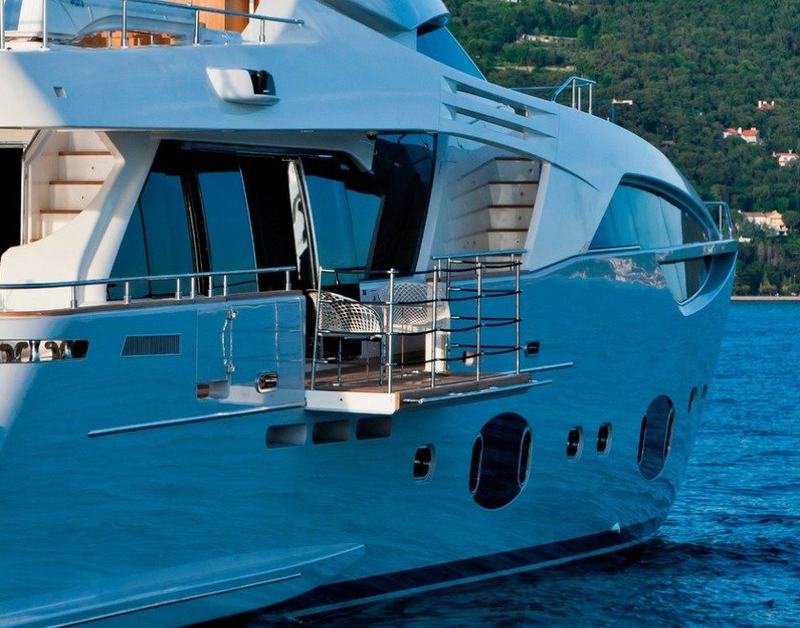
Official Besenzoni yacht balcony product photograph, from the manufacturer’s own gallery, © Besenzoni / original photographer. This is existing commercial equipment, not the MEMORA 2026 student design.
The primary source is Besenzoni's official 24 November 2026 award announcement distributed by Sculati & Partners. Details of the scholarship's preceding years are available on Besenzoni's own official 2025 award page, while the manufacturer's balcony and bulwark terrace category provides background on existing products.
Photographs are sourced directly from Besenzoni's corporate site, credited © Besenzoni / original photographer. The yacht balcony image illustrates an existing manufacturer product, not a rendering of MEMORA. The award-group photograph is from the 2025 scholarship event and is expressly labelled as archival, not a picture of the 2026 winners. This report does not invent images of student proposals or use AI-generated artwork.
Continue reading
Ferretti Yachts unveils INFYNITO 100, its new 100-foot flagship with private upper-deck owner accommodation and versatile aft and forward terraces.
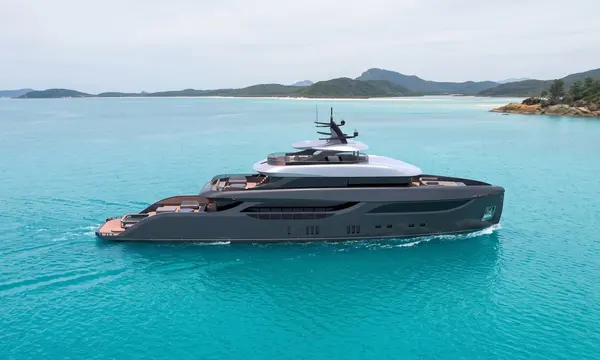
Australian designers unveil SATURDAY, a 43-metre aluminium superyacht concept with a proposed 2.5-metre draught, 9.1-metre beam and flexible indoor-outdoor spaces.

FOILER sets out its 28m GHOST hydrofoil superyacht with a planned 2029 launch, carbon and titanium construction, panoramic glazing and solar-powered systems.
Yacht Club de Monaco invites engineering students to redesign its Energy Class catamaran, with May 2027 submissions and final presentations in Monaco.
Superyacht Guide
Continue into the wider Superyacht Guide.
Business opportunities · Superyacht Guide
Companies serving the superyacht market can discuss clearly identified advertising, sponsorship and business-profile opportunities. Commercial activity remains separate from independent editorial coverage.