ICOMIA identifies Benetti, MC-ZERO Tenders and the JOOOL collaboration among the highlighted 2026 Boat Builder Awards recipients in Amsterdam.
An industry awards night with practical implications
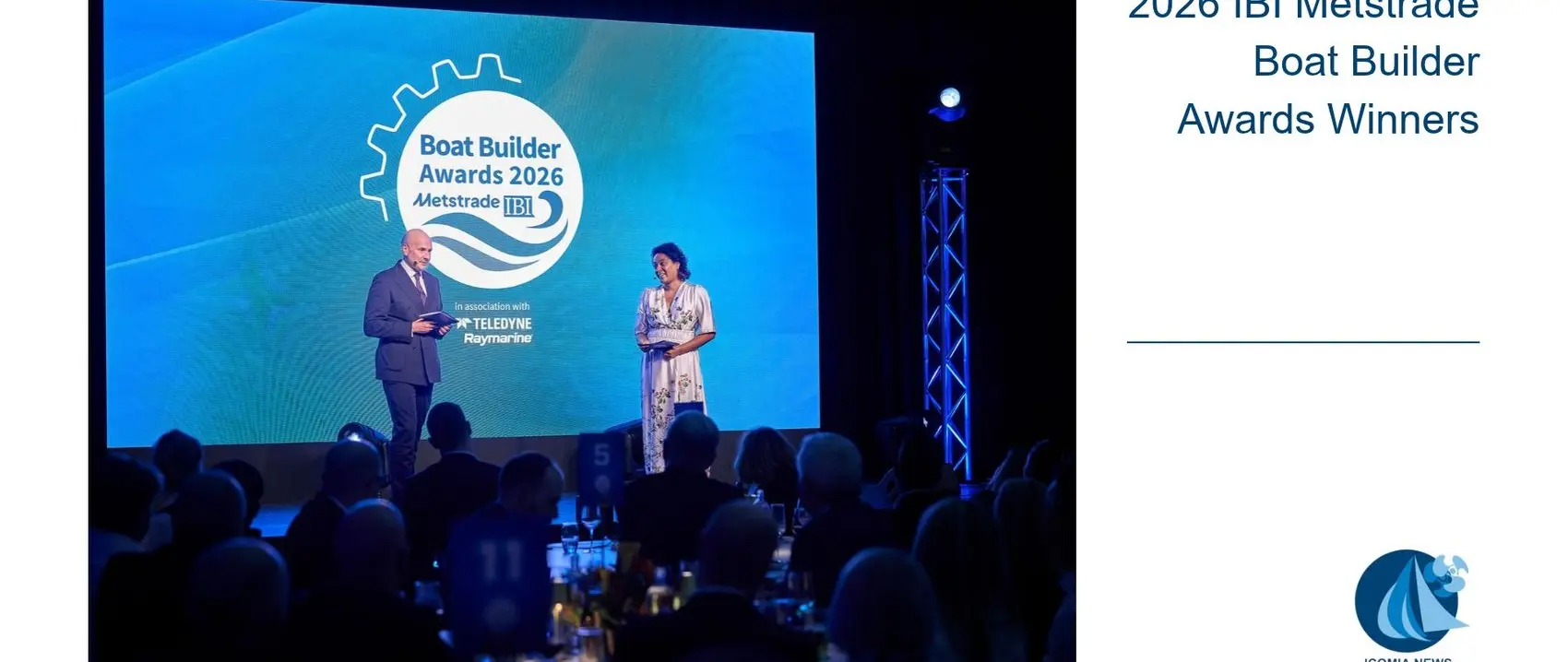
The 2026 IBI METSTRADE Boat Builder Awards were announced on 18 November in Amsterdam, with the International Council of Marine Industry Associations publishing a summary of the results two days later. The association identifies electrification, practical sustainability, collaborative innovation and emerging leadership as the themes reflected by this year's recipients. For the superyacht market, the significance lies less in the ceremony than in the kinds of work being recognised. A shipyard's propulsion development, a specialist tender manufacturer's product and cooperation between competing producers can influence how large-yacht projects are designed, supplied and maintained in future.
Benetti's hybrid work receives recognition
One of the recipients identified by ICOMIA is Benetti, recognised in connection with the MY Dagger hybrid propulsion system. A hybrid system is not a single universally applicable solution; its effectiveness depends on how power sources, energy storage and control systems are matched to a vessel's profile. The association's announcement confirms the award connection, but does not provide enough test information to quantify fuel savings on every yacht. That limitation matters. Owners considering hybrid equipment should request clear technical explanations of operating modes, verified loads, endurance and integration requirements rather than infer an efficiency figure from the fact that the system has received an industry honour.
Why hybrid arrangements matter on larger yachts
Large motor yachts spend different portions of their lives manoeuvring, cruising, travelling slowly and operating hotel systems at anchor. These activities create varied power demands. A hybrid arrangement may seek to match those demands more efficiently, but it adds equipment, software and maintenance responsibilities. Designers must consider redundancy, ventilation, battery protection, space, weight and the availability of qualified service personnel. The Benetti recognition makes hybrid technology a focal point for industry discussion, not a blanket recommendation for every new build or refit. The correct engineering assessment starts with the vessel's intended operating pattern and documented technical limits.
A tender manufacturer among the winners
ICOMIA's summary also names MC-ZERO Tenders, whose electric jet tender drew attention from the awards judges. Although a tender is smaller than its parent superyacht, the connection to large-vessel operations is direct. Tenders transfer guests and crew, reach shallow landing points and may be among the most frequently used craft aboard. Electric propulsion can affect local noise and emissions during short transfers, but it also creates questions about charging time, battery capacity, emergency reserve and handling. The award identifies a product that judges found notable; it does not remove the need to evaluate practical tender operations against weather, range and crew procedures.
Integrating a tender with its parent vessel
A large yacht's tender garage, lifting equipment and charging facilities must work as a complete system. An electric tender that appears attractive at a trade show may require modifications to a yacht's distribution board, ventilation or handling arrangements before being adopted. The charging schedule must also suit the owner's itinerary and the frequency of guest movements. Engineers should examine the consequences of a disabled charging circuit or an unusually busy operating day. A product's design award is therefore a starting point for integration questions, not proof of compatibility with an existing superyacht. The team responsible for the mother ship should be involved early.
JOOOL as an example of collaboration
The awards also highlighted JOOOL, a joint venture involving Groupe Beneteau and Groupe Fountaine Pajot. ICOMIA emphasises the rarity of competitors cooperating to advance electric propulsion. This is a separate kind of innovation from a single component: it involves pooling expertise and coordinating development. For the wider superyacht industry, that model raises useful questions about where cooperation can improve technical standards, supplier capacity and learning. It does not establish that a particular JOOOL product is intended for large yachts. The relevance is in the industry's willingness to explore collaboration on technical challenges that may be difficult for one company to solve alone.
What judges reward and what owners still need
An awards programme evaluates submitted work according to its own judging process. It does not substitute for a vessel-specific technical audit, a classification approval or a long-term reliability record. Owners and project managers should therefore distinguish design recognition from operational certification. If an award-winning component is proposed for a yacht, the relevant builder and engineer need to confirm its ratings, test results and suitability. Documentation should cover installation constraints, expected maintenance and service arrangements. A compelling innovation may still be inappropriate for a particular use case. The awards' value is to draw attention to promising developments that merit proper technical investigation.
The sustainability theme requires measurable definitions
ICOMIA identifies practical sustainability as one of the themes running through the results. In shipbuilding, this can refer to energy management, material selection, manufacturing efficiency, component life or reduced environmental impact in service. The term is broad, and different applications require different measurements. A yard claiming improvement should specify whether the change affects fuel consumption, electrical demand, emissions or another metric, together with the baseline. The Benetti system, tender innovation and JOOOL collaboration illustrate the range of approaches under discussion. They should not be combined into a single savings estimate, because their effects and intended operating environments are distinct.
Electric propulsion still depends on the full energy chain
It is tempting to regard a craft with an electric motor as inherently free of operational complexity. In practice, energy must still be generated, stored, distributed and replenished. For a superyacht carrying electric tenders, the parent vessel's systems may influence the overall environmental and economic result. Charging from shore power can produce one operating profile, while charging from onboard generation produces another. Battery longevity, replacement and end-of-life management are also part of the design picture. An industry award can support interest in electric systems, but a responsible investment decision should examine the entire energy chain rather than only the motor's immediate noise and exhaust characteristics.
The human element in engineering change
New propulsion systems require crew familiarisation and maintenance skills. A captain may need revised operational procedures, while engineers must understand isolation, alarms and diagnostic interfaces. The awards ceremony recognises products and organisations, but the successful use of any innovation depends on training and routine procedures. Yards should identify service support and documentation at procurement, and owners should budget for the people needed to operate the equipment safely. This is especially important for yachts travelling internationally, where the original supplier may be far away. A technologically sophisticated feature is of limited benefit if the crew cannot maintain or troubleshoot it.
A Lifetime Achievement recognition
The 2026 awards honoured Wes Moxey, chief executive of Riviera Australia, with a Lifetime Achievement Award. This is a people-centred acknowledgement, distinct from the technical awards for propulsion and design. ICOMIA's summary identifies the recipient but does not attempt to quantify the commercial or engineering contribution represented by the honour. For industry observers, its relevance is the importance of leadership continuity and accumulated manufacturing knowledge. Companies depend on long-term expertise as much as headline product launches. Training successive generations of managers and technicians remains essential as the marine sector introduces new power systems and design approaches.
Rising Stars signal a changing leadership pipeline
The association also names Ione Astondoa, chief operating officer of ASTONDOA, and Kaloyan Radulov, chief executive of Omaya Yachts, among the Rising Stars recognised. Their awards place attention on newer leadership at a time when shipyards face changing customer expectations and technical demands. The term does not imply that either company has a particular order-book figure or product specification; those would require separate sources. Its significance is the visibility of leaders operating across business and manufacturing roles. For superyacht owners and suppliers, capable management affects project communication, workforce retention and the consistency of decisions made through long build cycles.
How the awards relate to METSTRADE
The Boat Builder Awards are associated with the international equipment exhibition in Amsterdam, where builders and suppliers convene for technical and commercial discussions. This makes the results visible to businesses that may be considering products for future designs. A display or ceremony can initiate meetings but cannot replace subsequent evaluation. Procurement engineers need to follow up with manufacturers for drawings, electrical requirements, testing and references. Designers need to see whether a new component fits the vessel's layout. The most productive outcome of an awards week is not publicity alone but a clearer path from promising ideas to safely installed and maintainable equipment.
What a large-yacht buyer should ask
An owner representative considering the technologies highlighted by ICOMIA should seek answers to practical questions: What is the verified power or energy benefit? Under what conditions was it measured? How is the equipment serviced abroad? What are the safety and redundancy arrangements? Will it affect deck space, weight distribution or noise? Does the supplier provide appropriate documentation for the vessel's classification and flag requirements? These questions apply whether the proposal concerns a hybrid propulsion package or a tender. A recognised design can help place a supplier on the shortlist, but the purchasing decision remains an evidence-based engineering exercise.
Collaboration and intellectual property
Joint development between companies may help accelerate progress, but it also requires clarity about ownership of technical data, service responsibility and compatibility. A project team evaluating a product from a collaborative initiative should identify the entity responsible for warranty and future support. The name of a partnership does not by itself resolve those arrangements. From the wider industry's perspective, collaboration can offer a mechanism for sharing development costs and technical knowledge. From an owner's perspective, the practical priority remains a dependable component with a clear support structure. The JOOOL recognition creates a useful reason to examine these questions, rather than speculate about products not described in the source.
A careful reading of the 2026 outcome
ICOMIA's official report names the highlighted winners and connects them with themes affecting the industry. It directs readers to the full Boat Builder Awards results for the complete list. This distinction matters: the association's summary is not a substitute for the full judging record, and it would be misleading to claim every category or technical specification from the abbreviated announcement alone. The verified facts are the timing, the named recipients and the areas of work the association chose to highlight. Further details should be checked with award organisers and the manufacturers themselves before being used in specifications, valuations or procurement decisions.
What the winners say about the next development cycle
The 2026 results portray a marine industry experimenting with propulsion choices and acknowledging the importance of cooperation and capable leadership. For superyachts over 24 metres, the most immediate implications may be the evaluation of hybrid systems, the role of electric tenders and the need for practical integration throughout the vessel. The awards do not forecast how quickly those technologies will become standard. They establish that recognised manufacturers and design teams are working in these directions now. Owners, yards and crew can use the results to sharpen their questions, while leaving final judgments to verified performance, suitability and service experience.