Bure Marine Equipment official carbon-fibre tender-access company photograph, illustrative of manufacturer

News

Bure Marine Introduces Carbon-Fibre Lifting Beams for Superyacht Tenders at METSTRADE

Nov. 13, 2026 Technology

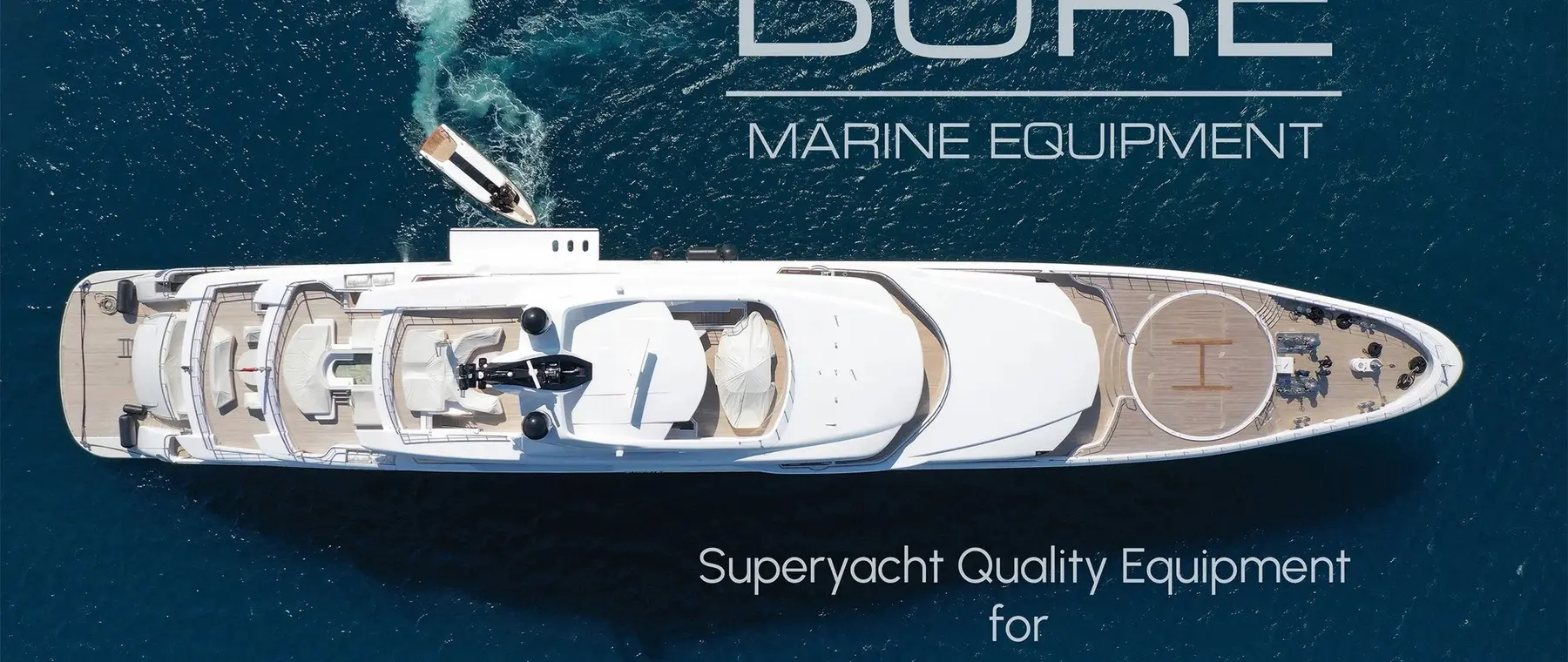
Bure Marine Equipment official carbon-fibre tender-access company photograph, illustrative of manufacturer

Bure Marine Equipment will introduce bespoke carbon-fibre lifting beams for superyacht tenders at METSTRADE, with Lloyd's-witnessed overload testing.

A specialised new product for tender garages Bure Marine Equipment has announced a range of bespoke carbon-fibre lifting beams and spreader bars for superyacht tenders ahead of METSTRADE 2026. The Norfolk-based manufacturer's products are intended to help yachts lift tenders safely into garages or onto decks, with their geometry adapted to a vessel's particular handling equipment and available space. Bure will introduce the range at its stand 08.531 during the Amsterdam exhibition, scheduled for 17–19 November. The announcement is relevant to owners of large yachts because a tender-lifting arrangement is more than a crane and a set of slings: a suitable system has to accommodate a boat's lifting points, weight distribution, stowage position and the yacht's structural and operational limits. The product launch does not establish that every existing crane will be compatible.

Carbon-fibre construction supports a lightweight approach According to the company, the lifting beams use autoclave-cured carbon fibre alongside titanium and 17-4PH stainless-steel components. Carbon composite structures can offer substantial stiffness with relatively low weight when the load paths and laminate design are appropriate. That may be beneficial when a lifting accessory has to be handled or rigged by crew in a confined superyacht tender garage. Yet the material name alone does not certify an assembly's safe working load, impact resistance or service life. The design of end fittings, fasteners and connections is just as important as the composite members. A responsible specification should therefore refer to the exact beam, its rigging and the complete lifting arrangement rather than assume carbon fibre automatically solves the problems involved.

Every beam is designed around the customer's requirements Bure says the system is tailored to individual lifting applications rather than supplied as one universal beam for every tender. That is a useful distinction because tenders vary widely in weight, centre of gravity, hull construction and the positions of their lifting eyes. A limousine tender may have substantial glazed structure and interior fittings, while a rescue or watersports tender has a different arrangement of machinery and loads. The yacht's crane may impose a limit on hook height or available headroom. A properly designed spreader can keep slings away from vulnerable superstructure, but only if the geometry is accurately calculated. Owners should provide current tender weight and lifting-point documentation before accepting a proposed arrangement.

A stated test factor of 2.2 times safe working load The company's announcement specifies that each lifting beam is ultrasound-inspected and overload-tested to 2.2 times its safe working load, with the test witnessed by a Lloyd's Register surveyor. This is a significant, concrete claim that prospective customers can verify through certificates and inspection records. It should not be confused with permission to use a beam in service above its rated safe working load. The test factor exists to demonstrate performance under controlled conditions, not to increase the load an operator may lift. An owner should check which parts of the assembly were tested, the applicable certification basis and any requirements governing subsequent inspections. Lifting equipment can remain safety-critical long after its initial factory acceptance.

Man-riding and unmanned lifts require careful distinctions Bure says the new range is designed to meet regulatory requirements for both man-riding and unmanned lifting operations. That does not mean every beam can carry people in every country or that a yacht automatically becomes certified for lifting passengers in a tender. Regulations may depend on the equipment, its intended use, local law, vessel procedures and specific approvals. A system used with people aboard the lifted craft can require additional safeguards and instructions. A captain must understand whether the assembled arrangement has approval for the precise operation being planned. Procurement documents should make the relevant duty and certification explicit, rather than treating a promotional statement as blanket authorisation.

Folding geometry has been part of the manufacturer's work Carbinium Engineering, the company behind Bure Marine Equipment, documents an earlier H-frame carbon lifting project intended to handle a roughly 40-foot boat on a superyacht support vessel. That bespoke system used transverse arms that rotated through ninety degrees for compact stowage, together with bracing and adjustable lifting arrangements. The project illustrates the firm's engineering experience but must not be conflated with every specification of the newly announced 2026 production range. Its design shows why constrained headroom and irregular tender weight distribution can create challenges even on very large yachts. An owner seeking a similar system should request drawings and testing for the actual tender, not rely on details from an unrelated historic installation.

Tender handling is a sequence, not a single movement A yacht crew may need to prepare the tender, connect lifting gear, check the rig, clear the working area, raise the craft, transfer it across the deck and secure it for passage. Each step introduces possible failure points. A lightweight beam could make rigging easier, but it does not reduce the need for communications between the crane operator, tender crew and spotters. Wind, vessel movement and restricted sightlines can affect the procedure. A suitable equipment package should include clear handling instructions, marked connection points and a storage plan. The lift must also be compatible with the tender's own approved lifting arrangement and the yacht's crane, foundations and permitted operating conditions.

Materials must withstand a demanding marine environment Composite members and metallic fittings may behave differently under heat, moisture, fatigue and impact. The compatibility of carbon fibre with metallic parts deserves particular attention because galvanic effects can arise if materials are placed in inappropriate electrical contact in the presence of seawater. Sound engineering and isolation can address such risks, but maintenance remains necessary. Stainless steel should not be assumed immune to crevice corrosion, especially where saltwater can be trapped. Owners need instructions for cleaning, inspection and the treatment of accidental knocks or scratches. A product that is strong when new may still require periodic examination after years of being moved, handled and stored in a working garage.

Lloyd's-witnessed testing is not an unlimited guarantee An independent surveyor witnessing an overload test is a valuable element of quality assurance, but it is essential to establish precisely what was inspected and on what basis. A certificate for a beam may not cover the yacht's crane, its rigging accessories or the supporting deck structure. The complete lifting operation involves multiple components, each of which can impose a lower limit than the strongest part. Owners' representatives should establish traceability, serial numbers and the documentation provided at handover. If parts are replaced or a tender is changed, further engineering assessment may be required. The manufacturer's test process is important evidence, not a substitute for the yacht's planned inspection and maintenance system.

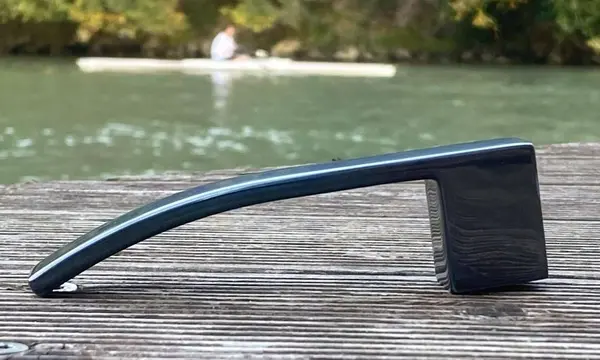
Bure already supplies access equipment to superyachts The lifting-beam launch extends the company's existing portfolio of carbon-fibre swim ladders and boarding poles. Managing director Ben Collett says those products are already used aboard more than 100 superyachts. That installed-base statement is attributed to the manufacturer rather than an independently audited fleet count. The company intends to bring its TriFold tender ladder to Amsterdam as well. The published specification describes a deployed length of about 2.3 metres with roughly 1.6 metres extending below the platform, while compact stowage is approximately 820 millimetres. Its ladders are offered in several widths and configurations, making the broader portfolio relevant to designers planning tender access and guest boarding as well as lifting.

A 150-kilogram ladder rating is separate from the beams Bure's swim ladders have a published safe working load of 150 kilograms. That figure applies to the ladder offering described by the company and should never be transferred to its lifting beams or used to infer the weight of a tender. Different products have different duty cycles and certification requirements. The ladder range spans widths from roughly 350 to 650 millimetres and many possible configurations, while the new beam range is developed around customers' lifting requirements. This makes the range a collection of related specialist accessories, not a single interchangeable system. Operators should keep the correct inspection records and operating instructions for each piece of equipment carried aboard.

An engineering background explains the product direction Ben Collett established Collett Marine Solutions in 2015 after work associated with development of the Aston Martin AM37 powerboat for Quintessence Yachts. The business later became Carbinium Engineering and established a manufacturing base in Norfolk. Its work covers design, composite fabrication and CNC machining for small-volume, high-quality components. This background helps explain a move into bespoke tender-handling equipment, where standardised accessories may not accommodate the varied shapes and weight distributions of superyacht tenders. Experience is relevant, but every lifting device still needs its own detailed engineering and testing. The appeal is the ability to address a specific technical problem rather than the reputation of a past project alone.

METSTRADE gives builders the chance to inspect the hardware The Amsterdam exhibition offers prospective customers a practical opportunity to discuss beam dimensions, attachment points and the paperwork needed to integrate a lifting accessory into a large-yacht project. Bure is scheduled to exhibit at stand 08.531, within the Superyacht Zone. The company also plans to show its carbon swim ladders and Ingol, Beck and Glaven boarding poles. Meetings with designers and engineering teams could clarify whether a standardised solution exists or whether a bespoke layout is required. No new sale, yard contract or fully operational vessel installation has been announced in the November launch report. Any such developments should be reported only once confirmed by the parties involved.

The significance is in controlled, documented lifting For a superyacht owner, a tender may be a major asset and a crucial part of everyday operations. Lifting it presents safety risks to crew, the yacht and the craft itself. Bure Marine's new carbon-fibre beams address those needs with lightweight materials, customer-specific engineering and a declared factory test regime. The most important questions remain concrete: what is the rated load, which configuration was tested, how will it be inspected and what are the permitted operating conditions aboard the actual yacht? The launch adds a specialist option to the tender-handling market without removing the need for well-trained crew and properly documented equipment.

**Sources:** Bure Marine Equipment / Carbinium Engineering first-party product and manufacturing information; the company's launch announcement reported by Marine Industry News on 13 November 2026. Hero: Bure Marine official corporate product image showing existing tender-access hardware, illustrative of the manufacturer rather than the newly announced carbon lifting beam.

Primary source: Bure Marine / Carbinium Engineering official tender-lifting engineering and 13 November 2026 launch announcement.

Image: Bure Marine Equipment first-party product photograph of existing tender-access equipment; illustrative company image, not the newly announced 2026 lifting beam. Official source image.

Photo licence and source

Image: Bure Marine Equipment first-party product photograph of existing tender-access equipment; illustrative company image, not the newly announced 2026 lifting beam.

Continue reading

All news

Superyacht Guide

Explore the superyacht world

Continue into the wider Superyacht Guide.

Business opportunities · Superyacht Guide

Reach the superyacht industry audience

Companies serving the superyacht market can discuss clearly identified advertising, sponsorship and business-profile opportunities. Commercial activity remains separate from independent editorial coverage.