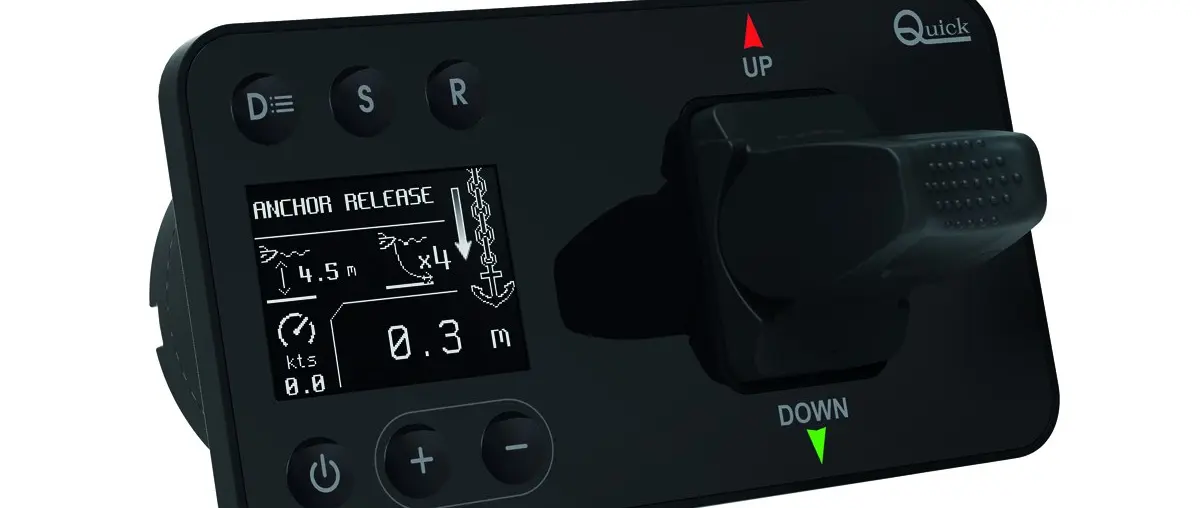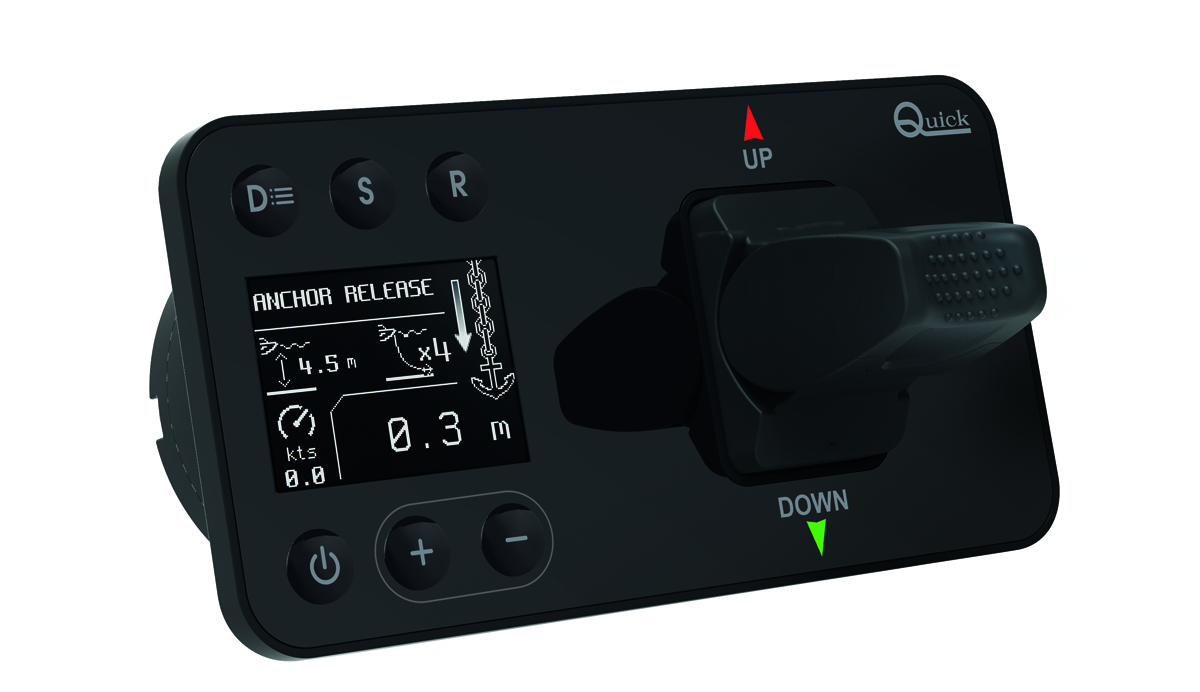
Quick Group Pacific W1XL yacht windlass controller, official 2026 manufacturer product photograph

News

Quick Group Unveils Intelligent Anchoring System for Data-Driven Yacht Windlass Control

Nov. 13, 2026 Technology

Quick Group Pacific W1XL yacht windlass controller, official 2026 manufacturer product photograph

Quick Group will debut its Intelligent Anchoring System at METSTRADE, linking proportional windlass controls with NMEA 2000 data and the QCentric platform.

A new development ahead of the Amsterdam exhibition Quick Group has announced that its Intelligent Anchoring System will make its official debut at METSTRADE in Amsterdam on 17 November 2026. The company described the new system in a 13 November briefing, positioning it as an alternative to conventional windlasses controlled largely by an on-or-off relay. The proposal is to combine a proportionally controlled drive with measurements from the yacht and the anchor-handling system, allowing the crew to manage deployment and recovery with more information. For larger yachts, anchoring can involve substantial equipment loads, complex foredeck operations and decisions about the distance between a vessel and surrounding hazards. The significance of the announcement is therefore in the claimed integration of controls, safety checks and information, not the suggestion that a windlass has suddenly become autonomous.

The QCentric architecture links the components The new product uses Quick Group's QCentric architecture, which the manufacturer describes as a digital platform based on a CAN bus communications network. It can receive information from compatible components and NMEA 2000-connected equipment. This is important because a windlass is only one part of a yacht's anchoring arrangement. The crew also needs information about chain length, water depth, boat speed and position. When these measurements are managed through disconnected displays, interpreting them during a manoeuvre may require more work. A shared system can present a more coherent view, but the quality of that view still depends on accurate sensors, appropriate installation and a clearly understood control interface.

New Pacific controllers provide the operating interface Quick Group identifies its new Pacific W1XL and W2XL controllers as the operating interfaces for the Intelligent Anchoring System. The controls build on the company's wider Pacific range and are intended to give operators access to the functions and information provided by QCentric. Control ergonomics are not merely a matter of appearance. The person handling a windlass may need to issue commands while monitoring nearby crew, the chain, other vessels and the yacht's position. A controller should therefore be straightforward to use under real operating conditions and should provide useful feedback without becoming a distraction. The announcement does not supply the complete certification and operating manual for every installation, so those details must be confirmed during procurement.

Checks begin before the anchor is released The manufacturer says its system assesses the windlass, chain counter and retaining devices before a deployment begins. These checks are intended to identify conditions that could make the operation inappropriate or unsafe. On a large yacht, anchor handling should already be preceded by established procedures covering the intended depth, seabed, weather, traffic and available swinging room. Electronic checks can support those procedures, but they cannot replace a crew's physical inspection or the captain's judgement about where to anchor. A computer may report that sensors are healthy while an unforeseen obstruction or a person in the working area presents a hazard. The correct safety case combines technology and disciplined seamanship.

Proportional speed changes the windlass response Once deployment begins, Quick Group says the system adjusts the chain payout speed through progressive acceleration and deceleration profiles. This differs from a simple fixed-speed arrangement because the command can vary as the operation develops. A smoother response could make it easier to control momentum and reduce sudden loads, although any specific reduction in mechanical wear needs evidence from testing. The speed appropriate for one yacht may not suit another, particularly when anchor mass, chain dimensions and windlass capacity differ. The system must be configured around its actual equipment and expected conditions. It would be misleading to suggest that proportional control by itself prevents every anchor-handling accident.

The yacht's movement becomes part of the decision Quick Group describes monitoring vessel position, speed and heading while the anchor is deployed. That information may help the operator understand how the yacht is moving in relation to the lowering chain. However, GPS position, speed-over-ground and heading are separate measurements and may behave differently in wind, current or confined waters. Their interpretation becomes especially important when a yacht is manoeuvring astern to lay its cable. A software system should use and display measurements in a way that crew can understand, and it must make the loss of an input clear. The announcement highlights this integration but does not explain every possible failure mode or the precise requirements for sensor redundancy.

Scope calculations need an informed user The manufacturer says the system calculates an optimum scope ratio from water depth and parameters entered by the user. Scope refers to the relationship between the length of rode deployed and the vertical distance involved in anchoring. Choosing the correct amount of chain depends on conditions beyond a simple mathematical ratio, including forecast weather, seabed holding, tidal variation and proximity to other vessels. An electronic recommendation should therefore be treated as decision support, not a guarantee that the anchor will hold. Crew should also consider the geometry of the vessel and the difference between displayed depth and the effective depth used for calculations. A well-designed system can help a captain apply a plan, but it cannot remove the need to create one.

Recovery is managed as carefully as deployment During retrieval, the system is intended to reduce speed progressively as the anchor approaches the bow, helping limit impacts and mechanical stress. The final stages of recovery can be demanding because a heavy anchor must be brought into its stowage without damaging the hull, roller or retaining equipment. On a superyacht, the foredeck crew should maintain observation and the appropriate communications with the bridge. Automatic slowing may be useful, but it is not a substitute for confirming that the anchor is correctly oriented and secured. The manufacturer's claim should be assessed in the context of individual anchor shapes, chain configurations and the actual arrangement of the yacht's bow equipment.

Safety alerts do not make anchoring risk-free Quick Group says the system can flag unavailable sensors, anomalous conditions and incorrect operating circumstances, with the operator retaining the ability to intervene. Those are useful goals, but an alarm is effective only if it is visible, unambiguous and understood by the person in control. Alarm fatigue is a real consideration where multiple systems produce frequent warnings. Operators need to know which alerts require an immediate stop and which indicate degraded functionality. It is also essential to establish the manual recovery procedure if communications, data or electrical power are lost. The public launch briefing does not contain enough detail to declare the system fail-safe under all circumstances.

The CAN bus may simplify some installation work The announcement describes a single communications cable per control station, plug-and-play connections and the ability to integrate handheld remotes. That approach may reduce some wiring complexity compared with more traditional arrangements, but it does not eliminate the need for properly rated power circuits, protection, isolation and marine-grade installation practices. A refit may require modifications to existing motor drives, chain counters or displays. Compatibility between equipment made by different companies should be verified at the exact software and hardware version. A CAN bus is a communications method, not a blanket guarantee that all devices can exchange every type of data safely.

Single and twin windlass arrangements are envisaged Quick Group states that its setup can be used with one or two windlasses. The possibility matters on larger yachts, some of which use dual anchoring systems to provide operational flexibility. A twin-windlass installation requires the crew to understand which controls and measurements apply to each side, including how devices are selected and how conflicting commands are prevented. Equipment may also differ in age, motor type or mechanical configuration. A system described as compatible with twin units should not be assumed to support every mixed installation without additional engineering. The manufacturer's current integration drawings and testing guidance will be decisive for owners considering a conversion.

Helm displays bring information to the bridge The company plans to make system data visible on multifunction displays at the helm. That can help the captain maintain an overview of the operation while a crew member works on the foredeck. It also reinforces the need for clear division of responsibilities, since anchoring involves vessel manoeuvring as well as handling heavy equipment. A bridge display does not replace local confirmation that the chain is running correctly or that retaining devices are secured. A communication plan should identify who is authorised to command the windlass and what happens if the bridge and deck stations issue conflicting requests. Such questions are particularly relevant to yachts with sophisticated integrated controls.

QCentric is intended to connect more than the windlass Quick Group has been developing QCentric as an open and scalable architecture for linking its products with selected third-party systems. Its recent activity has also included proportional thrusters, Pacific controls and stabilisation equipment. Integration offers the possibility of more coordinated operation, but it introduces software and network-management responsibilities that were less prominent on isolated hardware. Updates, diagnostics and access controls must be managed carefully. A captain should know which functions remain available if a central controller or network connection fails. The value of an ecosystem will depend on dependable interfaces and long-term support rather than merely the number of features shown on one display.

The XR8 and other equipment remain separate offerings At METSTRADE, the group also intends to display the XR8 windlass, reported as installed aboard the Azimut 44M, along with equipment from its Sanguineti and Nemo brands. The broader stand programme includes thrusters, lighting, doors, hatches and portlights. These are part of Quick Group's expanding product portfolio but should not be confused with the patent-pending anchoring software itself. The exhibition is a chance to inspect several technologies under one corporate umbrella. Procurement decisions for a specific yacht should still consider the individual product's duty ratings, approvals, integration requirements and service arrangements. One company's shared control architecture does not mean that all its hardware is designed for identical vessel sizes.

A new product needs operating evidence The Intelligent Anchoring System is a new public introduction, not a claim that it has already completed thousands of successful operations on superyachts. Buyers should ask which windlasses are compatible, what sensor failures look like on the interface, how manual intervention is prioritised and whether the control logic can be tested during commissioning. It would also be useful to obtain clear limits for chain types, motors, vessel sizes and any special operating conditions. Demonstrations at a trade show can reveal the interface and its basic logic, but they cannot replicate every anchorage or weather scenario. Carefully documented trials will be more persuasive than a general promise of stress-free anchoring.

What owners should take from the launch The announcement shows a direction in yacht deck equipment: systems that once operated as isolated pieces of machinery are being connected to vessel data and more sophisticated controls. Quick Group's proposal is to bring that approach to a critical manoeuvre using proportional windlass drives, chain monitoring and calculated scope recommendations. Those functions could assist crews when properly installed and used, yet neither the manufacturer nor a newsroom should present them as replacements for training, watchkeeping or good anchoring practice. The confirmed story is the planned debut on 17 November 2026 and the functions described in the company's briefing. Real operational value will be established through integration, reliability and the quality of the information delivered to crew.

**Reporting basis:** Quick Group product announcement distributed by PressMare on 13 November 2026. Official Pacific W1XL controller photograph used as manufacturer product media; it is not a photograph of a completed superyacht installation.

Primary source: Quick Group official product briefing distributed by PressMare, 13 November 2026.

Photo: Quick Group / PressMare official 13 November 2026 Pacific W1XL product press photograph; equipment illustration, not completed yacht installation. Official source image.

Photo licence and source

Photo: Quick Group / PressMare official 13 November 2026 Pacific W1XL product press photograph; equipment illustration, not completed yacht installation.

Continue reading

All news

Superyacht Guide

Explore the superyacht world

Continue into the wider Superyacht Guide.

Business opportunities · Superyacht Guide

Reach the superyacht industry audience

Companies serving the superyacht market can discuss clearly identified advertising, sponsorship and business-profile opportunities. Commercial activity remains separate from independent editorial coverage.