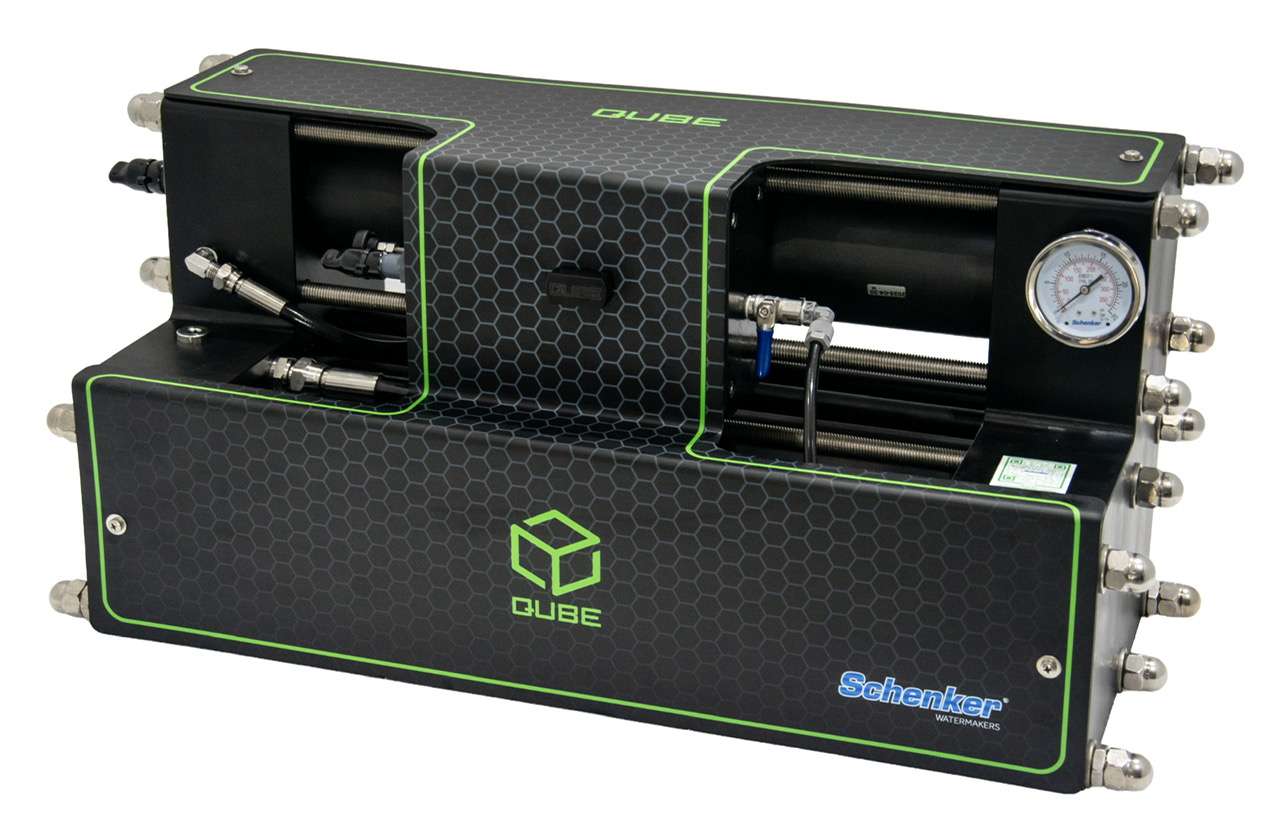
Schenker Qube 150 marine watermaker, official manufacturer METSTRADE product photograph

News

Schenker Qube 150 Brings 12V Watermaking to Larger Yachts Ahead of METSTRADE

Nov. 13, 2026 Technology

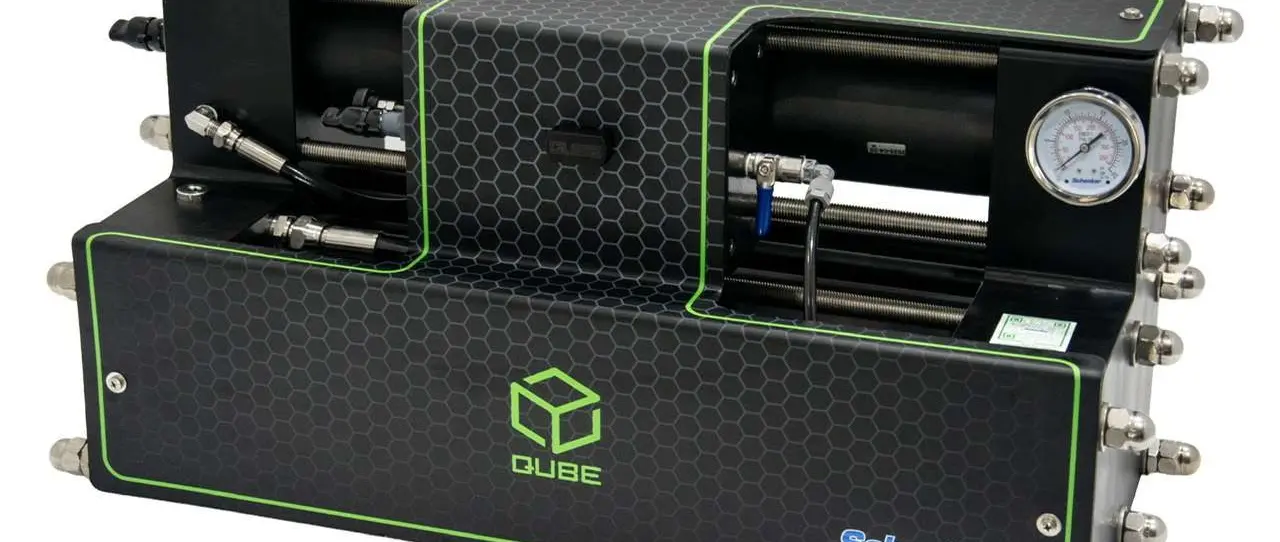
Schenker Qube 150 marine watermaker, official manufacturer METSTRADE product photograph

Schenker's Qube 150 watermaker is rated at 150 litres per hour and 500 watts, with 12V, 24V, 48V DC and 230V AC options for yacht engineering.

A new model expands a compact watermaker family Schenker Watermakers has introduced the Qube 150, a reverse-osmosis freshwater generator designed for medium-sized and larger yachts and scheduled for its official debut at METSTRADE 2026 in Amsterdam. In the November product briefing, the company states a capacity of 150 litres of freshwater per hour and a power draw of 500 watts. The model extends the Qube series beyond existing 30-, 65- and 100-litre-per-hour units. Schenker also highlights its availability for 12-volt electrical systems, as well as 24V and 48V DC and 230V AC configurations. The news is an announced marine equipment product, not evidence that a particular superyacht has completed an installation or that the manufacturer's consumption figures have been independently verified under every condition.

Freshwater production affects time away from port A yacht at anchor may use freshwater for cooking, cleaning, laundry, guest facilities and crew needs. The amount required depends on the number of people aboard, the equipment installed and the way the vessel is operated. On an extended voyage, a watermaker can reduce the frequency of tank-filling stops, but its usefulness depends on output, seawater conditions, storage and maintenance. A yacht with a large jacuzzi or a high-volume laundry operation may need considerably more capacity than a vessel that relies on careful water management. The Qube 150's rating is one input into that calculation. Owners should begin with an estimate of actual daily demand rather than select the largest or newest model simply because it has an attractive catalogue specification.

The 150-litre-per-hour figure needs context Schenker's claimed output is 150 litres of freshwater per hour when the equipment operates under its specified conditions. At full rated output, a period of several hours could produce a useful amount of water, but practical production depends on seawater temperature, salinity, feed quality and the installation. The stated figure is not a guarantee that the yacht can produce that volume continuously for every hour of every passage. Membrane condition and prefiltration can also affect performance. Operators need to consider startup, flushing and maintenance periods, alongside the actual duty cycle. For a 24-metre-plus yacht, the relevant question is how much reliable water is available during typical operations, with an appropriate reserve for unexpected delays.

Five hundred watts is the headline electrical claim The manufacturer reports a rated electrical absorption of 500 watts. This matters because watermakers can be important loads on a yacht's electrical system, especially when the crew wants to run them without starting a generator. The design incorporates energy recovery, which Schenker associates with reduced electrical consumption. Yet a single wattage figure cannot establish the complete energy cost of producing freshwater in every operating condition. A comparison should consider the watermaker's delivered output, power demand under realistic salinity and temperature, pretreatment equipment and the time required for flushing. Owners should seek test procedures and operational curves before basing a battery-management plan on an assumed fixed load.

Twelve-volt operation is the unusual feature Schenker says the Qube 150 can be operated from a 12V DC supply, a capability the company describes as unusual in the unit's production category. Many medium-sized vessels retain substantial 12-volt systems, while larger yachts may have multiple higher-voltage or AC circuits. The availability of different supply options could make the product relevant to a wider range of installations. It does not mean a 500-watt watermaker can be connected to any existing battery circuit without electrical modifications. At lower voltage, current and cable-sizing questions become especially important. An installer must consider protective devices, voltage drop, battery capacity and the load from other consumers before determining whether the yacht's electrical architecture is suitable.

Energy recovery is central to the design Reverse osmosis requires seawater to be pressurised and passed through a membrane, separating freshwater from brine. Energy recovery systems attempt to make use of pressure or energy that would otherwise be lost during the process, reducing the electrical work required. Schenker describes a new generation of this technology within the Qube 150. The actual construction and performance should be evaluated using manufacturer documentation and, where possible, independent test data. Energy recovery is a technical approach rather than a guarantee that the equipment has negligible power demand. A yacht's total efficiency also depends on whether the watermaker is operated at appropriate intervals and how effectively the crew maintains filters and membranes.

Closed-loop control adjusts the motor The company says its system uses feedback control to adapt motor speed to operating conditions and maintain the required pressure. This can help compensate for variations during normal operation, but it should not be interpreted as an ability to ignore seawater quality or prevent all faults. Reverse-osmosis equipment requires monitoring of pressure, flow and freshwater quality. If the feedwater is heavily contaminated or the membranes are fouled, the system may need attention regardless of the control software. Schenker also uses brushless electric motors in the Qube series, presenting them as a means of supporting efficiency, reliability and lower maintenance. Such benefits should be assessed against the complete system over time rather than one component's design.

A compact installation footprint is part of the proposition The Qube 150 is reported as 75 centimetres long, 28 centimetres deep and 34 centimetres high, with a weight of 56 kilograms. Those dimensions could help a designer place the main unit within a technical space where larger machinery would be difficult to accommodate. However, a complete watermaking installation also requires intake and discharge connections, prefilters, freshwater storage and space to access components. The practical footprint may therefore be greater than the dimensions of the main housing. Marine engineers should ask how much clearance is necessary to replace filters or membranes and whether the unit can be removed without dismantling other equipment. Compactness is useful only when the crew can still service the system safely.

Larger yachts may prefer more than one unit On some larger yachts, owners and engineers choose multiple watermakers so production can continue if one unit needs maintenance. Whether such a configuration makes sense depends on the available electrical power, tank capacity, expected demand and the desired redundancy. The Qube 150 could be considered as one component in a broader freshwater system, but the November announcement does not identify a certified multi-unit arrangement for a particular superyacht. The choice should be based on a practical study of guest use and operational requirements. A vessel with significant peak demand may benefit from storage and production capacity rather than relying on one watermaker running continuously at its published maximum output.

Seawater conditions can change the operating picture A yacht cruising between the Mediterranean, the Caribbean and colder regions will encounter different seawater temperatures and salinity. These conditions can affect the pressure and energy needed for reverse osmosis and the quality of the resulting water. Some locations may present problems with sediment, biological growth or other contamination, increasing the need for careful pretreatment. The operating environment should therefore influence system selection and the specification of filters and sensors. A yacht should not use a watermaker indiscriminately in every anchorage without considering water quality and local environmental or operational guidance. The supplier's technical documentation should establish the allowable conditions and maintenance procedures.

Freshwater quality requires independent attention A watermaker producing an adequate volume does not automatically establish that every litre is suitable for drinking without an appropriate water-management plan. Treatment, storage, pipework and monitoring can all influence quality after water leaves the membrane. Yachts may use different arrangements for potable and non-potable water, depending on their design and operating requirements. Crew should follow applicable guidance on testing, sanitation and tank maintenance. Product marketing should not be treated as a substitute for those procedures. Owners comparing equipment need to know what the manufacturer specifies for water quality and whether any post-treatment steps are required. A dependable freshwater system combines production, storage and hygienic distribution.

Service and consumables affect long-term ownership Filters, membranes, seals and pumps may require inspection or replacement during the equipment's life. A yacht cruising far from its home port will need a reliable source of consumables and the ability to identify faults without unreasonable delays. The cost of service should form part of any comparison with other watermakers. Schenker describes the Qube range as designed to reduce complexity and maintain a compact form, but this does not establish that every installation will require fewer service hours than a competing system. Maintenance demand depends on water quality, operating time and the crew's attention. A chief engineer should ask for service schedules, spare-parts availability and training requirements before committing to the equipment.

METSTRADE is the first opportunity for a detailed inspection The product is due to make its debut at the Amsterdam exhibition from 17 to 19 November, approximately one year after the Qube family first appeared. Visitors will be able to ask about the new 150-litre model and how it differs from the smaller units. A useful technical meeting should cover power quality, available voltage configurations, installation drawings, pressure limits and spare-parts requirements. Buyers who already operate a Schenker system may also wish to establish whether any controls or accessories can be retained during an upgrade. The event has not yet taken place at the time of this report, and there is no basis for announcing completed demonstrations, independent certification or customer deliveries arising from the show.

The supplier's efficiency ranking remains a claim Schenker describes the new model as highly efficient within the 150-litre-per-hour category and highlights the availability of 12V power as a distinctive feature. These are manufacturer statements, not a controlled comparison presented with identical test conditions for every competing product. A sensible purchaser should ask for evidence covering seawater temperature and salinity, output quality, electrical measurement and how the unit performs after extended use. The comparison should also include the cost of filters, membranes and any supporting pumps. A technically sound installation may be preferable to a marginally more efficient product that is difficult to maintain or poorly matched to the yacht's electrical and freshwater systems.

A relevant development for longer-range cruising The Qube 150 adds a specific capacity and electrical configuration to the equipment available for owners planning extended cruising. Its combination of 150 litres per hour, claimed 500-watt demand and multiple supply-voltage options could make it worth evaluating for selected 24-metre-plus yachts. Whether it is the right choice will depend on the vessel's freshwater consumption, installation space, electrical supply and desired redundancy. The announced product is not a ready-made solution for every superyacht, but it gives engineers another option to assess through detailed specification. In long-range operations, reliable water production is an unglamorous but important part of allowing owners and guests to spend more time away from shore facilities.

**Reporting basis:** Schenker Qube 150 manufacturer specifications reported in the PressMare preview of 10 November 2026 and independently corroborated by marine industry coverage of 12 November. Official Schenker product photograph distributed for its METSTRADE announcement. Electrical consumption and efficiency are unverified supplier claims.

Primary source: Schenker Qube 150 manufacturer specifications reported by PressMare, 10 November 2026.

Photo: Schenker Watermakers official Qube 150 product media distributed for METSTRADE 2026, November 2026. Official source image.

Photo licence and source

Photo: Schenker Watermakers official Qube 150 product media distributed for METSTRADE 2026, November 2026.

Continue reading

All news

Superyacht Guide

Explore the superyacht world

Continue into the wider Superyacht Guide.

Business opportunities · Superyacht Guide

Reach the superyacht industry audience

Companies serving the superyacht market can discuss clearly identified advertising, sponsorship and business-profile opportunities. Commercial activity remains separate from independent editorial coverage.