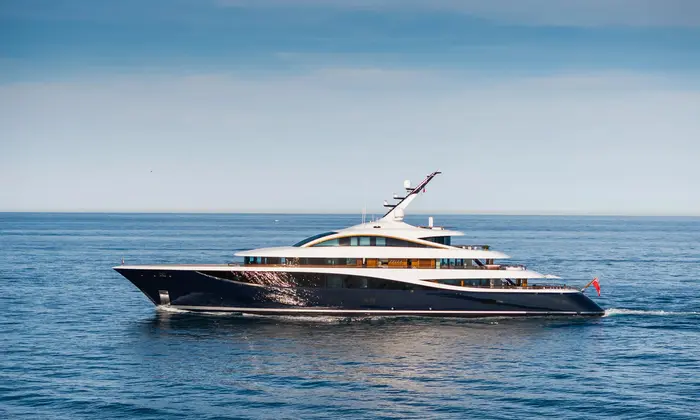
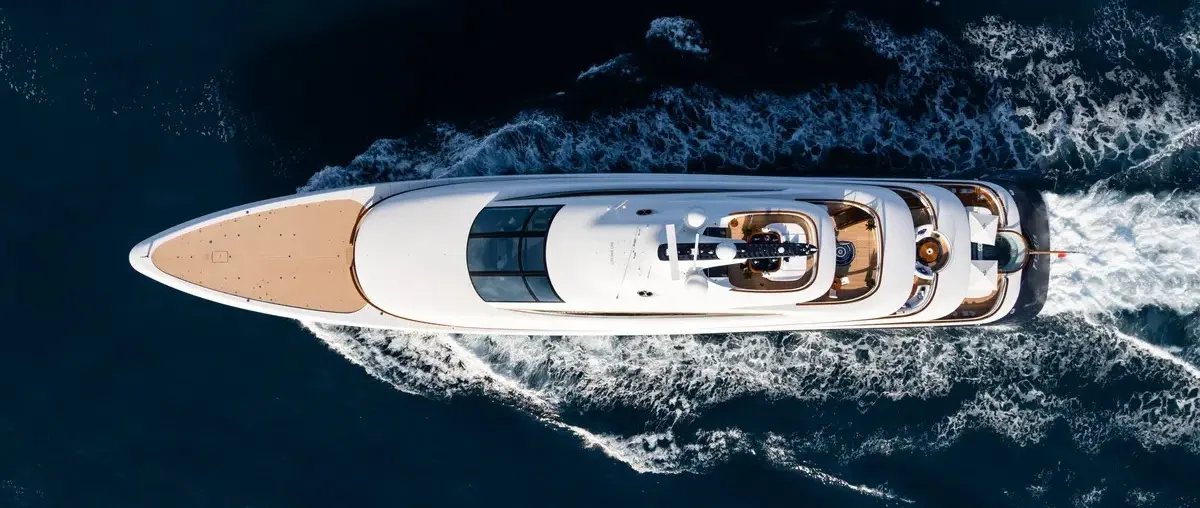
Feadship Faith hull 714 official 2025 Antibes image 2
How the 79.95m Feadship Faith became hull 714 in the fleet record, and what its RWD design and diesel-electric engineering reveal about custom yacht building.
The Feadship identified during construction as Project 714 has a name, an official hull identity and a distinctive engineering story: Faith. The 79.95-metre yacht emerged from the builder's Aalsmeer facility in February 2025, and Feadship's subsequent fleet catalogue identifies her as hull 714. For anyone following a new yacht from first photographs to a named fleet entry, that transition matters. A project number describes a construction programme; a verified yacht identity allows design, technical characteristics and later milestones to be traced to one vessel instead of scattered across several records. Feadship's original February announcement and its later official catalogue supply the two ends of that chain.
The yacht should also not be confused with a separate, larger Feadship already called Faith. A search for the name alone can return yachts with different dimensions and construction periods; in this case the reliable identifiers are hull 714, length 79.95 metres and the 2025 year in the builder's catalogue. This is precisely why a builder's original press correspondence is more useful than a shortened headline or an image caption. It gives editors and fleet researchers a route back to the underlying project, and it prevents a new photograph or price reference from being attached to the wrong yacht.
The first impression is controlled rather than extravagant. According to Feadship's announcement, British design studio RWD created a silhouette with sculpted curves, a deep blue hull and an emphasis on elegantly resolved proportions. A superyacht approaching 80 metres has enough length to carry substantial accommodation, yet its exterior can still appear heavy if every deck and technical enclosure competes for attention. Faith's profile instead uses an extended visual sweep and restrained detailing. The design challenge is to conceal the complexity of a modern private vessel without hiding its real size or operational purpose.
Looking at the builder's official photography also shows why launch-stage images must be interpreted carefully. The photographs establish her exterior design and physical presence, but a view beside a yard or during movement does not itself prove a delivery date, charter availability or operational location today. Those are separate claims requiring separate sources. Feadship's fleet catalogue confirms the present vessel identity and lists RWD among the design credits, while the launch statement concentrates on the emergence from the shed, the technical approach and the next construction stages.
Faith incorporates a diesel-electric hybrid arrangement developed through Feadship's Advanced Electrical Drive programme, often shortened to FAED. This is not a claim that an 80-metre yacht can cruise indefinitely without fuel. It describes an approach in which electrical generation, storage and propulsion are managed as parts of a coordinated system. Feadship's original material places particular emphasis on the system's scale, explaining that the electrical storage is approximately four and a half times that of Savannah, its earlier hybrid landmark. The comparative statement is a builder-supplied design reference, not an independent measurement of all operating modes.
Hybrid arrangements are significant because the hotel load of a large superyacht continues while guests are at anchor or in harbour, sometimes when maximum propulsive power is unnecessary. Separating the production and use of power can give designers more options for matching generation to demand, reducing intrusive noise and arranging machinery spaces. The benefits depend on how the yacht is operated, the electrical demand, the generation configuration and the actual duty cycle. It would be misleading to turn a system description into a universal claim about fuel savings without operating data from an identified voyage.
Feadship also describes propulsion and steering through two contra-rotating thrusters rather than a conventional arrangement of shafts, rudders and standard propellers. The approach allows propulsion and directional control to be considered together with the vessel's underwater geometry. Removing particular appendages can reduce drag, but the final result depends on the whole hull, propulsor and control system. The builder has described the use of computational fluid dynamics to refine that combination, with particular attention to vibration and comfort, as well as performance.
These engineering choices are relevant to owners because noise, motion and efficiency are not separate guest experiences. The way a propeller loads the surrounding water can influence vibration felt elsewhere in the yacht; the way electrical equipment operates can influence how machinery noise reaches cabins. A successful design needs the naval architects, structural designers, machinery suppliers and interior team working to common assumptions. Faith therefore provides an example of why superyacht innovation often lies below the waterline and behind the decorative surfaces, even when the first news photograph understandably focuses on her exterior.
The official catalogue credits RWD and Chahan in the interior design context, making clear that the project was conceived as a complete private environment rather than a hull with generic accommodation inserted later. Across a yacht of this size, circulation, privacy, sightlines and the relationship between enclosed rooms and open decks are significant design constraints. A guest may notice a quiet cabin or easy movement to an exterior lounge; the engineering teams must work backwards from those experiences into access routes, ventilation, power distribution and the distribution of weight.
Neither an attractive rendering nor a brief shipyard press release justifies inventing the number of guest suites, ownership arrangements or an itinerary where the public record has not established them. Feadship's account provides an unusually useful combination of exterior, propulsion and design information, but the boundaries of that information matter. The correct editorial response is to describe the verified features in depth and leave private specifications private. This is also consistent with Feadship's own direct correspondence reminding industry publishers to use information made publicly accessible by the builder.
The February 2025 announcement placed Project 714 at the stage of leaving the construction shed and entering the final outfitting and sea-trial sequence. Such a milestone is important, but it is not interchangeable with delivery. A yacht can be physically complete enough to emerge into daylight while requiring tests, adjustments and systems verification before being handed over. A chronological fleet database should preserve these distinctions and should not invent a specific delivery date simply because a later catalogue lists the yacht as part of a given year.
Feadship now lists Faith with hull number 714, a length of 79.95 metres and a 2025 year. Those details provide a stable public reference for matching the original press email, current images and any later independent coverage. They also allow the construction identity, Project 714, to remain searchable as an alias rather than appearing as a second yacht. This matters especially when old newsletter links, brokerage references and shipyard images are indexed for years after the public name becomes widely known.
The combination of a restrained RWD exterior, hybrid electrical architecture and engineered thrusters illustrates how technical choices and visual choices meet in current custom construction. An owner may commission a particular style, but the yacht must also be maintainable and practical for crew. Electrical equipment requires space, thermal management and service access; propulsion must deliver reliable handling in conditions that differ from carefully controlled trials. Integrating those requirements early is more productive than treating engineering as a constraint to resolve after the design has already been finalised.
The wider industry implication is not that every yacht should adopt Faith's exact configuration. Different cruising patterns, lengths, operating budgets and regulatory circumstances point toward different solutions. What Faith demonstrates, through Feadship's own public description, is a willingness to investigate the entire energy and propulsion arrangement instead of regarding the traditional shaft-and-rudder layout as inevitable. That makes her relevant to shipyards, naval architects, technical managers and owners watching how hybrid superyachts mature beyond an experimental phase.
For Superyacht Guide, the immediate practical outcome of reviewing Feadship's original release is a cleaner record: Faith at 79.95 metres, hull 714, with Project 714 retained as the construction alias and the official builder page as an identity source. This is not simply administrative tidiness. Names are reused, projects are renamed and photographs can circulate without dates. A record based on hull identity avoids mistakenly attaching a design statement, image or sale to a larger namesake. It also allows later information to be added without losing the yacht's construction history.
The same discipline should guide the reading of technical publicity. Feadship's statements about FAED, energy storage and contra-rotating thrusters are valuable primary-source descriptions; they should be attributed and kept distinct from any independent operational trials that may emerge later. The yacht's architecture is interesting precisely because its claims are specific enough to examine. Faith is both a highly individual custom yacht and a useful case study in the careful translation of shipyard engineering information into a reliable public fleet record.
Official images from Feadship are useful for identifying the 79.95-metre Faith, particularly when they are accompanied by the shipyard's name and hull number. Yet photography must still be attributed to the rights holder and matched to the correct vessel. A yacht of the same name but a different length does not become Project 714 merely because the photographs look compatible. The published Feadship catalogue and the original press release establish the subject; a caption alone should never substitute for them.
The editorial image selected for this feature comes from the builder's own Faith gallery rather than a stock library or an unrelated yacht article. The original source address, image checksum and credit form part of the publication record. That discipline supports later corrections if the builder updates a photograph or if a misleading image begins circulating. It also ensures that future articles can describe another stage of Faith's life without reusing an unrelated photograph or duplicating an earlier feature.
Photograph: © Feadship. Official subject-specific Feadship image sourced from the builder’s public media archive.
Sources: Feadship and credited representatives. The original dated Feadship emails are retained in the private SYMS correspondence archive.
Explore
Go deeper into the yachts, companies, events and destinations directly connected to this article.
Continue reading
ARES Yachts' 50.55m SPITFIRE project combines a lightweight composite hull, hybrid electric drive and a radically flexible guest layout as the Antalya yard develops …
The history and engineering of the 28.27m first hybrid-electric Swan 88 DreamCatcher, with its distinct Nautor hull identity and official 2024 source.
The verified link from Feadship's Project 824 to the 100m Pi, with diesel-electric ABB pod propulsion, builder specifications and design context.
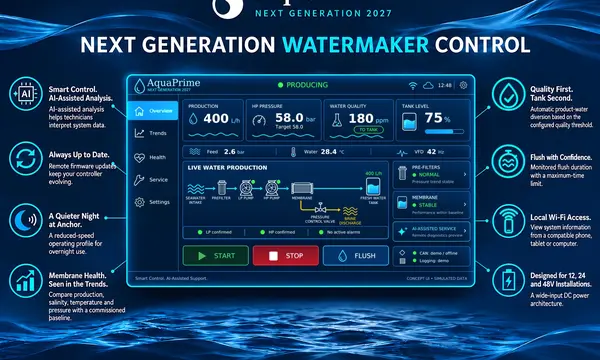
AquaPrime will preview its new watermaker control platform at METSTRADE, with touchscreen monitoring and diagnostic features under development for yacht crews.
Superyacht Guide
Continue into the wider Superyacht Guide.
Business opportunities · Superyacht Guide
Companies serving the superyacht market can discuss clearly identified advertising, sponsorship and business-profile opportunities. Commercial activity remains separate from independent editorial coverage.