Feadship Pi hull 824 official 100m yacht image
The verified link from Feadship's Project 824 to the 100m Pi, with diesel-electric ABB pod propulsion, builder specifications and design context.
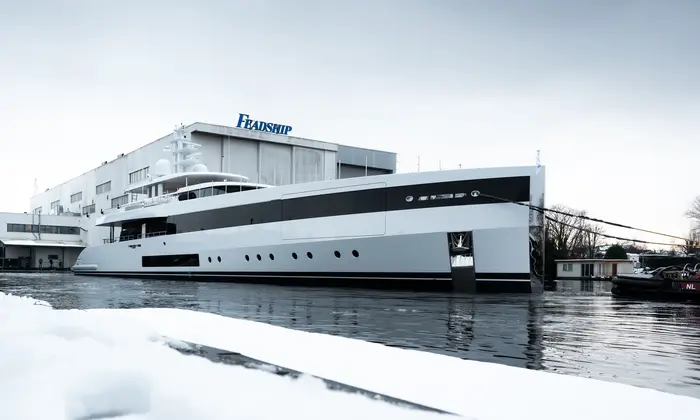
When Feadship announced the departure of Project 824 from its Kaag construction facility in May 2025, the public knew the vessel by a number. The builder's current fleet catalogue supplies the missing link: hull 824 is Pi, a 100.00-metre custom yacht with a 2025 year. This is more than an exercise in matching names. It brings together the original technical announcement, the shipyard's subject-specific photographs and the finished vessel's publicly listed specifications, allowing a clearer account of what was actually built instead of treating Project 824 as an anonymous second yacht still awaiting identification.
Pi's verified scale places her among the most substantial products of the Kaag yard. Feadship describes her as the second-largest yacht built at that facility, behind the 101.50-metre Symphony launched in 2015. That comparison is specific to the yard, not a claim about the world's largest superyachts or the complete Feadship fleet. It also makes the engineering decisions more interesting: a 100-metre displacement yacht is an operating system with extensive electrical, mechanical and domestic needs, and the choice of propulsion architecture influences far more than the way the vessel leaves a harbour.
Feadship's official May 2025 press statement introduced Project 824 as an all-custom 100-metre vessel with a steel hull and aluminium superstructure. The stated beam was 13.60 metres and the loaded draught 4.10 metres. Those numbers frame the challenge of making a vessel of this length appear proportionate and usable. They also help distinguish this particular hull from other similarly named yachts, especially when shortened database records or photographs circulate without project numbers. Hull 824 is the strongest persistent reference in the builder's own identity trail.
The current official yacht page identifies the same hull as Pi, and specifies 2025 as the fleet year. It lists De Voogt Naval Architects, the design practice Jamsen and Liaigre among the principal design contributors. In a fleet database, the appropriate treatment is therefore to record Pi as the current name and retain Project 824 as a historical construction alias. Creating a second yacht page simply because a press release used an earlier designation would split one set of characteristics, sources and imagery into two records and invite future inaccuracies.
The distinguishing mechanical feature is a diesel-electric arrangement driving two ABB pods. Feadship attributes smooth running, efficient performance and very low vibration to the integrated approach. Rather than presenting a conventional mechanical drive train as the only solution for a large custom yacht, the designer and builder have used electrical distribution to connect generation with podded propulsion. Feadship's public specifications identify two ABB DO980P units, each rated at 2,000 kilowatts at a listed 313 revolutions per minute, together with a generator set described in its catalogue.
Podded drives change the relationship between manoeuvring and propulsion. In a conventional installation, shafts and rudders occupy different parts of the underwater arrangement; in an electrically driven pod configuration, propulsion and directional control are more closely integrated. This does not make any operating figure automatic. Efficiency depends on hull form, the operating point, power conversion, electrical losses, hotel loads and maintenance. But it makes a large yacht like Pi a useful case study in the choices available when naval architecture and electrical engineering are designed as a unified system rather than a succession of independent purchases.
Feadship lists a range of 5,500 nautical miles at 12 knots, alongside a fuel capacity of 262,723 litres and a fresh-water capacity of 59,047 litres. These figures are builder-supplied specifications and should be presented with their stated conditions. Range at one cruising speed is not a prediction of mileage at every speed or sea state; real consumption can be affected by weather, loading, auxiliary demand, hull condition and operating practice. Owners and captains planning a specific passage would still use current vessel-specific calculations rather than relying solely on a public brochure.
The yacht's 13.60-metre beam and 4.10-metre draught also influence which locations can accommodate her. A builder's dimensions tell only part of the story: quay strength, berth length, manoeuvring room, water depth, access for tenders and local restrictions all matter. Pi illustrates why the transition from attractive photographs to operational information is important for the superyacht industry. The specifications serve owners, designers and facility planners differently, but all of them benefit when the values are attached to one verified hull and not mixed with a yacht of a similar name.
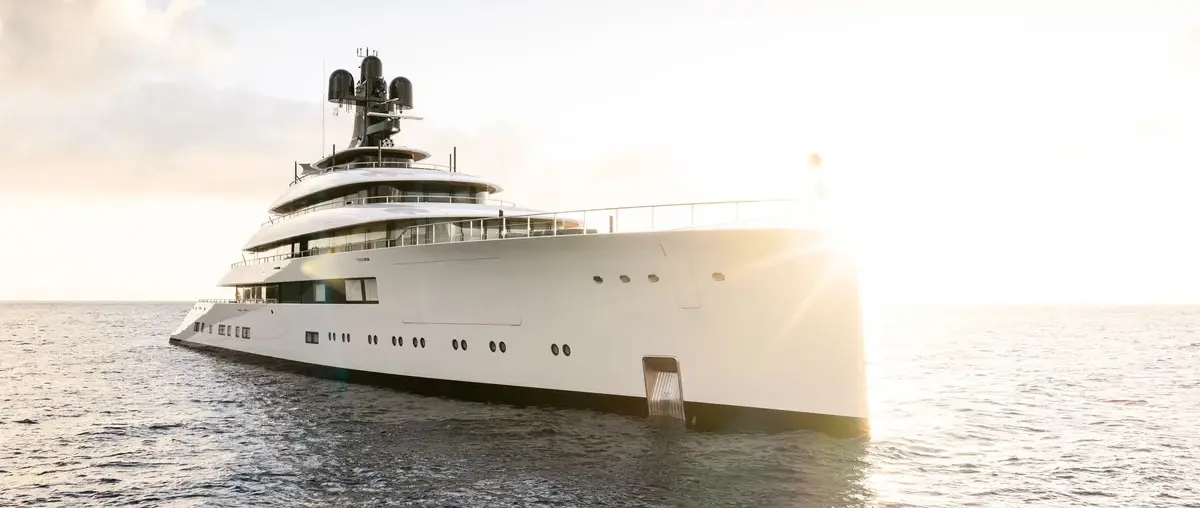
Feadship describes the exterior as the work of Jamsen, with clean flowing lines intended to balance the yacht's size with a more measured sense of elegance. At 100 metres there is a persistent risk that stacked deck volumes and technical enclosures overwhelm the profile. The publicly released images show a disciplined composition that seeks continuity along the hull and superstructure. That visual language should be credited to the named design practice, not to generic 'Feadship styling' alone, because custom construction brings together distinct design and engineering disciplines.
Inside, the builder credits Liaigre and describes an approach built around warmth, natural materials and architectural restraint. Its catalogue lists seven staterooms accommodating fourteen guests. Those are confirmed details, not a licence to invent individual suite arrangements or private owner requirements. The interesting question is how an interior team produces comfortable, human-scale spaces within a large vessel carrying substantial technical infrastructure. Spatial proportions, lighting, finishes, circulation and acoustic isolation must work together. The public material offers a broad design picture, while individual private arrangements properly remain outside speculation.
The May 2025 press announcement describes Project 824 emerging from the Kaag facility, a milestone that provided the industry with its first substantial public look at the vessel. A launch or float-out is a production event. It does not alone establish when the yacht was delivered, began an owner's cruising programme, joined a charter market or completed every trial. The finished public catalogue is the stronger source for her 2025 fleet identity, while the original release is the clearer source for how the programme entered public view.
This chronology matters even more once a project is renamed. Photographs labelled 'Project 824' may be indexed under that designation long after Pi becomes familiar. A historical article should retain the former name in the text and source references while using the current name in its headline and fleet links. That method respects the original document and also makes the finished record comprehensible to readers who encounter the yacht for the first time. Neither name has to be discarded; they serve different stages of the same vessel's history.
Pi is a useful example of the growing overlap between electrical systems, naval architecture and guest comfort. Generator capacity, propulsion motors and control systems have consequences for machinery space, structural arrangements and the acoustic environment. In a 100-metre yacht these effects can be distributed over a substantial volume, but they do not disappear. They require careful integration and the ability to service critical components during the yacht's working life. Feadship's own emphasis on vibration is therefore significant: quiet performance is an outcome of many coordinated design decisions, not a single headline product.
The same approach helps explain why very large custom building remains different from simply scaling up a smaller production model. Hull proportions, strength, weight, fuel and water requirements, crew operation and emergency systems all change as dimensions increase. Pi's combination of a 100-metre hull, podded propulsion and a tightly resolved exterior shows an ambition to make the overall vessel coherent. Whether other owners adopt similar equipment will depend on their priorities, but the technical direction is concrete enough to inform wider discussion of future superyacht construction.
Reviewing Feadship's original email and current public fleet records has produced a clear identity correction for Superyacht Guide. The existing 100-metre Pi fleet entry is hull 824, the vessel introduced as Project 824 in May 2025. Its public record can therefore retain the older project name as an alias, attach the correct builder and design credits, and point to the source-specific official press image. That is a more useful result than a second 'newly discovered' yacht record generated from the headline of an old release.
Pi also shows how a single verified construction source can support both a fleet database and a differentiated technical feature. The fleet page should state measured characteristics and named parties; the article can examine why those choices matter, how the construction identity changed and what can or cannot be inferred from published specifications. Together they give the reader both an accurate reference and an informed interpretation. The story is not a claim that Pi launched in November 2026, but a retrospective on a 2025 vessel whose technical choices remain relevant.
The visual record of Pi is unusually useful because Feadship's original Project 824 press material shows the yacht at a defined construction milestone, while the current hull 824 catalogue provides a wider selection of finished-vessel photography. Those images answer different questions. The former establishes how the ship looked when she emerged from Kaag; the latter illustrates her design as the named yacht Pi. An honest caption identifies which stage it represents instead of implying every photograph was taken at delivery.
For this technical feature the editorial photograph is sourced from Feadship's own hull-specific public gallery and credited to the builder. Its source URL and file checksum accompany the newsroom evidence. The image is not offered as proof of unlisted fuel savings or as a substitute for operational trial data. Paired with verified specifications, it helps a reader understand the scale and form of the yacht while keeping the engineering analysis distinct from publicity photography.
Photograph: © Feadship. Official subject-specific Feadship image sourced from the builder’s public media archive.
Sources: Feadship and credited representatives. The original dated Feadship emails are retained in the private SYMS correspondence archive.
Explore
Go deeper into the yachts, companies, events and destinations directly connected to this article.
Continue reading
How the 79.95m Feadship Faith became hull 714 in the fleet record, and what its RWD design and diesel-electric engineering reveal about custom yacht …
The history and engineering of the 28.27m first hybrid-electric Swan 88 DreamCatcher, with its distinct Nautor hull identity and official 2024 source.
AquaPrime will preview its new watermaker control platform at METSTRADE, with touchscreen monitoring and diagnostic features under development for yacht crews.

Vulkan Italia will present its 200kW H1000 parallel-hybrid module for marine diesel engines rated 500–1,500kW during METSTRADE's Next Gen showcase.
Superyacht Guide
Continue into the wider Superyacht Guide.
Business opportunities · Superyacht Guide
Companies serving the superyacht market can discuss clearly identified advertising, sponsorship and business-profile opportunities. Commercial activity remains separate from independent editorial coverage.