
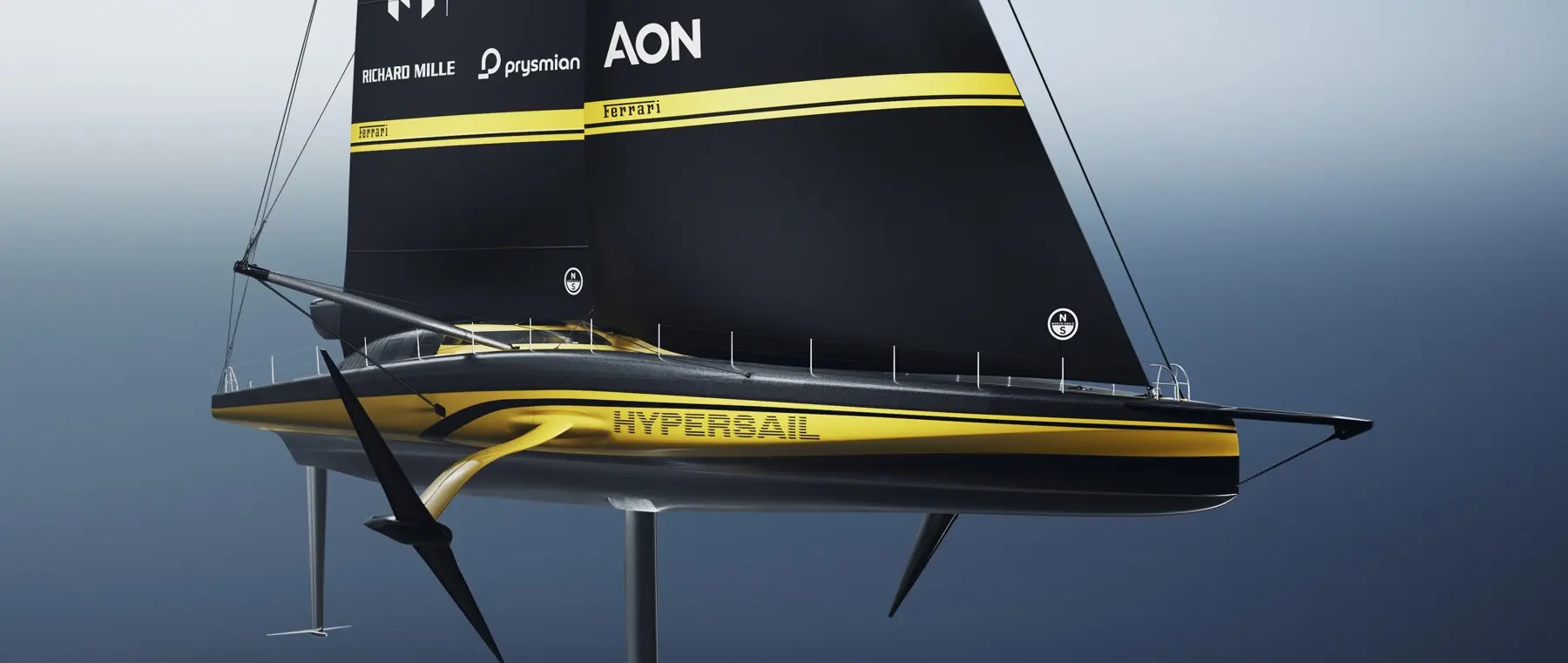
30m Ferrari Hypersail Hull Finish Complete Ahead of 2027 Launch
By Stephen Yardley · Edited by Stephen Yardley
A 16 October visit to the Ferrari Hypersail yard revealed the painted 100-foot hull, 6.5m lifting foils, canting keel and 2027 launch preparations.
Ferrari's 100-foot Hypersail foiling monohull is approaching the end of its current construction phase, with the hull finish and distinctive livery applied and the complex appendage assemblies being prepared for testing. A 16 October 2026 visit to the construction site, reported by Italian specialist publication SuperYacht24, offered unusually detailed information about the yacht's underwater structure and flight-control systems. It is a prototype under construction rather than an operating vessel.
The project, designed by naval architect Guillaume Verdier with Ferrari engineering and design teams, is intended to operate at high speed across oceans while using renewable energy generated on board. The new reporting goes beyond earlier announcements of technical partnerships and the Livorno base: it provides first-hand evidence of installation progress, the mechanisms beneath the hull and the problems the engineers must solve before an anticipated spring 2027 launch.
The visit revealed an exceptionally controlled finish for the carbon-fibre hull. Engineers described two grey coats and two clear coats, while the yellow sections receive three colour coats and two of clear. According to the project's technical team, the total applied paint weight is kept below 200 grams per square metre. That level of attention reflects the sensitivity of a foiling yacht to unnecessary mass and the need to minimise aerodynamic drag.
The colours combine Ferrari's new Giallo Fly with a carbon-inspired grey treatment, details already introduced in the company's earlier design presentation. What is newly significant is their application to the physical structure. A ceramic antifouling treatment is planned for the submerged surfaces, but this should not be taken as a verified claim about long-term coating life before extended trials have taken place.
The scale of the yacht's sailing equipment is striking. The technical description gives a 35.5-metre mast, overall height of roughly 44 metres and a sail area of 462 square metres. Two side foil arms measuring approximately 6.5 metres are designed to rotate through around eighty degrees between working and raised positions. These dimensions make clear why the engineering challenge differs from producing a conventional thirty-metre performance cruiser.
The hull transitions through displacement, partial lift and fully foiling modes, with control authority changing as less of the structure remains supported by the water. The team's work therefore involves understanding stability in intermediate conditions, not simply the efficiency of a foil at a single speed. Until towing and sailing trials are completed, target performance figures remain predictions rather than recorded achievements.
Under the main hull, engineers have provision for a tilting keel operated by two hydraulic cylinders working at a reported pressure of 350 bar. The keel can move by about thirty-five degrees to either side and includes stainless-steel and carbon-fibre components. The bulb had not yet been installed at the time of the reported visit, demonstrating that finishing the hull exterior is not equivalent to completing its underwater systems.
The keel is part of a broader combination of righting moment and flight control. The reported appendage design includes movable surfaces on an associated wing, while the side foils combine carbon-fibre elements with titanium protection against cavitation-related wear. Such components may be sophisticated, but their reliability at sea will depend on control software, hydraulics and extensive validation under variable loads.
Photovoltaic elements are integrated across selected surfaces of the deck and hull, their positions chosen after studying expected sunlight exposure during navigation. Ferrari's wider Hypersail programme also uses energy recovered from motion and onboard renewable sources. This has to serve critical control systems as well as the yacht's other electrical needs, making generation and storage as important as the physical sail plan.
The panels are designed to be walked on and incorporate a textured surface to aid grip. Integrating power generation into a working deck creates particular demands for waterproofing, maintenance access and safe movement by the crew. A prototype may demonstrate technical feasibility, but independent endurance data will be needed to establish how the energy system performs during prolonged overcast or high-latitude passages.
One of the most interesting reported systems is the use of electrically mediated winch control. Rather than transmitting human grinding force directly through mechanical shafts and gears, the design captures power from the grinders and distributes it to winches and hydraulic actuators through a control unit. The arrangement is intended to improve the flexibility of equipment placement and reduce physical effort during complex manoeuvres.
Ferrari's engineering approach also places unusual demands on redundancy and fault management. In an electrically coordinated system, crews will need to understand what happens if a sensor, controller or power module fails. The appeal of a shorter manoeuvre is significant in offshore racing, but it cannot replace tested procedures for protecting sailors and sails if an automatic sequence does not behave as expected.
The project is expected to move toward a new operational facility at Livorno, with Azimut supporting the programme as a technical yachting partner. A modified Azimut 72 Fly is planned as a tow boat for initial tests, allowing engineers to investigate the hull's response while it is pulled through the water without mast or sails. This can provide controlled measurements before the more demanding conditions of full powered and sailing trials.
The reported target is a spring 2027 launch, which remains a schedule rather than a completed milestone. Essential stages still include installing and checking appendages, verifying hydraulic and electrical integration, determining the sequence for controlled lift and proving the vessel can return safely to displacement operation when appropriate.
Although the hull measures more than 24 metres, Ferrari Hypersail should not be confused with a conventional owner-and-guest superyacht. It is an ocean-racing technology platform in which performance, sail handling and renewable-energy autonomy guide the design. Its interest to the wider large-yacht industry lies chiefly in control engineering, high-strength materials and the potential for selected ideas to migrate into future specialist vessels.
The October site visit confirms a physical construction milestone and makes the engineering questions more tangible. It does not establish an official top speed, a record result or a completed voyage. Those achievements, if realised, will depend on the extensive testing scheduled after the prototype has been made ready for the water.
Explore
Go deeper into the yachts, companies, events and destinations directly connected to this article.
Continue reading
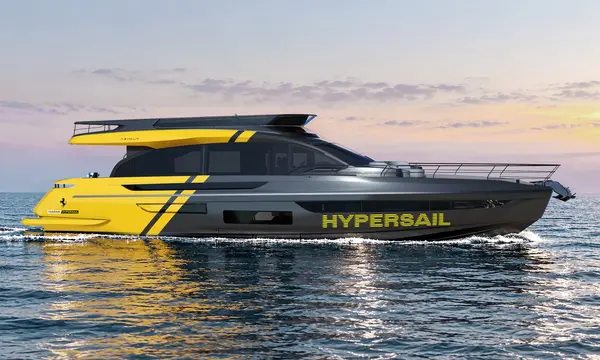
Azimut is providing a customised Fly 72 support vessel and shipyard facilities for Ferrari Hypersail's 100-foot offshore foiling sailing prototype.
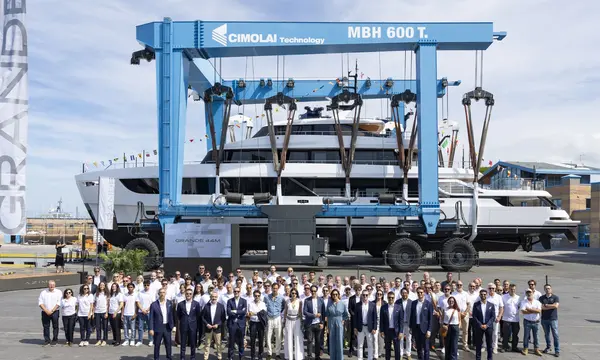
Azimut’s Grande 44M uses a 400kg carbon Hull Vane with mild-hybrid propulsion and solar generation as the builder reports seven units sold before Monaco.
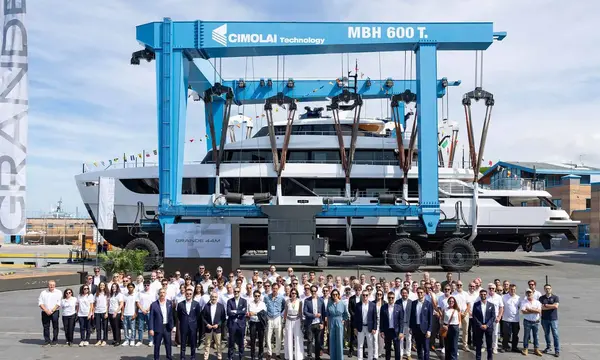
Azimut Grande 44M has won the Special Jury Award at the 2026 Innovation Route Awards during its Cannes Yachting Festival world debut.
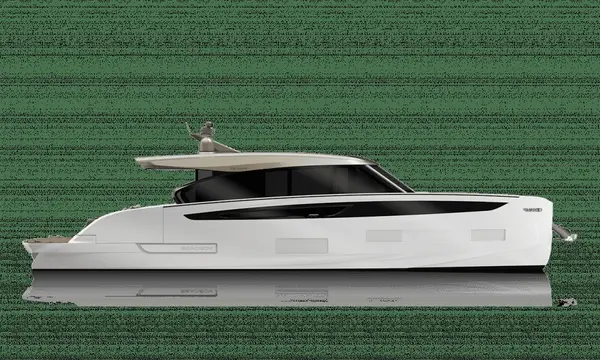
The Azimut Magellano 27M has won the 2026 Design Innovation Award in the superyachts over 24 metres category at the Genoa International Boat Show.
Superyacht Guide
Continue into the wider Superyacht Guide.
Business opportunities · Superyacht Guide
Companies serving the superyacht market can discuss clearly identified advertising, sponsorship and business-profile opportunities. Commercial activity remains separate from independent editorial coverage.