Fincantieri Partners With Poste Italiane and TIM on Industrial AI for Shipbuilding
By Superyacht Guide Newsroom · Edited by Superyacht Guide Newsroom
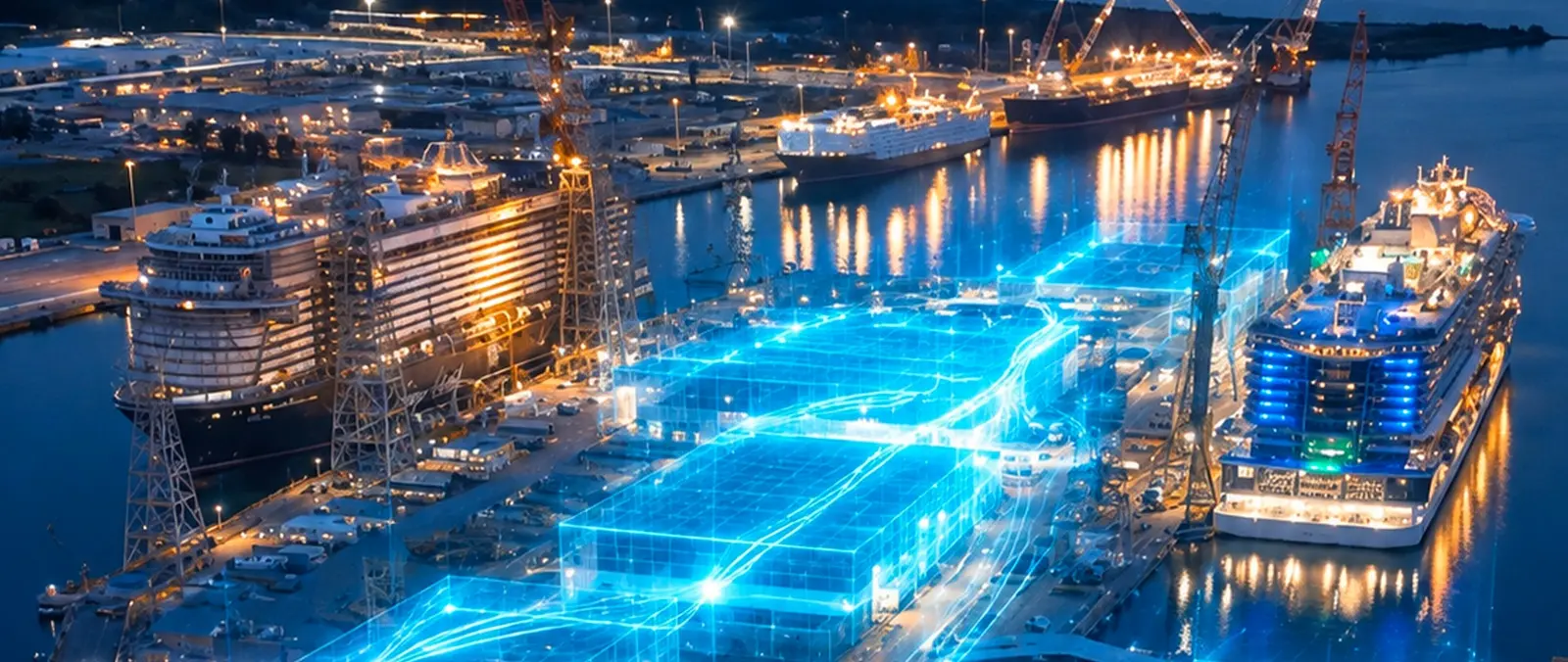
Fincantieri Poste Italiane TIM industrial AI partnership official signing press photograph November 2026
Fincantieri, Poste Italiane and TIM announce a joint industrial AI initiative spanning design knowledge, manufacturing automation and ship lifecycle management.
Fincantieri announced on 11 November 2026 that it had entered a strategic partnership with Poste Italiane and telecommunications group TIM to develop an Italian industrial artificial intelligence infrastructure. The initiative forms part of the shipbuilding group's industrial plan for 2026 through 2030. It brings together work on manufacturing knowledge, automation and the management of information associated with a vessel throughout its service life. Fincantieri operates across several maritime construction sectors, including large custom yacht construction through its yacht business, making developments in its broader manufacturing technology relevant to the specialist superyacht industry. The official release is a group-wide announcement, however, and does not identify a particular yacht project that will receive the new systems. Nor does it describe automation or artificial intelligence already installed aboard individual superyachts. Those distinctions are central to understanding the scope and significance of the news.
The company identifies two projects within its industrial strategy. Navis Sapiens is directed at managing the digital information associated with a ship over its lifecycle, with a longer-term ambition to support robotic integration. A second project, Fincantieri Ontology, concerns the digitalisation and automation of design and manufacturing processes within the group's shipyards. The November partnership is intended to connect these strands and provide computing infrastructure for the industrial applications. Although digital information is already important to many manufacturing businesses, the company's announcement places particular emphasis on encoding relationships within technical knowledge rather than simply accumulating individual documents. That approach is relevant to complex construction because information about an installation needs to be interpreted in conjunction with its intended function, associated components and manufacturing history. If these relationships can be recorded and maintained effectively, retrieving the information needed for a subsequent engineering task may become easier.
An ontology is a structured representation of the entities and relationships within a particular subject area. In an industrial context, such a representation may distinguish an item of machinery from its installation location, the systems to which it connects and the operations associated with its maintenance. It can also represent the relationship between a design decision and the manufacturing tasks required to implement it. The value of a structured knowledge base depends on the accuracy of those relationships and the consistency with which changes are recorded. A custom ship can contain equipment and materials from numerous suppliers, all of which may use different naming conventions and documentation formats. Organising that information in a consistent manner is a considerable task in its own right. Artificial intelligence might help users retrieve and interpret the structured information, but it does not establish the correctness of an inaccurate underlying record. Human review and authoritative engineering documents remain important.
A large custom yacht differs from a repetitive manufacturing product in the complexity of its individual specification. Modifying a detail of the accommodation can create consequences for related services running through the same area. A change in the position of a partition, for example, could affect the arrangement of electrical equipment or ducting. Engineers must ensure that the revised design is communicated to the people responsible for related work and reflected in the information used during construction. A structured digital record could assist the coordination of such activities by allowing the relevant dependencies to be identified more readily. This is a potential application of the broader strategy described by Fincantieri; it is not a claim that the new partnership has already delivered such capabilities on any particular yacht. The benefit will depend on how the digital systems interact with established design tools, project controls and the approval processes that govern changes to a vessel.
Fincantieri describes the intended development of four-dimensional models for design and construction. In general industrial usage, a fourth dimension may associate a physical or three-dimensional representation with information about time and the sequence of activities. A construction team can potentially use those relationships to assess when particular components will be required and when access needs to remain available for an installation. The concept is especially relevant to projects where numerous specialised trades must work within a constrained physical environment. As construction proceeds, components that were initially easy to reach may become less accessible behind completed structures or finishes. The order in which operations take place can therefore be as important as the final arrangement shown in the design. The release identifies four-dimensional modelling as a direction of development but does not specify the capabilities, implementation dates or particular software arrangements that might become available to yacht project teams.
The announcement envisages wider use of automated manufacturing processes, with personnel and robotic systems receiving work information optimised through artificial intelligence. Industrial robots can be valuable where a task can be represented accurately and performed within defined operating conditions. Large custom maritime projects also involve fitting and adjustment work that can vary considerably according to the particulars of each hull and its equipment. Such work may be less amenable to standardised automation than repeated manufacturing operations. The combination of digital planning and established practical expertise therefore warrants attention in the superyacht sector. Skilled workers may carry detailed knowledge about how an installation behaves during fabrication, assembly or subsequent testing, even where that knowledge has not been recorded in formal procedures. Capturing useful aspects of their experience in structured records may support future projects and training. The accuracy of such records and the appropriate limits of automated decision-making need continuing assessment.
Fincantieri describes an arrangement in which artificial intelligence processing can take place locally and through a secure cloud environment. The partnership is intended to preserve control of industrial knowledge and the associated data. For users in the large-yacht industry, information about a ship's design can have important commercial and operational implications. Design drawings, machinery configurations and supplier information may contain the intellectual property of several parties. Yacht projects may additionally involve confidentiality obligations relating to owners and intended use. Before introducing a shared digital system, businesses need to establish which information may be processed, where it can be held and which organisations or personnel are entitled to access it. The official announcement describes the group's objectives in cybersecurity and technological independence, but it does not establish the details of access rights or data handling for any particular yacht contract. Those arrangements would require project-specific examination.
The lifecycle strand of Fincantieri's strategy addresses the continued relevance of information after a ship is completed. A yacht's engineering team requires documentation that reflects its configuration in service, not merely the original design intent. Machinery may be replaced, electrical systems altered and interior spaces adapted over successive refit periods. If records are not updated, a drawing or equipment schedule may no longer describe the current installation. A structured lifecycle system could provide a useful means of maintaining links between a vessel's equipment and its service documentation, provided that changes are captured reliably and the information remains accessible to authorised users. An owner or manager evaluating such a proposal should also consider the long-term availability of the software, the means of obtaining records in usable formats and arrangements for transferring information when the operating organisation changes. The announcement does not specify that these functions are currently available to yacht owners.
Fincantieri gives its total order backlog as approximately €70 billion, with visibility extending to 2036, in discussing the commercial context for the industrial plan. These figures refer to the group's wider order book and should not be interpreted as a measure of yacht construction. The company also identifies an extensive procurement network, underlining the scale of the industrial ecosystem the digital initiative is intended to support. For the custom yacht sector, the relevance lies in the potential transfer of manufacturing methods and improved management of technical information from the broader shipbuilding operation. Specific benefits cannot yet be attributed to individual yachts, and no yacht division deployment schedule or quantified superyacht productivity improvement has been announced. The confirmed development is the strategic partnership between the three Italian companies, together with Fincantieri's stated industrial objectives. Future disclosures about particular applications, implementation progress and measured results will be needed to assess how far the initiative changes large custom yacht construction.
Primary source: Fincantieri official press release, 11 November 2026.
Photo: Fincantieri, official announcement image of the industrial AI partnership. Official source.
Photo: Fincantieri, official announcement image of the industrial AI partnership.
Explore
Go deeper into the yachts, companies, events and destinations directly connected to this article.
Continue reading
Fincantieri is moving its BOOST² robotics and Physical AI programme towards deployment, with planned investment approaching €100m across its shipyards.

Teignbridge's T-CPP is listed among the 2026 DAME overall winners and wins Propulsion and Dynamics, highlighting a different approach to adjusting propeller pitch.
Digital Yacht brings new battery monitoring, connectivity and diagnostic equipment to Amsterdam, with potential applications for yacht tenders and bridge systems.
As the 2026 Forum opens, its earlier panel review highlights fuel compatibility, lifecycle emissions, sourcing and cost considerations for existing yachts.
Superyacht Guide
Continue into the wider Superyacht Guide.
Business opportunities · Superyacht Guide
Companies serving the superyacht market can discuss clearly identified advertising, sponsorship and business-profile opportunities. Commercial activity remains separate from independent editorial coverage.