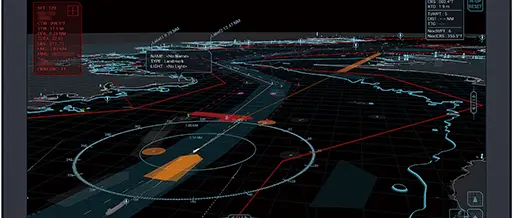
Furuno VNS-100 Brings 3D Collision Awareness to the Bridge
By Stephen Yardley · Edited by Stephen Yardley
Image: Furuno
Furuno’s VNS-100 combines charts, radar, AIS and collision-risk visualisation in a 3D bridge environment designed to improve situational awareness in congested waters.
Furuno has introduced the VNS-100, a virtual-reality navigation system that combines chart information, radar targets, AIS data and collision-risk visualisation in a three-dimensional bridge display. The system is designed to help navigators understand complex traffic situations more quickly, particularly in congested waters where several targets and routes may need to be assessed at once.
Rather than replacing conventional navigation judgement, the VNS-100 presents existing data in a different visual form intended to support decision-making. For large yachts operating in busy approaches, anchorages and ports, the product reflects a wider trend toward bridge systems that integrate more information while attempting to reduce the cognitive load on watchkeepers.
Furuno's Bird View provides a bird's-eye representation of surrounding vessel traffic, routes and potential hazards, with viewpoints that can be adjusted by the operator. The company says the aim is to make complex encounters easier to interpret from different angles instead of relying only on a conventional flat chart or radar presentation.
The system supports touch-enabled Full HD displays and multi-touch gestures for zooming, panning, rotating and changing viewpoints. A conventional display with a mouse or trackball can also be used, giving shipyards flexibility when integrating the processor into an existing bridge layout or a new console design.
The VNS-100 can automatically acquire and track radar targets around the vessel, subject to radar detection conditions and compatibility with selected Furuno X-band radars. Furuno says this reduces the need for manual target acquisition and can help limit the risk of overlooking vessels in poor visibility or dense traffic.
Its Risk Visualizer uses tracked information to show areas where a collision risk would exist if the yacht maintained its current speed while another vessel continued on its present course and speed. Because the assessment can include radar-detected non-AIS targets, it is not dependent solely on other vessels transmitting identification data.
An optional wireless connection allows a recommended tablet to display live images and recorded playback through a dedicated viewer. Furuno also describes remote control capability, but notes that the optional tablet remote-control function is currently not compliant with IACS UR E27, an important qualification for yards considering cyber requirements in a classed installation.
The main processor supports a display of up to 1,000 targets and can present heading, speed, risk areas, integrated AIS and tracked targets, routes, user charts and ENC symbols. Furuno recommends a dual-ECDIS configuration for full ENC coverage, reinforcing that the VR presentation is intended to sit within a broader professional bridge environment rather than operate as a stand-alone navigation substitute.
Three-dimensional navigation interfaces have appeared in recreational electronics for years, but the VNS-100 brings a more structured version of that idea into Furuno's merchant-marine and workboat portfolio. That makes it relevant to superyacht bridges, where commercial-grade radar, ECDIS, AIS and integrated navigation equipment are commonly specified alongside highly customised user interfaces.
The operational test will be whether a 3D presentation helps crews recognise risk faster without adding another source of distraction or overconfidence. As bridge systems become more integrated, training and disciplined cross-checking remain as important as the quality of the display, especially when visualisation software is interpreting several sensor inputs at the same time.
Explore
Go deeper into the yachts, companies, events and destinations directly connected to this article.
Continue reading
Intellian has given its new GMDSS Console a European debut at SMM while also showing the 65cm VS60 ViaSat-3 terminal and OneWeb maritime flat …
Caterpillar has received DNV Approval in Principle for a MaK fuel-blending conversion concept spanning M20 to M43 engines, with dual-fuel pathways including methanol.
Baudouin has expanded its yacht-engine offering at Cannes with the compact 100kW 4M11 and a new 16M23 platform aimed at larger yacht applications.
Rolls-Royce has secured DNV Methanol Readiness for current mtu Series 4000 marine engines after more than 5,000 hours of methanol testing, preserving a future …
Superyacht Guide
Continue into the wider Superyacht Guide.