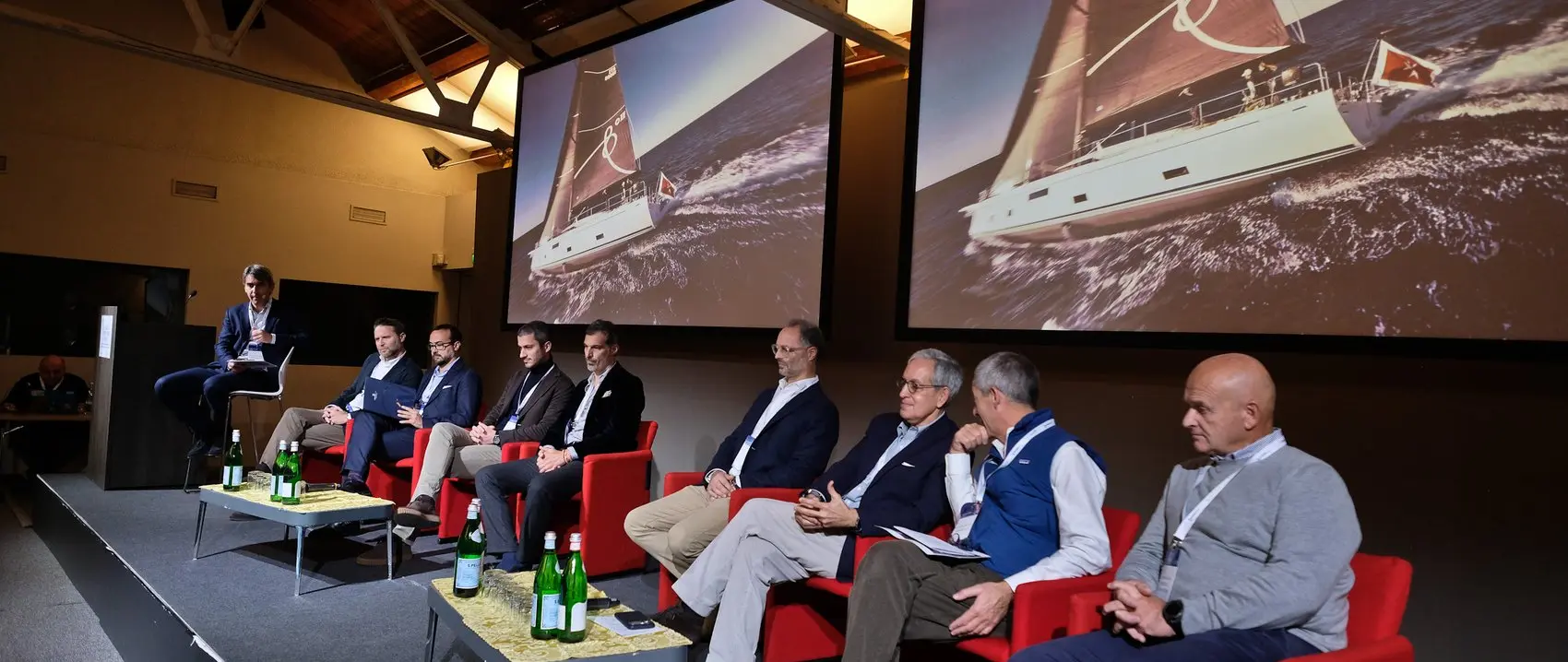
Owners and builders at Genoa's 27 November Sailing Super Yacht Forum shared lessons on hybrid propulsion, noise, onboard controls and environmental life-cycle assessment.
An industry conversation moves beyond green labels
The second Sailing Super Yacht Forum in Genoa brought owners, builders and suppliers together on 27 November 2026 to discuss the technical choices shaping large sailing yachts. The event organiser's account of the first panel describes hybrid power, onboard systems integration, equipment supply chains and the need to measure environmental performance instead of assuming that every sailing yacht is inherently sustainable.
A particularly useful example came from the 26-metre-plus Grand Soleil 80 Bianca II. Its owner, Marco Pastorino, discussed how hybrid propulsion and owner-led design decisions affected the vessel. The presentation was not an announcement that Bianca II had been launched again or a new general claim that every Grand Soleil model includes identical equipment.
Bianca II brings the discussion onto a real yacht
Pastorino explained that Bianca II was developed with charter use in mind, drawing on experience with the smaller Grand Soleil 72. A yacht intended for frequent guest operations can have different patterns of energy consumption, accommodation use and equipment access from one kept exclusively for occasional private family sailing. Those differences matter at the design stage.
The owner described around 150 changes from the initial configuration during development, including work to integrate hybrid propulsion. This reported change count reflects that specific project and should not be interpreted as an average for yachts of its size. The example illustrates the coordination required when owner requirements affect mechanical systems and accommodation plans.
Hybrid propulsion is an operational tool
According to the forum report, Bianca II can recover energy under sail and use electric propulsion for quieter harbour departures, while its energy arrangements are intended to support overnight anchoring without running generators. The account describes operating capabilities; it does not publish a universal fuel-saving percentage or an independently audited emissions total for the yacht.
An owner assessing a hybrid solution should ask how much electrical load the vessel carries at anchor, how energy is stored, and under which sailing conditions regeneration is practical. A capability to motor silently over a particular period does not imply that the yacht can cover any distance without fuel. The energy balance must include batteries, hotel systems and the eventual need to replenish stored power.
Noise moves to the foreground when engines quieten
The project also highlighted acoustic design. Electric propulsion can reduce the audible contribution of a combustion engine, but it may make other sounds more noticeable: ventilation, pumps, structure-borne vibration and the equipment used to serve guest spaces. The panel described the yard's approach to measuring noise and developing specific thresholds.
This is a reminder that quieter propulsion should be evaluated as part of an entire vessel rather than in isolation. Owners need to distinguish machinery operating modes from measured sound levels in cabins and social areas. A marketing description of silence is not a substitute for repeatable tests under defined conditions.
Modifications require control as well as creativity
Changing a yacht during construction can produce a more useful result, but every change has implications for cost, weight, space and schedules. The Bianca II example is notable because Pastorino has naval-engineering experience and worked closely with the yard. The reported number of alterations does not mean that changes are easy or harmless to make late.
A structured process should identify responsibility for each modification, how it interacts with other systems and the effects on delivery and maintenance. The same discipline can prevent a technically attractive addition from compromising access to existing equipment or requiring extensive rework later.
Harken points to manufacturing and supply chains
Harken Italia's Emanuele Cecchini outlined the company's work to reduce the footprint of manufacturing operations. The forum report attributes to Harken figures including electricity sourced entirely from renewables for its Italian factory and a 93-percent waste-recycling rate. It also describes around 45 percent of suppliers being located within 100 kilometres.
These are figures presented by the company at the event, not a third-party certification of every product's life-cycle impact. Electricity sourcing at a factory and the proportion of waste recycled are useful operational indicators, but they cannot alone determine the environmental profile of equipment fitted to a yacht. Materials, transport, service life and end-of-life treatment also matter.
Equipment for bigger rigs creates new demands
Harken also discussed equipment for larger sailing yachts, including its GP8 jib furler intended for boats from 75 to 150 feet. A system used to control a high-load sail affects handling efficiency and crew safety, and the required engineering standard rises with the forces involved. The panel linked such product development to collaboration with superyacht builders.
An equipment announcement should not be confused with a completed installation on every vessel in that category. Owners considering upgrades need project-specific load calculations, compatibility review and professional commissioning. The forum identified commercial development and intended applications, rather than a guarantee that a component suits any rig within a broad length band.
Integrated controls and a more usable bridge
Navico Group's Roberto Sesenna described the challenge of combining the many electronic systems found aboard modern large yachts. More information does not automatically improve decisions. If every supplier presents a separate screen, the captain and crew may spend unnecessary time searching for the controls relevant to the task at hand.
The firm's ambition, as reported by the organiser, is to provide more consistent interfaces and coordinate systems from different manufacturers. That goal requires cooperation early in design because equipment may use different protocols, data formats and operating assumptions. The contribution was about integration principles, not proof that one particular superyacht bridge is already free of such problems.
Less information can support better decisions
A bridge display should give the operator appropriate information at the correct moment, with important alerts clearly separated from optional monitoring detail. It is tempting to equate a larger number of functions with sophistication, but overloaded screens can complicate basic actions. The best interface depends on the vessel's actual operating procedures and bridge team.
There is also a maintenance dimension. An owner may change navigation equipment, communications systems or energy controllers over the yacht's life. Integration should be documented so that new hardware can be added without undermining essential functions. The industry challenge is sustained interoperability, not merely an impressive demonstration at a trade show.
Southern Wind questions assumptions about sustainability
Andrea Micheli of Southern Wind described the builder's work on life-cycle assessment for a 105-foot sailing yacht. According to the forum report, the project began in 2021 and took around two years, examining material procurement, construction, supply chains and operation. The motivation was to measure real environmental burdens instead of relying solely on the fact that a yacht has sails.
Gathering data can be difficult when suppliers do not report information in a common format. The scope of an assessment matters just as much as its final headline: results cannot be meaningfully compared if one study includes materials and long-term operation while another excludes them. Southern Wind's presentation demonstrated the value of defining the basis of measurement.
Operational fuel is only one part of the equation
The forum account attributes to Southern Wind an estimate that, across a 30-year horizon for the vessel studied, the operational phase accounted for around 60 percent of its assessed environmental impact. The calculation is tied to a specific vessel and methodology, not a universal share for all sailing yachts or a verified result for Bianca II.
The takeaway is that ownership patterns deserve consideration from the beginning. Energy use at anchor, propulsion choices, maintenance requirements and refits all contribute over time. Even if construction receives the most attention during a new-build campaign, the vessel's years of operation may have substantial consequences for its total footprint.
Comparing passages calls for care
The panel referred to fuel consumption on a long voyage from Cape Town to the Mediterranean and used that example to explain sailing's potential contribution to reduced operational fuel use. The reported numbers come from the speaker's discussion rather than a controlled side-by-side test of two otherwise identical yachts.
Route, speed, weather, displacement, hotel load and operating practices can all affect fuel use. A meaningful comparison must identify those conditions. It is reasonable to recognise that wind propulsion can reduce the need to burn fuel for movement, but not to convert one illustrative passage into a guaranteed saving for every owner.
Photovoltaic sails need real-world testing
The organiser also identified new photovoltaic sail technology among the topics discussed, including the work of OneSails. Integrating electrical generation into sails raises questions about weight, durability, sail shape, wiring and the maintenance environment. The concept is potentially interesting because it seeks energy production from an existing area of a sailing yacht.
Its practical value depends on how much useful power can be collected in real conditions, and whether that value outweighs added complexity. The forum coverage should not be interpreted as demonstrating production-scale output on every superyacht. Specific product performance and sea-trial results would need separate verified evidence.
Crew experience is part of the design outcome
Hybrid systems, new electronics and complex equipment are not operated in isolation by engineers in a laboratory. Captains, engineers and deck teams must interpret them while hosting guests and handling the yacht in changing conditions. Technology that is difficult to troubleshoot or maintain can impose hidden operational costs even when it performs well in a showroom.
Owners can improve results by involving the people who will operate the yacht before the systems are finalised. Their requirements can influence interface design, equipment access and the organisation of technical spaces. The panel's recurring emphasis on integration shows that collaboration is a central part of innovation.
What is and is not confirmed
The Genoa forum was a real event on 27 November, and the organiser recorded individual contributions from Bianca II's owner, Cantiere del Pardo, Harken, Navico and Southern Wind. The account provides useful examples of hybrid power, manufacturing initiatives and life-cycle methodology. It does not establish a common certification for every solution discussed.
No new general propulsion regulation, across-the-board emissions reduction or completed photovoltaic-sail deployment should be inferred from the panel. The responsible conclusion is that builders and suppliers are testing different approaches and, increasingly, asking for measurement rather than slogans.
Why the discussion matters to superyacht owners
Large sailing yachts offer the opportunity to use wind for propulsion, but their guest accommodation and complex onboard services still consume energy. The question is therefore how different technical decisions work together over the life of the yacht. Is the vessel designed to match its intended use, and can the crew operate it safely and efficiently?
The panel's practical message is that credible progress requires better information from suppliers, disciplined systems integration and transparent performance measurement. The next valuable developments will be documented operating data and actual commissioned installations, not simply another round of broad environmental promises.