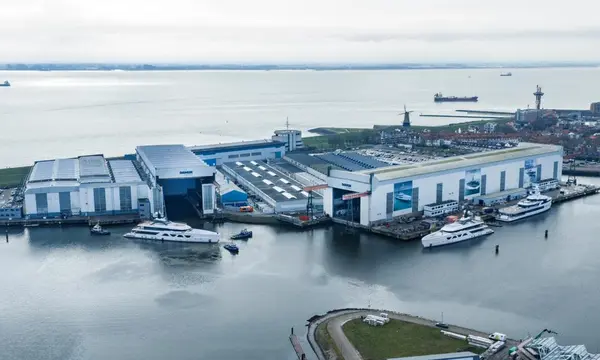
Damen Yachting to Open Vlissingen Superyacht Yard to Public
Damen Yachting will open its Vlissingen yard on 10 October, giving the public a look at the people, specialist trades and technology behind superyacht …
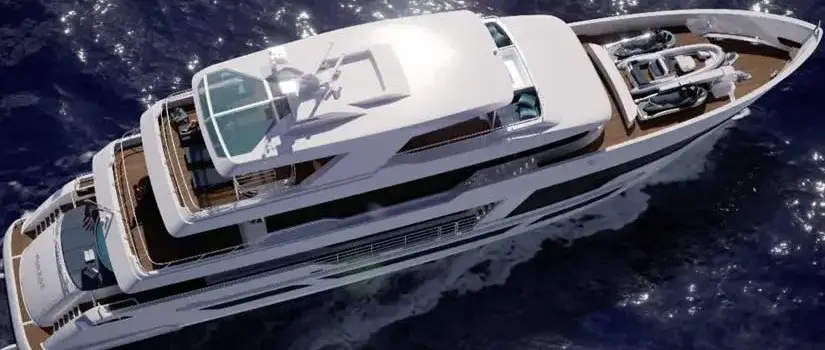
Hargrave Custom Yachts has introduced a new interpretation of its Signature E Series, combining Italian design, flexible layouts and extensive glazing across a 33-to-40-metre platform.
Hargrave Custom Yachts has revealed a new Signature E Series tri-deck design created in collaboration with Italian designer Gabriele Teruzzi. Covering yachts from approximately 33 to 40 metres, the concept builds on Hargrave’s established engineering platform while introducing a more distinctly European approach to exterior styling and interior detailing.
The collaboration marks Teruzzi’s first project with the American yacht builder. It also reflects Hargrave’s broader effort to work with a more international group of designers while retaining the practical characteristics and customisation options associated with its existing range.
The Signature E Series spans models from 108 to 132 feet, equivalent to approximately 33 to 40 metres. The range has already produced several yachts, including the 36-metre Romeo Foxtrot, delivered in 2023, followed by a second yacht of a similar size for the same owners in 2024. Further examples have since been delivered, while a 40-metre tri-deck model is expected to join the series in 2027.
Although each yacht can be adapted to its owner, Hargrave has established a recognisable design direction across the series. Large areas of glazing, reduced exterior bulkheads and full-beam interior spaces are intended to create stronger visual connections between the accommodation and the sea.
The platform is also being positioned towards owners seeking contemporary styling without moving into an entirely experimental or one-off custom project. The result is a balance between a proven technical foundation and the opportunity to personalise the yacht’s appearance, materials and internal arrangement.
Gabriele Teruzzi established his own design studio after working with Alberto Mancini’s AM Yacht Design. His earlier experience included projects associated with builders and brands such as Fairline, Azimut and Mangusta, while his independent work has included larger concepts developed in connection with Lürssen and Fincantieri Yachts.
For the Hargrave project, Teruzzi took inspiration from the structure and rhythm of classical music. That influence is expressed through balanced exterior proportions rather than aggressive styling features or decorative flourishes.
The profile is intended to appear refined and athletic, with long horizontal lines and extensive glazing helping to reduce the yacht’s apparent visual weight. The design avoids unnecessary details, allowing the overall composition and proportions to provide the yacht’s identity.
Inside, the concept draws on Italian materials and craftsmanship. Marble, leather and carefully selected surface finishes are combined with a light colour palette intended to maximise the effect of natural daylight. The design team has emphasised materials and colours intended to remain appealing beyond the yacht’s initial delivery period rather than relying heavily on short-term interior trends.
Hargrave and Teruzzi have developed two principal layout approaches for prospective owners. The most significant difference concerns the upper leisure area.
One version follows a more conventional arrangement with an enclosed lounge, providing a climate-controlled interior space that can be used in different seasons and cruising regions. The alternative replaces this with what Hargrave calls a Veranda Deck, transforming the area into a substantially more open environment.
The Veranda Deck arrangement is intended to blur the division between interior and exterior living. Large openings and reduced structural barriers allow the deck to function as an almost open-air social space while remaining integrated into the yacht’s main accommodation.
This choice gives owners the ability to prioritise either enclosed versatility or a more informal outdoor lifestyle. The final arrangement, overall length and detailed specification would be determined through the customisation process.
The new design does not represent a complete departure from the existing Signature E Series. Instead, it gives Hargrave another stylistic option within the same broad size range and engineering philosophy.
That approach may be commercially significant. Owners increasingly expect production-based or semi-custom yachts to offer a level of design choice once associated primarily with fully custom construction. By commissioning designers with distinct identities, builders can widen the appeal of an established platform without abandoning the efficiencies and technical experience gained from previous hulls.
Hargrave’s collaboration with Teruzzi therefore appears to be as much about broadening the identity of the Signature E Series as introducing a single yacht concept. The American builder retains its established platform and custom-building experience, while Teruzzi contributes a European visual language centred on proportion, natural light and Italian materials.
The project remains a design proposition rather than a confirmed individual yacht order. However, with a 40-metre E Series model expected in 2027, the collaboration provides a clear indication of how Hargrave intends to develop the range and appeal to a new generation of owners.
Continue reading
Damen Yachting will open its Vlissingen yard on 10 October, giving the public a look at the people, specialist trades and technology behind superyacht …
Port Authority di Pisa has awarded a 19,600m³ dredging programme to restore a 3m navigation channel through the Canale dei Navicelli yacht-building district.
Largest Superyachts Built in Turkey: 2026 Ranking Turkey has become one of the world’s most important large-yacht construction centres, and the current SYG fleet …
Superyacht Guide ranks the leading yacht builders of 2026 using its own structured fleet database rather than a subjective list of favourites. The results …
Superyacht Guide
Continue into the wider Superyacht Guide.