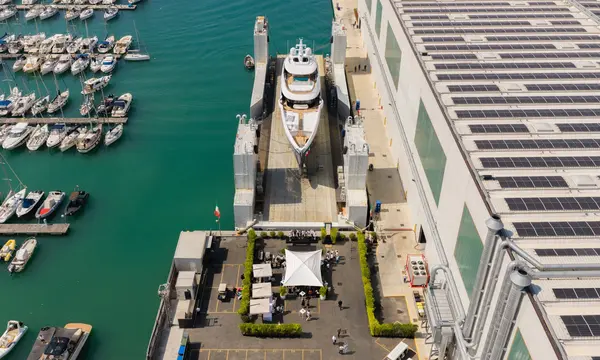
53.5m Silvia Combines a Blue Hull with Hybrid Quiet-Cruising Capability
FGI's July 2026 project announcement confirms the launch of 53.5-metre Silvia in Marina di Carrara, with hybrid propulsion and owner-focused detailing.
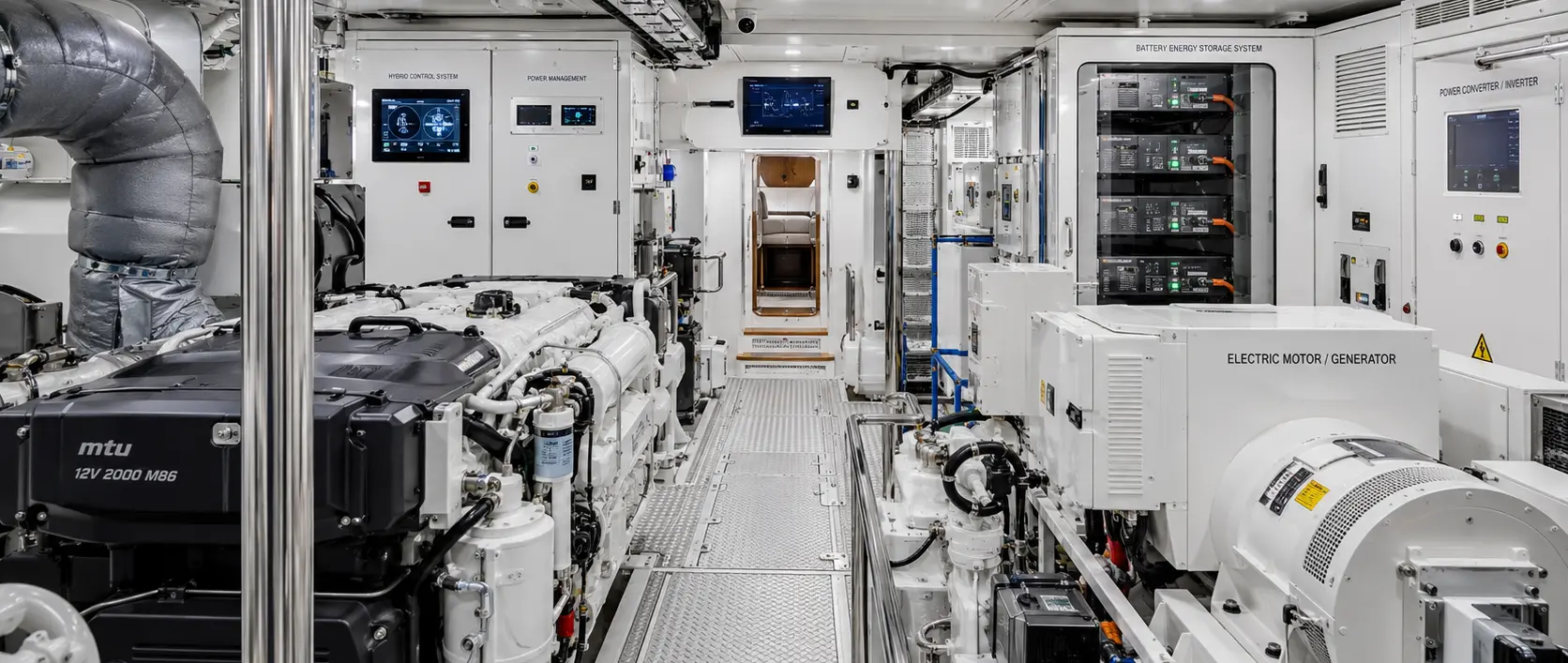
A superyacht's generator rating does not tell you how much electricity it actually uses. This guide explains kW versus kWh, hotel loads, shore power and worked daily and annual consumption scenarios.
A superyacht's generator rating does not tell you how much electricity the yacht actually uses. Electrical demand changes constantly with air-conditioning, refrigeration, pumps, galley equipment, lighting, watermakers, navigation electronics, entertainment systems and technical machinery, so the useful figures are average load in kilowatts and energy consumed over time in kilowatt-hours.
A kilowatt measures power at a particular moment, while a kilowatt-hour measures energy used over time. If the yacht carries a 500kW generator, that does not mean it continuously consumes 500kW; if the electrical system averages 250kW for 24 hours, daily consumption is 6,000kWh, or 6MWh.
The same arithmetic works at any scale: average load multiplied by operating hours gives energy consumption. That distinction matters because generator nameplate capacity is designed around peak demand, redundancy and operating margins, whereas the owner's electricity use is determined by the actual load profile.
Even when the main propulsion engines are stopped, a large yacht remains an energy-intensive floating building. HVAC, chilled-water pumps, ventilation, refrigeration, lighting, freshwater systems, sewage treatment, hydraulics, communications, bridge electronics, security equipment, galley appliances, laundry, AV/IT and crew services can all contribute to the hotel load.
Some loads are continuous and others are highly intermittent, which is why the electrical demand seen by the engineers rises and falls throughout the day. Guest activity, outside temperature, watermaking, laundry cycles, cooking, tender operations and technical maintenance can all move the average substantially without any change to the yacht's headline generator capacity.
A yacht may carry multiple generators so electrical supply can be maintained while machinery is serviced and available generation can be matched to the required load. The number printed on a generator's data plate therefore describes what the machine can deliver, not what the yacht is automatically consuming every hour that the generator is running.
A useful analogy is the maximum output of a building's electrical connection. A shore connection or generator may be capable of supplying a large peak, but the meter records only the energy actually drawn, so estimating yacht consumption from installed generating capacity alone can overstate real use significantly.
Because there is no defensible universal average for every superyacht, a transparent way to understand the scale is to calculate several continuous-load scenarios. These examples are arithmetic illustrations rather than claims that a yacht of a particular length must operate at the stated load.
Over a full year, those same continuous averages correspond to about 876MWh, 2.19GWh, 4.38GWh, 7.01GWh and 8.76GWh respectively. Real yachts do not hold one fixed load for 8,760 hours, but the calculation shows why a relatively small change in average electrical demand can have a large annual effect.
Consider a hypothetical 60m yacht whose hotel and technical systems average 350kW across a full day. At that assumed load the yacht uses 8,400kWh, or 8.4MWh, every 24 hours; if the same average persisted for a full year, the total would be approximately 3.07GWh.
This is deliberately a worked example, not a Superyacht Guide claim that all 60m yachts average 350kW. A modern yacht with extensive glazing, high air-conditioning demand, large refrigeration plant, multiple watermakers, pools, spas, heavy AV use or electrically driven auxiliaries can differ materially from another 60m yacht with a simpler hotel load.
On a conventional diesel yacht, propulsion power and hotel electricity are not necessarily the same thing. At sea the main engines may provide propulsion while generators supply the electrical network, although shaft generators, diesel-electric propulsion and hybrid systems can combine those roles in different ways.
At anchor, auxiliary generators can become the principal onboard source for hotel and technical electricity unless batteries or another system are carrying part of the load. Alongside, shore power can supply the yacht's onboard electrical systems while auxiliary engines are shut down, which is the basic purpose of shoreside electrical power described by the UK Department for Transport.
Cooling demand can be one of the largest variables in a yacht's hotel load because a superyacht has substantial internal volume, glazing and heat-generating equipment. The electrical requirement can increase when outside temperature and humidity rise, when doors are opened frequently, when guest spaces are fully occupied or when cooling is required across accommodation that might otherwise be set back.
This is one reason a yacht can show very different electricity use in a Mediterranean summer and during a cooler yard period. Comparing generator hours without comparing actual kW load, climate and operating mode can therefore produce misleading conclusions about efficiency.
Watermakers, pumps, galley equipment, laundry machinery, refrigeration compressors and technical workshops can create short periods of higher demand. Individually these systems may be smaller than the total HVAC plant, but when several operate together they influence peak load and may determine whether another generator has to be brought online.
Guest use also matters because the yacht is effectively running a private hotel with unusually high service standards. More cooking, laundry, lighting, entertainment, spa use, freshwater demand and tender support can raise consumption even when the yacht remains in exactly the same berth.
Battery systems can reduce generator running hours, absorb short peaks and allow some operating periods with engines stopped. The Maritime and Coastguard Agency specifically identifies battery use for redundant power and peak shaving, while also noting the potential for battery-electric systems on larger vessels to reduce in-port emissions.
A battery does not automatically make the underlying hotel demand disappear, because the stored energy must still come from generators, shore power or another charging source. Its value is often in allowing the yacht to produce and consume that energy more efficiently, move generator loading into better operating ranges and reduce periods of low-load diesel operation.
When a yacht connects to sufficient shore power, the same onboard hotel systems continue consuming electricity but the energy is supplied from the shoreside network instead of being generated onboard. The Department for Transport describes maritime shore power around exactly this principle: supplying electrical power to a docked vessel while its engines are shut down.
The practical limit is the berth's available electrical capacity, voltage, frequency and connection arrangement. A yacht that needs several hundred kilowatts continuously cannot assume that every marina berth can provide it, so captains and engineers need to confirm shore-power capacity just as carefully as berth length and draught.
The most reliable answer comes from the yacht's own power-management data rather than from a generic size formula. Engineers can record generator kW, shore-meter consumption, load trends, battery charge and discharge, generator hours and the operating state of major consumers to build a genuine 24-hour, seasonal and annual energy profile.
That data also makes efficiency work measurable. If an HVAC optimisation, new chiller, LED conversion, battery installation or operating-policy change reduces average load by 50kW, the saving is 1,200kWh every day that the reduction is sustained, which becomes 438MWh across a full year.
For ownership budgeting, the useful question is not simply how large the generators are but what the yacht's average and peak electrical loads actually are in each operating mode. A good energy report should separate time at sea, at anchor and alongside, identify shore-power consumption, record generator efficiency and show which systems are responsible for the largest recurring loads.
That turns “How much electricity does a superyacht use?” from a guess into an engineering measurement. The answer may be a few megawatt-hours per day or many times that amount depending on the yacht and its programme, but once average kW is known the energy calculation itself is straightforward: multiply power by time and measure the result in kWh or MWh.
Continue reading
FGI's July 2026 project announcement confirms the launch of 53.5-metre Silvia in Marina di Carrara, with hybrid propulsion and owner-focused detailing.
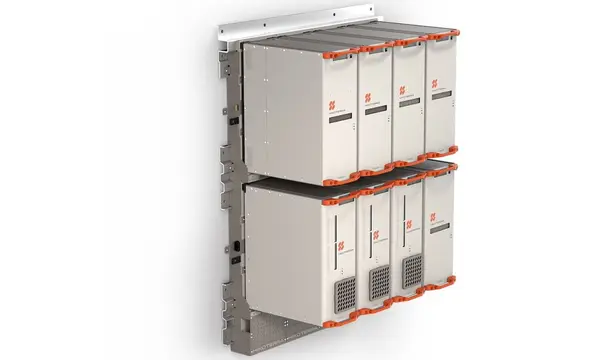
HikoTerra adds distributors and technical partners for the modular H⁴ Hybrid Power System, with configurations allowing up to 30kW of inversion and 96kWh of …

IMSO opens its 30th Assembly in London with delegates from 112 Parties reviewing GMDSS satellite distress service resilience and LRIT performance.
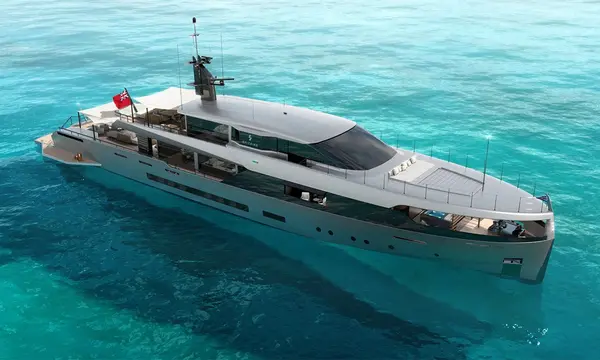
ARES Yachts' 50.55m SPITFIRE project combines a lightweight composite hull, hybrid electric drive and a radically flexible guest layout as the Antalya yard develops …
Superyacht Guide
Continue into the wider Superyacht Guide.
Business opportunities · Superyacht Guide
Companies serving the superyacht market can discuss clearly identified advertising, sponsorship and business-profile opportunities. Commercial activity remains separate from independent editorial coverage.