Becoming a yacht stewardess or steward requires more than polished service skills. This 2026 guide explains the essential STCW and medical requirements, what interior crew actually do, current junior salaries and how to turn daywork or hospitality experience into a first yacht job.
Working as a yacht stewardess or steward is one of the main entry routes into the superyacht industry, particularly for candidates with experience in hospitality, hotels, restaurants, bars, housekeeping or other customer-facing work. The position belongs to the yacht’s interior department and combines guest service with the less visible work required to keep cabins, communal areas, laundry, table settings and service operations at an exceptionally high standard.
No previous yachting experience is necessarily required for a junior position. Hospitality, food and beverage, catering and customer-service experience can all provide transferable skills, but the difficult part is normally not becoming technically eligible to work; it is persuading a captain or chief stewardess that a completely new crew member will work hard, learn quickly and fit into a small team living together for long periods.
What does a yacht stewardess or steward actually do?
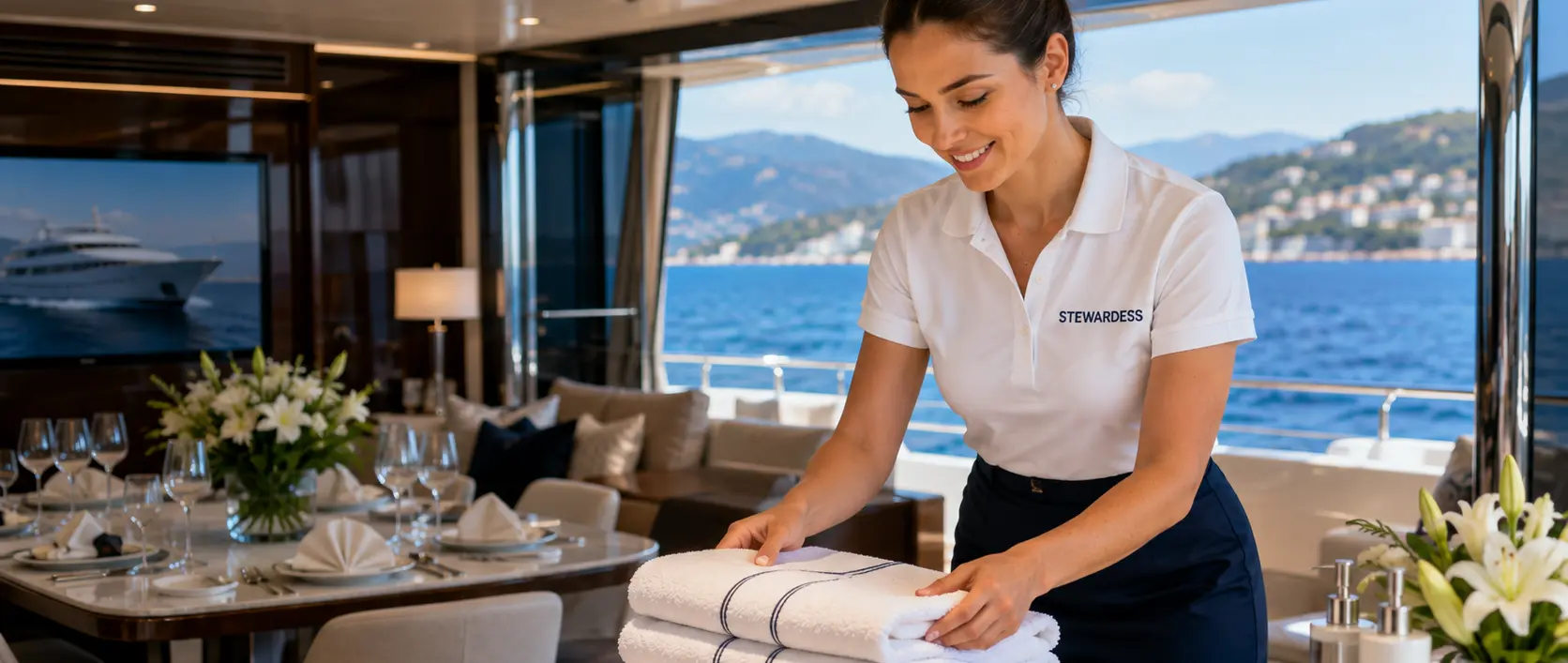
The interior department is responsible for maintaining the guest-facing areas of the yacht and delivering the standard of service expected on board. A junior steward or stewardess may move between housekeeping, laundry, meal and drink service, cabin preparation, crew-area duties, inventory and restocking, depending on the yacht’s size and how its interior team is organised.
On smaller yachts, one person may cover several of those functions during the same day, while larger yachts are more likely to divide the department into service, housekeeping, laundry and specialist positions. The work is considerably more physical than the luxury setting can suggest, with beds, bathrooms, polished surfaces, laundry and guest requests requiring constant attention during busy owner trips or charters.
Restaurant, hotel and private-household experience can therefore be highly relevant. Silver service, bartending, wine knowledge, housekeeping, laundry, childcare, spa therapy and similar skills can all transfer into the yacht environment, although they do not replace the maritime safety requirements needed before joining a vessel.
STCW and ENG1 are the essential starting qualifications
For most new crew seeking work aboard commercially operated superyachts, the normal starting point is STCW Basic Safety Training. Its core basic-safety elements include Personal Survival Techniques, Fire Prevention and Fire Fighting, Elementary First Aid, and Personal Safety and Social Responsibilities, giving new crew the minimum safety knowledge expected before working at sea.
There is an important 2026 change to Personal Safety and Social Responsibilities training. Amendments that entered into force on 1 January 2026 added competence concerning the prevention, identification, reporting and response to violence and harassment, including sexual harassment, bullying and sexual assault, so candidates should make sure their training meets the current requirements.
A valid seafarer medical certificate is the other fundamental requirement. Under the UK system, the normal certificate for yacht crew is the ENG1, issued by an MCA-approved doctor, and the current maximum fee for the standard examination is £115; accepted equivalent medical certificates may apply under some flags and circumstances.
Depending on the yacht, flag and assigned duties, candidates may also need security training, while food-hygiene, service, wine, cocktail, barista, housekeeping and floristry courses can strengthen an interior CV. Specialist interior programmes can improve practical preparation, but optional training should not be confused with the core maritime requirements or treated as a guarantee of employment.
How much does a yacht stewardess or steward earn in 2026?
Current recruitment data places a Junior Steward/ess with zero to one year of experience at approximately €3,000 to €3,500 per month across yacht sizes, with typical leave packages around 60 to 90 days or more. These figures are market ranges rather than guaranteed salaries, and yacht size, private or charter use, previous experience, specialist skills and leave arrangements can all influence an offer.
Accommodation and meals are normally provided while living aboard, making the economics different from an equivalent land-based hospitality job. Charter gratuities can increase earnings on some yachts but are variable rather than guaranteed, while personal tax treatment depends on the crew member’s residence, nationality, employment arrangement and time spent in different jurisdictions.
Progression can be relatively quick for capable crew who become strong in housekeeping and service. An entry-level steward or stewardess can move towards experienced steward, second stewardess, head-of-service, chief stewardess or purser positions as onboard experience, responsibility and specialist skills increase.
Building a first yacht CV that gets noticed
A first yacht CV has a difficult job because the candidate cannot yet prove yacht experience, so transferable skills need to be immediately visible. Restaurant service, cocktail preparation, wine knowledge, housekeeping, luxury retail, hotels, private households, childcare, nursing, beauty therapy, languages and examples of working long shifts or handling demanding customers can all help demonstrate usefulness to an interior team.
The CV should remain concise, clearly formatted and easy for a recruiter or chief stewardess to scan, with certificates, availability and relevant experience prominent rather than buried beneath unrelated employment history. Professional presentation matters because employers assessing a green candidate have little previous yacht performance on which to base a decision.
Daywork and the route to a first permanent position
The first permanent job is usually the hardest one to secure, and registration with reputable crew agencies should be only one part of the search. Daywork and legitimate dockwalking can be useful because they allow a yacht to assess somebody for a short period while giving the candidate genuine onboard experience and, if the work goes well, the beginnings of a yachting reference.
Useful interior daywork can include detailing guest areas, laundry, cabin preparation, polishing, inventories, storage organisation and helping an established interior team prepare for an owner trip or charter. Even routine work is valuable because it starts replacing “no yacht experience” with actual time aboard and demonstrated reliability.
Major recruitment centres such as Antibes, Palma and South Florida can become particularly active around seasonal crew changes, but candidates must check their legal right to work before travelling specifically to dockwalk or accept daywork. Being physically present in a yachting hub does not itself create permission to work, and qualifications should ideally be completed before seasonal hiring accelerates.
What employers are really looking for in a green steward
Certificates establish a minimum level of safety preparation, but they do not show whether somebody will be good at the job. A junior steward or stewardess needs to be comfortable taking instructions, repeating tasks to a consistently high standard, correcting mistakes without argument and working within a clear onboard hierarchy.
Life aboard also means sharing living space with colleagues and spending long periods away from home, while busy guest periods can involve demanding schedules and limited personal space. Candidates attracted only by travel photographs or headline salary figures can quickly discover that the reality is closer to intensive luxury hospitality at sea than to a paid holiday.
For somebody who genuinely enjoys hospitality, the entry route is straightforward even if the competition is not. Complete current STCW safety training, secure an ENG1 or accepted equivalent medical, build a professional CV around transferable interior skills, register with reputable crew agencies and actively pursue legitimate daywork and junior-stew opportunities.
The first contract is the difficult threshold, but the employment picture changes once a steward or stewardess can show a successful season, references and genuine onboard experience. At that point, the candidate is no longer asking an employer to take a chance on potential alone and can instead demonstrate an established record of professional service at sea.