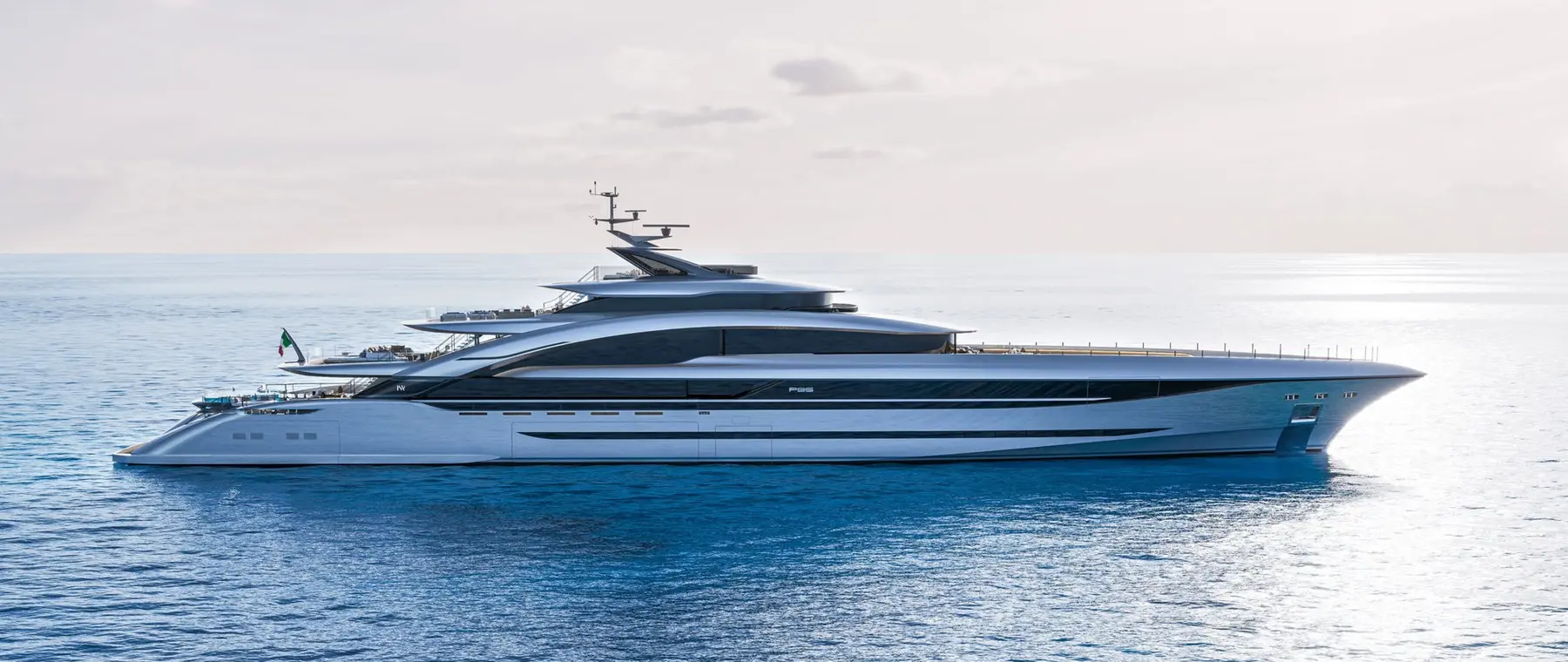
ISA Yachts Unveils 86m Poseidon With Owner's Pool Deck
By Stephen Yardley · Edited by Stephen Yardley
ISA Yachts has introduced the 86-metre Poseidon concept, combining a highly private owner’s level, multiple water-facing terraces and an engineering platform designed for customisation.
ISA Yachts has presented Poseidon, an 86-metre design within its Large Yacht Collection, extending the Italian builder's portfolio of very large custom superyacht projects. The announcement describes a developed design proposition, rather than a newly launched or delivered vessel. That distinction matters: dimensions, accommodation and projected performance are the yard's proposed specifications, not independent sea-trial results. Poseidon is intended to offer a recognisable architectural identity while leaving room for the considerable personal decisions that define a yacht of this scale.
The project builds on a common engineering approach in the Large Yacht Collection. A shared technical basis is meant to support custom choices without treating the whole yacht as a purely speculative sketch. ISA places particular emphasis on the relationship between open terraces, glass and protected accommodation. The concept is consequently a useful indicator of what the builder believes prospective owners want from the 80-metre-plus market: meaningful privacy, outdoor space, and amenities that remain connected to the water.
Enrico Gobbi – TEAM for Design is responsible for both the exterior and interior design, with naval architecture assigned to ISA Yachts' technical department. The proposed 12.8-metre beam creates room for a deep superstructure and extensive deck areas. The long forward section is paired with a tall, gently curved bow and a more aft-set superstructure. Those proportions separate Poseidon visually from a conventional stack of equal decks and give the owner level an unusually prominent position.
ISA's familiar arch is reinterpreted in a slimmer form, reducing interruptions to the glazing and outward views. Air intakes and sharply defined structural surfaces draw some inspiration from automotive styling, according to the builder. The idea is not to claim automotive performance at sea; it is an aesthetic treatment of surfaces and sightlines. The more important naval-architectural question is how the visual decisions coexist with machinery, circulation and practical spaces in a completed custom build.
The lower-deck beach club is presented as a substantial social destination, with fold-down side platforms enlarging the usable waterside footprint. A lounge, bar and glass-sided whirlpool are grouped near the open stern. Moving forward from this area, the design connects to a proposed wellness suite with a gym, sauna, steam room and dedicated treatment spaces. Two additional opening balconies would allow users of those spaces to connect directly with the outside environment without leaving the deck.
Further above, the main-deck aft area is dominated by a T-shaped pool combining a swimming section and a whirlpool element. Glass and sculptural framing are intended to keep the water visible as an architectural feature. Multiple terraces rise behind the stern, with low visual barriers to preserve the relationship with the sea. Such arrangements create attractive guest circulation but also demand careful design of drainage, privacy, wind protection and service access before construction.
The upper deck is reserved principally for the owner and includes a suite surrounded by extensive glazing, a study, dressing area and a bathroom with bath and separate shower arrangements. The forward exterior zone has a long pool and sunbathing area, creating a private outdoor space well removed from the principal guest terraces. The same general zone is described as capable of supporting touch-and-go helicopter operations, an option that would require the appropriate technical and regulatory assessment.
Aft of the private rooms, Poseidon provides for indoor and exterior entertaining, including dining for fourteen people. A panoramic sky lounge and another Jacuzzi occupy the uppermost deck, contained beneath a roofline that recalls a sports-car cockpit. For guests, the plans offer either six cabins for twelve people or seven cabins for fourteen. The crew complement is described as eighteen across ten cabins, underlining the operational scale behind the owner's private experience.
The design proposes a high-tensile-steel hull with an aluminium superstructure and a full-load draught of approximately 3.6 metres. Two MTU 16V4000 M63L engines, each rated at 2,240 kW, are specified. ISA projects a top speed of seventeen knots, a cruising speed of fourteen knots and a range of roughly 5,000 nautical miles at twelve knots. As with any concept-stage specification, these numbers remain subject to detailed engineering, displacement choices and the final owner's brief.
Tender storage is distributed between a forward garage for a rescue craft and water toys and another amidships with capacity for a tender up to about 9.5 metres. The second arrangement can alter the space allocated to the gym, demonstrating the trade-offs that even large superyachts face when owners prioritise different activities. The published concept should be assessed as a set of design choices and proposed capabilities, not as evidence that sea trials or regulatory certification have already taken place.
Poseidon joins other ISA Large Yacht Collection studies at a time when owners can compare several interpretations of private-deck architecture and large beach clubs. The proposed abundance of pools is eye-catching, but its more consequential feature may be the deliberate hierarchy of spaces: public guest entertaining at the stern, a largely private owner level forward and service zones arranged to support both. That is a planning response to the way very large private yachts are used over extended stays.
No construction start, confirmed buyer or delivery timetable is established by the unveiling. Those details should be distinguished from the builder's stated design ambitions. ISA and parent Palumbo Superyachts have experience in the custom-yacht segment, while Poseidon represents a proposition for future work rather than an addition to the delivered fleet. Its significance for prospective owners will depend on how successfully the final specification reconciles privacy, exterior space, range, crew efficiency and maintainable systems.
Explore
Go deeper into the yachts, companies, events and destinations directly connected to this article.
Continue reading
An IYC and SuperYacht Times panel at Monaco Yacht Show 2026 examined how crew rest, staffing, mental wellbeing and working culture affect the guest …
A sanctions freeze can immobilise a superyacht without making its crew sanctioned, leaving wages, contracts and daily operations caught between employment law and financial …
European superyacht charter VAT is determined by more than a country's headline tax rate. This 2026 guide compares major charter jurisdictions and explains the …
During a charter, the captain has to balance guest expectations with crew capability, rest requirements and a weather picture that can change by the …
Superyacht Guide
Continue into the wider Superyacht Guide.
Business opportunities · Superyacht Guide
Companies serving the superyacht market can discuss clearly identified advertising, sponsorship and business-profile opportunities. Commercial activity remains separate from independent editorial coverage.