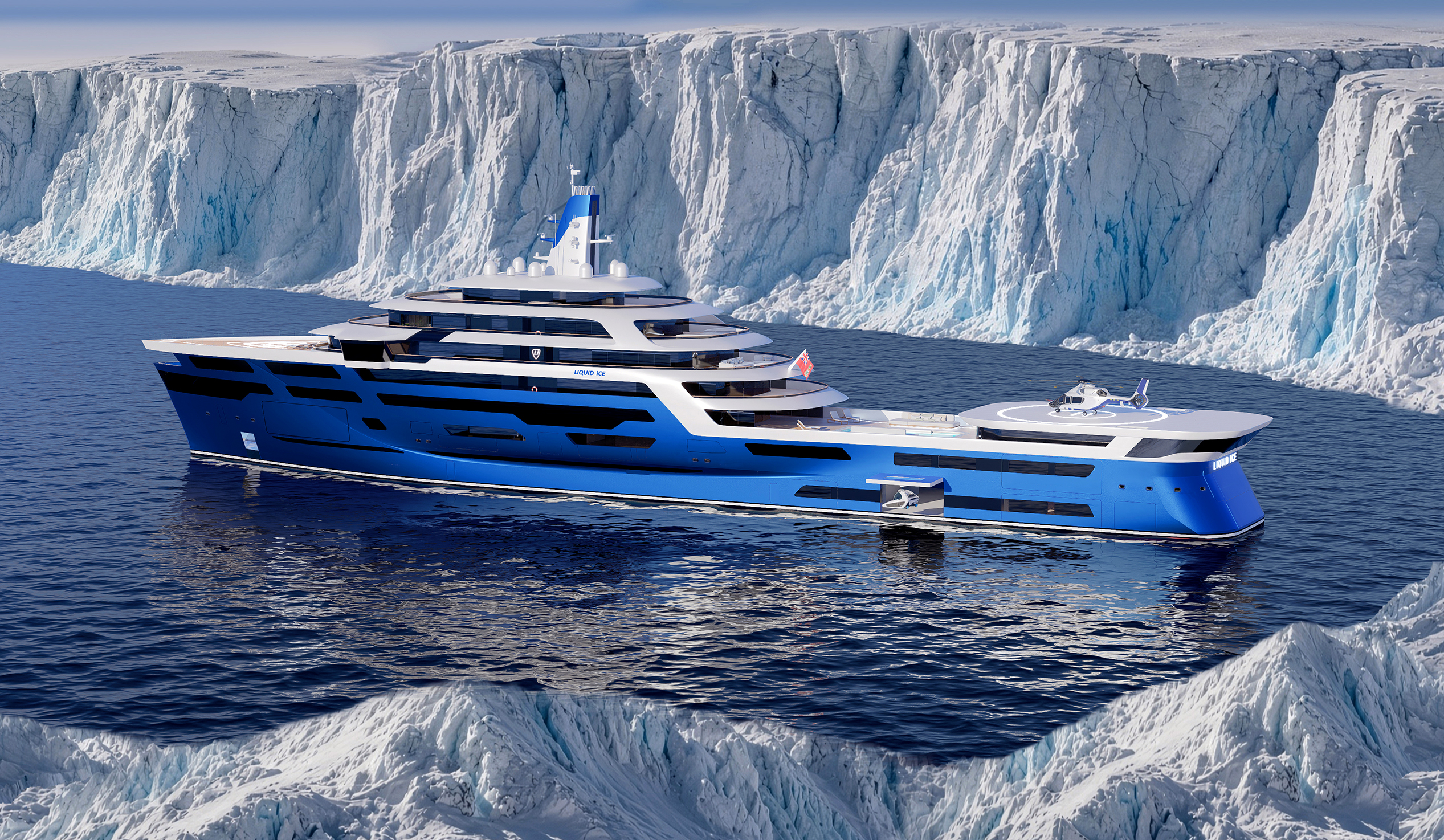
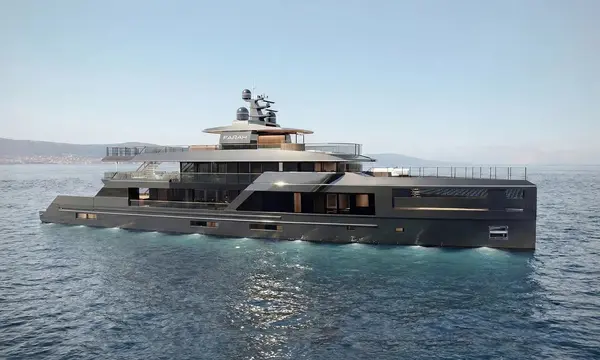
Baglietto Reveals Interiors of 50m Custom Superyacht FARAH
Baglietto has unveiled the first interior imagery of FARAH, its 50-metre custom yacht under construction in La Spezia, with a Brazilian design collaboration.
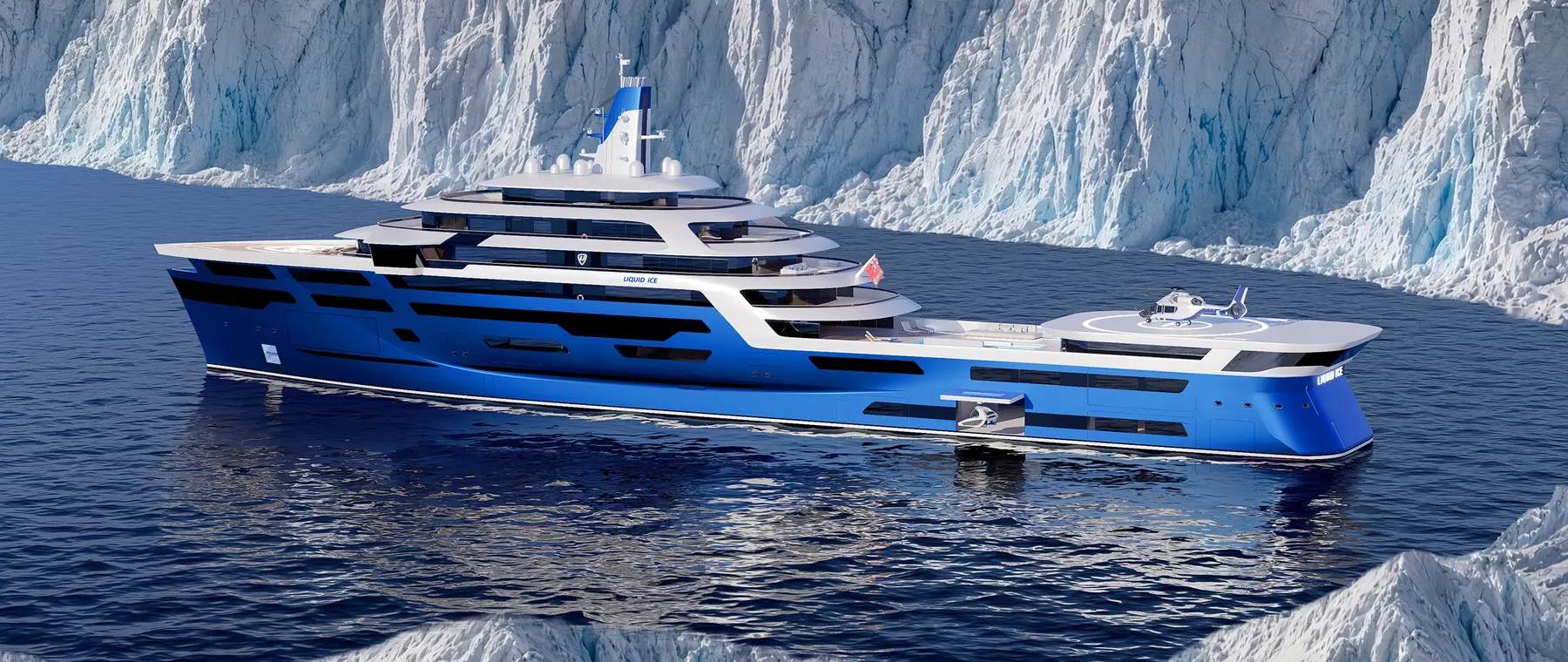
Liquid Ice 148.5m explorer yacht official designer rendering in polar scenery
Aria Yacht Design and Janthina Naval Architects present a 148.5-metre explorer concept combining liquid hydrogen storage, fuel cells and scientific facilities.
Aria Yacht Design and Janthina Naval Architects have presented Liquid Ice, a 148.5-metre explorer yacht concept incorporating hydrogen-electric propulsion, scientific research facilities and equipment intended for extended remote expeditions. The design, which entered industry news coverage in November 2026, has an indicated beam of 28.8 metres and an estimated gross tonnage of 13,500. Its scale makes it particularly interesting from the perspective of the relationship between energy storage and naval architecture. The design team has chosen to organise the vessel around a substantial liquid hydrogen installation rather than adapt the appearance of a conventional yacht and place alternative propulsion equipment within its existing machinery spaces. No construction contract, building yard or delivery schedule is identified in the published material. Nor have the predicted speed and range been demonstrated through sea trials. The proposal is appropriately understood as a design study that illustrates a possible approach to the combination of private accommodation, ocean research and long-distance operation on a very large vessel.
The concept identifies two liquid hydrogen storage tanks using technology developed by SHZ Advanced Technologies. The designers envisage approximately 150 tonnes of usable hydrogen, with the tanks housed in two dedicated and protected compartments. The volume occupied by this fuel is an important consideration because hydrogen has a much lower volumetric density than conventional liquid hydrocarbons, even in its liquid state. Its storage also requires cryogenic conditions and associated management equipment. The allocation of volume is therefore not limited to the tanks themselves. Access, supporting equipment, ventilation arrangements, structural protection and integration with the energy system must all be considered in the detailed design. The designer report estimates a total fuelled weight of 650 tonnes for the proposed installation and says that this would be lower than that of a comparable fuel-oil system. That is a project estimate, not a measured comparison of two completed ships. Determining the actual difference would require detailed specifications covering the complete propulsion arrangement, energy storage, supporting equipment and stated operational assumptions.
Liquid Ice is described as using a modular fuel-cell installation in combination with a battery bank of 13 megawatt-hours. The proposed arrangement would use electrical energy both for propulsion and for the vessel's hotel and technical services. That combination has a number of possible advantages in principle. Fuel cells can be operated according to their preferred loading characteristics while the batteries help accommodate changes in demand. Propulsion requirements fluctuate as the yacht accelerates or changes speed, and some onboard equipment introduces additional electrical loads over shorter periods. A compatible storage system can help separate some of those fluctuations from the operation of the fuel cells. The designers envisage modules being taken out of operation for maintenance while the remaining systems continue to provide power. That intention would need to be demonstrated through a complete electrical and safety specification that establishes the capacity available in different operating and fault conditions. The published announcement does not identify the final number and rating of individual modules or the power available following any particular equipment failure.
The design team states a target maximum speed of 21 knots and a range of 7,000 nautical miles when cruising at 12 knots. Those are two distinct proposed operating conditions, not a claim that the yacht could sustain its maximum speed throughout a voyage of 7,000 nautical miles. At the indicated cruising speed the range corresponds to a substantial period of travel without returning to a fuel source. Its feasibility would depend on the yacht's actual resistance characteristics, propulsion efficiency, usable hydrogen inventory and the energy consumed by non-propulsion equipment. In a remote expedition environment, wind, waves, currents and operational restrictions may materially alter the energy required for a journey. The designers also refer to the long dormancy period envisaged for the tanks and low hydrogen boil-off. The performance of the storage arrangement while the vessel is anchored or operating at low load would be another subject requiring verification. The intended range cannot be treated as a commercially guaranteed endurance figure until the relevant design, operating assumptions and verification programme have been established.
Beyond the propulsion study, the project describes infrastructure for carrying out a variety of activities away from conventional shore facilities. The proposed yacht includes two deep-sea submarines, two helicopters, three guest tenders and six personal watercraft. The design team also identifies dedicated laboratories, a mission control room and facilities for twelve researchers to live and work alongside the yacht's guests and crew. The inclusion of research accommodation distinguishes the concept from a private yacht carrying only a small collection of scientific instruments as optional equipment. A research programme may introduce requirements for sample handling, storage, communication, data acquisition and the management of specialist personnel. Those functions must coexist with ordinary operation of the vessel. The announcement does not specify the type of scientific missions envisaged, the equipment to be installed within the laboratories or the operating depth and certification of the proposed submersibles. Nor does the statement establish that a particular research institution is participating. The project establishes the proposed allocation of space and intended capabilities, while leaving the detailed programme to future development.
The designers have developed the accommodation around a main outdoor pool area framed by a double-height saloon and a raised aft deck. A panoramic lounge occupies the aft part of this arrangement. The raised area is envisaged as adaptable when the helicopter is stowed below deck, allowing its use for activities such as an outdoor cinema or tennis. Forward, a further double-height observation space is intended to offer a broad view across the bow, with an adjoining exterior observation deck. Below the pool deck, the design identifies a combined spa, gym, beach club and equipment area approaching 1,000 square metres. A winter garden provides an alternative indoor setting with a closer visual connection to the environment. These different environments are particularly relevant to a yacht intended for both temperate and high-latitude operation. Conditions appropriate for exposed exterior spaces may change considerably during a long voyage. The design proposal illustrates how accommodation can be organised to provide sheltered alternatives without requiring every social activity to take place deep within the interior.
Liquid Ice is proposed with ice-class capability, but the public concept does not identify a final class notation, a verified polar operational envelope or a permitted range of specific ice conditions. These would need to be established through detailed engineering and approval. The location of tanks and other major components also needs to be considered in relation to vessel protection and the consequences of damage. At the same time, a vessel relying on liquid hydrogen must have an achievable approach to fuel procurement. Appropriate port infrastructure, supply arrangements and regulatory approvals would need to be available for the intended routes. There is no published network of hydrogen replenishment locations associated with this concept. The emissions arising from the production, liquefaction and transportation of the fuel also depend on how it is supplied. Although fuel cells using hydrogen can avoid direct carbon dioxide emissions from the energy conversion process, the environmental performance of the complete operation cannot be established from the onboard propulsion system alone. The design should consequently be examined as part of a proposed operational and supply system.
Aria and Janthina have brought several substantial design questions together in Liquid Ice: alternative fuel storage, long-distance electrical propulsion, private accommodation, aircraft and submersible operations, and facilities for scientific work. The proposed figures are unusually ambitious, and their significance lies in the way they influence the vessel's architecture. A successful realisation would require detailed engineering of the interfaces between these functions, verification of the predicted performance, assessment by the applicable authorities and a shipyard capable of executing such a large project. Superyacht Guide has not assessed the engineering calculations or independently confirmed the feasibility of the design targets. The official image accompanying this report is a rendering of the concept, not a photograph of an existing ship. The current proposal nonetheless deserves attention because it makes the constraints associated with future energy systems visible in the design of the vessel itself. The next meaningful milestones would be more detailed technical specifications, arrangements for construction if an owner commissions the project, and ultimately verification of the system under operating conditions.
Primary source: Aria Yacht Design and Janthina Naval Architects official concept presentation.
Further information: Superyachts Channel, 11 November 2026, corroborating announcement timing.
Aria Yacht Design / Janthina Naval Architects, official concept rendering. Not a photograph of a built vessel. Official source.
Continue reading
Baglietto has unveiled the first interior imagery of FARAH, its 50-metre custom yacht under construction in La Spezia, with a Brazilian design collaboration.
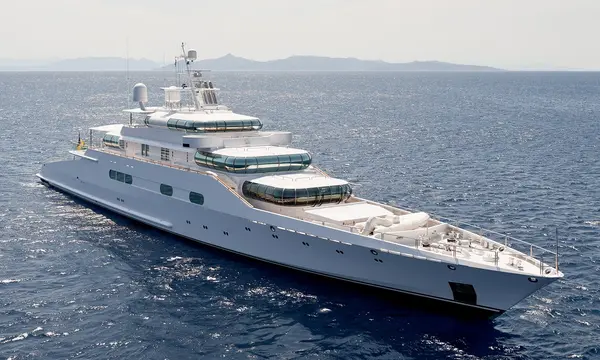
IYC's November retrospective reunites the original designers of 74.5m ZEUS, examining her distinctive glazing, engineering and continued appeal to buyers.
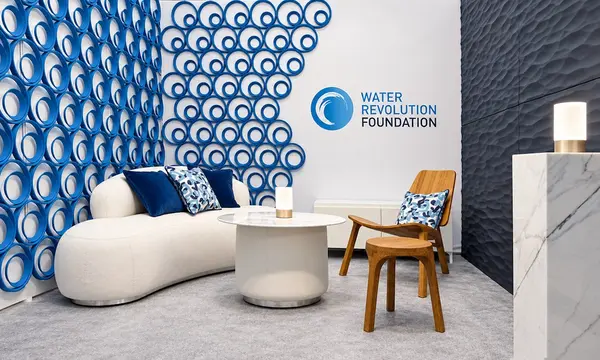
Amadei Collett details how designers and specialist suppliers created Water Revolution Foundation's Monaco Yacht Show stand through shared expertise and materials.
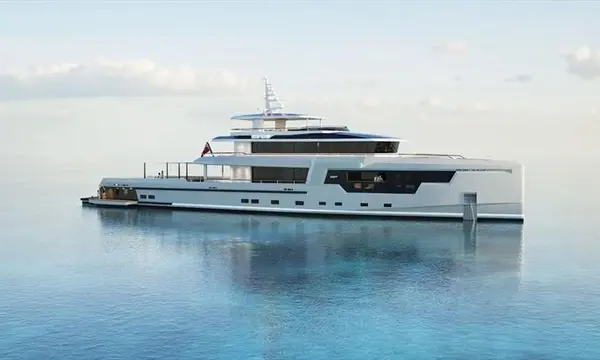
Humphreys Yacht Design introduces the 50m H50EXP explorer concept with Mark Whiteley Design and Occam Marine, targeting over 5,000nm of range at 12 knots …
Superyacht Guide
Continue into the wider Superyacht Guide.
Business opportunities · Superyacht Guide
Companies serving the superyacht market can discuss clearly identified advertising, sponsorship and business-profile opportunities. Commercial activity remains separate from independent editorial coverage.