
Company
Lloyd's Register Yacht Services
Explore the company profile and related Superyacht Guide coverage.

Monaco harbour — Lloyd's Register Horizons editorial photograph
Lloyd's Register urges the yacht industry to evaluate potential carbon costs as the EU considers extending its emissions trading scheme to some smaller vessels.
Lloyd's Register has called on the yacht industry to examine the implications of possible changes to European carbon pricing before the legislative process is completed. In a November Horizons article, listed by the classification society on 12 November 2026, its global yacht segment director, Engel-Jan de Boer, considers the consequences that an extension of the European Union Emissions Trading System could have for yacht operation, design and investment. The subject is especially relevant to owners and managers of larger yachts, whose operating budgets and technical specifications may be established years before the legislation under discussion would take effect.
The European Commission proposed modifications to its emissions trading framework in July 2026. Its subsequent climate action progress report describes a possible extension from 2031 to certain additional ship categories in the 400 to 5,000 gross tonnage range. Lloyd's Register identifies the potential for yachts to be affected by the developing framework. The distinction is important: the proposal is not a blanket enacted obligation covering every yacht above 400 GT, and the Commission's summary names particular categories of shipping. Individual yacht applicability must be determined from the final legal text, vessel classification and circumstances. The classification society's intervention is therefore a call for forward planning rather than notice of a new payment requirement already applicable to the fleet.
Gross tonnage describes the volume of a vessel through an internationally defined measurement system. It is not a measurement of displacement or fuel consumption, and two yachts of similar length can have materially different gross tonnages. Enclosed accommodation, the arrangement of decks and the overall configuration of a vessel all contribute to the nature of the spaces being measured. An owner interested in the potential scope of a tonnage-based requirement should begin by establishing the certified particulars of the actual vessel, not by estimating tonnage from the length given in a brokerage listing.
For newbuild projects, this also means that early architectural decisions may need to be considered alongside an evolving regulatory environment. The applicable measurement rules and any exemptions need specialist interpretation. A designer should not optimise a project around the assumption that staying just below a particular threshold will necessarily resolve every regulatory or operating concern. Other maritime requirements use different criteria, and changes to vessel use or the physical arrangement can have consequences that go beyond a single carbon-pricing proposal.
An important feature of the wider legislative framework is that monitoring obligations and the surrender of emissions allowances are distinct. Reporting arrangements can apply to a population of vessels that differs from those currently brought within carbon pricing. The European Commission's explanation of the existing maritime ETS and its proposed changes makes clear that the boundaries of the schemes have evolved over time. This is one reason that yacht management teams should obtain advice for the particular vessel instead of treating a headline about a proposed tonnage threshold as a compliance determination.
From a management perspective, reliable records of energy use are valuable independently of the final outcome of these negotiations. Owners can benefit from knowing how much fuel their yacht uses during different types of activity and how those figures vary between seasons. Where statutory obligations apply, the records and verification processes must satisfy the specific requirements. Where they do not, comparable internal information can still support technical decisions. The managerial objective is to avoid a situation in which the vessel's first attempt to establish meaningful emissions data takes place under the pressure of a newly applicable reporting deadline.
A large yacht may spend substantial portions of its operational year at anchor or alongside, punctuated by relatively short relocations and occasional extended passages. Fuel use is not confined to propulsion. Electrical generation for accommodation, climate control, galley equipment, guest facilities and technical services may continue when the main propulsion machinery is idle. Two yachts with similar machinery specifications can consequently have different annual consumption patterns.
The first analytical task is to establish a representative picture of the vessel's activities. A comparison of operating periods should consider distance travelled, weather, load conditions and the extent of guest use. Fuel and electrical records gathered at meaningful intervals can help the technical management team identify which systems account for a substantial share of energy demand. Such work is preferable to applying an assumed efficiency improvement from a component brochure to the whole vessel's annual operating budget. Real savings depend on how a particular yacht uses the equipment.
Lloyd's Register sees potential carbon costs as another factor in the assessment of investment decisions. Superyacht construction already involves numerous trade-offs among interior volume, speed, range, comfort and machinery architecture. A future financial exposure to emissions might give owners another reason to quantify the energy consequences of those choices. The economics should be assessed over an appropriate period, recognising that the purchase price of equipment is only one part of its cost.
For a vessel under development, naval architects and engineers can compare candidate arrangements before major specifications become fixed. The options might include alternative propulsion architectures, modifications to hotel-load generation and greater use of shore electricity when available. Each must be considered within the constraints of the project, including available space, mass, technical maturity, servicing provision and intended voyage profile. There is no universal technology that makes every yacht efficient, and an apparently attractive solution for a vessel used predominantly in port need not be the right choice for one engaged in longer-distance cruising.
For yachts already operating, choices are constrained by machinery spaces, installed equipment, cable routes, structural arrangements and existing approvals. A complete replacement of the propulsion installation may make little sense where reliable machinery has substantial remaining service life. More limited projects can sometimes offer a more proportionate way of addressing energy demand. Their merits depend on the baseline established for the vessel and on the opportunities identified during engineering assessment.
An owner considering refit should ask the project team to distinguish improvements in individual equipment performance from changes in whole-vessel consumption. A replacement component must also be examined in the context of maintenance expenditure, operational disruption and compatibility with the remaining systems. A defined method of measuring performance after completion can help demonstrate whether the expected benefit has been achieved. Potential changes to carbon pricing should inform these assessments, but should not be the sole reason for committing to expensive modifications when the legislative position remains unsettled.
Energy choices aboard yachts depend in part on the facilities encountered ashore. If a vessel can safely connect to an appropriate electrical supply at its berth, it may be able to reduce its reliance on onboard generation during that stay. The practical benefit varies with the vessel's electrical demand, the connection available, local electricity generation and operational requirements. Merely providing a connection does not establish that every yacht can use it or that the resulting emissions will be zero.
Marina operators and yacht managers therefore have a shared interest in understanding the technical requirements for electrical infrastructure. Advance communication about vessel particulars and berth capability can support itinerary planning. Investments ashore take time to design, approve and commission, just as machinery upgrades do aboard a yacht. The development of more consistent arrangements between ports, vessel operators and service providers could help owners make better use of existing technology, regardless of the precise scope of any future carbon-pricing regime.
It is reasonable for an owner representative to ask how different regulatory outcomes could affect a vessel's future expenditure. An illustrative scenario might combine estimated eligible emissions, an assumed allowance price and an assumed proportion of activity within the relevant scope. Such a model is only a sensitivity exercise: it should state the assumptions and should not present the resulting figure as an actual liability. Changes in the final legal framework, trading prices or intended itinerary could materially alter any estimate.
The people responsible for technical operation, budgeting and compliance should be involved in developing these scenarios together. A charter programme may have different patterns of activity from a predominantly private programme, and the relevant operating arrangements should be considered on their own merits. Owners should seek qualified maritime legal and classification advice before deciding that a specific contract or cost allocation is required. At this stage the purpose of budgeting is to recognise uncertainty and identify the information necessary for later decisions.
Lloyd's Register's November assessment is a useful reminder that changes in maritime regulation are not confined to commercial cargo fleets. The classification society brings technical and regulatory expertise to the yacht industry, including the assessment of machinery, vessel design and safety arrangements. Its advice is to consider potential implications early, while the European legislative process remains open. The European Commission's own November progress report provides essential context for understanding the proposal and the specific additional ship categories it describes.
For the superyacht industry, the practical response is to maintain accurate vessel particulars, understand the real energy profile, review the applicable legal scope and assess engineering investments on their individual merits. These activities can improve the quality of operating and capital decisions even if the ultimate legislative outcome differs from present expectations. The important point is to distinguish sensible preparation from an assertion that a future rule has already entered force. Owners and their advisers should keep the formal legislative developments under review rather than infer an obligation from the tonnage threshold alone.
European Commission background: https://climate.ec.europa.eu/areas-action/climate-strategies-targets/progress-climate-action/eu-climate-action-progress-report-2026/chapter-2-eu-emissions-trading-system_en
Primary source: Lloyd's Register Horizons, 12 November 2026.
Monaco harbour — photograph accompanying Lloyd's Register's original Horizons article; contextual image. Official source.
Explore
Go deeper into the yachts, companies, events and destinations directly connected to this article.
Company
Explore the company profile and related Superyacht Guide coverage.
Continue reading
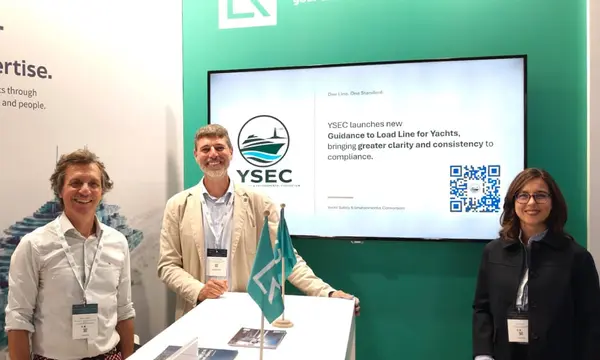
YSEC has launched new load-line guidance for yachts, aiming to make regulatory interpretation more consistent across design, approval and survey work.
Lloyd’s Register says onboard carbon capture could help reduce emissions from existing vessels while alternative-fuel infrastructure develops, but space, energy use and CO2 offloading …
The Beijing Convention on judicial sales of ships takes effect for the European Union on 15 December 2026, adding a treaty framework for cross-border …
British Marine says the proposed Visitor Levy (England) Bill should generally leave visiting boats outside the charge, while seeking assurances about permanently moored commercial …
Superyacht Guide
Continue into the wider Superyacht Guide.
Business opportunities · Superyacht Guide
Companies serving the superyacht market can discuss clearly identified advertising, sponsorship and business-profile opportunities. Commercial activity remains separate from independent editorial coverage.