
Image: Marlink
Marlink has launched an operational-technology security offering for connected vessel systems, targeting risks around navigation, propulsion, HVAC, access control and other operational equipment.
Marlink has launched a dedicated Operational Technology Security offering for maritime and industrial operators, extending cyber protection beyond conventional office IT into systems that control physical processes. At sea, the company identifies navigation, propulsion and cargo handling among the environments that can be exposed as vessels become more connected and remote access expands.
The development is directly relevant to superyachts, where bridge systems, machinery controls, access systems and increasingly sophisticated automation can sit alongside guest networks, crew communications and shore-based support. Marlink says its customer base includes superyachts and is positioning the service around operational continuity as well as data security.
Traditional IT security is concerned largely with information, accounts and business systems, while operational technology can influence equipment that physically moves, controls or protects a vessel. A compromise affecting propulsion or navigation therefore has a different risk profile from a stolen email password because the consequences can extend to safety, pollution and loss of operational capability.
Marlink says connectivity, remote maintenance and removable devices can expose equipment that was originally designed to operate in relative isolation. Its new service is intended to identify OT assets, understand how they communicate and reveal vulnerabilities before those weaknesses become a route into critical systems.
The technology layer uses passive monitoring to identify connected assets and unusual activity without relying on aggressive scanning of sensitive control networks. Marlink combines that visibility with safeguards intended to contain threats and protect essential processes, while professional services support assessment and remediation around the technical platform.
The company also provides 24/7 security monitoring through its wider security operations capability. For yachts with globally distributed management, engineering support and connectivity providers, continuous monitoring can be particularly valuable because the vessel may move between jurisdictions and time zones while still depending on remote technical access.
Marlink says the OT Security offering helps customers address IACS UR E26 requirements for ships, while its own onboard systems and equipment are developed in accordance with IACS UR E27. Those rules have pushed cybersecurity deeper into class and newbuild discussions by focusing attention on the resilience of ships and the cyber design of onboard systems and equipment.
For a classed superyacht, compliance should not be treated as a one-off certificate exercise because systems change during refits and software updates. New entertainment servers, remote-service connections, machinery upgrades and temporary contractor access can all alter the attack surface after the yacht has entered service.
Marlink cites a late-2025 case in which it detected and contained an early-stage cyber threat in a tanker's cargo-control network, illustrating why OT monitoring is treated differently from ordinary business cybersecurity. The same principle applies on yachts even where the equipment mix is different, because connected machinery and navigation systems can have consequences that reach beyond confidentiality.
The practical lesson for owners, captains and managers is that yacht cyber plans increasingly need to cover the full technical network rather than stop at Wi-Fi and guest devices. Segmentation, controlled remote access, asset inventories, monitoring and response procedures become part of the same operational-safety discussion as bridge redundancy and machinery maintenance.
Explore
Go deeper into the yachts, companies, events and destinations directly connected to this article.
Continue reading
Cybersecurity on superyachts is now a core safety, privacy and operational issue, covering navigation, Wi-Fi, AV, crew devices and suppliers.
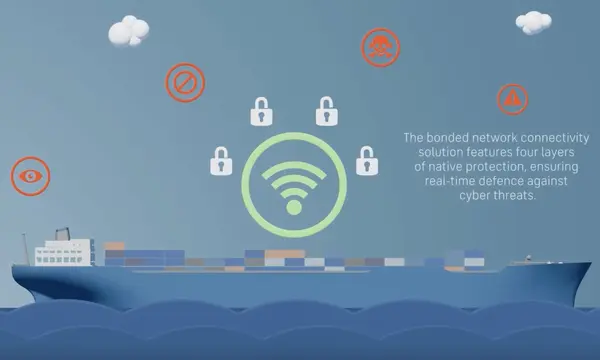
Bureau Veritas has granted Cyber Security Type Approval to Inmarsat Maritime’s NexusWave bonded multi-network service against IACS UR E27.
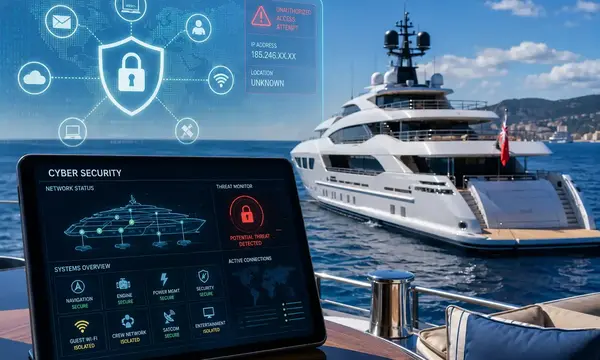
As superyachts become more connected, the threat is moving beyond stolen data. Navigation, machinery, guest networks and remote access can now share the same …

Superyacht security now covers far more than guards and cameras, from drone privacy and intruders to cyber risk, social media leaks and shore movements.
Superyacht Guide
Continue into the wider Superyacht Guide.