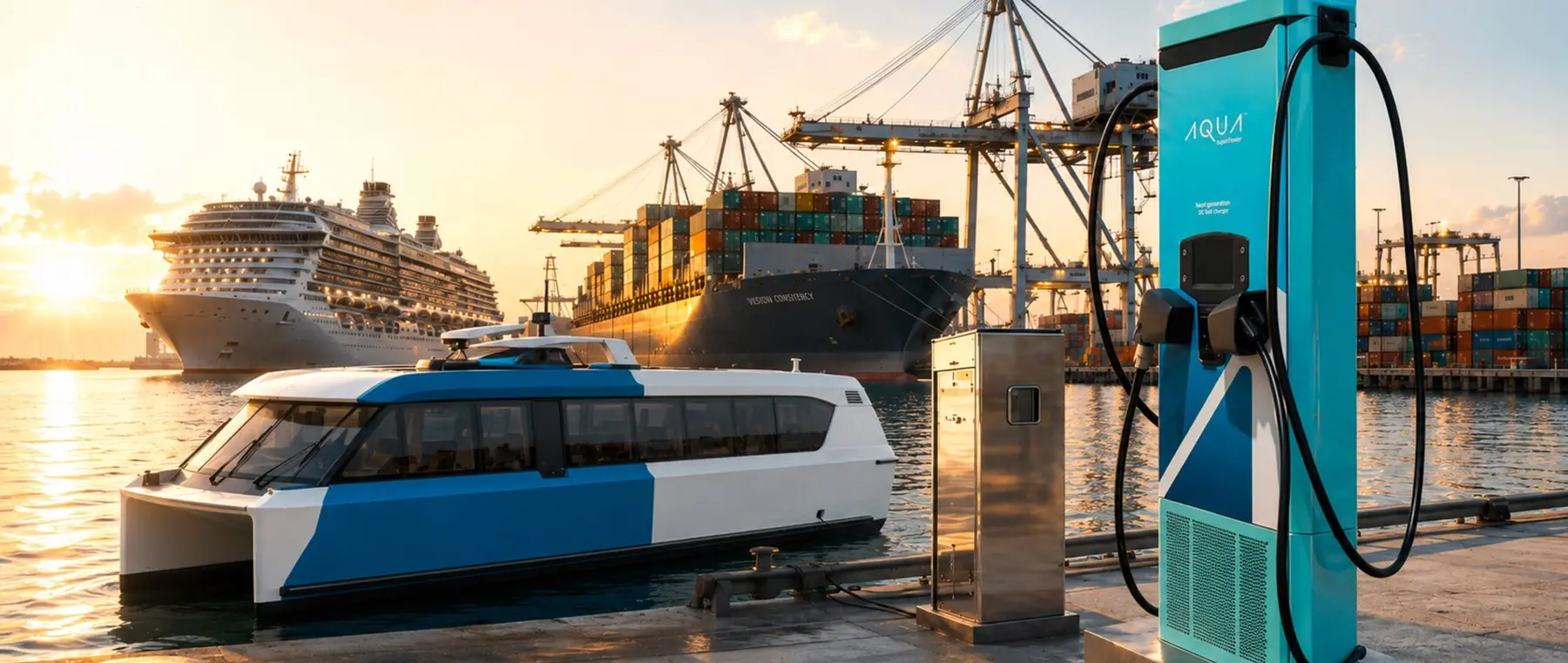
NatPower Marine's Aqua superPower Deal Targets Over 80 Ports and Marinas
By Stephen Yardley · Edited by Stephen Yardley
NatPower Marine agreed to acquire Aqua superPower's network spanning over 80 ports and marinas, aiming to accelerate charging access for electric boats, tenders and yachts.
NatPower Marine announced a strategic agreement on 10 July 2026 to acquire Aqua superPower's international boat-charging network from ATV Power. Unveiled at the Monaco Energy Boat Challenge, the agreement is intended to combine NatPower's energy-infrastructure plans with one of the largest established networks of electric-vessel chargers serving European and North American marinas. Aqua superPower says the existing network spans more than eighty ports and marinas, giving the buyer an operational footprint that would otherwise take years to assemble.
An agreement to acquire is not necessarily the same thing as a completed legal transfer. The announcement does not by itself establish the transaction's financial consideration, the completion of every required consent or the future charging tariff at each location. The present significance is that a company focused on maritime energy infrastructure has committed to integrate a network that already connects many familiar yacht destinations.
The network covers locations on the French and Italian Rivieras, in Venice, Trieste and Genoa, around Lake Maggiore and Lake Geneva, and in other European markets. North American locations cited in the announcement include San Francisco Bay, Lake Tahoe, San Diego and Lake Michigan. The geographical spread is notable because recreational vessels often move between different jurisdictions and marina operators rather than returning regularly to the same home berth.
A port named in a corporate list does not guarantee that every dock has the same power connector, charging capacity, service availability or price. Captains and technical managers should verify the exact installation before planning a passage that depends on shore electricity. Some sites primarily serve smaller electric craft, while large yacht hotel loads require separate electrical arrangements. The network's commercial value will depend on consistent service and transparent technical information.
A marine charging point must be designed for exposure to salt, spray, variable water levels and the movement of vessels alongside. It needs safe electrical protection, reliable isolation, metering and connectors compatible with the receiving craft. In a busy marina, chargers may have to operate near refuelling areas, metal pontoons and people unfamiliar with high-power equipment. Maintenance and personnel training can therefore matter as much as the headline power rating.
For larger yachts, a conventional shore-power connection may supply hotel loads while charging energy-storage batteries, but the electrical architecture is rarely identical to that of a small electrically propelled runabout. Transformer ratings, voltage, frequency, cable management and vessel-side distribution must be checked. Port managers also need to understand local grid capacity and whether simultaneous charging can create peak-demand problems.
Building a new network requires separate marina agreements, grid connections, equipment supply, payment systems and customer education in each region. Purchasing an established operator could give NatPower quicker access to trained partners, installed equipment and operational data. The integration may also allow investment in higher-capacity chargers or common digital management tools, although these benefits depend on detailed execution rather than the announcement alone.
A corporate transaction can bring risks for customers during the transition. Existing service contracts, roaming arrangements, customer accounts and maintenance responsibilities must be maintained or clearly replaced. Operators should communicate any change of brand, billing or technical support well before it affects visiting vessels. Predictable charging access is essential when a ship's passage plan assumes a particular destination.
Electric propulsion can reduce local exhaust and noise, especially in enclosed waterways, but emissions performance depends on how the electricity is generated and how efficiently it reaches the vessel. Ports may use grid electricity, local renewable generation, batteries or a combination of sources. If a charger relies on fossil-fuel electricity at peak demand, the wider emissions profile differs from charging during periods with a substantial renewable contribution.
Lifecycle assessment also matters. Batteries, converters, switchgear and installation work have manufacturing impacts and require maintenance and eventual replacement. A credible environmental claim should specify the comparison being made and whether it concerns local pollution, total energy use or full-chain greenhouse-gas emissions. The fact that a vessel uses an electric charger is not alone proof of zero overall environmental impact.
Most of the current electric-boat charging ecosystem has developed around smaller motorboats, tenders, ferries and other high-utilisation coastal craft. Superyachts present different opportunities. Electric tenders can charge from the mother ship or shore, while larger hybrid yachts may use shore energy to support overnight hotel loads and batteries. Such applications could make charging access increasingly relevant to superyacht captains, particularly in protected bays and densely populated marinas.
The practical benefit depends on the vessel's equipment. A conventionally powered yacht cannot automatically use every high-power charger, and a tender's connector may differ from that of a marina network. Owners considering future-proofing can ask builders about appropriate shore-power management, battery-system safety and documentation that will make later infrastructure upgrades easier.
NatPower Marine is part of NatPower Group and describes its business around the maritime energy transition, investment and the creation of infrastructure capable of supporting cleaner vessel operations. Aqua superPower has worked with marinas and watercraft manufacturers to develop a public marine charging network, supported by software and operating services. ATV Power is identified as the seller in the announced agreement.
This division of roles helps explain the strategic logic of the transaction. NatPower may provide access to capital and larger energy projects, while Aqua superPower brings installed equipment, site relationships and sector experience. Each element must be coordinated with local marina owners and grid operators, who retain essential responsibilities for physical access, permits and safe infrastructure.
The next material developments will be clarification of acquisition completion, the treatment of existing customer accounts, additional sites entering service and verified increases in capacity where demand justifies them. Owners should not infer these outcomes merely because a corporate statement describes ambitious global objectives. Independent confirmation of working charging points and reliable maintenance will matter more than aggregate network counts.
For the superyacht sector, the acquisition plan is a sign that waterfront electricity is moving beyond scattered pilot installations toward larger coordinated businesses. Its success could simplify the logistics of electric tenders and hybrid vessels, but it will be judged by real availability, compatibility and safe service over time. That is the difference between a network on a map and infrastructure a captain can confidently incorporate into an itinerary.
Explore
Go deeper into the yachts, companies, events and destinations directly connected to this article.
Continue reading
Kongsberg Maritime is building dedicated superyacht sales and service teams, citing installations aboard at least 250 new-build yachts over 70 metres since 2000.

ARES outlines its full-custom shipbuilding strategy after delivering the 62m SIMENA, drawing on Antalya facilities and more than 350 commercial and naval projects.

AST is investing roughly €3m in a 4,000-square-metre Berlin-area factory for specialist composite marine structures and yacht tenders, targeting mid-2027 operations.
Smart Yachts lists long-term right-of-use opportunities for a 60m superyacht at Marina Genova and a 53.99m yacht at Port Vauban, Antibes.
Superyacht Guide
Continue into the wider Superyacht Guide.
Business opportunities · Superyacht Guide
Companies serving the superyacht market can discuss clearly identified advertising, sponsorship and business-profile opportunities. Commercial activity remains separate from independent editorial coverage.