Cayman Warns Stylised Yacht Names Must Remain Clearly Legible
Cayman’s new Guidance Note 10/2026 tells owners, captains and managers to ensure bespoke stern names remain clearly readable before fabrication and installation.
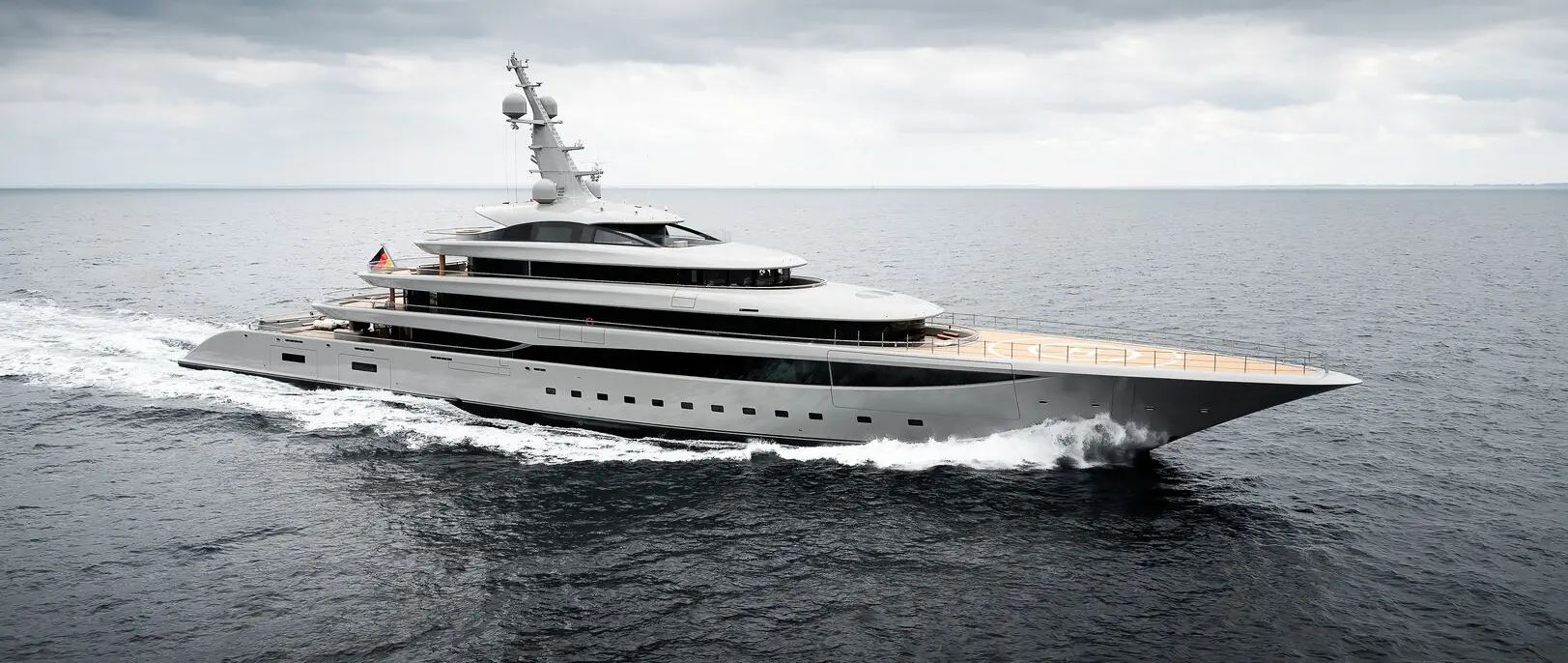
Cecil Wright & Partners has brought a High Court claim against Revolut founder Nik Storonsky, alleging that it was cut out of a €350 million transaction involving the 102-metre Lürssen superyacht Nixie.
Cecil Wright & Partners has brought a High Court claim against Revolut founder Nik Storonsky, alleging that it was cut out of a €350 million transaction involving the 102-metre Lürssen superyacht Nixie.
A dispute over one of the most valuable superyacht transactions reported in recent years has reached London's High Court, where brokerage Cecil Wright & Partners is seeking €17.5 million from Revolut co-founder and chief executive Nik Storonsky.
According to court filings reported by the Financial Times, The Times and The Wall Street Journal, the brokerage alleges that it introduced Storonsky's representatives to the opportunity to acquire the 102-metre Lürssen yacht Nixie, but was excluded before the purchase was completed directly with the seller. Storonsky's family office disputes the claim and has said it will be defended. No court has yet determined whether any commission is payable.
Cecil Wright's case is based on an alleged brokerage entitlement equivalent to five per cent of the reported €350 million purchase price. That produces the €17.5 million sum now being claimed.
The brokerage says an adviser to Storonsky's family office first approached it in October 2024 for assistance with the construction of a new yacht. In 2025, while that longer-term project was being considered, the adviser reportedly asked whether a suitable yacht could be acquired in the meantime.
Cecil Wright alleges that it identified the Lürssen then under construction and brought the opportunity to Storonsky's attention. Its filing reportedly argues that the brokerage was the effective cause of the eventual transaction, even though the final agreement was completed without it participating in the closing.
The phrase is important. In brokerage disputes, the issue is not always limited to who signed the final paperwork or attended the last negotiation. A broker may argue that its introduction, information, negotiations or other work created the chain of events that resulted in the sale.
Whether that principle applies here will depend on the brokerage agreement, the instructions given by the buyer's representatives, the extent of Cecil Wright's involvement and the circumstances in which direct contact with the seller was established.
The claim is contested. A spokesperson for Storonsky's family office has described it as being without merit and said it would be defended. No detailed public defence has yet been reported, and the allegations contained in the claim remain unproven.
The Financial Times reported that Cecil Wright founder Chris Cecil-Wright considers the circumstances unusual and regards the claim as sufficiently important to pursue through the courts. The Times reported that the case was filed on 13 July 2026, with Dentons acting for Cecil Wright and Hannaford Turner representing Storonsky.
The dispute therefore concerns more than a disagreement over the amount of a fee. It raises the central question of whether the broker had earned its commission before the buyer and seller concluded their agreement directly.
At the scale of the reported transaction, even a conventional percentage produces an exceptional sum. A five per cent commission on €350 million is greater than the total value of many substantial yachts, brokerage companies and marine businesses.
The yacht identified in reporting on the case is Nixie, the 102.4-metre Lürssen previously known as Project JassJ. She was delivered in June 2026 following a build programme lasting approximately 44 months and has since entered the charter market.
Designed inside and out by RWD, Nixie has a steel hull, aluminium superstructure and diesel-electric propulsion supported by energy storage. Her public specifications include extensive wellness and leisure facilities, a large glass swimming pool, substantial beach club, gym, cryotherapy chamber and indoor and outdoor cinemas.
The yacht's reported ownership history forms part of the background to the dispute. The Financial Times and The Times reported that the project was originally commissioned by Canadian businessman Patrick Dovigi. It was subsequently sold, later reacquired by Dovigi and then sold to Storonsky in January 2026, according to the brokerage's claim.
Superyacht Guide previously examined Nixie's construction, engineering, design and delivery in a separate feature. The new court case concerns the brokerage arrangements surrounding her reported sale rather than the yacht's technical build or operation.
Large-yacht transactions are often conducted away from public listings. A broker may identify an off-market opportunity, establish contact between principals, obtain confidential information, organise inspections, assess pricing, coordinate advisers and maintain negotiations over many months.
That work can begin long before a sale agreement is signed. It may also continue through family offices, lawyers, yacht managers, technical consultants and representatives rather than through direct communication with the beneficial buyer.
The risk for a broker arises when the parties it introduced begin communicating directly. From the buyer's perspective, direct negotiations may appear faster or more efficient. From the broker's perspective, completing a transaction without recognising the original introduction may amount to avoiding a fee that has already been earned.
Clear written agreements are therefore particularly important. They should identify who the broker represents, who is responsible for the commission, when entitlement arises, whether the appointment is exclusive and what happens when a transaction is completed through a related person, adviser or alternative structure.
The Storonsky dispute may ultimately turn on the wording of such arrangements and the evidence showing what Cecil Wright did before the reported January purchase.
The claim is likely to attract close attention across the brokerage sector because the commercial principle extends beyond Nixie or any single owner.
The highest-value yacht market depends heavily on discretion, personal relationships and trusted introductions. Brokers invest substantial time in transactions that may never complete, with the expectation that successful deals will compensate for unsuccessful ones.
If a broker can demonstrate that it originated and materially advanced a transaction, it will normally seek to protect its commission even when the final stages take place without its involvement. Buyers and advisers, meanwhile, may dispute whether the broker was formally appointed, whether its work actually caused the sale or whether the opportunity was available through other channels.
These questions are particularly sensitive when yachts change hands privately and the precise purchase price, ownership structure and contractual arrangements are not publicly disclosed.
For that reason, the case should not be interpreted as proof that Storonsky avoided a lawful payment or that Cecil Wright is automatically entitled to the amount claimed. It is a contested commercial action in which the court will need to assess the agreement and evidence presented by both sides.
Beyond the personalities and scale of the transaction, the case illustrates how much of the superyacht market rests on contracts, introductions and professional trust.
A yacht may be the visible asset, but a major sale can involve brokers, family offices, maritime lawyers, tax advisers, technical surveyors, managers, financiers and ownership companies across several jurisdictions. Each participant needs to understand who has authority to act and when fees become due.
At €17.5 million, the claim is unusually large, but the underlying issue is familiar throughout brokerage: who created the transaction, who completed it and who should be paid.
Until the High Court rules or the parties reach a settlement, Cecil Wright's assertions remain allegations and Storonsky's liability remains disputed. The eventual outcome could nevertheless provide a significant case study for brokers and buyers operating at the top of the global yacht market.
Continue reading
Cayman’s new Guidance Note 10/2026 tells owners, captains and managers to ensure bespoke stern names remain clearly readable before fabrication and installation.

EU Regulation 2026/1434 updates Marine Equipment Directive testing and certification requirements for equipment including gyrocompasses, radios, EPIRBs and GMDSS systems.

The MCA is consulting on replacement Safety of Navigation Regulations for 2027, updating the UK implementation of SOLAS Chapter V and its navigation requirements.

MCA MIN 738 confirms that existing UK Ship Register registrations granted through the former EU/EEA eligibility route remain valid and can continue to be …
Superyacht Guide
Continue into the wider Superyacht Guide.